
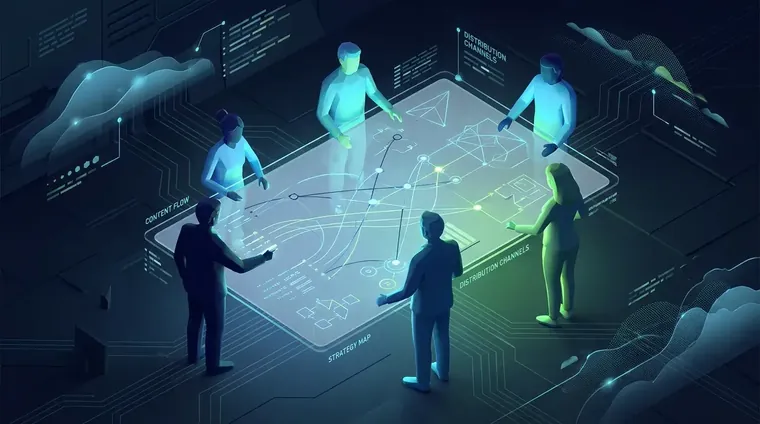
Content Distribution Channels: A Sequencing Guide
Only 9% of B2B content pieces earn meaningful organic traffic in the first 90 days. That's not a quality problem. It's a sequencing problem. Most teams pick distribution channels before they know what the content has already proven it can do. This is the field-level companion to our content marketing agency playbook. That pillar covers the full program architecture. This one answers a tighter question: which channels, in which order, at which stage of a piece's lifecycle?
Why does the owned/earned/paid framework fail teams?
The owned/earned/paid model describes who controls the channel. Not whether that channel will move the needle at your content's current maturity stage.
The owned/earned/paid trichotomy is the default mental model for content distribution. Every major SEO blog uses it. We used it too, early on. The problem: it sorts channels by *who controls them*, not by *when they work*.
A guest post (earned) is a bad investment for a brand-new piece with zero traction. Outreach emails go unanswered. Editors ignore pitches. You've spent three hours chasing a link for content that hasn't proven anything yet. That same guest post, deployed six months later when the piece is already ranking on page 2 and pulling real engagement data, is a completely different ROI calculation.
The more useful lens is channel ROI by content maturity stage. New content needs paid and owned amplification first. Only content that has already shown organic traction. Climbing from position 18 to position 9, pulling real dwell time. Is worth pushing into earned distribution like outreach and syndication. Sequencing beats categorization every time.
What are the right content distribution channels for each stage?
New content belongs on paid and owned channels first; earned channels like outreach and syndication only pay off once organic traction is already confirmed.
- Stage 1. Launch (Days 0–30) Push to your own email list, publish to social profiles you already own, and run a small paid amplification budget ($150–$300) to seed early engagement signals. Organic ranking needs those early click signals. You can't build them from nothing.
- Stage 2. Traction (Days 30–90) If Search Console shows impressions climbing and dwell time is over 90 seconds, it's time to expand. Syndicate to LinkedIn Articles or Medium with a canonical tag. Test one dark social channel. A relevant Slack community or private Discord. Where the topic fits naturally.
- Stage 3. Stacking (Days 90–180+) Now earned distribution earns its cost. Outreach for backlinks, pitch for guest post placements, submit to aggregators like Hacker News or niche newsletters. Backlinko drives 14K+ users per month from earned referring sites. But that took years of proven content first.
- Stage 4. Stalled Traffic Triage A piece stuck at position 11–15 for 60+ days is a republish candidate, not a distribution candidate. Add depth, refresh data, update the publish date, then re-run Stage 1. As one practitioner put it on Hacker News: 'adding content to a page usually results in fairly quick change in ranks'. And the channel sequence follows the same logic.
Email distribution of a new post generates early engagement signals. Time-on-page, low bounce rate. That measurably accelerate organic ranking within 2–3 weeks.
Send your email list to a fresh post within 48 hours of publication. Google's crawlers pick up the engagement spike. Real dwell time, real return visits, real social sharing. That activity pushes indexing faster and gets ranking movement started earlier. We've watched posts move from unranked to page 2 in 17 days on the strength of an email send alone. The channel isn't just delivering traffic. It's accelerating a separate channel's performance.
When should you kill a content distribution channel?
Kill a channel when its cost-per-qualified-visit exceeds 3× your best-performing channel's cost. Or when maintenance hours outpace monthly traffic contribution.
Every guide on the internet tells you to keep adding content distribution channels. None of them tell you when to stop. That's a real operational mistake.
We track a simple kill threshold: if a channel's cost-per-qualified-visit. Paid or time-equivalent for organic. Runs 3× higher than our best-performing channel over a rolling 60-day window, we deprioritize it. No drama, no strategy deck. The numbers say stop.
For most sub-$5M businesses, that means Twitter/X and Pinterest get cut first. Both require constant posting volume to maintain any distribution at all. Neither drives bottom-funnel traffic for B2B services. Meanwhile, a well-maintained email list of 2,400 subscribers consistently outperforms both combined. At roughly 40 minutes of effort per send.
Maintaining too many content distribution channels at once is where most content programs die quietly. You're not spreading reach. You're spreading focus.

Receipts Group runs channel audits as part of onboarding. We cut what's bleeding time and double down on what's stacking.
We're selective about clients, but if your content program is running on 4+ channels with no clear ROI hierarchy, book a call and we'll show you which ones to cut first.
How does content format affect which channels to use?
Data-heavy research pieces belong on LinkedIn and email first; how-to guides convert better through organic search and YouTube than through social amplification.
Format-to-channel fit is the gap nobody in the top SERPs addresses. It's where most content budgets leak.
A data-heavy original research piece. The kind built on proprietary survey data or first-party benchmarks. Belongs on LinkedIn and email before it ever hits organic search. Data pieces get shared in B2B Slack communities and private Discord servers constantly. That's dark social: no UTM parameters, no referral data, just direct traffic that looks like it came from nowhere. It's a real channel. Build for it on purpose. Make your data shareable: clean charts, embed-ready visuals, tweetable stats.
A how-to guide is an organic search asset first. Push it to email to accelerate ranking, sure. But don't burn paid budget on it at launch. The search intent is already there. Let the Helpful Content System find it. Get your E-E-A-T signals tight. First-person author experience, named credentials, real examples. The channel does its own work from there.
For paid distribution, Performance Max works well for high-value gated content. Original research, tools, calculators. Where you can track a clear conversion event. Pair it with Enhanced Conversions so your bidding algorithm has clean data to work from. Without that conversion data, Smart Bidding is guessing.
What does distribution look like at real program scale?
The Safeguard Impact program grew from $800K to $2M/month over 15 months. Driven by tightly sequenced content distribution across owned and paid channels.
When are earned channels the wrong primary strategy?
Brands under 18 months old or with fewer than 20 indexed posts should treat earned channels as a bonus, not a strategy. Owned and paid channels compound faster at that stage.
Here's the truth no distribution guide will print: most small brands shouldn't lead with earned channels at all.
Guest posts, backlink outreach, PR placements. These build on each other beautifully once you have scale. But as one commenter put it on r/bigseo: "You can't take a domain with nothing and just put in internal links and change titles." Earned distribution works the same way. Fewer than 20 indexed posts and a domain rating under 25 means every hour on outreach is an hour not spent building the owned-channel foundation that makes outreach worth anything later.
The concrete criteria we use: site under 18 months old, email list under 500 subscribers, or top organic post pulling fewer than 300 sessions per month. Own the owned channels first. Email, your blog, your SEO content writing services pipeline. Get those stacking before you chase earned.
For businesses targeting local service intent, Local Service Ads bridge the gap between zero organic authority and real lead flow while your content program matures. It's not an editorial distribution channel. But it keeps pipeline alive while you build.
For a fuller look at running the whole program. Not just picking channels. Our Reddit Ads Agency page covers one of the most underrated paid distribution plays for B2B content. And if you're evaluating an outside partner, read the B2B content marketing agency guide before you get on any call.

Owned-first vs. Earned-first: which distribution approach wins?
Owned-first distribution builds up predictably for sub-scale programs; earned-first only wins when you already have proven content and domain authority above DR 35.
| Feature | Owned-First (Under DR 35) | Earned-First (DR 35+, 20+ posts) |
|---|---|---|
| Time to first traffic | 2–4 weeks via email + paid | 6–12 weeks via outreach cycle |
| Cost per qualified visit | Low — list already exists | High — outreach is labor-intensive |
| Compounding effect | Moderate — list grows with content | Strong — backlinks lift all pages |
| Failure mode | List fatigue if email cadence is wrong | Wasted outreach on unproven content |
| Right for | New programs, sub-$3M businesses | Mature programs with proven organic traction |
Frequently Asked Questions
What are the most effective content distribution channels for a new business?
For businesses under 18 months old, owned channels. Your email list, your blog, and your social profiles. Should come before earned or paid channels. In our experience running programs like Safeguard Impact, the snowball of owned channels at early stage consistently outperforms outreach-heavy earned strategies. Once your email list clears 500 subscribers and your top post hits 300+ sessions/month, then layer in paid amplification and earned outreach.
How do I know when to stop using a content distribution channel?
Use a kill threshold: if a channel's cost-per-qualified-visit runs 3× higher than your best-performing channel over a 60-day rolling window, cut it. Most sub-$5M businesses find that Twitter/X and Pinterest fail this test quickly, while email and organic search consistently pass it. The operational cost of maintaining too many channels is the most common reason content programs stall.
Does dark social really count as a content distribution channel worth targeting?
Yes. And it's the most underreported channel in most analytics stacks. Dark social (private Slack communities, Discord servers, WhatsApp groups, direct DMs) accounts for a significant share of B2B content sharing, and it shows up as direct traffic in Google Analytics with no referral source. Build for it by creating clean, embeddable data visuals and tweetable stats in your research pieces. You can't track it fully, but you can design for it.
How does email distribution help a piece rank faster in search results?
Sending your email list to a new post within 48 hours generates an early engagement spike. Real dwell time, low bounce rate, and social sharing. That crawlers read as quality signals. We've watched posts move from unranked to page 2 in 17 days on the back of a single email send to a ~2,400-subscriber list. Email isn't just a traffic channel here; it's an organic ranking accelerant when deployed early in a piece's lifecycle.
Related reading
Ready to sequence your content distribution properly?
The Safeguard Impact program runs from the inside. It grew from $800K to $2M/month over 15 months. That didn't happen by adding more channels. It happened by sequencing content distribution channels to match each piece's lifecycle stage. If you want that kind of program applied to your business, start at our content marketing agency page. We keep a short client list for a reason.