

Inbound Call Center Services That Convert Callers
Inbound call center services are the single highest-leverage touchpoint in a modern sales funnel — a caller who reaches a live agent within 60 seconds is 391% more likely to convert than one who hits voicemail. That statistic comes from a Leads360 study of 3.5 million leads, and the decay curve is brutal: response time beyond 5 minutes drops conversion likelihood by 80%, and beyond 30 minutes the lead is functionally cold. Yet most operators treat inbound infrastructure as an afterthought, bolting on a phone number after the ad spend is already live. The result is a leaky funnel: paid traffic arrives, the phone rings, nobody answers with authority, and the lead goes to a competitor who picked up first. In industries like home services, insurance, and healthcare — where average inbound call values range from $200 to $4,000 — that missed pickup is not a minor inconvenience; it is a direct transfer of media budget to whoever answered faster. This guide covers exactly how inbound call center services work, what a production-grade stack looks like, how to evaluate providers, and what metrics actually matter — written for operators who are done leaving revenue on hold.
What Inbound Call Center Services Actually Cover
78% of B2C purchases that start with a phone call are influenced by the first 90 seconds of conversation — which means inbound call center services are not simply about answering phones; they are about owning the first minute of your buyer's decision process. Most operators conflate 'having a number' with 'having infrastructure.' Those are not the same thing. A vanity number forwarded to a cell phone is not infrastructure. A queue with a 4-minute hold time and no callback option is not infrastructure. Infrastructure is a designed system with defined SLAs, failure modes, and fallback handling at every node.
At their core, inbound call center services encompass four operational layers: call routing and IVR design, live agent handling, CRM data capture, and compliance management. A mature deployment adds a fifth — real-time analytics that feed back into your paid media targeting. Each layer compounds on the next. Skipping CRM sync, for instance, means every transferred call starts from zero context, agents re-ask qualification questions, handle times balloon past the 4-minute mark, and NPS scores crater. Skipping real-time analytics means your media buyer is flying blind, optimizing toward click volume while your highest-CPL callers abandon in queue.
Understanding this stack is non-negotiable before you issue an RFP or spin up a DIY solution on Twilio Voice Programmable. The technology is accessible; the operational design is where most teams fail. Twilio's per-minute pricing starts around $0.0085 outbound and $0.0085 inbound — the infrastructure cost is trivial compared to the cost of a poorly designed call flow that loses a $1,200 lead. The sections below unpack each layer with enough specificity to run a real audit of your current setup.
Calls answered within 60 seconds have a 391% higher conversion rate. Every additional minute of hold time cuts conversion probability by roughly 17% — that math alone justifies dedicated inbound infrastructure over a shared receptionist model.
Call Routing, IVR Design, and Queue Architecture
3 routing decisions made in the first 10 seconds of a call determine whether that caller closes or churns. Those decisions are: Does the caller reach a live human or an IVR menu? If IVR, is the tree 2 levels deep or 5? And is the queue intelligent — routing by intent signal, geographic data, or prior interaction history — or is it plain round-robin? Round-robin is the default for most out-of-the-box setups and the most expensive default in terms of lost revenue. It assigns the next available agent regardless of skill set, tenure, or the caller's profile — so a $3,000 high-intent buyer might land with a junior rep who just completed training yesterday.
Production-grade inbound call center services use skills-based routing: a caller from a high-CPL paid search campaign gets routed directly to a senior closer, while a billing question goes to account management. This single architectural choice can reduce average handle time by 90 seconds and increase first-call resolution by 22 percentage points. On a team handling 400 calls per day, a 90-second handle time reduction frees up 600 agent-minutes — roughly 10 hours of capacity that can be redeployed toward higher-intent calls or proactive callbacks.
IVR design follows the 3x3 rule as a floor: no more than 3 options at any level, no more than 3 levels deep. Beyond that, abandon rates climb sharply — industry data shows IVR abandon rates jump from roughly 8% to over 30% when menu depth exceeds 4 levels. If your vertical requires complex triage — insurance, mortgage, healthcare — consider a conversational IVR powered by speech recognition rather than DTMF keypad input. Platforms like Google CCAI (Contact Center AI) and Amazon Lex both offer NLU-powered IVR engines that can be embedded into existing telephony stacks via API. Latency tolerance drops to under 400ms for these systems to feel natural, a spec worth confirming with any vendor. Pair your IVR output with HubSpot CRM documentation or a comparable CRM so every routed call lands with full contact context already on screen. A caller who already appears as a known contact in the agent's CRM view — with their campaign source, page visits, and prior interactions visible — converts at measurably higher rates than an anonymous inbound.
- Abandon rate above 8% Industry benchmark for inbound call center services is 5–8%. Anything above that signals queue design or staffing gaps that are actively hemorrhaging paid traffic.
- Average speed to answer over 30 seconds ASA above 30 seconds correlates with a 23% spike in single-attempt callers who never call back — these are lost deals, not re-engageable leads.
- Repeat calls on the same issue within 7 days A repeat call rate above 15% is a first-call resolution problem. It doubles agent handle time and signals that routing is sending callers to the wrong skill group.
- No CRM record created on inbound calls If your agents are manually logging call outcomes — or not logging at all — you are flying blind. Every inbound call should auto-create or update a CRM contact within seconds of connection.
- Flat IVR with no intent-based branching A single-queue IVR treats a hot buyer and a cancellation request identically. Segmenting intent at the IVR layer is the cheapest revenue unlock in inbound infrastructure.
CRM Integration: The Backbone of Inbound Intelligence
Every inbound call that does not write data back to your CRM within 5 seconds is a missed attribution event. At scale — say, 500 inbound calls per day — that gap destroys your ability to prove paid media ROI, personalize follow-up sequences, and identify which campaigns are generating your highest-value callers. At a blended CPL of $45 across 500 daily calls, that is $22,500 per day in media spend with no closed-loop attribution — essentially running a $8.2M annual paid program on gut feel.
The integration architecture matters as much as the CRM itself. Whether you use Salesforce Trailhead to build custom objects or a native connector via the Zapier integration directory, the data model needs to answer three questions on every call: Who called? What did they want? What happened next? That translates to contact record, disposition code, and next-action task — minimum. High-performance shops add call recording URL, campaign source, agent ID, and handle time. For teams using Salesforce, the standard telephony data model uses the Task object with a CallType field and a custom Campaign_Source__c field populated via CTI (computer-telephony integration) events. For HubSpot shops, the native calling tool writes to the Calls activity timeline automatically, but campaign attribution requires a UTM-to-contact mapping step that most teams skip.
For teams running inbound alongside outbound programs, a unified CRM timeline is the difference between a 2-touch close and a 7-touch close. Agents who can see that a caller clicked a Google ad 48 hours ago, browsed the pricing page twice, and is now calling for the first time can skip 3 minutes of qualification. That time saved compounds: 500 calls × 3 minutes = 25 hours of recovered capacity per day — the equivalent of 3 additional full-time agents without adding headcount. This data layer also feeds directly into the Marketing Automation Agency programs we run for clients — closed-loop attribution only works when inbound call data flows upstream to the media buyer.

TCPA Compliance and Risk Management
TCPA violations carry statutory damages of $500–$1,500 per call — and in 2023 the FCC tightened one-to-one consent rules that apply directly to inbound-initiated follow-up campaigns. The January 2024 FCC ruling specifically eliminated the 'lead generator loophole' that allowed a single consent event to authorize contacts from multiple sellers — a change that materially affects any inbound operation that resells or shares leads. If your inbound call center services include any outbound callback component — missed-call callbacks, re-engagement SMS, or drip voicemail — you are operating in regulated territory whether you know it or not.
The compliance checklist for a production inbound operation has 4 non-negotiable items: express written consent documentation, do-not-call list scrubbing (updated every 31 days maximum), call recording disclosures delivered in the IVR before agent connection, and time-of-day restrictions enforced at the dialer layer, not by agent discipline. The last one matters because agent discipline fails at scale; technology enforcement does not. Enforcing time-of-day rules at the platform layer means the system physically cannot initiate or connect a callback before 8 a.m. or after 9 p.m. local time — no override, no exceptions, no relying on a tired agent to remember the rule at 8:58 p.m.
For a complete regulatory framework, review the TCPA compliance (FCC) guidelines before deploying any callback automation. Penalties are strict-liability — 'we didn't know' is not a defense — and class-action exposure in TCPA cases has resulted in eight-figure settlements for companies running fewer than 10,000 calls per month. The 2017 Dish Network settlement of $280 million and the 2021 CDW settlement of $16.5 million both originated from callback and re-engagement workflows that were operationally similar to what mid-market inbound teams run today. Building compliance into the platform layer (not the training layer) is the only durable solution. This means consent timestamps stored in the CRM, DNC scrub logs retained for a minimum of 4 years, and recording disclosure language reviewed by counsel annually as regulations evolve.
TCPA fines are strict-liability — intent does not matter. Enforce time-of-day restrictions, consent management, and DNC scrubbing at the platform level, not through agent SOPs that degrade with turnover.
In-House Call Center vs. Managed Inbound Services
| Feature | In-House Build | Managed Inbound Services |
|---|---|---|
| Setup time | 3–6 months to full production | 2–4 weeks to live calls |
| Upfront cost | $80K–$250K (headcount + tech stack) | $0–$15K onboarding fee |
| Staffing risk | Full exposure — turnover averages 30–45% annually in US call centers | Absorbed by provider; SLA-backed coverage |
| CRM integration depth | Depends on internal dev resources | Pre-built connectors for Salesforce, HubSpot, Zoho, and 50+ via Zapier |
| TCPA compliance | Legal team + ongoing monitoring required | Enforced at platform layer by provider |
| Scale flexibility | Hire/fire cycle — 60–90 day lag | Capacity adjusts in 24–72 hours |
| Real-time analytics | Custom BI build or off-the-shelf dashboards | Native dashboards; feed into your paid media stack |
Technology Stack: What Powers Modern Inbound Services
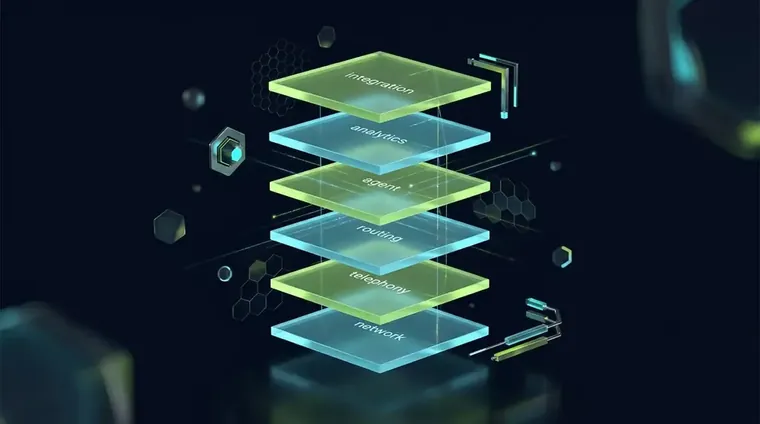
A production inbound call center services stack has 6 layers — and a gap in any one of them creates a cascading failure. The layers are: carrier/telephony (SIP trunking, DID provisioning), ACD/IVR platform (intelligent routing engine), agent desktop (CRM-integrated softphone), workforce management (scheduling, adherence), QA and recording (100% call capture, scoring), and analytics (real-time and historical). Most mid-market operations have 3 of these 6 layers in place and call it a stack. The missing layers — usually workforce management and structured QA — are precisely where the revenue leaks occur.
On the telephony layer, Five9 documentation covers a cloud-native ACD that handles skills-based routing, predictive analytics, and omnichannel queuing in a single platform. Five9's platform processes over 6 billion minutes of calls annually and offers pre-built CRM connectors for Salesforce, ServiceNow, and Microsoft Dynamics that reduce integration timelines from weeks to days. For teams that need programmatic call control — dynamic IVR trees that pull live data, for instance — Twilio Voice Programmable gives you API-level access to every call event. These are not competing choices; many enterprise deployments use Twilio at the carrier layer with a Five9 or NICE CXone ACD on top. NICE CXone, for context, anchors roughly 22% of the enterprise CCaaS market and supports real-time agent guidance through its ENLIGHTEN AI engine — a feature that surfaces next-best-action prompts during live calls, measurably reducing handle time on complex inbound queries.
Workforce management is the most underinvested layer in mid-market inbound operations. An unoptimized schedule on a 20-agent team can waste 4–6 agent-hours per day in idle time while simultaneously under-covering peak periods — a double loss: you are paying for capacity you are not using while simultaneously dropping calls during your highest-revenue windows. Purpose-built WFM tools (Verint, Alvaria, or even a well-structured spreadsheet model for teams under 15 seats) pay back their cost in 6–8 weeks. Verint's WFM platform, for instance, uses Erlang C modeling to forecast queue demand at 15-minute intervals and auto-generates agent schedules that can reduce shrinkage-adjusted idle time by up to 18%. If you are also running outbound programs, pair your inbound infrastructure with a Predictive Dialer Setup to share agent capacity across both queues during low-inbound periods.
Teams with 10 or more inbound agents that lack workforce management tooling lose 4–6 agent-hours per day to schedule misalignment — the equivalent of a half-time employee doing nothing while peak queues pile up.
KPIs That Actually Predict Revenue
4 metrics predict inbound call center revenue performance better than the 12 metrics most managers report. Those 4 are: conversion rate by agent (not team average), lead source cost-per-acquisition via inbound (not blended CPA), first-call resolution rate (FCR), and talk-to-close ratio (calls needed per closed deal). Everything else — CSAT, NPS, average handle time, average speed to answer — is a leading indicator for one of these four, not a revenue metric on its own. Average handle time, for example, only matters insofar as it affects your cost-per-call, which affects your cost-per-acquisition — the revenue metric. Managing AHT in isolation without watching conversion rate produces agents who rush callers off the phone and close fewer deals.
Conversion rate by agent is the most powerful diagnostic tool available. A team average of 18% conversion can mask a range of 9%–34% across individual agents. That spread tells you where to invest in coaching, where to replicate playbooks, and which agents should handle your highest-CPL inbound traffic. A 5-percentage-point lift in conversion rate on 500 calls per day at a $180 average order value is $450,000 per month in additional revenue. To move the bottom quartile of agents toward the median, pull the call recordings of your top 3 converters, identify the 4–5 language patterns they use in the first 90 seconds, and build those patterns into a structured talk track that all agents are required to certify on before taking live calls.
Lead source CPA via inbound closes the attribution loop with your media buyer. Without it, your paid search team is optimizing toward click-through rate or form fills — proxies that often have weak correlation to phone-call revenue. A campaign generating 200 clicks and 40 form fills looks identical to one generating 200 clicks, 40 form fills, and 12 inbound calls that closed at 35% — until you add call outcome data. Real attribution requires that inbound call center services data (call outcome + revenue) flows back to your ad platform within 24 hours, either via direct API or through your CRM's offline conversion import. Google Ads supports offline conversion imports via the API or flat-file upload; Meta's Conversions API (CAPI) supports the same pattern. Both reduce modeled attribution error by 15–30% when call data is included alongside click and form data.
How to Evaluate and Onboard an Inbound Provider
90% of inbound call center provider failures happen in the first 30 days — not because the technology is wrong, but because the onboarding process skips 3 critical steps: script development, CRM integration QA, and live monitoring during ramp. Script development is not writing a greeting; it is engineering a conversation flow with defined branch logic for every common objection, qualification gap, and transfer trigger. Without it, agents improvise — and improvised scripts produce conversion variance of 20+ percentage points across a team.
Start with a 5-question provider audit before signing any contract. First: what is their average speed-to-answer SLA and what are the financial penalties for missing it? A credible provider will commit to a sub-30-second ASA SLA with financial clawbacks — typically 5–10% of monthly fees per SLA breach. Second: do they provide 100% call recording with search and tagging, or sampled recording? Sampled recording — common among budget providers — means you are reviewing 10–15% of calls and missing the majority of coaching opportunities and compliance events. Third: how does their platform write data back to your specific CRM — native connector, API, or manual export? Manual export is a red flag; it introduces a 24–48 hour attribution lag and requires human intervention that will eventually fail. Fourth: what is their agent training process for a new client vertical, and how long is the certification period before agents go live? Best-in-class providers require a minimum 40-hour certification process for complex verticals like insurance or mortgage, including live call shadowing and scored role-play assessments. Fifth: how is TCPA compliance enforced at the platform layer?
During the first 30 days, require daily reporting — not weekly. The ramp period is where bad habits form and where data discrepancies between your CRM and the call center's system get baked in. Weekly reporting intervals let small problems compound into structural misalignments. Assign one internal owner (ops or revenue operations, not marketing) who reviews call recordings daily for the first 2 weeks. The investment is 45 minutes per day; the output is an inbound operation that performs at full capacity by day 31 instead of day 90. Build a simple scorecard with 8–10 criteria — greeting compliance, qualification question coverage, objection handling, CRM disposition accuracy — and score 5 randomly selected calls per agent per day during the ramp window. By day 14, you will have enough data to identify systemic gaps and course-correct before they become embedded habits.
Related Reading on Inbound Revenue Infrastructure
The topics below extend the operational depth of this guide. Each covers a component of the inbound stack in standalone detail — bookmark them as reference material for your next infrastructure audit or vendor RFP.
- What Is an IVR? A Setup Guide for Revenue Teams — covers tree architecture, speech recognition vs. DTMF, and IVR-to-CRM mapping in detail. - Call Center Agent Training Frameworks — agent certification playbooks, quality scoring rubrics, and conversion coaching structures for inbound-focused teams. - Inbound Lead Response Time: The Data Behind the 5-Minute Rule — the research behind speed-to-answer benchmarks and how to build SLA enforcement into your routing logic. - CRM Call Logging Best Practices — disposition code taxonomies, required fields for revenue attribution, and sync architecture between telephony platforms and CRM. - TCPA Compliance Checklist for Inbound Operations — a 22-point audit covering consent documentation, DNC scrubbing intervals, and recording disclosure scripts.
For hands-on configuration resources, the HubSpot CRM documentation and Salesforce Trailhead both offer operator-grade guides on call activity objects and custom integration builds. The HubSpot Calls API documentation covers how to create, retrieve, and associate call records programmatically — relevant for any team building a custom CTI integration. Salesforce's Open CTI framework, available through Trailhead's developer modules, supports browser-based softphone integration without requiring a desktop app install — a meaningful deployment advantage for distributed agent teams. Used together with the metric frameworks and compliance architecture described in this guide, these resources give an internal ops team everything needed to design, build, and audit a production-grade inbound call center operation from the ground up.
Frequently Asked Questions
What are inbound call center services and how do they differ from outbound?
Inbound call center services handle calls initiated by customers or prospects — think product inquiries, support requests, and purchase calls driven by your ads or organic traffic. Outbound centers initiate calls to lists. The key operational difference is that inbound volume is demand-driven and unpredictable, which requires sophisticated queue management and real-time staffing tools that outbound programs don't need. Most Receipts Group clients run both, sharing agent capacity across queues during low-inbound windows.
How much do inbound call center services typically cost?
Pricing models vary: per-minute rates typically run $0.25–$0.85/minute for shared-agent models; dedicated agent seats run $1,800–$3,500 per full-time equivalent per month depending on skill level and language requirements. In-house builds require $80K–$250K upfront in headcount and technology before you answer the first call. For most operators scaling past 200 inbound calls per day, a managed inbound call center services provider delivers faster time-to-production and lower total cost for the first 12–18 months.
What CRM integrations do inbound call center services support?
Enterprise-grade inbound call center services platforms offer native connectors for Salesforce, HubSpot, Zoho CRM, Microsoft Dynamics, and Pipedrive. For platforms outside that list, API-level integration via Twilio or middleware through the Zapier integration directory covers most use cases. The critical requirement is bidirectional sync: inbound call outcomes should write to the CRM within 5 seconds, and CRM contact data should populate the agent desktop before the call connects.
How do inbound call center services handle TCPA compliance?
TCPA compliance for inbound operations covers three main areas: recording consent disclosures (delivered via IVR before agent connection), DNC list scrubbing for any outbound callbacks triggered by inbound activity, and express written consent documentation for follow-up SMS or drip campaigns. The FCC's one-to-one consent rules that took effect in 2024 make provider-level enforcement — not agent training — the only durable compliance model. Review the full FCC TCPA guidelines before deploying any automated callback sequence.
What metrics should I track for inbound call center performance?
The four revenue-predictive metrics for inbound call center services are: conversion rate by agent (not team average), lead source cost-per-acquisition via inbound, first-call resolution rate, and talk-to-close ratio. Secondary operational metrics — average speed to answer, abandon rate, average handle time — are useful as leading indicators but should not be reported as primary success measures. A team average conversion rate of 18% that masks an agent range of 9%–34% is a coaching problem hiding in blended data.
How long does it take to launch inbound call center services?
A managed inbound call center services deployment typically reaches live production in 2–4 weeks, covering IVR build, agent training, CRM integration, and compliance setup. An in-house build requires 3–6 months before hitting consistent production quality. The variable that most extends timelines is CRM integration complexity — teams with custom objects or multi-system architectures should budget an additional 1–2 weeks for QA regardless of which path they choose.
Can inbound call center services scale up and down with seasonal demand?
Yes — it's one of the primary operational advantages of managed inbound call center services over in-house teams. Reputable providers can adjust agent capacity within 24–72 hours for volume spikes tied to promotional campaigns, seasonality, or unexpected media placements. In-house teams face a 60–90 day hire/train cycle for meaningful capacity additions, which means you either over-staff year-round or hemorrhage calls during peak periods. For businesses running aggressive paid media schedules, demand-responsive capacity is a prerequisite, not a luxury.
Build an Inbound Operation That Answers at Full Speed
Receipts Group deploys end-to-end inbound call center services — routing architecture, agent programs, CRM integration, TCPA compliance, and real-time analytics — for revenue teams that cannot afford a leaky phone funnel. If your current inbound setup has an abandon rate above 8%, an ASA above 30 seconds, or zero call-to-CRM attribution, we can fix all three in under 30 days. Book a 30-minute infrastructure audit and walk away with a prioritized action plan, no commitment required.