
Call Center Training: The Operator's Complete Playbook
Call center training is the single highest-leverage investment a sales or support operation can make — a well-trained agent generates 3–5× the revenue of an undertrained one, yet most teams still run new hires through a two-day slide deck and call it done. The gap between a rep who can handle 80 calls a day and one who can convert 18% of them isn't talent — it's structured, repeated practice against real objections, real scripts, and real call recordings. In practical terms, that gap translates to roughly $120,000–$200,000 in annual revenue per seat at a mid-market inside-sales floor running a $500 average order value — a number that makes a properly funded training program look cheap by comparison. This guide covers every layer of a modern call center training program: pre-hire curriculum design, live-floor coaching cadences, technology stack configuration, compliance guardrails, and the performance metrics that tell you whether any of it is working. Whether you're standing up a 5-seat inside-sales team or scaling a 200-seat BPO floor, the frameworks here are operator-tested and numbers-backed.
Why Most Call Center Training Programs Fail
78% of call center attrition happens within the first 90 days — almost always because agents were never given the repetitions they needed to feel competent before going live. That stat, tracked across dozens of contact-center benchmarking studies, points to the same root cause: programs confuse exposure with proficiency. A rep watching a product demo video is not the same as a rep who has handled the 'I need to think about it' objection 40 times in a controlled setting. Industry data from ICMI and SQM Group consistently shows that agents who complete structured role-play drilling before going live reach full productivity in 3–4 weeks instead of 8–10 weeks — a difference that compounds across every seat you add.
The second failure mode is inconsistency. When 12 managers each run their own informal call center training process, you get 12 different versions of the pitch, 12 different compliance interpretations, and no common language for coaching. Top-performing operations run a documented curriculum with defined checkpoints — typically a 2-week structured onboarding followed by a 30-day shadowing and live-floor ramp. The curriculum doesn't have to be elaborate; it has to be the same for everyone. Documenting it in a shared knowledge base — tools like Notion, Guru, or Confluence work well for this — and requiring a manager sign-off at each checkpoint creates the accountability layer that informal programs lack.
The third failure mode is treating training as an event rather than a system. Real call center training is ongoing: weekly call reviews, monthly objection libraries refreshed against new recordings, and quarterly skill assessments that dictate coaching priorities for the next 90 days. Operations that build the system see 25–35% lower attrition and 15–20% higher conversion rates within 6 months. The math is straightforward: at an average re-hire cost of $4,000–$7,000 per agent, a 200-seat floor cutting attrition from 40% to 25% in the first 90-day window saves between $120,000 and $210,000 annually — before a single additional conversion is counted.
78% of call center attrition occurs in the first 90 days. The fastest fix isn't better hiring — it's structured repetition in the first 2 weeks that builds competence before agents hit a live floor.
The Four Phases of a Modern Training Curriculum
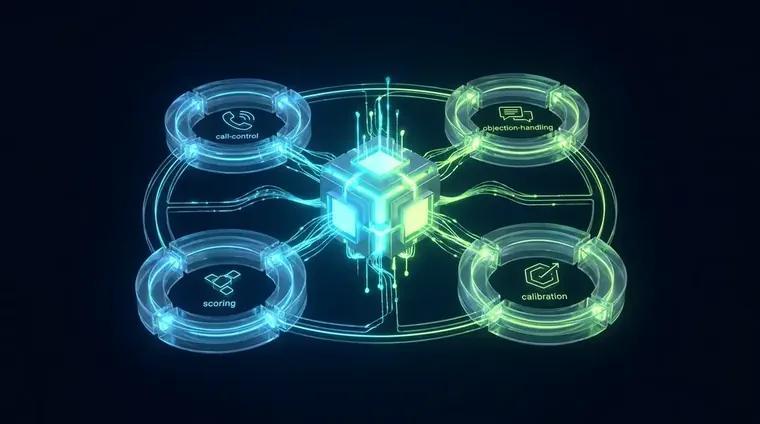
A production-grade call center training curriculum runs in four phases, each with a hard exit criterion before the rep moves forward. Phase 1 is Product & Process Mastery (Days 1–5): the rep learns what they're selling or supporting, how the CRM is structured — reference HubSpot CRM documentation for field mapping standards — and what the compliance guardrails are per TCPA compliance (FCC) rules. Exit criterion: 90% score on a written product quiz and a clean compliance attestation. This phase should also include a recorded walk-through of every disposition code in the dialer and CRM, so reps are logging outcomes correctly from their very first live call — bad disposition data in Week 1 corrupts every performance metric you pull for the next 90 days.
Phase 2 is Script & Objection Drilling (Days 6–10): the rep runs 50+ role-play calls against a designated objection library covering the 8–12 objections that appear in 80% of real calls. Each role-play session should be recorded — tools like Gong, Chorus, or even a simple Zoom cloud recording work — so coaches can score against a rubric rather than relying on memory. A minimum passing threshold of 80% on the rubric before the rep moves to Phase 3 is the standard we see on high-performing floors. Phase 3 is Supervised Live Floor (Days 11–30): the rep takes real calls with a senior agent or coach listening live, reviewing every session the same day. Exit criterion: 3 consecutive days at or above the floor's average handle time and conversion rate. Same-day review is critical here; feedback delivered 24 hours after a call loses roughly 60% of its corrective value because the rep can no longer recall the specific moment the coach is referencing. Phase 4 is Ongoing Calibration — weekly, permanent, non-optional. Most programs only build Phases 1–3 and then wonder why performance degrades at Month 3.
Technology Stack: What to Configure Before Day One
3 platform categories need to be live before a single agent joins training: a dialer, a CRM, and a call recording + coaching tool. If any of them aren't configured, agents learn bad habits filling the gap — manual logging, off-system notes, unrecorded calls you can't review. Configuration should be completed and user-acceptance tested at least 5 business days before the first training cohort starts, giving your IT or RevOps team time to resolve permission errors, SSO issues, and integration failures without burning into training hours.
For the dialer layer, operations running outbound volume should review Twilio Voice Programmable for custom call flows or evaluate a managed solution like Five9 for enterprise-scale blended environments. The dialer choice dictates how you structure wrap time, call disposition codes, and agent status — all of which feed back into training metrics. A typical outbound floor sets wrap time at 60–90 seconds; anything longer inflates ACW numbers and masks agents who are avoiding the next dial. For predictive dialing specifically, see our guide to Predictive Dialer Setup before you configure drop-rate thresholds, since TCPA exposure starts there. The FCC's 3% abandoned-call rule applies to predictive dialers, and a misconfigured pacing algorithm can breach that threshold within a single campaign without a single manager noticing.
The CRM configuration is where most teams take a shortcut they regret. Disposition codes, lead stages, and outcome fields need to be locked before training begins — if you change the picklist mid-program, every call reviewed before the change becomes incomparable. Use Salesforce Trailhead if your floor runs SFDC; build a validation rule that forces reps to log a disposition before closing a record. If you're on HubSpot, the equivalent is a required property on the contact or deal record tied to a workflow that blocks stage advancement without a logged outcome. Connecting these platforms via Zapier integration directory handles handoff automation between dialer, CRM, and your coaching queue without custom development. For higher-volume floors where Zapier's task limits become a constraint, a native integration through Five9's CRM connector or Twilio's Flex plugins is the cleaner long-term architecture.

Training without automation is a leaky bucket. If your agents close a call correctly but the CRM doesn't log it because the workflow isn't built, you lose the data that drives every future coaching decision. Build the ops layer first — then train into it. See our Marketing Automation Agency guide for the workflow architecture that supports a trained floor.
Structured Training vs. Ad-Hoc Onboarding
| Feature | Structured 4-Phase Program | Ad-Hoc / Informal Onboarding |
|---|---|---|
| Ramp Time to Full Productivity | 3–5 weeks with defined exit criteria | 8–12 weeks, outcome varies by manager |
| 90-Day Retention Rate | 65–75% typical | 40–50% typical |
| Compliance Risk | Low — attestation + recorded modules | High — verbal-only, no audit trail |
| Script Consistency | 100% aligned across all agents | Drifts by manager and tenure |
| Coaching Cadence | Weekly calibration sessions, documented | Reactive — only when performance drops |
| Performance Visibility | Real-time dashboards tied to curriculum phase | Lagging indicators only (monthly reports) |
Objection Handling: Building the Library
Most floors have 8–12 objections that account for 75–80% of all call outcomes — and yet fewer than 30% of training programs have a written, versioned objection library. Building one is the highest-ROI training task you can assign a senior agent or floor manager. Pull the last 90 days of call recordings, tag every objection raised, count frequency, and rank them. The top 8 become the mandatory drill set for every new hire. The next 4 become the advanced module. If your call recording platform supports AI-assisted tagging — Gong, Chorus, and Jiminny all offer this natively — the analysis that would take a manager 20 hours manually can be completed in 2–3 hours, with objection frequency sorted and timestamped automatically.
Each objection entry needs four components: the verbatim objection as customers actually say it (not a paraphrase), a 2–3 sentence reframe script, a pivot line that moves toward a close or next step, and a fallback if the reframe doesn't land. A fifth component worth adding for mature libraries is a counter-indicator flag — a note on which customer profiles or lead sources generate this objection most frequently, so reps can anticipate it before it surfaces rather than reacting after. When you run role-plays, grade against those four components — not against whether the trainee 'sounded good.' Subjective coaching doesn't scale.
Refresh the library every 90 days. Product changes, pricing changes, and macro conditions change what objections surface. An objection library that was accurate in Q1 may be 40% stale by Q3 if your offer or market has shifted. Assign a specific team member to own the refresh cadence — it doesn't happen by committee. In practice, a 2-hour quarterly review session where the library owner pulls the latest recording data, compares new objection frequencies to the existing ranked list, and updates or retires entries is sufficient for most floors running fewer than 50 seats.
Core Components of Every Objection Library Entry
- Verbatim Objection Transcribed exactly as customers say it — pulled from real recordings, not paraphrased by a manager writing from memory.
- Reframe Script (2–3 sentences) A concise, field-tested response that acknowledges the concern and pivots toward value. Tested on live calls before being added to the library.
- Pivot Line A single transition sentence that moves the conversation toward a commitment, a next step, or a qualifying question.
- Fallback Response What the agent says if the primary reframe doesn't move the prospect. Prevents dead air and keeps the call alive for 30–60 more seconds.
- Refresh Date & Owner Every entry carries a 90-day review date and a named owner. Stale objection scripts are often worse than no script at all.
Compliance Training: The Non-Negotiable Layer
A single TCPA violation can cost between $500 and $1,500 per call — and class-action exposure runs into the millions. Compliance is not a legal team problem; it is a training program problem. Every agent who dials needs to pass a documented compliance module before they touch a live line, and that attestation needs to be stored for a minimum of 4 years per FCC guidance. See the full TCPA compliance (FCC) framework for the current rules on consent, calling hours, and do-not-call registry requirements. A floor dialing 500 contacts per day with a 2% non-compliant contact rate — a rate that's easy to hit without proper DNC scrubbing — generates a theoretical liability of $5,000–$15,000 per day before a single lawsuit is filed.
Beyond TCPA, state-level regulations — notably Florida, California (CCPA), and New York — add additional layers for any floor dialing into those states. Florida's Mini-TCPA (SB 1120), effective July 2021, is significantly stricter than the federal standard on automated dialing consent. Train to the strictest applicable standard, not the average. Build a compliance refresher into your quarterly calibration sessions so that agents who were hired before a regulatory change get updated before your next audit cycle. Tracking which agents completed which version of the compliance module — and on what date — is essential documentation if you ever face a regulatory inquiry.
The practical training structure: a 45-minute recorded compliance module, a 20-question attestation quiz (passing score 95%+), a signed acknowledgment, and a mandatory re-certification every 12 months or within 30 days of any regulation change. Store all attestations in the CRM or a dedicated HR system — not in a shared Google Drive folder with no version control. Platforms like Lessonly (now Seismic Learning) or TalentLMS allow you to deliver the module, capture the quiz score, and timestamp the completion automatically, giving you an auditable record that holds up to FCC or FTC scrutiny.
Every TCPA fine that hits a contact center traces back to an undertrained agent. Document the module, store the attestation, and re-certify annually — or pay $500–$1,500 per violation instead.
How to Run a Weekly Call Calibration Session
- 1Pull 3–5 Recordings Per AgentSelect calls that span the performance range — one strong, one average, one below target. Avoid cherry-picking only problem calls, which skews agent perception of what 'normal' looks like.
- 2Score Against a Fixed RubricUse a 10–15 point scorecard covering opener quality, objection handling, compliance adherence, CRM logging, and call outcome. Scores must map to specific timestamps in the recording — not general impressions.
- 3Run the Debrief in Under 30 MinutesPlay the flagged moment, state the score, explain the gap, and demonstrate the correct behavior. Agents retain more from 3 precise examples than from a 90-minute general feedback session.
- 4Assign One Focus DrillEach agent leaves with exactly one thing to practice before the next session — one objection, one transition line, one compliance phrasing. One drill executed 20 times beats five drills executed four times each.
- 5Log and Track Trend LinesEvery score goes into a shared performance tracker. Review trend lines monthly — if an agent's score hasn't moved in 4 weeks despite consistent coaching, the issue is structural (script, tools, or fit) not effort.

Metrics: What to Measure and When
6 metrics separate a call center training program that works from one that looks like it works. The first three are lagging indicators — conversion rate, average handle time (AHT), and after-call work (ACW) time. These tell you where performance landed. The second three are leading indicators — role-play score, compliance quiz score, and call review rubric score. These tell you where performance is going before it shows up in the lagging numbers. A well-calibrated floor reviews leading indicators weekly and lagging indicators monthly; conflating the two cadences is how managers end up surprised by a bad month that was entirely predictable from the prior three weeks of role-play data.
Most operations measure only lagging indicators and then scramble reactively when conversion drops. A training-mature floor tracks leading indicators weekly and uses them to adjust coaching priorities before the month's numbers are written. If a cohort's role-play scores on objection handling are trending down in Week 2, you know to add drilling volume in Week 3 — not wait until the Month 1 conversion report. A simple weekly dashboard in Salesforce, HubSpot, or even a Google Looker Studio report connected to your call recording platform's API can surface all six metrics in under 30 minutes of setup time.
Two additional metrics belong on every training dashboard: First Call Resolution (FCR) for support floors (target: 70–80% for a well-trained team) and Script Adherence Rate for sales floors (target: 85%+ on the critical compliance and opener sections). Both are extractable from modern call recording platforms and should feed back into the curriculum refresh cycle every 90 days. FCR below 65% on a support floor is almost always a training signal, not a staffing signal — it means agents are escalating or calling back on issues the curriculum didn't prepare them to resolve. Track it at the individual agent level for the first 60 days post-ramp, then at the cohort level to identify curriculum gaps that affect everyone trained in the same period.
Scaling Training Across Multi-Seat and BPO Environments
Operations with more than 25 seats need a dedicated Training Coordinator role — not a manager who trains 'when there's time.' At 25+ agents, the cost of inconsistent training exceeds the cost of the salary within 90 days, based on typical attrition and re-hire costs of $4,000–$7,000 per agent. The coordinator owns the curriculum, the objection library, the compliance refresh calendar, and the weekly calibration data. At 50+ seats, a ratio of one Training Coordinator per 40–50 agents is the operational benchmark that keeps coaching feedback loops tight enough to be actionable — beyond that ratio, individual feedback quality degrades and you're back to the inconsistency problem.
For distributed or offshore BPO environments, synchronous training is expensive and asynchronous training is often ignored. The model that works: a recorded module library with required completion tracking, followed by synchronous role-play sessions with a live coach. Platforms like Lessonly, TalentLMS, or Docebo handle the async delivery and completion tracking; schedule the live role-play blocks in 90-minute windows that overlap with both the trainer's and the offshore cohort's business hours. Run role-play cohorts of 4–6 agents per coach — any larger and you lose the individual feedback that makes role-play effective. For call flow architecture across distributed sites, the Twilio Voice Programmable platform supports per-site routing logic that lets you segment training cohorts without building separate infrastructure.
As you scale, version-control your curriculum. A training document that gets edited informally by 3 different managers over 6 months becomes a compliance liability. Use a versioned document system — Git-based tools like Notion with version history, or a formal LMS with content versioning — tag each curriculum with an effective date and an owner, and maintain a changelog that shows what changed, when, and why. At audit time, being able to produce the exact curriculum version an agent was trained on, with the date and their attestation, is the difference between a defensible compliance posture and an expensive exposure.
At 25+ agents, every week without a documented training program costs you more in attrition and re-hire spend than a full-time Training Coordinator would. Build the system once — it runs every cohort after.
Related Reading: Go Deeper on the Ops Stack
Call center training doesn't exist in isolation — it sits inside a broader revenue operations infrastructure. The topics below go deeper on adjacent layers that your training program will eventually touch:
- Predictive Dialer Setup — How to configure drop-rate thresholds, answer detection, and agent pacing rules without creating TCPA exposure. See our full guide at Predictive Dialer Setup. - Marketing Automation for Sales Floors — How to build lead-routing workflows that feed trained agents the right leads at the right time. See Marketing Automation Agency. - Call Scoring Rubric Design — Building the 10–15 point scorecard that makes weekly calibration sessions objective and scalable. *(Related reading — coming soon)* - Outbound Compliance Checklist — A field-by-field TCPA and state-law audit template for any floor dialing more than 500 contacts per day. *(Related reading — coming soon)* - Agent Retention Playbook — The 6 structural changes that cut 90-day attrition from 40% to under 20%, starting with onboarding design. *(Related reading — coming soon)*
Each topic links back to the training layer — because a well-designed floor is a system, not a collection of independent parts. The compounding effect of getting all of these layers right simultaneously is significant: floors that align their dialer configuration, lead routing, compliance posture, and training curriculum into a single integrated system typically outperform floors that optimize each layer in isolation by 20–30% on net revenue per agent — a gap that widens as headcount scales.
Frequently Asked Questions
How long should call center training take for a new hire?
A production-ready call center training program runs 3–5 weeks for most sales or blended environments: 2 weeks of structured classroom and role-play, followed by 1–3 weeks of supervised live-floor ramp with a defined exit criterion (typically 3 consecutive days at or above floor average). Support floors with complex product sets may extend to 6–8 weeks. The key variable isn't calendar time — it's hitting the exit criteria, not hitting a date.
What's the most common mistake in call center training programs?
Treating call center training as a one-time onboarding event instead of an ongoing system. Most programs invest in weeks 1–2 and then drop all structure — no weekly call review, no refreshed objection library, no calibration sessions. Performance predictably degrades at Month 2–3, which most managers attribute to 'bad hires' rather than the absence of continued training infrastructure.
How do you measure whether call center training is working?
Track both leading and lagging indicators. Leading indicators — role-play rubric scores, compliance quiz scores, call review scores — tell you where performance is heading before it shows up in revenue numbers. Lagging indicators — conversion rate, AHT, FCR — tell you what happened. A training-mature floor reviews leading indicators weekly so coaching adjustments happen before the month's numbers are locked, not after.
What technology is required to run a serious call center training program?
At minimum: a configured CRM with locked disposition codes and outcome fields, a dialer with call recording enabled, and a coaching tool that allows timestamped annotations on recordings. Operations running Salesforce can use Salesforce Trailhead to build training content directly in the platform. For call infrastructure, Twilio Voice Programmable and Five9 both support the routing and recording architecture a training program needs. The stack doesn't need to be expensive — it needs to be consistent and fully configured before Day 1 of any training cohort.
How does TCPA compliance fit into call center training?
Every agent who dials outbound needs to complete a documented TCPA compliance module and pass a written attestation (95%+ passing score) before touching a live line. The attestation should be stored for at least 4 years per FCC guidance. Re-certification is required annually or within 30 days of any regulation change. Floors dialing into California, Florida, or New York face additional state-level rules — train to the strictest applicable standard. A single uncertified agent creating a TCPA violation can cost $500–$1,500 per call.
At what team size does a dedicated training role become necessary?
At 25 seats, the math typically favors a full-time Training Coordinator over distributing training responsibilities across managers. The average cost to replace a call center agent runs $4,000–$7,000 in recruiting, onboarding, and lost-productivity time. At 25 agents with a 40% 90-day attrition rate, you're replacing 10 agents per quarter — roughly $40,000–$70,000 in turn costs — compared to a coordinator salary that usually runs $45,000–$65,000 annually while simultaneously improving retention and conversion across the entire floor.
Ready to Build a Training Program That Actually Scales?
Receipts Group designs and implements end-to-end call center training programs — from curriculum architecture and objection library builds to tech stack configuration and weekly calibration frameworks. We've stood up training systems for floors ranging from 8 seats to 300+. If your ramp time is too long, your attrition is too high, or your conversion rate stopped moving, book a call and we'll audit your current program in 30 minutes — no deck, no pitch, just a working session. Most clients leave with 3 actionable changes they can implement before the next cohort starts.