The SEO case study.
Safeguard Impact — impact windows, doors & roofing in South Florida, where I run marketing as Marketing Director. 14 days ago we cut over from a legacy WordPress stack to the agent-built platform that became Receipts Group's foundation, and let the agents run the SEO. Same operator, same domain, completely different machine underneath. Every number in this deck is a screenshot from a tool we don't own.
Where it started
A WordPress site on a monthly agency retainer is the default — and the default is slow, bloated, and priced by the hour. Two weeks ago, as Marketing Director at Safeguard, I rebuilt the site from the ground up on the agent-built platform that became Receipts Group's foundation, and handed the SEO program to the agents. Same domain, completely different machine underneath.
The rest of this deck is the four scoreboards that prove the new machine works: Domain Rating, SEO score, AI-detection, and page speed — then the traffic those four produce.
How we build, in order
Ranking at scale isn't writing more posts. It's a fixed sequence: research the cluster, tear down the top-3 competitors, build the pillar, build the money pages off it, scale with programmatic pages, then gate every publish on quality. The agents run the same six steps every time.
Every service starts as an Ahrefs keyword pull — search volume, difficulty, intent — grouped into a cluster map of one pillar topic and its supporting long-tail.
Every blog topic gets searched. The three pages currently ranking are compared side by side — depth, structure, angles, the gaps they leave open — and the brief is built to beat all three.
The pillar-writer agent drafts the deep, comprehensive page for the head term first — the page everything else will link up into. Authority is built top-down.
AI writer agents produce the money pages — one per service — plus the supporting cluster posts, each targeting its own long-tail term and linking back to the pillar.
The same cluster gets multiplied across every city in the service area — capturing local long-tail at a volume no hourly retainer could ever hand-write.
Nothing publishes until it clears ~17 quality gates — hard gates that abort the run, soft gates that flag and pass. Then schema + IndexNow fire.
The input
Most agencies pick topics from a brainstorm. We pick them from data. Ahrefs pulls every term a buyer searches around a service, scores it, and the agents group it into a pillar-and-spoke cluster. The cluster is the content plan — no page exists without a keyword behind it.
Ahrefs returns volume, keyword difficulty and intent for the full search space around a service — hundreds of terms, not a dozen guesses.
Terms group into one head-term pillar and its long-tail spokes — a map of exactly which pages to build and how they link.
The cluster hands the writers a ranked queue: pillar first, money pages next, programmatic last. Steps 3–5 of the pipeline.
Why it compounds: when every page on the domain maps to a real cluster, internal links form naturally, topical authority builds in one direction, and Google sees a site that covers a subject — not a site that posts about it occasionally. That coverage is what the next four scoreboards measure.
Receipt #1 · AI detection
Pillar writers and AI writers do the drafting — but the only thing that matters is what a detector sees. Ahrefs' AI Detector grades the agent-written pages Low on AI: across the library they read 0–8% likely-AI, the rest mostly human. That's the difference between content that ranks and content that gets filtered.
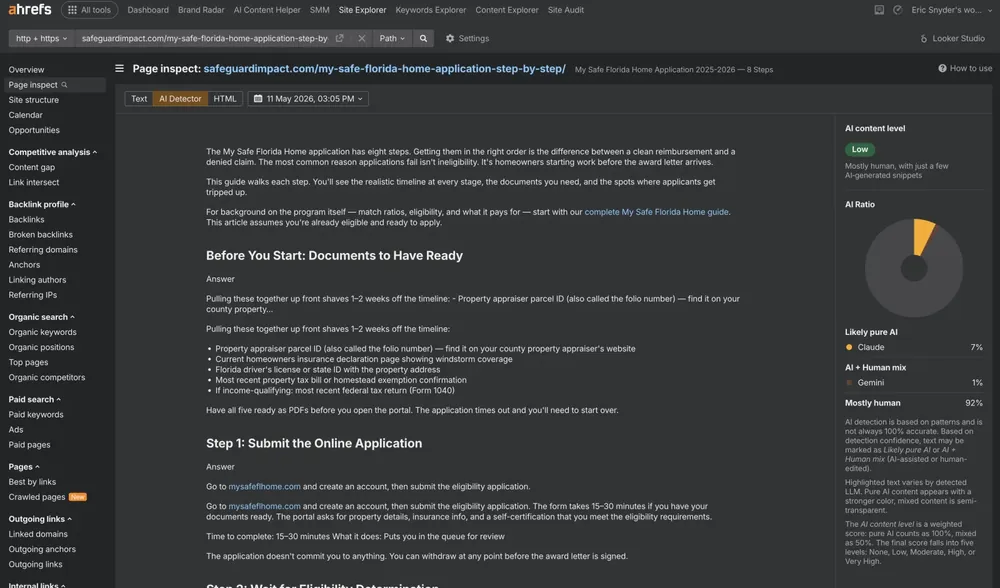
Why it matters: AI-flagged content is a ranking and trust liability. Staying in the Low band keeps the whole library eligible — and protects E-E-A-T.
Step 6, up close
The publish gate isn't one check — it's a stack of roughly 17, and they come in two kinds. The split between them is the whole reason agent-written pages read human instead of robotic.
A hard gate is an objective pass/fail. Miss it and the run won't insert the page. The agent runs a surgical patch — re-prompting only the block that failed and leaving the rest verbatim — then re-checks. After three tries it aborts the run rather than ship something broken.
A soft gate never aborts the run. A miss is either repaired mechanically before save — meta length, link counts, a missing stat anchor — or simply logged. It covers the fuzzy, stylistic calls where there's no single correct answer.
Hard-gating a subjective target sends the agent into retry loops, grinding every page toward the same robotic mean — or killing good copy a retry can't "fix." Reading level is soft on purpose: real trade language — HVHZ ratings, Florida Building Code, product specs — ships intact instead of being dumbed to a uniform grade.
Why this is the human-like engine: hard gates are machine-strict on the mechanics that get content flagged as AI or SEO spam — stuffing, duplication, missing structure. Soft gates stay loose on the style that makes writing sound like a person wrote it. Strict where a rule is objective, human where judgment beats a threshold — that's why the AI Detector on slide 5 grades these pages Low.
Receipt #2 · Domain Rating
Domain Rating is the strength of a site's backlink profile on a 0–100 scale. It's the single best proxy for "can this domain rank competitive terms at all." Safeguard's DR sits at 41 — up 11 over Ahrefs' trailing 3-month window — and the backlink profile behind it nearly quadrupled.
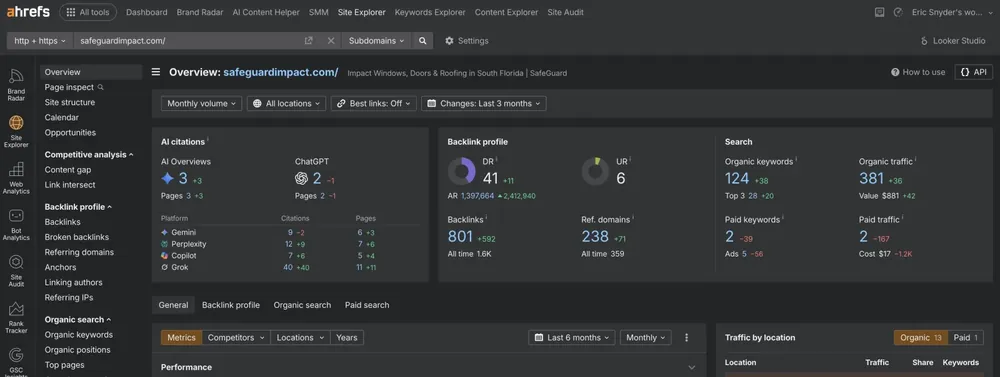
Why it matters: DR is earned, not bought. A rising DR means every future page launches with more ranking power than the last — the compounding the ROI deck is built on.
Receipt #3 · On-page score
An independent audit — SEOmator, 189 checks across 16 categories — graded a Safeguard service page built entirely by the agents. The on-page score came back 95, with SEO, accessibility and best-practices all at 100. This isn't one lucky page; it's what the publish gate enforces on every page.
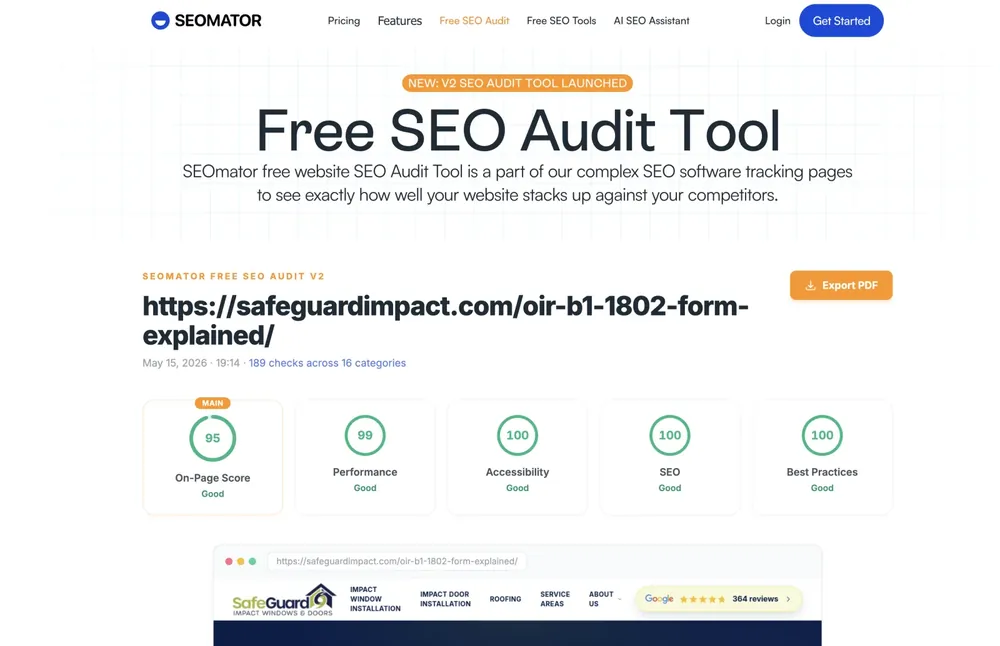
Why it matters: a high on-page score means Google spends zero crawl budget tripping over technical debt — it reads the content and ranks it. Clean code is a ranking input.
Receipt #4 · Page speed
Because the front-end is hand-built — no plugin tax, no bloated theme — Core Web Vitals pass clean. PageSpeed Insights returns a perfect 100 / 100 / 100 / 100 on desktop, and the bar holds across the whole portfolio: 97+ on mobile, 100 on desktop, on every page the agents ship.
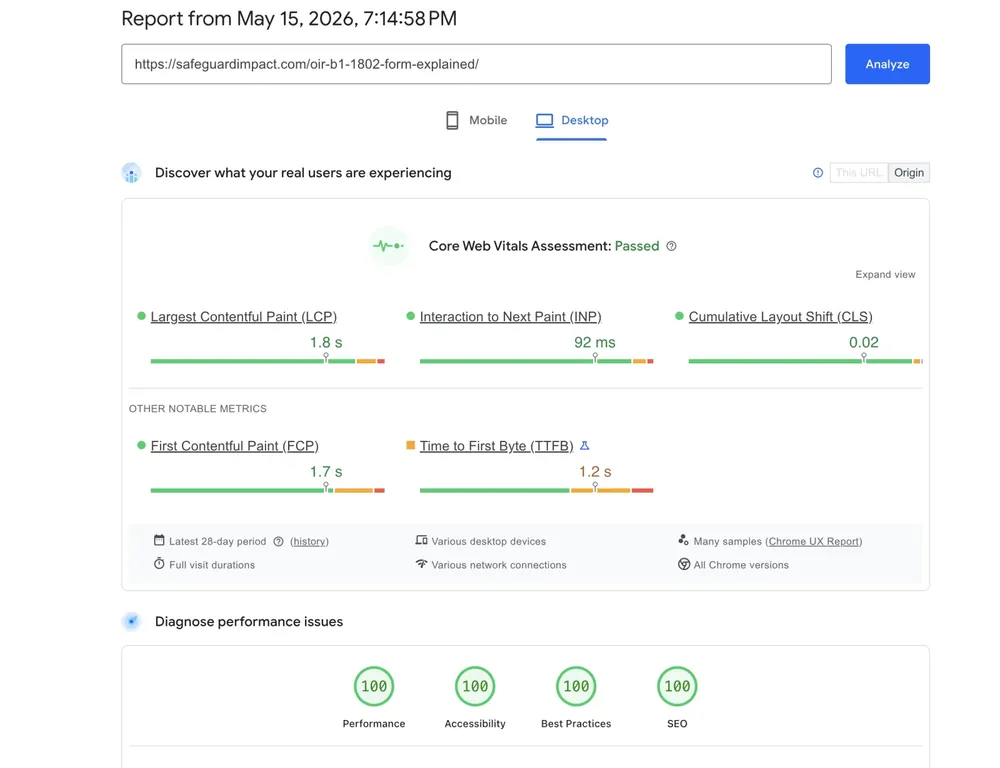
Why it matters: speed is a confirmed ranking factor and a conversion factor. A fast page ranks higher and turns more of that traffic into booked calls.
Receipt #6 · Microsoft Clarity
A #1 ranking that doesn't convert is a vanity metric. So every Safeguard page is wired to Microsoft Clarity — every click, scroll, dead-click and rage-click recorded. The landing page gets optimized against what visitors actually do, not what we guess they do.
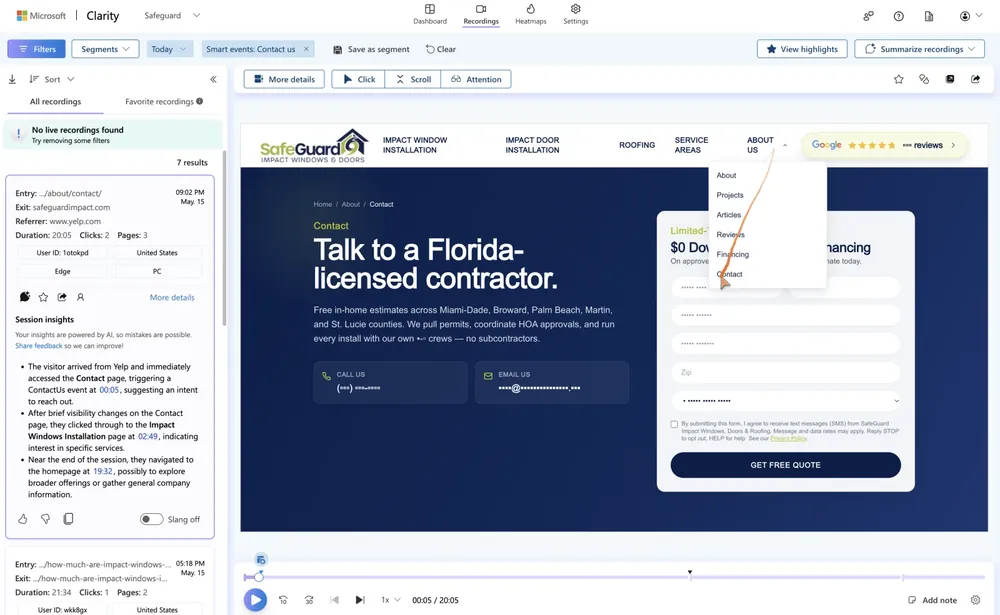
Full session replay plus heatmaps — and Clarity writes a plain-English summary of each visit. Here: a visitor lands from Yelp, hits Contact, fires a contact event at 0:09, clicks through to Impact Windows Installation, then the homepage. That's a conversion path you can read and improve.
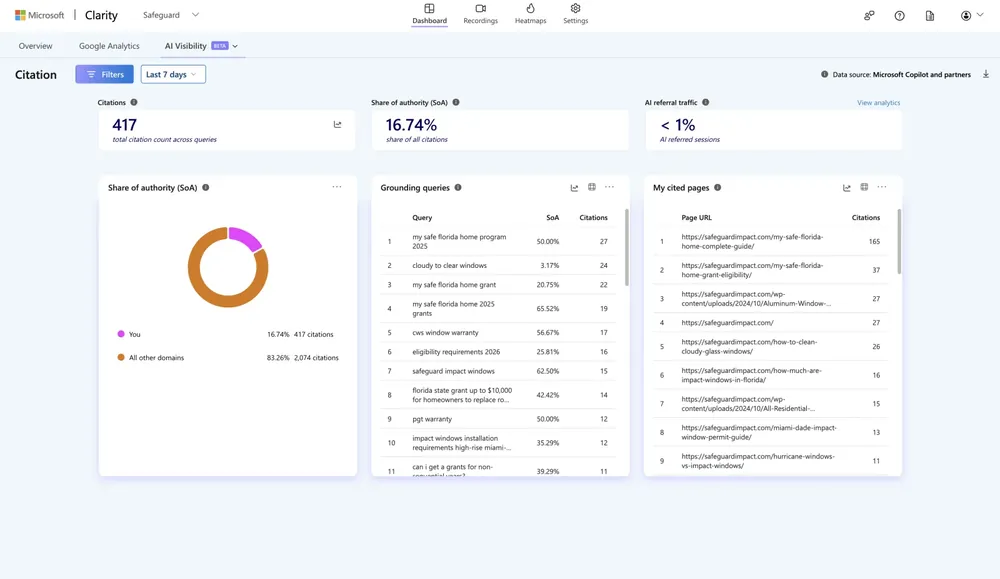
Clarity also tracks the Copilot side: 417 citations across AI queries and a 16.74% share of authority against every other domain — the content is getting pulled into AI answers, not just blue links.
Why it matters: SEO wins the click; conversion optimization wins the customer. You can't optimize what you can't see — Clarity makes every interaction visible, and the AI-citation view is a free read on where search is heading.
Receipt #5 · Search Console
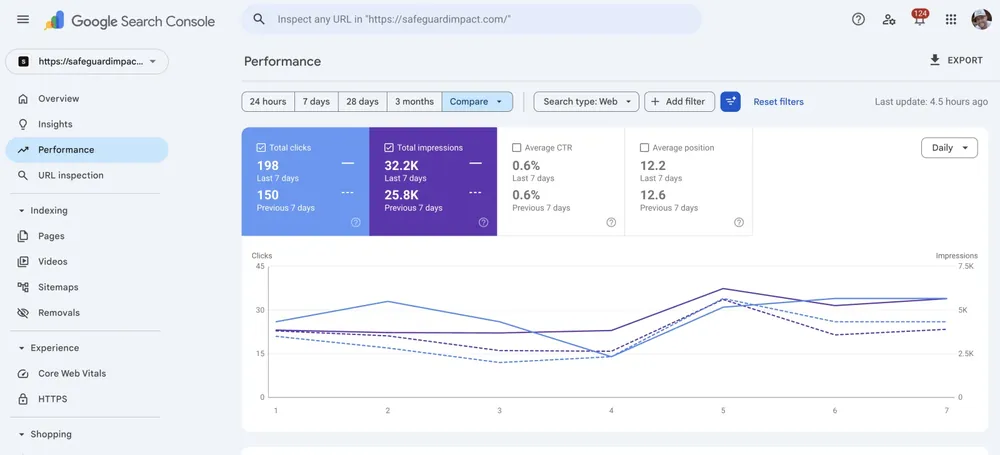
DR, SEO score, AI-detection and speed aren't the goal — they're the leading indicators. Here's the lagging one: Google Search Console, week over week, in the two weeks since the rebuild went live.
The next search box
Clean, human-reading, well-structured content doesn't just rank in Google — it gets quoted by the LLMs. Safeguard is already being cited across Grok, Perplexity, Gemini and Copilot, plus Google AI Overviews. That's why the AI-detection score on slide 5 matters: the engines surface human-grade content.
Why it matters: AI answers are becoming the first result a buyer sees. Being the cited source is the new page-one — and the agent stack is built for it.
Tying it back
The ROI deck says year 1 is the build: index the site, earn the authority, pick up the long-tail. Safeguard Impact is that build — two weeks in, and every leading indicator already pointing the right way.
DR 41, climbing. 238 referring domains. 124 keywords ranking, 28 in the top 3. That's a balance-sheet item appreciating in real time.
Clusters → competitor teardown → pillars → service pages → programmatic → gate. The same six steps run on any domain, in any service area.
Low AI, 95 on-page, 100 desktop speed — not aspirations. Publish gates. Every page clears them or it doesn't ship.
Impressions and clicks are already climbing week over week. The ROI deck shows where that curve goes next.
We bring the receipts.
Same pipeline, same publish gates, same dashboards you just saw. Drop your domain and we'll pull your current DR, indexability and keyword footprint — and show you exactly which clusters we'd build first.
Receipts Group · We bring the receipts. · SEO ROI Deck
10569 Walnut Valley Dr · Boynton Beach, FL 33473 · (561) 287-8506