The Content Strategy Framework Built for Decisions, Not Checklists
A content strategy framework is a decision architecture. It's a repeatable structure that tells you *how* to make content choices. Not which choices to make this month. That distinction sounds subtle. It isn't. Every top-ranking guide on this topic hands you a numbered checklist that expires the moment your first piece underperforms. We've watched that happen to clients who came to us with binders full of "strategies" that were actually just editorial calendars dressed up in jargon. The real problem: their frameworks told them *what* to do, not *how to decide* when the data changed.
This post is part of our broader thinking at our content marketing agency. It goes deeper on one specific question: how do you build a framework that outlasts its first contact with reality?
What makes a content strategy framework different from a content strategy?
A framework is the repeatable decision structure; a strategy is the specific plan you build inside it. Conflating them is why most strategies expire.
The two terms get used interchangeably everywhere. That's the problem. A content strategy is the specific plan: these topics, this cadence, this channel, this quarter. A content strategy framework is the machine that produces plans. It answers: what criteria do we use to choose topics? What signals trigger a channel switch? Who approves copy when three teams are producing at once?
Only 39% of B2B marketers and 33% of B2C marketers have a documented content strategy. The documented-framework number is probably in the single digits. Most operators skip the architecture layer entirely and wonder why their strategy needs rebuilding every six months.
Build the framework first and every future content decision has a rulebook. Build the strategy first and you're starting over every time the market moves.
What should a content strategy framework actually govern?
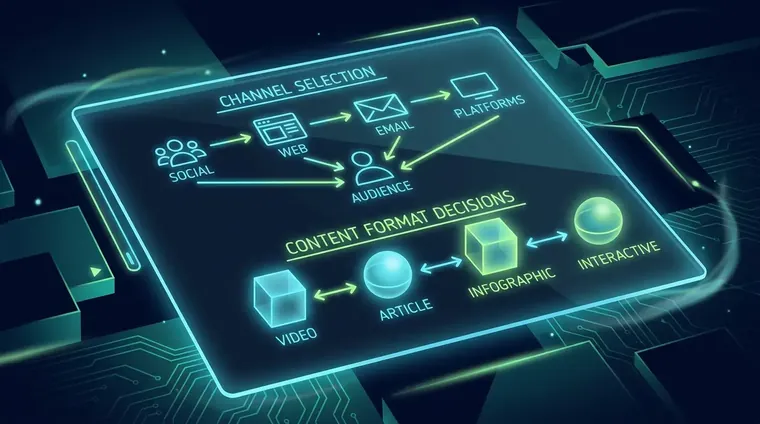
A real framework governs channel selection, content format, ownership, and the thresholds that trigger a strategic pivot. Not just editorial topics.
- Channel before format The channel you publish on dictates format, not the other way around. A LinkedIn-first framework produces different assets than a YouTube-first one. Deciding format before channel is why so many teams produce content nobody sees.
- Ownership and governance Who has final approval? What happens when product, marketing, and sales all want the next blog post to say something different? The framework names the decision-maker before the conflict happens.
- Pivot thresholds Define the data threshold that triggers a strategic review, not just a tactical tweak. Is it 90 days of flat organic traffic? A 20% drop in lead-to-content attribution? Name it in advance or every underperforming piece becomes a politics fight.
- Sales and product cycle alignment Content produced in a vacuum disconnected from launch calendars and pipeline stages burns resources. The framework maps content production to real demand windows. Product launches, seasonal spikes, sales-cycle entry points.
- Resource constraints as inputs Most frameworks assume unlimited capacity. Yours shouldn't. If you can produce four pieces per month, the framework tells you which format gets the budget first. Not all of them simultaneously.
Programmatic SEO without proprietary data is effectively dead. Thin scaled content no longer earns rankings after Google's Helpful Content updates.
"pSEO without unique data is dead now." That's a direct quote from r/bigseo, and it's right. Google's Helpful Content System turned scaled thin content from an asset into a liability. Any content strategy that ignores this is chasing 2021 rankings. The framework needs original research, first-party data, or real operator experience baked in from the start. Keyword targeting alone doesn't cut it anymore.
How does operator experience change what goes into the framework?
Operator experience replaces theoretical personas with real buying signals. Frameworks built from inside an industry survive algorithm updates that wipe generic content.
Receipts Group's founder built Cash Buyers Network from $0 to $6M/year as Operations Director. That background is why the platform-specific playbook works. We know what content a motivated seller reads at 11pm before calling, and it isn't a blog post about "how to sell your home fast." Topic selection, format choice, and call-to-action placement all shift when you've lived inside the buying cycle.
Google's E-E-A-T guidelines reward exactly this. Experience is a ranking signal now. A content strategy that doesn't surface the operator's actual experience in every piece leaves a real SEO advantage sitting on the table.
We later rebuilt a dead-domain version of the Cash Buyers Network site for backlink recovery. Two completely separate engagements. Operator history and agency work inform each other in ways that purely theoretical frameworks never capture. If you want to see how we structure this for clients, our content marketing agency page walks through the full approach.
When should a framework be pivoted vs. Tactically adjusted?
Tactical adjustments fix execution; a framework pivot is warranted when the channel, audience signal, or business model underneath the strategy has materially changed.
Every top-ranking guide skips this question entirely. Carl Broadbent invested heavily in podcasts. His audience wanted infographics. The podcast push failed. Not because the content was bad, but because he picked the channel after he picked the format. That's a framework problem, not a tactical one.
Here's the rule we use. If underperformance is in execution. Headline quality, publish frequency, CTA copy. Fix the execution. If three consecutive months of data show the channel isn't generating attributed pipeline, that's a framework problem. Pull the thread.
One Hacker News commenter put it plainly: "adding content to a page usually results in fairly quick change in ranks." (source) That's a tactical observation. But if the page targets the wrong channel's audience entirely, tactical fixes won't close the gap. Know which layer you're working on before you start pulling levers.
For B2B operators, our guide to choosing a B2B content marketing agency goes deeper on how to pressure-test whether your current partner is fixing the right layer.
Framework-first vs. Checklist-first: what actually differs?
A framework-first approach produces reusable decision rules; a checklist-first approach produces a single-use plan that breaks when conditions change.
| Feature | Framework-First | Checklist-First |
|---|---|---|
| Channel selection | Chosen before format based on audience signal | Listed after topics and content types |
| Governance | Approval chain named in the framework doc | Figured out when a conflict surfaces |
| Pivot triggers | Data thresholds defined in advance | Decisions made reactively, often emotionally |
| Shelf life | Reusable across campaigns and quarters | Expires with the editorial calendar it produced |
| Resource constraints | Built into format prioritization logic | Ignored — all formats assumed simultaneously viable |
The numbers that frame why framework quality matters
Only 39% of B2B marketers have a documented content strategy. Meaning fewer still have a reusable framework underneath it.
How does a content strategy framework connect to paid distribution?
Paid channels amplify what organic content proves. The framework should define the signal threshold that triggers paid promotion, not treat them as separate programs.
Organic and paid aren't two strategies. They're one loop. A content piece that earns clicks and dwell time in organic search is a validated creative asset for paid distribution. Your content strategy should define that handoff explicitly: when a piece crosses a defined engagement threshold, it gets budget behind it.
For home services and local businesses, Local Service Ads surface trust signals. Reviews, categories, response time. That mirror what a strong content program builds organically. The framework should acknowledge those paid surfaces exist and define how content feeds them.
We've written more on building content that accumulates authority in our piece on SEO content writing services and in our overview of SEO-friendly content writing services. Content that builds authority over time, not just publishing volume.
Frequently Asked Questions
What is a content strategy framework?
A content strategy framework is a reusable decision architecture. It defines the rules for how content decisions get made repeatedly, not just the decisions themselves for one quarter. Think of it as the system that produces strategies, not the strategy itself.
When does a content framework need a strategic pivot?
When three consecutive months of data show the channel isn't generating attributed pipeline, that's a framework-level signal. Not a tactical one. Execution failures (headline quality, cadence) get tactical fixes. Channel failures require framework revision.
Why should channel selection come before content format?
The channel dictates what format your audience actually consumes. Choosing format first. Then hunting for a channel to distribute it. Is why teams produce content nobody sees. Carl Broadbent's podcast-vs-infographic failure is a clean example of this sequencing error.
How many content formats should a framework cover?
However many your team can execute with genuine quality given real resource constraints. Not all formats simultaneously. A framework for a two-person team prioritizes one or two formats and names the decision criteria explicitly rather than listing every possible format as a goal.
How does a content framework connect to SEO rankings?
Google's E-E-A-T guidelines reward first-hand operator experience surfaced in content. A content strategy framework that mandates original data, real case studies, or practitioner voice outperforms frameworks built purely around keyword volume. Especially after the Helpful Content System updates.
Related reading
Ready to build a framework that doesn't expire?
We take on a small number of content clients, and we're selective about them. If you want a content strategy built around your actual sales cycle, your real channels, and what your team can actually execute. Not a generic checklist. Read our content marketing agency overview first, then book a call. We bring the receipts.