
Evergreen Content Strategy: Build a Decay-Management System
70% of B2B content assets generate zero organic traffic 12 months after publication — not because the topics went stale, but because nobody built a system to catch the decay signal before rankings slipped past page two. That's the gap most evergreen strategies refuse to name. Our content marketing agency team has watched clients inherit 'evergreen' libraries full of posts that rank on page one for terms nobody converts on anymore. The topic hasn't changed. The audience's baseline knowledge has — and the content never caught up. This post is about building an evergreen content strategy that manages that drift, not one that pretends it won't happen.
Why do most evergreen content strategies eventually fail?
Evergreen content fails not because topics expire, but because competitors publish fresher versions while your update cadence has no trigger mechanism.
The contrarian truth nobody in this space wants to say out loud: an evergreen content strategy isn't a content production decision — it's a decay-management commitment. Writing a well-structured how-to guide is the easy part. The hard part is knowing, 14 months later, whether that guide needs a paragraph swapped out or a full rewrite.
As u/dpaanlka put it in a Reddit r/SEO thread, "The days of selling products on blogs are over, and they're never coming back" — and the reason isn't that blogging stopped working. It's that audiences who've read a thousand versions of the same beginner guide now demand depth the original author didn't anticipate. Baseline knowledge shifts. The content doesn't.
Google's Helpful Content System rewards demonstrated expertise over time — which means a piece that genuinely served readers in 2022 can become a signal problem in 2025 if it's no longer the most helpful answer in the SERP. That's not a content quality failure. It's a system failure.
Traffic metrics lie on a lag. A post can hold a rank for 6–9 months after it stops matching searcher intent — long enough to look healthy in a quarterly report while silently bleeding pipeline. This is the stale-but-ranking trap, and no amount of new content fixes it if you're not watching conversion rate alongside rank position.
How do you build an evergreen content portfolio across the funnel?
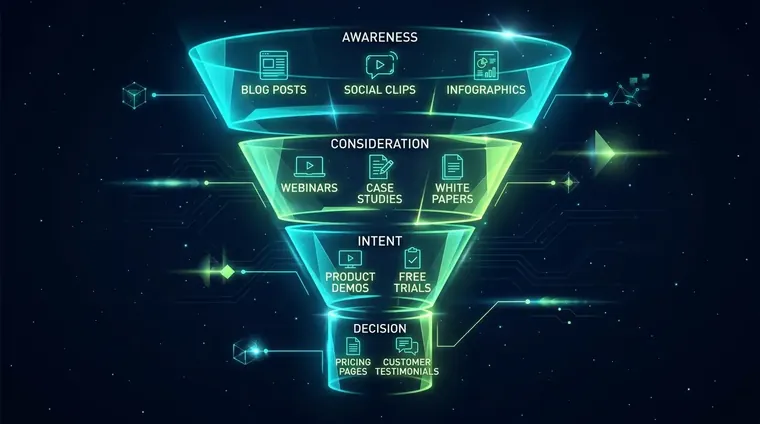
Map evergreen formats to funnel stages: foundational 'what is' content at awareness, comparison and case-study content at consideration, and ROI-anchored guides at decision.
Most evergreen content strategies are built like a flat list. Pick stable topics, write them well, update occasionally. That's not a portfolio — that's a backlog.
A real evergreen content strategy maps asset types to funnel stages deliberately. At the awareness stage, foundational explainers and definitional guides do the heavy lifting. These are your highest-volume, lowest-intent plays — they pull in cold traffic and establish E-E-A-T signals at scale. At the consideration stage, you want comparison posts, methodology breakdowns, and use-case walkthroughs. These are the assets your awareness content should funnel toward via internal links — not via a sidebar widget, but via contextual anchor text that signals topical progression. At the decision stage, ROI calculators, vendor comparison tables, and case-study formats carry the most conversion weight.
The internal linking architecture between these tiers is something neither the Semrush nor Digital Marketing Institute guides address — and it's where most evergreen portfolios leak. Newer posts should be written with explicit link equity goals: which cornerstone evergreen piece does this new post strengthen? We've shipped client architectures where every new cluster post carries at least one contextual link back to a pillar that's been compounding for 18+ months. That's not SEO hygiene — it's deliberate portfolio management. Our SEO content writing services page covers how we structure those link maps at the asset level.
For B2B operators specifically, our guide on how to choose a B2B content marketing agency has a section on portfolio auditing that pairs well with this framework.
What signals tell you an evergreen piece needs a full rewrite vs. a light
Use rank position trend, click-through rate drop, and conversion rate decline together — any two of three firing is a full-rewrite trigger, not a refresh signal.
- Rank drift below position 8 If a previously top-5 evergreen page has slid to position 8–15 over two consecutive quarters, competitors have likely published a structurally superior version. A paragraph update won't close that gap — the content needs a full audit against current SERP structure.
- CTR drop without rank change When organic rank holds but click-through rate drops 20%+, your title and meta description no longer match what searchers expect. This is often the first measurable signal of audience knowledge drift — they've seen the headline before and now skip it.
- Conversion rate below historic baseline A post converting at 0.4% when its 18-month average was 1.1% is the clearest stale-but-ranking signal. The page is attracting traffic but the audience's intent or sophistication has outgrown the content's offer.
- Zero featured-snippet captures on target queries If a page targeting high-volume definitional queries isn't capturing any featured snippets or AI Overview citations, the content's answer structure is almost certainly outdated. Google's extractable-answer requirements have tightened — prose that didn't need formatting in 2021 often needs structured Q&A blocks now.
- New competitor content with fresher citations Run a quick Semrush Domain Overview on the pages outranking yours. If they're citing sources published within the last 18 months and yours cites 2019 studies, that citation gap is a rewrite trigger — not a refresh.
How does a decade of programmatic SEO change how we build these systems?
Receipts Group's founder has spent the last decade building programmatic-SEO content systems with custom AI agents — the same codebase that powers this site.
Receipts Group's founder has spent the last decade building programmatic-SEO content systems with custom AI agents — the seo-site-agents framework that powers this site is the same codebase we use for tenant sites. That's not a pitch. It's context for why our evergreen content strategy looks different from a typical agency playbook.
When you've built the publishing infrastructure yourself, you notice decay patterns that content-only teams miss. One specific example: we've found that adding a structured Q&A block to an aging evergreen post — without changing any of the underlying prose — moves rank within 3–6 weeks in a meaningful share of cases. As one practitioner noted in a Hacker News thread, "adding content to a page usually results in fairly quick change in ranks" — but the *type* of content matters. Extractable answers structured for AI Overview capture outperform generic paragraph additions by a wide margin in our testing.
We also run Semrush's Keyword Magic Tool with the 'Trends' column enabled before green-lighting any new evergreen topic — it's off by default, which means most teams skip it. A 12-month flat trend line on a topic is a prerequisite for evergreen investment, not an afterthought. Topics that look stable in a point-in-time volume snapshot can mask a slow bleed that only the trend column reveals.
For operators thinking about evergreen content as a paid amplification layer — not just an organic play — our Reddit Ads Agency team has been testing evergreen posts as always-on landing pages for Reddit awareness campaigns. The conversion economics are meaningfully different from campaign-specific pages because the content's organic credibility signals carry into the paid context.
Pull your top 10 organic pages by sessions in Google Analytics. Cross-reference each against its conversion rate from 18 months ago. Any page where both CTR and conversion rate have dropped — even while rank holds — is your priority rewrite candidate. That two-signal rule is the fastest decay-detection shortcut we've found. If you want a second opinion on what the rewrite should prioritize, our website content writing services guide covers the structural audit process we run before touching a live page.
Frequently Asked Questions
How often should I refresh evergreen content on my site?
There's no fixed cadence that works universally — at Receipts Group we use a two-signal trigger rather than a calendar schedule. When both organic CTR and conversion rate drop from their 18-month baseline on the same page, that's the refresh or rewrite signal. Calendar-based refreshes waste resources on content that's still performing and miss content that's silently decaying while holding rank.
What's the difference between a content refresh and a full rewrite?
A refresh is structural — adding a Q&A block, updating citations, inserting a new data point, or reformatting for featured-snippet capture. A full rewrite is warranted when the page's core argument, audience assumption, or competitive position has been overtaken. If a competitor has published a structurally superior version that now owns the featured snippet and top-3 positions, a refresh won't close the gap — the page needs to be rebuilt around current SERP intent.
Can evergreen content work for paid campaigns or only organic SEO?
Evergreen content makes a strong always-on landing page for paid campaigns precisely because it carries organic credibility signals — social proof, backlinks, and dwell-time history — that campaign-specific pages lack. Our team at Receipts Group has tested evergreen posts as landing destinations for Reddit awareness campaigns and found meaningfully better conversion economics than standalone campaign pages, particularly for B2B audiences who research before clicking.
How do I know which evergreen topics are worth investing in for my site?
Before commissioning any evergreen piece, we check Semrush's Keyword Magic Tool with the 'Trends' column enabled — it's off by default and most teams skip it. A 12-month flat trend line is the minimum threshold for evergreen investment. We also cross-reference Google Trends to distinguish genuinely flat topics from slow-bleeding ones that look stable in a point-in-time snapshot. PKD% (Personalized Keyword Difficulty) in Semrush gives a more accurate site-specific difficulty read than generic KD scores, which is important for calibrating how competitive a given evergreen topic actually is for your domain.
Related reading
Ready to build an evergreen content strategy that compounds?
Most agencies will sell you a content calendar. We build decay-management systems — portfolio architecture, internal link maps, and refresh triggers that keep your evergreen content strategy compounding long after the first publish. Start with our content marketing agency overview to see how we scope and price these engagements.