

The SaaS Link Building Agency Playbook for 2026
If you've searched 'saas link building agency' in 2026, the SERP is a wall of generic agency landing pages without an actual definition — let alone a framework for choosing one that moves your revenue needle. Most results are written by the agencies themselves, ranking for a keyword while listing 'competitors' they've hand-picked. That's a conflict of interest dressed as a buyer's guide. This playbook is different. It's built on the contrarian premise that DR (Domain Rating) is the wrong scorecard entirely — and that the metric which actually predicts pipeline impact is topical proximity to your ICP's reading stack. If you want the broader case for outsourcing link acquisition, start with our link building services pillar and come back here for the SaaS-specific operating layer.
Why Is DR the Wrong Metric for SaaS Link Building?
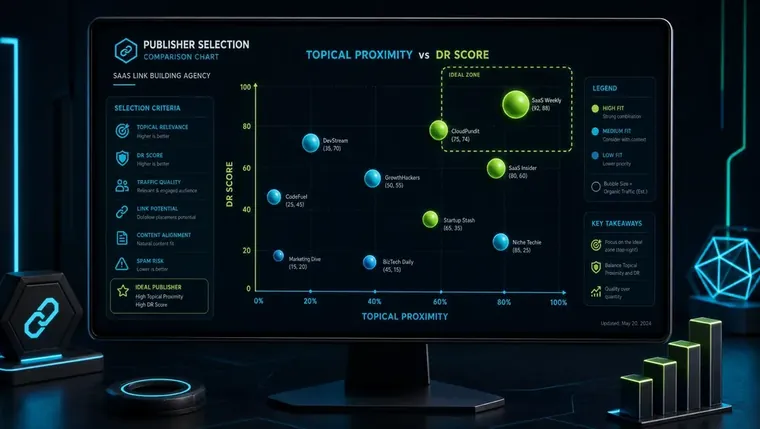
DR is a composite score that rewards general web authority, not topical relevance to your ICP — so a DR 45 niche SaaS publication routinely outperforms a DR 80 general site.
Domain Rating is a Moz/Ahrefs composite score that blends link quantity, link quality, and referring domain diversity into a single number. It was designed to approximate Google's PageRank — it was never designed to measure whether a publication's readership matches your ICP's buying intent. Yet nearly every saas link building agency still leads with DR ranges in their pricing tiers ($170–$250/link at DR 50–90, according to publicly listed agency rate cards).
Here's the gap that pricing structure creates: a DR 45 publication read by 80,000 SaaS operators, heads of growth, and product leads will generate more referral signal, branded search lift, and contextual anchor relevance than a DR 80 general-web publisher whose audience skews toward bloggers and affiliate marketers. The former publication sits inside your ICP's reading stack; the latter is a stranger to your category.
According to Google's own link best practices, the signals Google values are about relevance and editorial context — not third-party composite scores. Any agency that can't articulate topical proximity as a selection criterion alongside (or instead of) DR is optimizing for a metric that flatters their deliverables rather than your revenue. Push them on it in discovery.
Before you trust any 'best SaaS link building agencies' list, check who published it. If the publisher is also an agency ranking for the same keyword, their list is a marketing asset — not independent research. Verify methodology, client references, and case study verifiability before shortlisting anyone.
How Should Strategy Differ by SaaS Growth Stage?
Seed-stage SaaS needs linkable asset creation before outreach; Series B SaaS needs portfolio gap analysis and competitive displacement — one-size-fits-all outreach fails both.
Every top-ranking page for this keyword writes advice for a generic 'SaaS company' — as if a seed-stage startup with no published content and a Series B company with a full content team have the same link building needs. They don't, and the gap is operationally significant.
Seed to Series A: At this stage, the primary constraint isn't outreach capacity — it's the absence of linkable assets. A saas link building agency onboarding a seed-stage client should spend the first two to four weeks doing exactly what the OutreachZ 90-day sequencing model describes: fix internal linking architecture and publish two to four genuinely citable assets (original data, a methodology doc, a free tool) *before* a single outreach email goes out. Skipping this phase means pitching publishers with nothing worth linking to.
Series A to Series B: Here the constraint shifts. You likely have content, some existing backlinks, and a competitive set that has also been building links. The right agency move is a portfolio gap analysis: which pages need link equity most urgently, and which competitor pages are outranking you on navigational terms like 'best [your category] software'? That analysis should drive the outreach priority list — not a generic monthly link quota.
Series B and beyond: At scale, the most important and under-discussed risk is niche cannibalization. If a saas link building agency already works with your two closest competitors, their publisher relationships and outreach targets are partially claimed. Ask directly: which clients in your category are you currently serving? This is not an unreasonable question — it's table stakes due diligence.
What Page Types Generate the Most Linkable Value for SaaS?
Best/alternatives/vs pages, integration pages, use-case pages, and original data pages attract the most natural editorial citations in the SaaS category.
- Best / Alternatives / vs Pages Comparison and alternative pages attract citations from review sites, newsletters, and communities because they answer high-intent navigational queries. These are the pages most likely to earn links from listicle roundups without outreach.
- Integration & Ecosystem Pages A page documenting your native integrations with popular tools (Slack, HubSpot, Salesforce) becomes a natural citation target for those tools' own partner content and user communities.
- Use-Case & Industry Pages Vertical landing pages ('project management for agencies,' 'CRM for SaaS') attract links from niche publications and associations whose audiences match that specific ICP — far more topically proximate than general software directories.
- Original Data & Research Pages A proprietary data set or annual benchmark report gives journalists and bloggers a citable primary source. These pages generate long-tail editorial links for 12–24 months after publication with minimal ongoing outreach.
- Free Tool or Calculator Pages Interactive tools embedded in your product ecosystem attract inbound links from educators, bloggers, and community threads — often without any active outreach required.
How Do You Audit a Publisher Network for Recycling Risk?
Ask prospective agencies to share the referring domain overlap across their current SaaS client base — recycled publisher networks dilute link equity and create footprint risk with Google.
One gap none of the top-ranking pages address: publisher network recycling. If a saas link building agency runs the same 50 domains across all their SaaS clients, the link equity those placements carry gets diluted — and more importantly, Google's spam detection systems, as outlined in Google's Spam Policies, are increasingly sensitive to link footprint patterns. A cluster of SaaS companies all receiving links from the same 40 referring domains within 90 days is a pattern, not editorial diversity.
Ask any prospective agency three questions before signing: First, how many active SaaS clients are you currently running outreach for? Second, what is the average referring domain overlap between your client portfolios — and can you show a sample anonymized report? Third, how do you rotate publisher targets to prevent footprint clustering?
If they can't answer questions two and three specifically, their network is almost certainly recycled. The case studies worth referencing here are instructive as baselines: Jeenam's Systeme.io engagement (865% traffic growth, 1K to 9K monthly visits, 530 links over 23 months) and their Superside engagement (415% traffic growth, 380 links over 19 months) both show multi-year engagement windows — which is meaningful, because diversified publisher outreach at that scale *requires* a large, non-recycled network. Short engagements with fast link counts are a signal in the opposite direction.
For a broader view of how link acquisition fits into a full paid + organic growth stack, see how our Google Ads Agency team thinks about channel attribution when organic link equity starts generating branded search volume — the two channels interact more than most buyers expect.
DR-Led Agency vs. Topical Proximity-Led Agency: What's the Difference?
DR-led agencies optimize for deliverable optics; topical proximity-led agencies optimize for ICP relevance, referral quality, and ranking lift on commercial pages.
| Feature | DR-Led Agency | Topical Proximity-Led Agency |
|---|---|---|
| Primary selection criterion | Domain Rating (DR 50–90 tiers) | Audience overlap with your ICP's reading stack |
| Pricing structure | Cost per link, tiered by DR score | Cost tied to placement relevance + page-level ranking outcomes |
| Publisher network transparency | Often undisclosed — 'we have exclusive relationships' | Auditable — overlap reports available per client vertical |
| Growth stage flexibility | Same outreach quota regardless of content asset maturity | Asset-readiness audit before outreach begins |
| Risk posture | Footprint clustering risk from recycled domains | Active domain rotation to avoid pattern signals |

Pull the agency's own backlink profile in Ahrefs or Semrush — if their site lacks topical depth in your category, their publisher relationships probably do too.
Run a quick backlink audit on any agency you're considering. Export their referring domain list and filter for publications in your SaaS vertical. If fewer than 20% of their own inbound links come from category-relevant publications, their network skews general — and you'll pay DR-range prices for general-web placements that won't move your commercial pages. This 10-minute audit has saved more than one SaaS buyer from a six-month retainer mistake. For the broader case for outsourcing link acquisition, see our link building services pillar.
Frequently Asked Questions
How does a SaaS link building agency differ from a general one?
A SaaS-specific agency understands that the highest-value link targets for software companies are navigational and comparison pages ('best [category] software,' 'alternatives to [competitor]') — not the generic blog placements a general agency defaults to. They should also understand SaaS buying cycles, which means prioritizing publications read by product leads, heads of growth, and technical buyers rather than broad consumer audiences.
How much should a SaaS link building agency cost per link?
Publicly listed rate cards in 2026 range from approximately $170/link at volume (30+ links/month) to $250/link at smaller monthly commitments — a roughly 32% bulk discount. However, cost per link is a misleading primary metric. A more useful frame is: which pages need ranking lift, what are those pages worth in pipeline terms, and how many topically relevant links does it take to close the gap on competing pages? Agencies that can't translate link costs into ranking outcome estimates are pricing on deliverable optics, not results.
How can I tell if an agency recycles publishers across clients?
Ask directly for an anonymized referring domain overlap report across their current SaaS client portfolio. If they can't or won't produce one, assume recycling. You can also cross-reference their case study clients in Ahrefs — if multiple clients share 30+ of the same referring domains within overlapping time windows, that's a footprint pattern worth flagging.
How long does it take for SaaS link building to show measurable results?
Based on published case study data, meaningful traffic impact typically requires 19–23 months of sustained outreach — Superside saw 415% traffic growth over 19 months (380 links), and Systeme.io saw 865% growth over 23 months (530 links). Agencies promising significant ranking movement in 60–90 days are almost certainly referencing vanity metrics rather than commercial page performance.
More from Receipts Group
Ready to Build Links That Actually Match Your ICP?
The difference between a saas link building agency that moves your rankings and one that fills a monthly link report isn't budget — it's whether they can name the publications your buyers actually read and show you a non-recycled publisher network to reach them. Our link building services are built on topical proximity-first targeting, full portfolio conflict checks, and engagement windows designed for SaaS growth stages — not generic monthly quotas. Book a discovery call and we'll audit your current backlink profile against your top three competitors before the first conversation.