Topic Cluster Strategy: Fix What You Have Before You Build
Search 'topic cluster strategy' in 2026 and the SERP is a wall of generic agency landing pages recycling the same pillar-page diagram — none of them tell you what to do when your content library is already a mess. That's the gap this article fills. We're treating topic cluster strategy as a triage operation, not a greenfield project, because the teams we work with at our content marketing agency almost never have a blank slate. They have 200 published posts, three pages competing for the same keyword, and no internal link coherence. That's the real starting point — and the real opportunity.
Why does topic cluster strategy fail so often?
Topic clusters fail when teams build new content on top of structurally broken libraries — cannibalizing pages, orphaned posts, and zero internal link coherence.
The failure mode nobody writes about: most topic cluster strategy breakdowns aren't caused by bad content — they're caused by structural problems that new content makes worse. You publish a shiny new pillar page, it competes with three older posts targeting the same root keyword, and Google's crawl budget gets split across all four. Rankings stagnate. The team blames the strategy when the real culprit is that nobody audited before they published.
Backlinko's SEO marketing cluster — 57 pages, ranking for 29K+ keywords and pulling 158K+ monthly visitors — gets cited constantly as proof that clusters work. What doesn't get cited is how long that took to architect and the fact that Backlinko had one coherent topic ownership from day one. That's not the situation most teams inherit.
The moment we audit a new client's content library, the same pattern appears: cluster pages that cannibalize each other, a pillar page that's thinner than the cluster posts it's supposed to anchor, and internal links that point inward randomly rather than funneling authority toward money pages. No amount of new content fixes that. You have to triage first.
Publishing more content before you fix your cluster structure is the most expensive mistake in content marketing — see Entity SEO Strategy: Fix the Misread Before You Build More Content. Every new page you add to a broken cluster dilutes the authority signal further. The audit comes first — always.
What does a cluster audit actually catch?
A cluster audit surfaces keyword cannibalization, internal link decay, thin pillar pages, and cluster pages with no commercial fit — all before you write anything new.
- Keyword cannibalization Two or more pages targeting the same root term split ranking signals. Google can't pick a winner, so neither ranks well. The fix is usually a merge-and-redirect, not a new post.
- Orphaned cluster pages Posts that live in a topic area but have zero internal links pointing to them — or pointing out from them — are invisible to Google's authority-passing crawl. They need to be wired in or cut.
- Thin pillar pages A pillar page that's shorter or less comprehensive than the cluster posts it anchors is a structural problem. The pillar should be the definitive resource; if it isn't, cluster authority leaks away.
- Internal link decay Cluster pages that get updated, redirected, or deleted take their internal link equity with them — often silently. We've seen site migrations wipe out 40% of a cluster's link graph with no one noticing for months.
- Commercial fit gaps Clusters built around informational topics with no buyer intent at the pillar level generate traffic that never converts. Topical depth only pays off when the pillar maps to a real service or product.
How do you retrofit an existing library into clusters?
Retrofitting starts with a content inventory, groups pages by topic intent, identifies the strongest existing page as the pillar candidate, and merges or redirects competitors before rewiring internal links.
Most topic cluster strategy guides assume you're building from scratch. We've never once had that luxury with a real client engagement. Here's the actual retrofit sequence we run.
First, pull a full content inventory — URL, title, target keyword, organic traffic (last 90 days), and internal links in/out. We use Screaming Frog for the crawl and layer in Google Search Console data to see which pages already have ranking signals worth preserving. Group pages into topic buckets by intent, not just keyword similarity. A page about 'content marketing ROI' and a page about 'how to measure content marketing' belong in the same cluster; they're answering the same commercial question from slightly different angles.
Once buckets are defined, the decision tree is: (1) Is there one clear winner in this bucket by traffic and backlinks? Make it the pillar candidate. (2) Do any other pages in the bucket compete directly? Merge them into the pillar or redirect. (3) What subtopic gaps exist that aren't covered? *Those* are the new cluster pages you greenlight. This sequencing is how Usman Akram at Omniscient Digital describes batching related topics — you consolidate SME effort and eliminate research duplication before a single new word is written. The principle holds for retrofits just as much as new builds.
For internal linking, the rule is directional: every cluster page links up to the pillar, and the pillar links out to cluster pages explicitly. Cross-links between cluster pages are fine but secondary. Once that graph is wired, you'll often see ranking improvements within one to two crawl cycles — before any new content ships.

We scope cluster audits in a single 30-minute call — no deck, no sales pitch. Book a call with the Receipts Group team and we'll tell you in the first session whether your site needs triage or greenfield build.
How many cluster pages does a strategy actually need?
A functional cluster needs at least 8-12 supporting pages to generate meaningful authority depth; clusters under 5 pages rarely move the needle on competitive terms.
This is the sizing question nobody in the SERP answers directly. Backlinko's YouTube marketing cluster ranks for 17K+ keywords on roughly 7K backlinks — a smaller cluster that still generates significant visibility. Their SEO marketing cluster at 57 pages is the high-water mark. Those two data points bracket the useful range.
From our own build history, clusters under five pages rarely generate enough topical depth to influence rankings on competitive head terms. The Helpful Content System rewards demonstrable expertise across a topic — five pages isn't enough surface area to demonstrate it. Our operational benchmark is 8–12 cluster pages as the minimum viable cluster for a competitive keyword, scaling to 20–30 pages for high-authority verticals where competitors have deep content libraries.
Bandwidth prioritization matters here. When a team is resource-constrained, we sequence cluster pages by query intent stage: transactional and commercial investigation pages first (they convert), then informational pages that support the pillar's internal link graph. This is the opposite of what most teams do — they write the easy informational posts first because they're faster to produce. Flipping that sequence is the single change that most immediately improves revenue attribution from organic. Nathan Gotch's guidance for new sites — build authority around a single topic line before expanding — applies to retrofit teams too. Finish one cluster before starting the next. Diluting effort across three half-built clusters is how you end up with nothing ranking.
As one practitioner put it on r/bigseo: 'what we should track are actual leads coming from ChatGPT' — and that framing applies to cluster ROI measurement too. Cluster pages that appear in AI Overviews and Perplexity citations are generating brand impressions even when they don't get a click. MoneyHelper's personal finance clusters appear in People Also Ask for 1,500+ keywords — PAA visibility is a real KPI, not a vanity metric.

How does topic cluster strategy connect to AI search citation?
Clusters earn AI Overview citations because Google's query fan-out technique issues multiple sub-searches per query — depth across a cluster fills multiple citation slots simultaneously.
The E-E-A-T signal most teams miss in 2026 isn't about author bios or outbound links in isolation — it's about cluster depth as a proxy for demonstrated expertise. Google's query fan-out technique, documented in Search Central, means that a single AI Overview query spawns multiple related sub-searches. A well-structured cluster fills several of those citation slots at once. A single standalone page fills one, at best.
HubSpot's State of AEO 2026 report confirmed this operationally: pages with outbound links, statistics, visible author bios, and a 'last updated' date earn more citations across AI Overviews, Gemini, and Perplexity. Those aren't decorative signals — they're the surface-area markers that tell the model this page belongs to a coherent, maintained knowledge base. Our cluster pages ship with all four by default.
The agent stack Receipts Group ships isn't a 2024 ChatGPT wrapper — it's a decade of operator-built programmatic SEO infrastructure. That matters for cluster builds because the tooling handles internal link graph maintenance automatically: when a cluster page gets updated or redirected, the link graph updates with it. That's the internal link decay problem solved at the infrastructure level, not the spreadsheet level. For teams managing clusters at scale — or looking to pair content depth with paid distribution — our Reddit Ads Agency work shows how organic cluster visibility and targeted paid amplification interact. A cluster that's ranking is a cluster worth amplifying. The two aren't separate strategies.
For deeper context on the content production side, our guides on SEO content writing services and SEO-friendly content writing services that compound walk through how we sequence and produce cluster content once the audit is done.
Frequently Asked Questions
What is a topic cluster strategy and how does it differ from regular SEO?
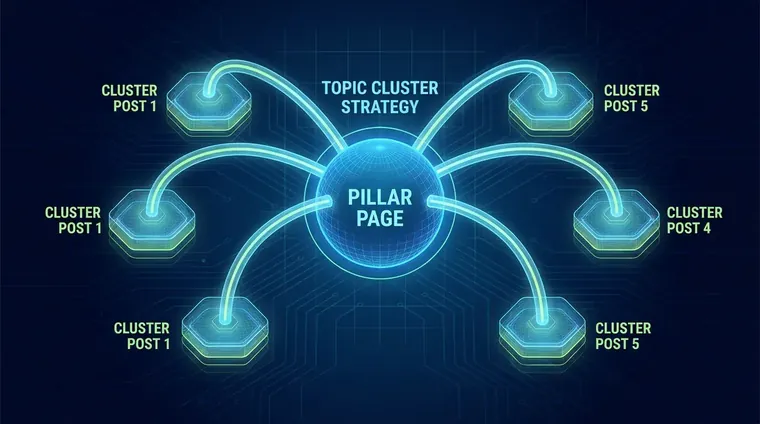
A topic cluster strategy organizes your content into a pillar page — the definitive resource on a broad topic — supported by cluster pages covering specific subtopics, all internally linked. Regular SEO treats pages as independent ranking units. Cluster strategy treats them as a connected authority network, where the strength of the cluster lifts every page in it. The practical difference: cluster pages that would never rank alone often rank well when wired to a strong pillar.
How do I know if my content needs a cluster audit first?
The clearest signals are: two or more pages on your site targeting the same root keyword (check Google Search Console for ranking overlap), a pillar page that's shorter than the blog posts beneath it, or cluster pages with zero internal links in or out. If any of those are true, audit before you publish. Adding new content to a broken cluster structure dilutes authority rather than building it.
How many cluster pages does a topic cluster strategy need to work?
Eight to twelve cluster pages is the practical minimum for a competitive head term — below five pages, there isn't enough topical depth to signal comprehensive coverage to Google's Helpful Content System. High-authority verticals often require 20–30 pages. The more useful benchmark isn't total count but coverage of the full intent spectrum: at least one transactional page, several commercial investigation pages, and supporting informational pages that reinforce the pillar.
What happens to my cluster when I update or delete cluster pages?
Internal link decay is the silent cluster killer. When a cluster page is redirected or deleted, the internal links pointing to it either become 301 chains or dead ends — both reduce the authority signal flowing through the cluster. The fix is to audit your internal link graph any time you do a content migration or CMS cleanup, update or remove links pointing to changed URLs, and ensure the redirect target is semantically appropriate. Teams managing clusters at scale should automate this as part of their publish workflow, not treat it as a one-time cleanup task.
Related reading
Ready to fix your cluster structure — not just add to it?
Most content strategies we inherit are three to five merged pages away from a meaningful ranking improvement. We find those pages in the audit, cut what's cannibalizing, wire up what's worth keeping, and build out from a clean structure. If that sounds like your situation, our content marketing agency is the right starting point — book a scoping call and we'll map your cluster audit in the first session.