From discovery to the close.
Most agencies pitch services. We find your gap, do the math, and show you the multiplier on every dollar in. If the numbers don't work, we tell you. If they do, we start Monday.
Append ?rep=1 to URL · numbers auto-save · press R to reveal gated slides
"Quick frame before we dig in — I'm going to ask you about your business for ~10 minutes, then we'll do some math together, then I'll show you exactly what working with us looks like. By the end of the call, you'll know if it's a fit and what the investment is. Sound good?"
Wait for verbal yes. Then advance.
The single yes here is the most important micro-commitment of the call. If they push back ("just send me info"), you didn't earn the meeting — book a real one.
Discovery
We don't pitch services until we understand the shape of your business — your customer flow, your operational health, and where the gap actually is. The whole call hinges on what we learn here.
If marketing brings you 20 leads tomorrow but you can't answer the phone, can't book them fast enough, or can't deliver — we've made your problem worse, not better. The discovery protects you. We won't take an engagement that's set up to fail.
Work through the questions on the slide. Enter each answer in the live calculator above as you go. The math runs in the background — output stays locked until slide 06.
As you fill the calc, echo what they're telling you back: "$5K gross profit, 15 customer gap — we're talking $75K/mo on the table right now." Plant the gap before slide 06 reveals it.
"OK, this gives me a clear picture. Before I show you the math, I want to tell you who we are and why we're different — because that affects what we can do with your numbers."
Who we are
Three founders. Full-stack coders. Operators who've built and managed real companies — not people who sell marketing as a service. That changes what we build and how it gets priced.
The receipt · AI detection
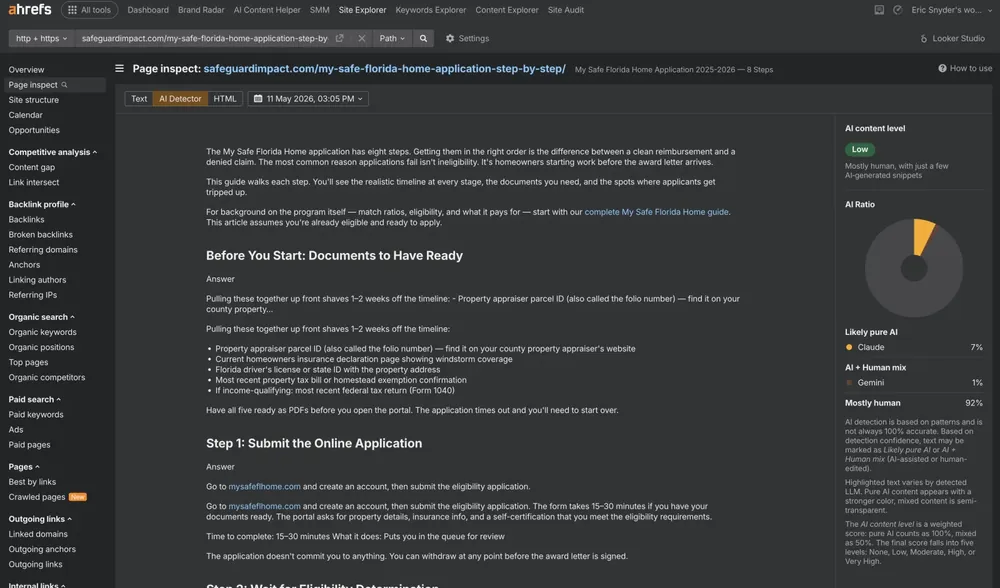
verifiedMost agencies are running AI-generated content that detectors flag at 90%+ — Google reads it the same way. Our 17-stage custom-agent pipeline produces content that Ahrefs' detector reads as Low AI — between 0 and 12%. Long-term, that's the difference between content Google ranks and content Google buries.
The receipt · Real results
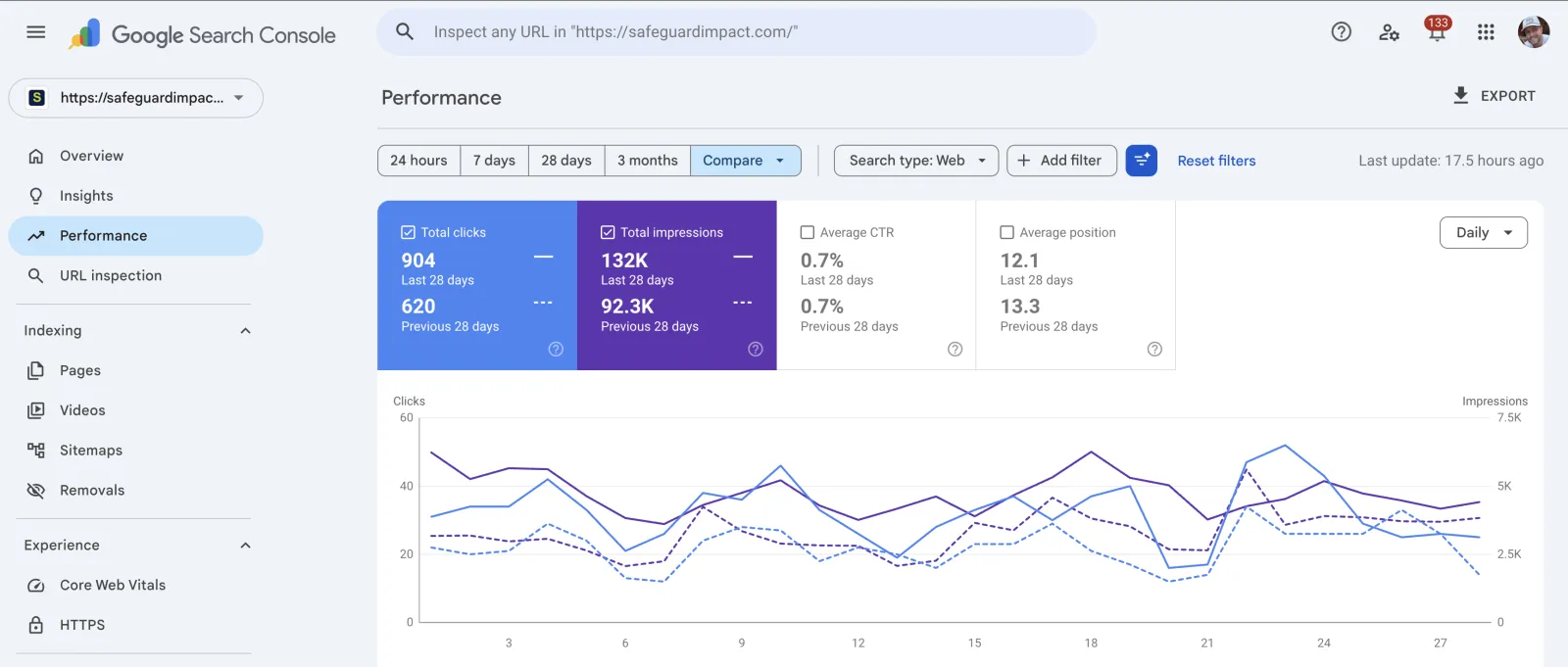
verifiedSafeguard Impact is a portfolio company we hold equity in. We fired their marketing agency and rebuilt the site on our own platform. First 28 days, organic search: clicks 620 → 904 (almost +300), impressions 92K → 132K, and average position climbed 13.3 → 12.1. Same business — better engine.
Validate their prior-agency burn. Don't attack — let the contrast do it.
"You mentioned [prior agency they worked with]. What you described — that's the model. The bigger the agency, the less of your money actually hits work that moves the needle."
"Three of us. We've built and sold businesses, we run a home-services operation that does ~$5M/yr, and we built the stack we use on you because nothing on the market does what we need it to do. Not a fit if you want a polished agency. Right fit if you want the work."
If they're not tech-fluent, just say "we built our own AI system that doesn't get flagged like everyone else's — here's the receipt" and move on. Don't explain stages.
"Let me show you where your money actually goes at most agencies — and where it goes with us."
The receipt
Not an opinion — math. Same dollar amount. Two completely different outcomes for where the money lands.
By the time your dollar reaches a backlink, a citation, or a page that ranks — there's almost nothing left.
Lower fees aren't charity — they're a math choice. We charge less so more of your dollar goes to the work.
"This is why most engagements fail — not because marketing doesn't work, but because by the time your budget gets to the actual ranking work, there's nothing left. Same $10K, completely different outcome."
"How can you afford to put 90% to the work?" → "Because we don't have layers. Three founders, built our own tools, no salespeople on commission, no project managers reading back what the writer said. Math, not magic."
The question
If every time you handed me $1, I handed you back $10 —
how many times would you do that?
This slide qualifies the prospect. Bad fits self-disqualify here.
"Do you see marketing as an expense, or a return?" — wait. Let them answer.
If they say "expense" → "Honest answer. Most operators do. That's exactly why most operators stay stuck."
If they say "return" → "Then you already think the right way. Let's quantify it."
"If every time you handed me a dollar I handed you back ten — how many times would you do that?"
Wait for the answer. It's always "as many as I could."
"Right. So the only question that matters is: what's the multiplier on YOUR business? Let me show you."
If they refuse to engage with the multiplier framing — "yeah but marketing's expensive" / "I just need leads" — they're a bad-fit prospect. Don't push to close. Note it, end politely, move on. They'll churn in 60 days and blame you.
The reveal
Using the numbers from discovery: enter values in the rep pane.
The funnel · tunable per call
Visitors → 10% → Appointments → 30% → Deals
Net visitor → deal: 3.0%. SEO $3K/mo buys ~750 visitors at scale. Paid $3K ad spend buys ~1,000 visitors at $3 CPC.
$3K ad spend + $2K mgmt · steady-state from month 2
Premium tier · 6–12 mo ramp · month-12 steady state
SEO + Paid stacked · steady state month 12+
5 to 50 SEO pages per month. Pages are marginal-tier priced: 1–10 = $100/pg, 11–20 = $80/pg, 21+ = $70/pg. We add +30% for backlinks & authority on top. That's your monthly package. Year 1 ramps; Year 2 plateaus at +5%; Year 3 holds at +10%.
All path math uses the same conversion funnel: 10% visitors book an appointment, 30% of appointments close as deals. SEO uses a 12-month J-curve ramp to steady state; Paid is steady from month 2; combined adds the two visitor streams. The SEO drill-down above assumes 30% of base spend goes to backlinks & authority (the part most agencies skip — and the reason their content never ranks). Numbers update live as you tune the inputs and the slider.
This slide stays locked until you press R. Don't reveal until the mindset shift on slide 5 has landed.
"OK — based on YOUR numbers, here's the math." (press R)
"Right now you're leaving $0 on the table every month. Not because marketing doesn't work — because you don't have the system to capture it yet. That's the gap."
"Three ways to close that gap. Each one fits a different situation. Let me show you which one I'd recommend based on what you told me."
Time horizon > budget → Path B (SEO).
Need leads in 30 days → Path A (Paid).
Aggressive + funded → Path C (Both).
The method
Most agencies write whatever topics they guess will rank. We don't guess. Every page gets scored against a model that finds the highest-ROI keywords for your business and your geography. That's why the math on the previous slide actually works.
Seed list comes from live Ahrefs scrapes of your niche's organic keyword universe — including the keywords your competitors rank for and the gaps they don't cover.
Result: pages that rank in months 6–12 instead of 18–24. And rank for queries that actually book jobs.
Seed list comes from your service catalog crossed with every city in your service radius — weighted by how much demand and dollars actually live there.
Result: city pages that capture the highest-dollar local searches first. Not uniform doorway pages.
Worked example · Charlotte HVAC
illustrative| Candidate keyword | Vol | KD | Score |
|---|---|---|---|
| ac repair charlotte | 1,800 | 14 | ★★★ |
| hvac maintenance plans | 900 | 22 | ★★ |
| how an air conditioner works | 4,500 | 38 | ★ |
"How an air conditioner works" has 2.5× the volume — and the lowest score. Volume alone never works.
"Most agencies pick topics by vibe. We pick them with a scoring model — and I'm going to show you how that works, because it's the entire reason the math on the last slide is real, not aspirational."
"The tool's the industry standard, yes. But the filter we layer on top is the part most agencies skip. We don't write 'how an AC works' for a Charlotte HVAC just because it has volume — it has zero conversion intent and is too competitive to rank for. The score-and-filter is the work."
"So that's how we pick the pages. Now — here's how we actually build each one."
The build
Once a keyword earns its spot, it runs the same repeatable pipeline — research it, reverse-engineer whoever's already winning, then build to a brief with your real facts. No blank page, no generic filler.
We take the winner from the scoring model — real volume, beatable difficulty, buying intent — as the page's target.
Volume, keyword difficulty, related terms, and the exact queries the top results already rank for — straight from Ahrefs, not a hunch.
We break down the page-one results — structure, subtopics, entities, depth — to see what they cover and where they're thin. That becomes the brief.
The page is built to outdo what's ranking — using your services, real facts, credentials, and geography — then enriched with FAQs, schema, and internal links.
Every page runs ~20 automated SEO & quality gates — headings, schema, E-E-A-T byline, image alts, internal links, no thin or doorway content — and must pass before publish.
We publish, ping the search engines instantly (IndexNow), and track rankings so the next round targets what's already moving.
Same pipeline on every page — which is how we build at volume without it reading like a content farm.
"You saw how we pick the pages. Here's how each one actually gets built — it's a pipeline, not a writer guessing at a blank page."
"The opposite. We reverse-engineer what's already winning, build to beat it with your real facts, then run every page through ~20 quality gates. AI does the drafting — the research, the filter, and the QA are the work. That's why these rank."
"Pages are half of it. The other half — the part most agencies won't tell you about — is the links."
The links
Most agencies barely mention link building — because there's little margin in it for them. So they sell you more content instead. But the truth is simple: better-written, technical pages backed by real backlinks and authority outrank a pile of thin content every time — and they hold those rankings as the site ages.
Content gets you eligible to rank. Authority is what actually moves you up — and keeps you there. That's why every plan can pair pages with a managed link campaign, run the right way:
Research, outreach, placement, indexation, and reporting — all handled. You don't chase anything.
A natural spread of sources and domains — not 100 links from the same footprint that Google discounts or flags.
Guest posts, niche edits, news links, and supporting PBNs — each does a different job. (PBNs point at the campaign's backlinks, never your site.)
A link Google never indexes passes zero authority. We push and verify indexation so every link you pay for actually counts.
Anchor-text and link-type ratios kept in safe, natural ranges so the profile reads organic — not over-optimized.
Every link is logged and tied to ranking movement, so you can see what each one actually bought.
Each month's links are mapped to the pages and keywords that need authority next — not scattered at random.
Smarter anchor categorization so the mix targets the right pages and keywords without tripping over-optimization.
"Here's something most agencies won't say out loud: there's no money in link building for them, so they sell you more content instead. But authority is what actually moves rankings — so we do the links right."
"Bad ones are. That's the whole point of managing it — diversified types, natural ratios, verified indexation, and tracking. PBNs only ever point at the backlinks, never your site. Done this way it's an asset, not a liability."
"So that's how we pick pages, build them, and back them with authority. Now let's pick the path that fits your situation."
The recommendation
Three legitimate paths. The right one depends on your time horizon, your cashflow, and how big you want to scale. All three work. We recommend the one that fits what you told us.
For who: need leads in 30 days, budget is the binding constraint, can't wait for SEO ramp.
Trade-off: the day you stop spending, leads stop.
When to recommend: they're cash-tight or need leads now.
For who: can think 6–12 months out, wants a business asset that compounds, ready to own the search layer instead of rent it.
Trade-off: longer ramp, but you eventually stop paying for every lead. The asset is yours.
When to recommend: default for most. Pick this if no urgent timing pressure and they want to own the asset.
For who: cashflow available, want to capture demand now AND own the asset later, aggressive growth shop.
Trade-off: highest investment, fastest market capture, hardest to copy.
When to recommend: they have capacity for 30+ leads/mo and can fund it.
"All three work. They're not better or worse — they're different bets on time and risk. Based on what you just told me, [Path X] is the one I'd run if it were my business."
Tap the path that matches what they told you in discovery. The slide will highlight it.
"I'm going to be straight with you. Path A is the right move if [reason from discovery]. Path B is the right move if [reason]. Path C is the right move if [reason]. Based on what you told me, here's what I'd do…"
We bring the receipts.
No long contracts. No discovery-phase billing. Month-to-month, 30-day cancellation. We do the work, the work shows up in the report, and you decide every month if it's worth continuing.
| Hosting | $250/mo |
| SEO content (25 pages) | $2,150/mo |
| Link building — | $0/mo |
| Domain — (registration + management) | $0.00/mo |
| + CRM (pipelines · workflows · lead notifications) | $297/mo |
| + Paid Ads management | $2,000/mo |
| Monthly total | $3,045/mo |
| Website setup — 3 services · 6 areas | $500 |
| Google Business Profile setup | $500 |
| NAP citations & cleanup | $600 |
| + CRM setup | $500 |
| + Paid Ads setup | $3,000 |
| Setup (one-time) | $0 |
| Day-1 (month 1 + setup) | $3,295 |
| Year 1 total commitment | $36,790 |
No payment collected here. You'll receive your contract by email and continue to a secure checkout next.
Receipts Group · We bring the receipts.
10569 Walnut Valley Dr · Boynton Beach, FL 33473 · (561) 287-8506
"OK — based on everything we just walked through, do you want to start with [recommended path]?"
Don't hedge. Don't soft-ask. Make the commitment specific and binary.
"Perfect. I'll send the agreement today, you sign by Friday, and we kick off Monday. Confirm the email address."
"Totally — but let me ask: what specifically are you thinking about? If it's a constraint I can solve, I'd rather solve it now than have you guessing for two weeks."
If they really won't commit: hit the follow-up button — they get a personalized link with their numbers baked in. Don't chase.
Generates a URL with their discovery inputs encoded — when they open it, they see THEIR numbers, not the demo defaults. Use this when they need a day, NOT when they're trying to ghost.