
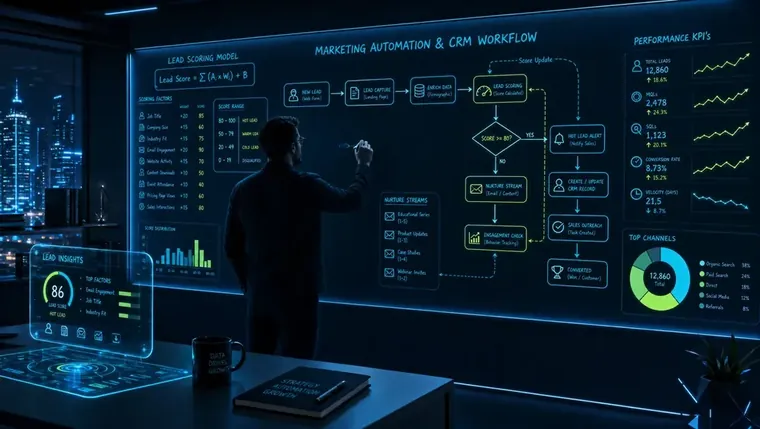
What a Marketing Automation Consultant Actually Does
63% of marketing automation implementations are considered underperforming within the first year — not because the platform failed, but because the underlying data and internal processes were never fixed before the tool went live. That's the stat most consultants won't put on their homepage. If you're weighing whether to bring in outside help, our marketing automation agency overview covers the full landscape of options. This post goes narrower: what a marketing automation consultant actually delivers, how engagements are structured, what they cost, and the red flags that separate good consultants from expensive ones.
Why Do Most Automation Engagements Fail?
Most automation engagements fail due to dirty CRM data and low internal adoption, not platform limitations.
Here's the contrarian view: the tool is almost never the problem. Whether you're running HubSpot CRM, Salesforce, Oracle Eloqua, or any of the platforms B Automated lists — including 6sense for ABM and ZoomInfo for enrichment — the failure mode is nearly always upstream. Contacts are duplicated. Lead stages are undefined or inconsistently applied. Sales and marketing have different definitions of a qualified lead. No one owns the system after the consultant leaves.
A competent marketing automation consultant should be asking hard questions about CRM data quality and internal adoption before a single workflow is built. If the first call is mostly about which platform they're certified on, that's a signal the engagement will optimize the wrong layer. Certifications in Salesforce Marketing Cloud, Pardot, HubSpot, and 14+ additional tools (a benchmark set by consultants like TheAutomationist, who claims 200+ projects) are table stakes — they do not substitute for a diagnostic process that starts with your data.
The consultants who consistently produce durable results are the ones who open with an audit: what does your contact database actually look like? What percentage of records are actionable? Where does the handoff between marketing and sales break down? Those answers determine the platform choice and workflow architecture — not the other way around.
Before signing any consulting agreement, ask: 'What do you do when you discover our CRM data is bad?' A consultant without a clear answer to that question is likely to build automations on top of broken inputs — and you'll spend months wondering why your open rates and conversion metrics aren't moving.
Consultant vs. Agency: What's the Real Difference?
A consultant typically embeds in your team and builds your internal capability; an agency owns execution on your behalf.
Buyers consistently conflate these two engagement models, and the confusion is expensive. A marketing automation consultant is generally a single practitioner or a small team that embeds in your existing operation. They diagnose, architect, and often implement — but the goal is to transfer knowledge and leave you self-sufficient. Think of it as hiring a staff augmentation expert with a defined exit.
A marketing automation agency is a different contract. Agencies like Flowium — a Klaviyo Elite Partner cited for working with 1,000+ global brands including True Classic and Dr. Squatch — own the execution indefinitely. You're buying an ongoing service, not a capability transfer. The right choice depends on whether you want to build internal expertise or outsource the function permanently.
For companies that have the headcount but lack the technical depth, a consultant is the faster path to self-sufficiency. For companies that want to stay lean and have marketing automation run as a managed service, an agency model makes more sense. Neither is universally better — the decision hinges on your org structure and 18-month roadmap, not on which option costs less in month one.
If you're also evaluating outbound infrastructure, our predictive dialer setup guide covers how automation layers connect to calling workflows, including Twilio Voice Programmable and compliance considerations under TCPA guidelines (FCC).
How to Vet a Marketing Automation Consultant
Vet consultants by testing their diagnostic process, not their platform certification list.
- Ask for a data audit methodology Any consultant worth hiring should have a defined process for assessing CRM data quality before building anything. If they can't describe it clearly, they'll build on a broken foundation.
- Request a phased project plan Week-by-week deliverables matter. Vague promises about 'setting up your automation stack' with no milestone structure are a red flag — you should see a discovery phase, a build phase, and a handoff phase at minimum.
- Probe their failure stories Ask directly: 'Tell me about an engagement that didn't go well and what you did about it.' Consultants who can't answer this haven't reflected on failure — or won't be honest about it.
- Verify integration depth, not just platform names A consultant who lists HubSpot, Salesforce, and Zapier on their site may only know surface-level setup. Ask which Zapier integrations they've built in production and what broke. Real experience shows in edge cases.
- Confirm post-engagement documentation If the consultant leaves with no written workflow documentation, you're locked into hiring them again. Deliverables should include annotated workflow maps, naming conventions, and a runbook your team can maintain.

What Does a Marketing Automation Consultant Cost?
Expect $150–$300/hr for hourly work, $5,000–$20,000 for fixed projects, and $3,000–$10,000/month for retainers.
Pricing transparency is almost entirely absent from consultant websites, which forces buyers into discovery calls blind. Here's a realistic anchor based on current market rates:
Hourly engagements typically run $150–$300/hour for a mid-to-senior independent consultant. This model works well for scoped audits or single-platform troubleshooting, but costs can escalate fast if scope isn't defined in writing.
Fixed-fee project engagements are the most common structure for initial implementations. A full CRM build with lead scoring, multi-stage nurture sequences, and sales handoff workflows typically ranges from $5,000 on the low end (simple stack, one platform) to $20,000+ for multi-platform environments integrating tools like Salesforce, Eloqua, and a CDP layer. Firms citing 200+ completed projects — a benchmark from TheAutomationist — suggest this is a mature, volume-capable market where pricing is increasingly competitive.
Retainer agreements ($3,000–$10,000/month) make sense when you need ongoing optimization, A/B test analysis, and platform management rather than a one-time build. If the engagement is open-ended with no defined outcome, push back and request quarterly milestone reviews baked into the contract.
One pricing red flag: consultants who charge a flat fee with no discovery phase. Without a diagnostic period, they're pricing based on assumptions about your stack — and you'll typically hit scope changes by week three.
Retainer vs. Project-Based Consulting: Which Fits You?
Choose project-based for a defined build; choose a retainer if you need ongoing optimization and no internal team to hand off to.
| Feature | Project-Based | Retainer |
|---|---|---|
| Best for | First-time implementation or platform migration | Ongoing optimization, testing, and platform management |
| Typical cost | $5,000–$20,000 fixed fee | $3,000–$10,000/month |
| Deliverables | Defined scope: workflows, documentation, handoff | Ongoing: reports, A/B tests, database hygiene, new sequences |
| Risk | Scope creep if discovery is skipped | Dependency risk if no internal capability is built |
| Exit outcome | You own and operate the system after handoff | System runs but team may lack deep operational knowledge |
A consultant who leaves no documentation forces you to rehire — build handoff deliverables into the contract before work starts.
The most expensive consulting engagement is the one you repeat. If your contract doesn't explicitly list workflow documentation, a naming convention guide, and a post-launch runbook as deliverables, add them before you sign. A good marketing automation consultant should make themselves replaceable — that's the whole point.
Frequently Asked Questions
How much does a marketing automation consultant typically charge in 2025?
Rates vary by engagement model. Independent consultants typically charge $150–$300/hour for hourly work. Fixed-fee projects for a full CRM and automation build range from $5,000 to $20,000+ depending on stack complexity. Monthly retainers generally run $3,000–$10,000. Always ask for a discovery phase to be scoped separately — consultants who price without it are guessing at scope.
What's the difference between a consultant and an agency?
A marketing automation consultant typically embeds in your team, builds your internal capability, and hands off a documented system. A marketing automation agency owns execution on an ongoing basis — you're buying a managed service, not a capability transfer. The right choice depends on whether you want to build internal expertise or keep the function outsourced long-term.
What questions should I ask before hiring a marketing automation consultant?
Ask how they handle CRM data quality issues before building, whether they provide a phased project plan with milestones, what their post-engagement documentation includes, and if they can describe an engagement that failed and what they did about it. Consultants who can't answer these clearly tend to deliver fragile implementations that require ongoing support.
Why do marketing automation consulting engagements fail so often?
The most common failure causes are dirty CRM data, undefined lead stages, and lack of internal adoption — none of which are platform problems. Consultants who start with tool configuration before running a data and process audit are building on a broken foundation. The engagement fails when the automations run but produce no measurable pipeline impact because the inputs were never reliable.
Related reading
Ready to Build Automation Infrastructure That Lasts?
If you've read this far, you're past the 'should I hire a consultant?' question and into the 'how do I not waste this budget?' territory. That's the right place to be. Receipts Group works with growth-stage B2B companies to design and implement automation systems built on clean data and documented processes — not credential walls and vague efficiency claims. Explore our full marketing automation agency approach, or book a diagnostic call to get a straight answer on whether your stack needs a consultant, an agency, or something else entirely.