
What a Dental PPC Agency Actually Can't Fix for You
Hiring a dental PPC agency before your practice can convert inbound calls is the fastest way to burn through ad budget with nothing to show for it. Most practices lose 50–70% of the patients they've already paid to attract — not in the auction, but on hold with the front desk. If you're evaluating paid acquisition and want the full picture of where dental PPC fits inside a broader channel strategy, start with our Google Ads agency pillar before reading on.
The dental PPC industry has spent years selling specialization as its primary value prop. What it hasn't sold — and what no agency will tell you upfront — is that front-desk call conversion rates at dental practices typically sit between 30% and 50%. That means for every $100 you spend driving a call, you're functionally throwing away $50 to $70 before the agency's keyword strategy even matters. This post covers what to fix before you scale spend, how CPL targets should actually vary by service line, and the questions you must ask any agency before signing a contract.
Why does front-desk readiness matter more than ad targeting?
Front-desk call conversion rates of 30–50% mean wasted PPC spend is usually an operations problem, not an ads problem.
A well-run Smart Bidding campaign can get your implant ad in front of someone actively searching for 'full arch restoration near me.' What it cannot do is make your front-desk coordinator ask the right qualifying questions, offer a same-day consult slot, or handle objections on pricing. Those gaps are operational, and they sit entirely outside a dental PPC agency's scope of work.
Before any agency touches your account, audit three things: average call answer rate (industry standard is under 3 rings), conversion rate from call to booked appointment (benchmark for healthy practices is 65–75%), and booking software integration with your ad tracking. If callers are reaching voicemail, if staff aren't trained to book on the first call, or if your CRM isn't logging which ad drove the call, you have no feedback loop. Every optimization the agency attempts is flying blind.
The fix isn't complicated. It's call-handling scripts, blocked appointment slots reserved for PPC inquiries, and a clear intake workflow before the campaign goes live. Practices that complete this setup first see dramatically different outcomes — not because the ads got smarter, but because the revenue per lead stopped leaking out the back end.
Not sure if your practice is ready to scale paid acquisition? We run a no-obligation PPC readiness call to identify conversion leaks before you commit to ad spend. Book a call now — takes 20 minutes.
How should CPL targets differ by dental service line?
CPL benchmarks vary widely by service — hygiene recalls warrant under $40, while full-arch restorations can justify $150+ per lead given patient lifetime value.
- Hygiene & Recall ($15–$40 CPL) New hygiene patients carry lower immediate revenue but anchor long-term patient lifetime value through repeat visits, referrals, and upsell into restorative work. CPL targets should be tight — if you're paying $80 for a cleaning inquiry, something is broken in your keyword match types.
- General Restorative ($40–$80 CPL) Crowns, fillings, and basic restorative work sit in the mid-tier. DentistVox benchmarks general dentistry CPL at $25–$45 in competitive markets. Anything above $80 warrants a campaign audit, starting with your negative keyword list.
- Cosmetic & Invisalign ($60–$120 CPL) CPC rates for cosmetic dentistry and orthodontics exceed $15–$40 per click in major urban markets, per MarketingLTB's 2026 benchmark data. A well-structured cosmetic campaign with dedicated landing pages and Enhanced Conversions tracking can still deliver strong ROI at this CPL.
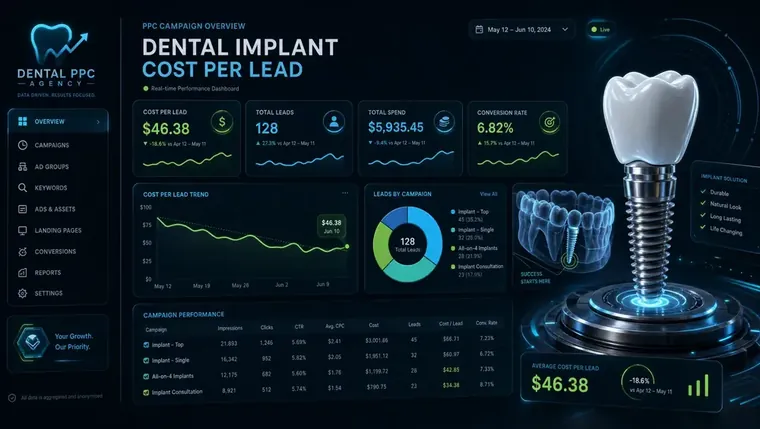
- Dental Implants & Full Arch ($100–$200+ CPL) Implant campaigns are the highest-risk, highest-reward segment. DentistVox cites $60–$150+ CPL as the benchmark range, and implant CPCs routinely exceed $30–$50 per click. Sagapixel-managed implant campaigns have documented 30–50% CPL reductions within the first 90 days — but only after eliminating broad match on 'dentist' and tightening to implant-specific intent keywords.
What red flags should you look for when vetting a dental PPC agency?
Demand granular CPL data by service line, HIPAA-compliant call tracking disclosure, and a clear negative keyword strategy before signing anything.
The dental PPC space has no shortage of agencies claiming deep vertical expertise, but very few can produce auditable proof. When you evaluate any dental PPC agency — including us — insist on the following before a contract is signed.
Ask for a live account walkthrough, not a case study PDF. A 169-lead-in-60-days result (DentistVox's most-cited benchmark) is impressive, but you need to see *how* it was structured: what match types were used, what the search term report looked like, what the negative keyword list contained, and how call conversions were attributed. Agencies that can't walk through a live account are agencies running templated campaigns.
Demand HIPAA-compliant call tracking disclosure. Call tracking is standard in dental PPC — it's how the agency closes the loop between an ad click and a booked appointment. But call recordings that include patient health information are subject to HIPAA. Any agency that can't name their call tracking provider or hasn't addressed BAA (Business Associate Agreement) requirements is a liability, not a partner. Local Service Ads run through Google come with their own lead verification layer, but standard search campaigns do not.
Watch for broad match abuse on high-CPC keywords. The fastest way a dental PPC agency bleeds your budget is by running broad match on terms like 'dentist,' 'teeth,' or 'dental.' In a market where implant clicks cost $30–$50, a broad match campaign will funnel significant spend toward queries like 'dental schools near me' or 'why do my teeth hurt' — neither of which converts to a $4,000 implant case. Ask to see the search terms report from a comparable client's first 30 days, and count the irrelevant impressions. That number tells you more than any pitch deck.
For a broader framework on what separates commodity PPC management from genuinely accountable campaign strategy, our Facebook Ads Agency piece covers the same vetting logic applied to social acquisition — worth reading if you're considering a multi-channel approach.
What compliance constraints affect dental PPC campaigns specifically?
Before/after imagery, unsubstantiated outcome claims, and HIPAA call tracking gaps are the three most common dental PPC compliance failure points.
Dental advertising carries a compliance surface that most generic PPC agencies underestimate and that even some specialist dental PPC agencies handle carelessly. Three areas matter most.
Before/after imagery in Google Ads. Google's Healthcare and Medicines policy restricts before/after images in ad creatives for cosmetic procedures. Dental practices running smile makeover or implant campaigns that include transformation imagery in responsive display ads frequently trigger disapprovals — and some agencies don't flag this until the campaign is already paused. Build compliant creative assets from day one: patient testimonials (with written consent), outcome-focused copy without transformation imagery, and landing pages that match the ad's implied promise.
Claims that trigger ad disapprovals. Superlatives like '#1 dental implant provider in [city]' or 'best dentist' require substantiation under Google's policy. Unqualified claims about pain-free procedures, guaranteed results, or 'permanent' solutions will get creative rejected. A competent dental PPC agency should have a pre-submission compliance checklist — ask to see it.
Enhanced Conversions and HIPAA. Enhanced Conversions passes hashed first-party data (email, phone) back to Google to improve conversion modeling. This is valuable for campaign optimization — but if that data includes any patient health information, you're in HIPAA territory. The correct approach is to capture conversion signals at the booking-intent stage (form submissions, call initiated) *before* health information is exchanged, not after. Google Search Central documentation covers structured data and tracking implementation standards that agencies should be following as baseline hygiene.
Full-funnel dental PPC vs. ads-only management: what's the difference?
Full-funnel management covers pre-call operations and conversion tracking; ads-only stops at the click, leaving 50%+ of ROI on the table.
| Feature | Ads-Only Agency | Full-Funnel Agency (Receipts Group) |
|---|---|---|
| Scope | Campaign setup, bid management, ad copy | Pre-launch ops audit + campaign + conversion tracking |
| Call Tracking | Basic call extension reporting | HIPAA-aware attribution with BAA documentation |
| CPL Targeting | Single blended CPL across all service lines | CPL targets segmented by service line and patient LTV |
| Compliance Review | Reactive (fixes disapprovals after they happen) | Proactive pre-submission compliance checklist |
| Reporting | Click and impression data | Booked appointments attributed to campaign, ad group, keyword |
Frequently Asked Questions
How much should a dental practice spend monthly on PPC?
Most dental practices in mid-to-large markets spend between $2,000 and $8,000 per month on paid search, depending on service mix and competitive density. Implant-focused campaigns in metro markets often require the upper end of that range to generate meaningful volume, given CPC rates of $30–$50 per click for high-intent implant keywords. Practices new to PPC should start at the lower end while call-handling and conversion infrastructure is being validated.
What questions should I ask a dental PPC agency before hiring them?
Ask to see a live account walkthrough for a comparable client (not a PDF case study), request their negative keyword strategy for high-CPC service lines like implants, ask how they handle HIPAA compliance for call tracking, and find out whether CPL targets are segmented by service line or blended. Any agency that can't answer all four in specific, auditable terms is a risk.
Why do dental implant PPC campaigns often waste budget without producing cases?
The most common culprits are broad match keyword settings on terms like 'dentist' or 'teeth,' which funnel clicks from low-intent queries at the same $30–$50 CPC as high-intent implant searches. The second major cause is poor front-desk conversion — a practice paying $120 per implant lead but converting only 30% of those calls to consultations is effectively paying $400 per consultation, which breaks the economics of most implant funnels.
Are there HIPAA considerations for dental PPC call tracking?
Yes. Call tracking platforms that record calls containing patient health information require a signed Business Associate Agreement (BAA) with the call tracking vendor. Practices should also ensure that Enhanced Conversions data passed back to Google is captured at the booking-intent stage — before any health information is exchanged — to avoid transmitting PHI to third-party ad platforms.
How long does it take for a dental PPC agency to deliver results?
Initial lead volume typically appears within the first two to four weeks of a campaign going live. However, meaningful cost-per-lead optimization — particularly for implant and cosmetic campaigns — generally requires 60 to 90 days of search term data, negative keyword refinement, and landing page testing. Sagapixel has documented 30–50% CPL reductions within the first 90 days of active management for implant campaigns, which aligns with our own client experience.
Related reading
Ready to scale dental PPC without wasting the budget?
Most dental practices don't have an ads problem — they have a conversion infrastructure problem that ads spending makes worse. We audit the full funnel before a single keyword bid is placed. Whether you need a Google Ads agency managing the whole acquisition engine or a focused dental PPC engagement, Receipts Group builds campaigns against booked appointments, not vanity metrics. Talk to us about your practice →