
What an Ecommerce PPC Agency Should Actually Do for You
If you've searched ecommerce ppc agency in 2026, the SERP is a wall of generic landing pages — none of which define what the discipline actually entails, let alone help you separate a sharp operator from a shop that'll burn your budget on vanity metrics. This post is the canonical answer. It covers what competent ecommerce PPC management looks like, how to vet any agency you're considering, and why margin-aware reporting is the only reporting that matters. If you're simultaneously evaluating broader paid-search partners, our Google Ads Agency guide covers the full account-structure landscape — read this piece first for the ecommerce-specific lens.
Why ROAS Alone Is a Misleading KPI for Ecommerce PPC
ROAS without margin context is a vanity number — a 6:1 ROAS on a 12% margin product can lose money while a 2.5:1 ROAS on a 60% margin product prints profit.
Industry benchmarks put average Google Ads ROAS for ecommerce between 4:1 and 8:1 — and virtually every agency in this space leads with that range as the goalpost. The problem is that ROAS is a revenue ratio, not a profit ratio. A 6:1 ROAS on a product with a 12% gross margin likely means you're losing money once you account for COGS, fulfilment, and returns. Meanwhile a 2.5:1 ROAS on a 60% margin product can be the most profitable campaign in your stack.
That's the contrarian position Receipts Group holds publicly: we refuse to report ROAS without attaching contribution margin to it. This isn't a philosophical stance — it's arithmetic. An ecommerce PPC agency that doesn't ask for your margin structure in the first discovery call is structurally incapable of optimising toward profit. Ask any agency you're vetting whether they build margin-adjusted ROAS targets into campaign goals. If they look confused, leave.
Smart Bidding target-ROAS inputs are only as intelligent as the profit signal you feed them. Pair that with Enhanced Conversions for more complete purchase data, and you shift the optimisation loop from chasing revenue to chasing margin — which is a fundamentally different (and far more valuable) problem to solve.
Before any ecommerce PPC agency sets a bid strategy or ROAS target, they need your blended gross margin by product category — not your average order value, not your lifetime value estimate. Margin by SKU group is the single number that converts ROAS from a feel-good metric into a decision-making tool.
How to Vet an Ecommerce PPC Agency: Questions That Expose Competence
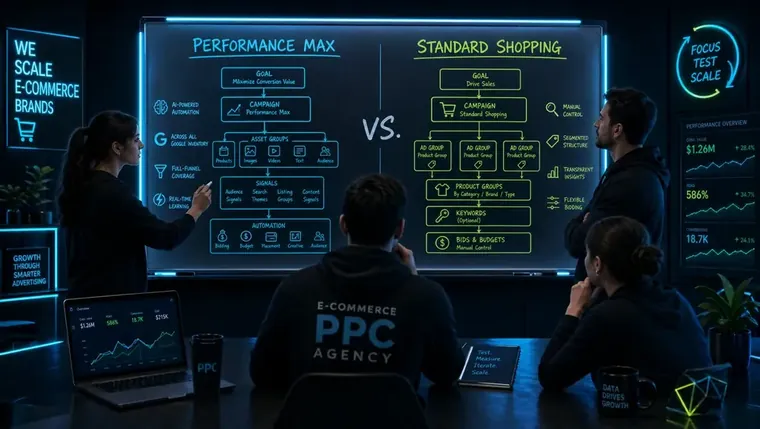
Ask about their feed audit process, how they set margin-adjusted ROAS targets, and how they decide between Performance Max and Standard Shopping — vague answers are red flags.
No page ranking for this keyword today gives you a practical framework for evaluating ecommerce PPC agencies. Here's one built from first principles, not sales copy.
Questions to ask in the first call:
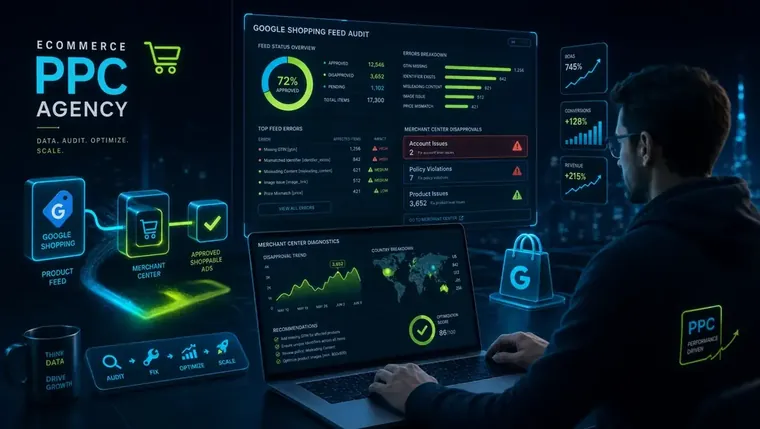
- *What's your process for a Merchant Center feed audit before launch?* A competent agency will describe a systematic review of title optimisation, custom labels, GTIN coverage, and disapproval categories. WordStream research cited by OuterBox suggests roughly 1 in 3 ecommerce paid clicks goes to Shopping ads — which means feed quality directly controls a third or more of your paid traffic volume. An agency that skips a feed audit is skipping the foundation. - *How do you decide between Performance Max and Standard Shopping?* PMax cost share among ecommerce advertisers peaked near 82% by mid-2024, making it the dominant campaign type on Google Ads. But dominance doesn't mean universally correct. A good agency should articulate a decision framework — not just default to PMax because it's the path of least resistance. - *What attribution model do you use, and why?* Last-click attribution systematically undercounts upper-funnel paid channels. If the agency defaults to last-click without discussion, they're likely over-crediting one campaign and starving budget from others that are actually driving pipeline. - *How do you structure campaigns for Q4 and category-specific demand spikes?* Seasonality strategy — pre-loading inventory signals, adjusting bid modifiers ahead of Black Friday, managing budget pacing across Cyber Monday — is where agency experience shows up in actual account performance. Vague answers here are a red flag.
For context on what a broader paid-media partner looks like beyond search, see our Facebook Ads Agency page — social and search PPC require different feed logic but share the same margin-first philosophy.
Red Flags That Signal an Underqualified Ecommerce PPC Agency
Watch for agencies that skip feed audits, report only top-line ROAS, and can't explain when to use Performance Max vs. Standard Shopping.
- No feed audit at onboarding A disapproved product in Merchant Center doesn't just lose that SKU's impressions — it can suppress an entire product group. Agencies that skip this step are flying blind from day one.
- ROAS reported without margin context If every reporting slide shows ROAS but never contribution margin, the agency is optimising for a metric that can look great while your P&L bleeds.
- PMax as the default answer for everything Performance Max is powerful but it's not a universal solution. Agencies that can't articulate when Standard Shopping outperforms PMax — such as for high-SKU catalogues with strong historical data — are following Google's defaults, not managing your account.
- No attribution model conversation Defaulting to last-click in a multi-channel ecommerce stack will misallocate budget. Any credible agency should surface this in week one.
- Vague seasonality planning Q4 ecommerce PPC isn't just raising bids in November. Budget pacing, audience layering, and promotional feed updates need to start in September. If the agency hasn't asked about your promotional calendar, they'll be reactive when it matters most.
Budget Level vs. Agency Tier: Which Type of Ecommerce PPC Agency Fits?
A $5K/month ad budget and a $500K/month budget need fundamentally different agency tiers — the same pitch should not apply to both.
One of the most glaring gaps across every page ranking for this keyword: no one addresses the relationship between monthly ad spend and the type of agency that actually makes sense at that level. A $5,000/month ecommerce PPC budget and a $500,000/month budget should not be reading the same pitch — but they are.
Here's a rough tiering framework based on spend level:
Under $10K/month in ad spend: At this level, you need a lean operator — likely a boutique agency or senior freelancer who can hand-manage accounts without burning your budget on account management overhead. Sophisticated bid automation like value-based bidding requires substantial conversion data volume to function correctly, so expect more manual control at this stage. The bidding strategy framework that OuterBox cites is instructive: manual CPC for new launches, target ROAS once you have 30+ conversions per month in a campaign, and value-based bidding when data volume truly supports it.
$10K–$100K/month: This is the range where a dedicated ecommerce PPC agency earns its fee. You have enough data for Smart Bidding to work, enough SKU volume to justify rigorous feed management, and enough creative capacity to test ad copy and product imagery systematically. Look for agencies that use Google Ads Editor for bulk campaign operations and have a documented Merchant Center QA process.
$100K+/month: At this spend level, you should expect full attribution modelling (not just last-click), contribution margin reporting built into every dashboard, and a named strategist — not an account manager reading from a shared template. Results at this level are real: 1Digital reported a +495.32% paid-traffic revenue lift for a $13M/year automotive merchant over a three-year PPC engagement, and a +131.3% annual revenue lift for a fashion apparel brand with 92% of new revenue attributed to agency-created initiatives. Those numbers only happen when the agency is operating with full margin and attribution context.
For anyone who wants to understand the platform mechanics your ecommerce PPC agency is working within, Google Search Central is the authoritative source on how Google indexes and surfaces product data — relevant context for any brand investing heavily in Shopping and feed-driven PPC.
Frequently Asked Questions
How does an ecommerce PPC agency differ from a general one?
An ecommerce PPC agency specialises in feed-driven campaign formats — Google Shopping, Performance Max, and Dynamic Search Ads built around product catalogues. Unlike general PPC agencies, they manage Merchant Center health, product feed optimisation, and SKU-level bid logic. The key differentiator is that ecommerce PPC performance lives or dies on data quality at the feed level, not just ad copy — a capability that requires dedicated ecommerce platform expertise most general agencies don't have.
How much should I budget before hiring an ecommerce PPC agency in 2026?
As a rule of thumb, you need at least $5,000/month in ad spend before an ecommerce PPC agency's management fee becomes cost-efficient relative to DIY. Below that threshold, a senior freelancer or self-managed account is usually the better return. At $10,000+/month, you have enough conversion data for Smart Bidding to function properly, which is where agency-level account structure and feed management starts to pay for itself materially.
What Merchant Center errors hurt ecommerce PPC performance?
The most damaging Merchant Center errors are missing or incorrect GTINs (which limit Shopping eligibility and quality scores), price mismatches between the feed and the landing page (which trigger immediate disapprovals), and missing required attributes for specific product categories like apparel or electronics. A single disapproved product can suppress an entire ad group's impressions. Any credible ecommerce PPC agency should run a full Merchant Center audit before touching bid strategy.
Should ecommerce brands use Performance Max or Standard Shopping campaigns?
Performance Max is the right default for most ecommerce brands with mature conversion data — it dominated roughly 82% of ecommerce Google Ads spend by mid-2024. But Standard Shopping can outperform PMax for high-SKU catalogues where you need granular bid control by product group, or in categories where PMax's automated asset generation produces off-brand creative. The honest answer is both campaign types have a place, and the decision should follow account data — not platform defaults or agency convenience.
Related reading
Ready to See What Margin-First PPC Actually Looks Like?
Most ecommerce PPC agencies will show you a ROAS number and call it a win. Receipts Group builds every account around contribution margin — because that's the only metric that connects paid spend to actual profit. Start with our Google Ads Agency overview to see the full account philosophy, then book a discovery call to get a margin-adjusted audit of your current campaigns. No generic deck. No vague benchmarks. Just the math.