
Enterprise Marketing Automation: What It Actually Costs in 2026
If you've searched *enterprise marketing automation* in 2026, the SERP is a wall of generic agency landing pages without an actual definition — just feature checklists, tier charts, and logo grids. What's missing is the number that actually matters: what this decision costs in year one, all-in, before a single lead enters your funnel. This post is the canonical answer to that question. It's built on real published pricing, real implementation realities, and the organizational risks that every platform comparison page quietly skips. If you're evaluating whether to build or buy, start with our marketing automation agency overview for the strategic framing — then come back here for the financial anatomy.
Why Is Enterprise Marketing Automation So Expensive in Year One?
Enterprise marketing automation year-one costs routinely exceed $300K once licenses, mandatory onboarding, consultant fees, and personnel are aggregated.
The conventional framing treats enterprise marketing automation as a software subscription decision. It isn't. It's a capital commitment — and the gap between the advertised monthly fee and the actual first-year spend is where most procurement disasters live.
Take the numbers that are actually published. HubSpot Marketing Hub Professional runs $890/mo for 2,000 contacts, but carries a mandatory $3,000 onboarding fee and requires an annual contract — putting true year-one cost at $13,680 minimum, before any implementation work touches your CRM, data model, or existing toolchain. Marketo's Select and Prime tiers land between $1,700–$3,000+/mo with pricing unpublished and gated behind a sales conversation. Salesforce Marketing Cloud starts at approximately $1,250–$1,500/mo and scales to six figures annually, with an explicitly documented 6–12 month implementation expectation.
Here's what those numbers look like when you aggregate them honestly: a Salesforce Marketing Cloud license at $1,500/mo is $18,000/yr in software alone. Add a Marketo-certified consultant or Salesforce-credentialed implementation partner — often billed at $150–$200/hr for 500–800 hours — and you're at $75K–$160K in professional services before counting internal headcount, data migration, or the three months your ops team spends in meetings instead of running campaigns. A $300K+ year-one bet is the norm, not the exception. Calling it a 'learning curve' without that number attached is a disservice to every CFO who has to sign off on the PO.
What Is the 'Feature Utilization Trap' and How Do You Avoid It?
Most enterprise teams use roughly 20% of their platform's features — auditing actual usage needs before signing prevents paying for capability you'll never deploy.
The dirty open secret of enterprise marketing automation is that most teams use about 20% of the features they're paying for. This isn't a skills problem — it's a scoping problem. Platforms are sold on maximum capability; teams are staffed and structured for minimum viable execution. The result is a six-figure annual spend on functionality that never gets switched on.
The fix isn't a better platform — it's a pre-purchase usage audit. Before any vendor conversation, map your current automation workflows: how many active sequences are running, which triggers fire reliably, and where manual handoffs still exist. Then cross-reference that against the feature set you're being sold. If your team isn't using conditional branching today, you won't use AI-driven send-time optimization tomorrow. Salesforce Einstein AI is genuinely impressive for predictive lead scoring and engagement frequency optimization — but only if your org is already deeply embedded in Salesforce CRM and has the data volume to train the models. For most teams landing on Salesforce Marketing Cloud, Einstein is a future-state feature bought at present-state pricing.
For teams that need 80% of the automation capability at a fraction of the cost, ActiveCampaign's Plus plan at $49/mo includes a functional CRM and 900+ pre-built automation recipes. That's not a consolation prize — that's a deliberate right-sizing decision. Pairing it with a purpose-built dialer stack (see our predictive dialer setup guide) and a clean data layer often outperforms a bloated enterprise platform for teams under 50 seats. The Zapier integration directory alone can bridge the workflow gaps without a six-figure middleware engagement.
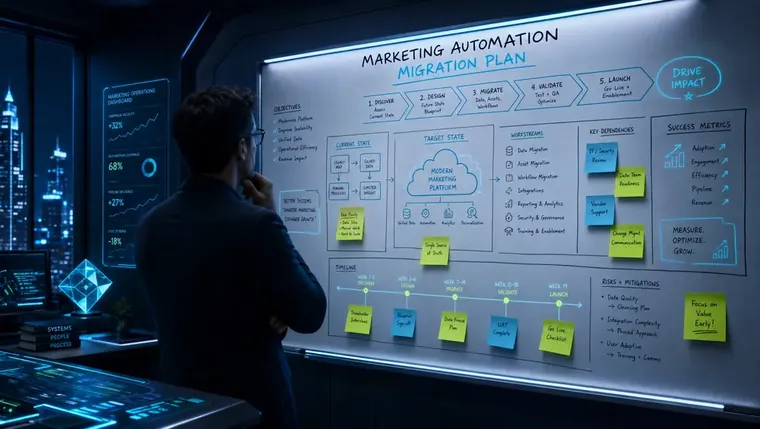
When an enterprise is mid-migration between platforms — say, moving off Marketo onto HubSpot, or consolidating a legacy ESP into Salesforce Marketing Cloud — the operational exposure is significant. Contact records split across systems. Attribution models break. Suppression lists fall out of sync. Parallel-system periods routinely last 3–6 months, and every week of overlap is a week of compounding data debt. Plan the cutover as aggressively as your compliance team allows — and audit your HubSpot CRM data model before you import a single contact into the new environment.
- GDPR & CCPA Data Residency Confirm whether the platform offers EU data residency options and supports right-to-erasure workflows natively. Many platforms bolt this on as a paid add-on rather than a default configuration.
- TCPA Compliance for Outbound Any enterprise stack involving SMS or outbound calling must map to FCC TCPA requirements — including consent capture, opt-out processing, and call-time restrictions. This is a legal review item, not a marketing ops item.
- SOC 2 Type II Certification Enterprise InfoSec teams will require SOC 2 Type II audit reports before any platform touches customer PII. Confirm availability of reports and the audit cadence before procurement.
- Vendor Lock-In and Data Portability Deeply embedding Salesforce Marketing Cloud creates near-irreversible switching costs — custom data extensions, Journey Builder logic, and Einstein configurations don't export cleanly. Evaluate data portability SLAs and export formats before signing a multi-year contract.
- Telephony Compliance Stack If your automation includes voice workflows, ensure the telephony layer — whether Twilio Voice or a CCaaS platform like Five9 — has auditable call recording consent and DNC list integration built into the platform, not patched in via Zapier.
Right-Sized vs. Over-Scoped: Two Enterprise Automation Approaches
A right-sized enterprise automation stack matched to actual ops capacity almost always outperforms an over-scoped platform purchase during the first 18 months.
| Feature | Right-Sized Stack | Over-Scoped Platform |
|---|---|---|
| Year-One License Cost | $10K–$30K (e.g., HubSpot Pro + ActiveCampaign) | $50K–$180K+ (Salesforce MC / Marketo Prime) |
| Implementation Timeline | 4–8 weeks to first live workflow | 6–12 months to full deployment |
| Consultant Requirement | Optional; most teams self-serve with onboarding | Mandatory; certified admin or partner engagement |
| Feature Utilization at 6 Months | 60–80% of purchased features active | 15–25% of purchased features active |
| Data Portability Risk | Low; standard export formats | High; proprietary data extensions, locked migration path |
| Compliance Coverage | Requires third-party integrations for full coverage | Native SOC 2 + GDPR tooling, but complex to configure |
Before you commit to a six-figure platform, book a scoping call with the Receipts Group team. We'll map your current ops maturity, estimate true year-one TCO for your shortlist, and tell you honestly whether you need an enterprise platform or a better-configured mid-market stack. Book a call →
How Do You Build an Internal Business Case for a $1,500+/mo Platform?
A credible CFO-ready business case for enterprise marketing automation anchors on pipeline attribution, not feature lists — tie every cost line to a revenue outcome.
The organizational and political process of enterprise software procurement is almost entirely absent from platform comparison content — and it's where deals die. A CFO or CTO signing off on a $300K+ year-one commitment needs a business case anchored in pipeline outcomes, not feature bullet points.
Start with attribution data from your current stack. What is your current cost per marketing-qualified lead? What percentage of MQLs convert to pipeline, and at what average deal size? From those numbers, reverse-engineer the automation ROI: if the new platform improves MQL-to-pipeline conversion by 15%, what does that mean in closed revenue at your current sales velocity? Make the case in dollars, not in workflow nodes.
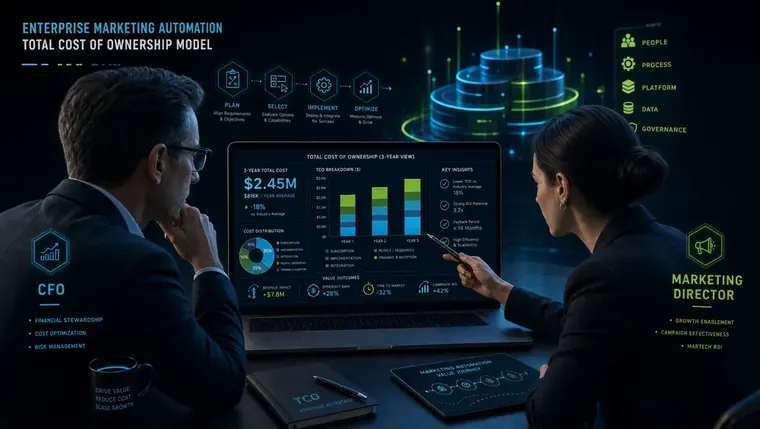
Second, build the TCO model explicitly. Line-item the license, the mandatory onboarding (HubSpot's $3,000 is non-negotiable regardless of what your AE implies), the consultant engagement, the internal ops time at fully-loaded salary cost, and the parallel-system overlap period. Present this as a 24-month model, not a monthly rate. The delta between 'what sales quoted' and 'what year one actually costs' is the single biggest source of stakeholder trust erosion in enterprise automation projects — and it's entirely preventable with honest upfront modeling.
For related context on the data layer that underpins any automation investment, see our deep-dive on CRM implementation services — because no automation platform performs against bad contact data, regardless of the tier.
Frequently Asked Questions
What does enterprise marketing automation actually cost in year one in 2026?
Year-one costs for enterprise marketing automation routinely exceed $200K–$300K when you aggregate license fees, mandatory onboarding (e.g., HubSpot's non-negotiable $3,000 Professional onboarding), implementation consultant engagements ($75K–$160K for Salesforce or Marketo), and internal ops time at fully-loaded salary. The published monthly fee is the smallest line item in the real budget.
Is HubSpot actually a mid-market ceiling, or can it handle enterprise needs?
HubSpot Marketing Hub Professional at $890/mo handles the automation requirements of most companies up to a few hundred employees — including complex multi-step workflows, lead scoring, and CRM sync. For organizations with very high contact volumes, complex multi-brand structures, or enterprise data governance requirements, Marketo or Salesforce Marketing Cloud may be warranted. But 'enterprise need' should be defined by ops complexity and compliance requirements, not headcount.
How do you avoid vendor lock-in with enterprise marketing automation platforms?
Before signing any multi-year enterprise contract, audit the platform's data export capabilities: can you export all contact records, custom fields, automation logic, and engagement history in standard formats? Salesforce Marketing Cloud's proprietary data extensions and Journey Builder configurations create near-irreversible switching costs. Negotiate data portability SLAs and export format requirements into the contract before signing.
What compliance certifications should enterprise automation platforms have?
Enterprise buyers should require SOC 2 Type II certification (with current audit reports available), documented GDPR data residency options, native CCPA opt-out workflow support, and — if the stack includes outbound calling or SMS — auditable TCPA compliance tooling with DNC list integration. These are legal review requirements, not feature preferences, and should be validated before procurement, not during implementation.
How long does enterprise marketing automation take to go live?
For Salesforce Marketing Cloud and Marketo, the published 6–12 month implementation timeline reflects full deployment — but 'live' in any meaningful sense often means 3–6 months before a single automated campaign runs at scale. Right-sized stacks (HubSpot Professional, ActiveCampaign) can reach first-workflow live in 4–8 weeks. The gap in time-to-value between these paths is often the strongest argument for right-sizing before over-scoping.
Related reading
Stop Buying Platforms. Start Building Systems.
Enterprise marketing automation done right is an ops architecture decision — not a software catalog choice. Receipts Group helps growth-stage and enterprise teams design automation stacks matched to their actual ops capacity, compliance requirements, and budget reality. No feature-checklist demos. No six-figure implementations that go live twelve months after you needed them. Visit our marketing automation agency page to see how we scope and build these systems — or reach out directly to start with a TCO audit of your current shortlist.