

Technical SEO Audit Services That Actually Get Fixed
The conventional advice is that a great technical SEO audit delivers a long, ranked list of issues. The conventional advice is wrong — because a ranked list with no implementation plan is just an expensive to-do list. Research shows the most common outcome of a standalone audit report is that fewer than half the findings ever get remediated. That's not an audit problem; it's a delivery model problem. Our SEO Audit approach is built differently: every finding comes attached to a phased remediation roadmap, defined fix owners, effort estimates, and re-validation checkpoints. This post explains why that distinction matters more than the audit scope itself — and what separates a $500 crawl export from a $5,000 strategic engagement.
Why Do Most Technical SEO Audits Fail to Move Rankings?
Most audits fail because findings are delivered without fix ownership, effort estimates, or re-validation — so they sit unimplemented.
The failure isn't in the discovery phase. Modern crawl tools are genuinely good at surfacing issues. The failure happens the moment the PDF lands in someone's inbox and the engagement ends.
Consider the issue sequence that Google Search Central documentation makes clear but most audit providers ignore: crawl problems suppress indexing, weakened indexing degrades structural signals, and degraded structure reduces performance visibility — a compounding chain. If you fix crawl issues in isolation without verifying downstream indexing recovery in Search Console, you haven't solved the problem; you've addressed a symptom. Statuses like 'discovered, not indexed' and 'crawled, not indexed' in Google Search Console are precise diagnostic signals for where in that chain the breakdown occurred. Yet most audit reports list them as equivalent line items rather than as indicators of different root causes requiring different fixes.
The second failure mode is prioritization theater. Listing 200 issues ranked by a proprietary severity score feels rigorous. But severity scores don't account for your dev team's actual capacity, your CMS constraints, or your release cycle. A finding that scores '9/10 critical' but requires a platform migration is not your next sprint item. Technical SEO audit services that matter translate findings into effort-tiered work packages your team can actually execute.
Audit spend is only justified when fixes ship. A phased remediation roadmap with defined owners and re-validation checkpoints is the only delivery model that reliably closes that gap. Everything else is documentation.
What a Remediation-First Audit Scope Actually Covers
A remediation-first audit covers crawl path integrity, indexing signals, Core Web Vitals including INP, structured data, and AI crawler configuration.
- Crawl Path & Indexing Integrity We map exactly where 'discovered, not indexed' and 'crawled, not indexed' statuses originate — robots.txt conflicts, internal signal dilution, or crawl budget misallocation — and assign a fix owner and effort estimate to each.
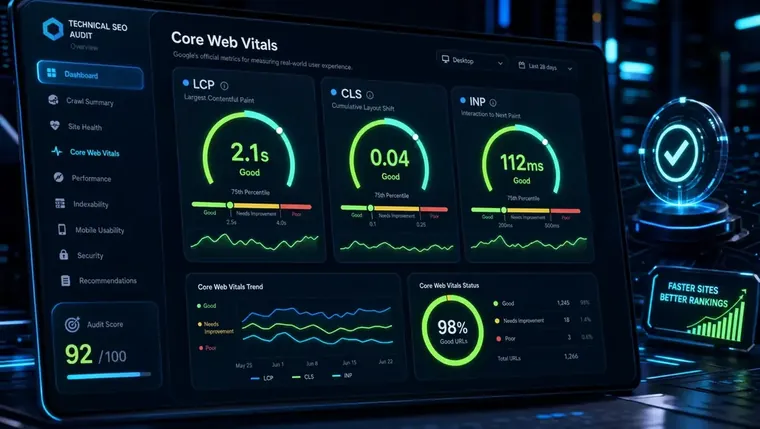
- Core Web Vitals: LCP, CLS, and INP Core Web Vitals now includes INP (Interaction to Next Paint) as a ranking signal alongside LCP and CLS. We audit all three with PageSpeed Insights baseline data and flag regressions by template type, not just by individual URL.
- Structured Data & Schema Coverage We audit existing Schema.org markup for validity, coverage gaps by content type, and eligibility for rich result features — each gap mapped to a specific implementation ticket.
- AI Crawler & LLMS.txt Configuration AI crawler handling is now an audit category. We review your robots.txt and LLMS.txt configuration to ensure you're controlling which content is accessible to LLM indexers — a signal for GenAI search visibility most audits still ignore.
- Off-Page Signal Quality Backlink toxicity and keyword-to-intent alignment affect technical trust signals. We flag toxic link patterns and content-intent mismatches that suppress crawl priority for your highest-value pages.
How Do You Validate That SEO Audit Fixes Actually Worked?
Fix validation requires a re-crawl, Search Console coverage monitoring, and a before-and-after Core Web Vitals comparison — not just a closed dev ticket.
Closing a Jira ticket is not fix validation. Technical SEO audit services that include re-validation checkpoints are rare — and that gap is where most of the ROI disappears.
Our re-validation process runs in three passes. First, a targeted re-crawl of the affected URL set within 72 hours of deployment — not a full-site crawl, which obscures signal changes in the noise. Second, Search Console coverage monitoring over a 14-day window: if 'discovered, not indexed' counts aren't declining, the fix didn't land as intended. Third, a before-and-after Core Web Vitals comparison by template type using field data, not just lab data from PageSpeed Insights. Lab scores can be gamed by isolated optimizations that don't translate to real-user performance.
This loop also defines the realistic improvement timeline most clients want but rarely get from audit providers. Crawl and indexing fixes typically reflect in Search Console within 2–4 weeks. Core Web Vitals field data updates on a 28-day rolling window. Ranking movements that stem from structural signal improvements generally appear in 6–12 weeks — depending on crawl frequency for the domain tier. Knowing this timeline prevents the common mistake of re-auditing and stacking new changes before the first wave of fixes has had time to register.
Checklist Audit vs. Remediation Roadmap: What's the Difference?
A checklist audit delivers findings; a remediation roadmap delivers fix owners, effort tiers, and validation checkpoints — which is what actually moves rankings.
| Feature | Standard Checklist Audit | Remediation Roadmap Audit |
|---|---|---|
| Deliverable format | Ranked issue list or PDF report | Phased fix plan with effort estimates and sprint-ready tickets |
| Fix ownership | Undefined — client figures it out | Named owner per finding (dev, content, ops) |
| Prioritization logic | Severity score from crawl tool | Impact × dev capacity × release cycle |
| Re-validation | Not included | Re-crawl + Search Console + CWV comparison |
| AI crawler coverage | Rarely addressed | LLMS.txt + robots.txt + GenAI visibility audit |
| Typical engagement model | One-time, project-based | Phased: audit → remediation → re-validation cycle |
What Does a Technical SEO Audit Service Actually Cost?
A credible technical SEO audit ranges from $1,500 for a targeted crawl review to $8,000+ for a full remediation roadmap engagement with re-validation cycles.
Pricing for technical SEO audit services varies because the term covers a wide range of scope and depth. Here's a transparent breakdown of what the market actually looks like — and what you're trading off at each tier.
A $500–$1,500 audit is typically an automated crawl export with a templated summary. It will surface obvious issues — missing meta descriptions, crawl errors, redirect chains — but it won't triage by ranking impact, assign fix owners, or include any implementation support. Useful as a quick health check; not useful as a growth strategy.
A $2,000–$5,000 audit adds manual analysis, a prioritized finding set, and usually a readout call. Some providers at this tier include basic implementation guidance. The gap is still re-validation: most engagements end at delivery.
A $5,000–$10,000+ engagement should deliver what we've described above: phased remediation roadmap, effort-tiered fix packages, named owners, and re-validation checkpoints. This is the tier where technical SEO audit services generate measurable ROI rather than just documentation. If you're also investing in SEO website design or a broader content buildout, the audit findings feed directly into those workstreams — which is where the compounding value lives. For a deeper look at how these services integrate, see our guide to website design and SEO services built as one system.
Paid traffic amplifies technical SEO problems — slow pages and indexing failures cost you on CPC and organic rankings simultaneously.
If you're running Google Ads alongside SEO, slow landing pages and indexing failures cost you twice — once in Quality Score and once in organic visibility. A coordinated technical audit that covers both surfaces the highest-leverage fixes first. Explore how paid and organic signals compound in our SEO Audit framework.
Frequently Asked Questions
What does a technical SEO audit service include at Receipts Group?
Our technical SEO audit services include crawl path and indexing analysis, Core Web Vitals assessment across all three metrics (LCP, CLS, and INP), structured data and Schema.org coverage, AI crawler configuration review (including LLMS.txt), and a phased remediation roadmap with fix owners and effort estimates — not just a ranked issue list.
How long does it take to see results after a technical SEO audit?
Crawl and indexing fixes typically show up in Google Search Console within 2–4 weeks. Core Web Vitals field data updates on a 28-day rolling window. Ranking improvements that stem from structural signal fixes generally appear within 6–12 weeks, depending on the domain's crawl frequency tier.
How do I know if the technical SEO audit fixes actually worked?
We run three re-validation passes: a targeted re-crawl of the affected URL set within 72 hours of deployment, a 14-day Search Console coverage monitoring window to confirm 'discovered, not indexed' counts are declining, and a before-and-after Core Web Vitals comparison using field data — not just lab scores.
What's the difference between a $500 audit and a $5,000 technical SEO audit?
A $500 audit is typically an automated crawl export with a templated summary — useful for a quick health check but not for growth. A $5,000+ engagement delivers a phased remediation roadmap, named fix owners per finding, effort-tiered sprint packages, and re-validation checkpoints. The higher-tier engagement is where technical SEO audit services generate measurable ROI rather than just documentation.
Do technical SEO audits cover AI crawler and LLM visibility at Receipts Group?
Yes. AI crawler configuration is now a formal audit category. We review your robots.txt and LLMS.txt setup to ensure you're correctly controlling which content is accessible to LLM indexers — a growing factor in GenAI search visibility that most technical SEO audit providers still don't address.
Related reading
Ready for a Technical SEO Audit That Ships Fixes?
Most audits end with a report. Ours ends with a re-validated fix set. If you want technical SEO audit services built around remediation — not documentation — start with our SEO Audit framework. We'll map your crawl chain, triage by real ranking impact, and hand your dev team sprint-ready tickets with re-validation baked in. Book a scoping call and we'll tell you within 48 hours what tier of engagement your site actually needs.