

Website Design and SEO Services Built as One System
Website design and SEO services are not two services that happen to pair well — they are one architectural decision that either succeeds or fails at the moment the first line of code is written. Most operators discover this the hard way: they commission a visually polished site, then hand it to an SEO vendor six months later, and spend the next year undoing design choices that were never built to be crawled. This post is a technical and strategic guide to what integrated website design and seo services actually look like, why the sequencing of design-first and SEO-second is the most expensive mistake in digital marketing, and what a properly structured engagement delivers across the first 180 days.
Why are web design and SEO architecturally inseparable?
Design decisions — JavaScript rendering, image compression, internal link structure — directly control whether Google can crawl and rank a page at all.
The short answer is that every design decision is simultaneously an SEO decision. When a developer chooses a JavaScript-heavy framework to render product listings, those listings may be invisible to Googlebot unless server-side rendering is explicitly configured. When a designer compresses hero images to under 100 KB, Core Web Vitals scores improve measurably — and Google Search Central has confirmed that page experience signals influence ranking tier placement.
The failure mode most agencies won't mention is this: a site built without an SEO architect in the room will almost certainly need a second project to fix what the first project broke. EZMarketing's own service list — on-page optimization, keyword research, content updates, and local SEO — contains no mention of technical SEO or site architecture. That omission is telling. When technical remediation is sold after design is locked, you are buying two projects instead of one, and the second project is always more expensive because it works against the grain of decisions already made.
Our SEO Website Design framework builds the crawl logic, internal linking hierarchy, and Schema.org structured data into the design system itself — not retrofitted in sprint six.
What design decisions break SEO before launch?
JavaScript-rendered content, uncompressed images, flat internal link structures, and missing schema markup are the four most common pre-launch SEO killers.
- Client-side JavaScript rendering Menus, product grids, or blog feeds rendered entirely by JavaScript may not be indexed at all. Googlebot processes JS in a second wave — often days later — meaning freshly launched pages can sit unindexed for weeks.
- Unoptimised images at the CMS level Designers deliver assets at print resolution; developers upload them unchanged. A single uncompressed hero image can push Largest Contentful Paint past the 2.5-second threshold that defines a 'good' Core Web Vitals score. Run every page through PageSpeed Insights before launch, not after.
- Flat site architecture A site where every page is one click from the homepage passes zero topical authority through internal links. Siloed architecture — category pages linking to sub-category pages linking to posts — concentrates PageRank on the URLs that actually need to rank.
- Missing or broken structured data Schema markup for LocalBusiness, Product, Article, and FAQ entities is most efficiently implemented during the theme build. Retrofitting it later requires a developer to re-open templates that were considered closed, adding unnecessary cost and regression risk.

How does local SEO fit into a design-first build?
Local SEO requires location-specific schema, dedicated landing pages, and Google Business Profile alignment baked into the site architecture from day one — not added as afterthoughts.
Most discussions of local SEO treat it as a content and citation problem — add your address to the footer, claim your Google Business Profile, build some directory links. That framing misses the structural layer entirely. Local website design and seo services should embed Schema.org `LocalBusiness` markup at the template level so every page in the site inherits the correct NAP (name, address, phone) data without manual entry. Location-specific landing pages — one per service area — need to be planned in the information architecture before the sitemap is finalised, not created as an afterthought when a local campaign needs a destination URL.
Alignment between the Google Business Profile and the on-site data is another design-phase decision. If the GBP primary category is 'HVAC Contractor' and the site's `<title>` tags use a different taxonomy, the topical signal is diluted. That alignment is trivially easy to build during design and genuinely painful to reconcile post-launch across hundreds of pages. For a deeper look at uncovering these gaps before you build, our SEO Audit Service runs a full technical and local signal review.
Agencies that sequence design before SEO are selling two separate projects — the build and the remediation — when one integrated engagement would suffice.
Any agency that completes a website design engagement and *then* begins SEO strategy is, by definition, selling you two projects — see Entity SEO Strategy: Fix the Misread Before You Build More Content. The remediation sprint to fix crawlability, page speed, and schema gaps after launch typically costs 40–70% of the original design budget. Integrated website design and seo services eliminate that second invoice entirely.
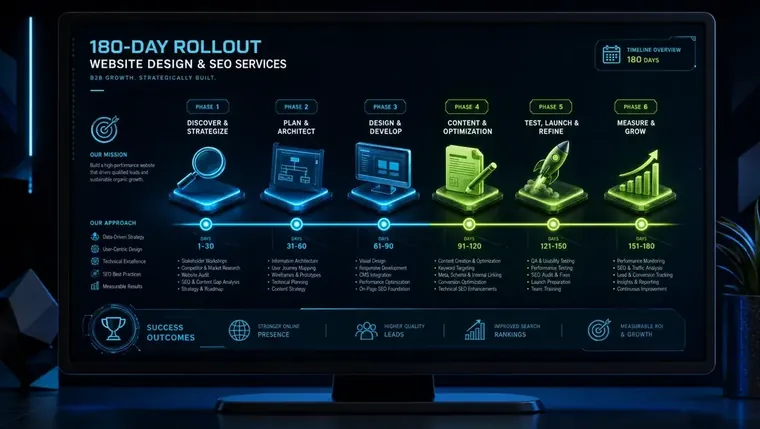
What does a 90–180 day integrated engagement look like?
An integrated engagement runs from keyword-informed architecture in weeks 1–4, through technical build in weeks 5–10, to content and authority work in months 3–6.
The agencies that avoid giving a timeline — including those citing '28 years of experience' as a primary trust signal — do so because their process has no defined phases. Here is what a structured website design and seo services engagement actually looks like:
Weeks 1–4 (Discovery + Architecture): Keyword research drives the information architecture. Every planned URL is mapped to a target query cluster before a designer touches a wireframe. Crawl logic, canonical structure, and internal link hierarchy are defined in a document that the designer works from, not around.
Weeks 5–10 (Build + Technical Implementation): Development follows the architecture spec. Core Web Vitals benchmarks are set at component level — not audited at the end. Schema markup is templated into the theme. PageSpeed Insights scores are a build acceptance criterion, not a post-launch to-do.
Weeks 11–16 (Launch + Content Activation): Site launches with the full technical foundation in place. Existing content is migrated with redirect mapping. New content targets the query clusters defined in week one. The Search Quality Rater Guidelines E-E-A-T signals — author credentials, sourced claims, demonstrated expertise — are built into the content templates.
Months 4–6 (Authority + Iteration): Link acquisition and content expansion target the ranking gaps identified at launch. Our SEO content writing approach treats every article as a durable ranking asset rather than a publishing event. By month six, organic visibility should be measurably climbing against the specific query clusters targeted in week one — not a vague 'trending upward' narrative.
Integrated vs. sequential website design and SEO
Integrated website design and seo services ship once, rank faster, and cost less over 12 months than the design-then-SEO sequence most agencies default to.
| Feature | Integrated (Design + SEO Together) | Sequential (Design First, SEO Later) |
|---|---|---|
| Architecture planning | Keyword research informs every URL before wireframing | URLs chosen by designer, re-evaluated by SEO vendor post-launch |
| Core Web Vitals | Acceptance criteria during build — pass before launch | Audited after launch; fixes require re-opening closed templates |
| Schema markup | Templated into the theme — zero per-page manual work | Added retroactively page by page, often incomplete |
| Time to first ranking | Typically 90–120 days post-launch | Delayed by 2–4 months of technical remediation before content work starts |
| 12-month total cost | One engagement fee | Design fee + SEO retainer + remediation sprint |
Frequently Asked Questions
What changes when design and SEO services are bundled together?
When purchased separately, the design vendor makes hundreds of architecture decisions — URL structure, JavaScript rendering, image handling — without SEO input. The SEO vendor then inherits a site they didn't build and must work around those decisions rather than with them. Buying integrated website design and seo services means every technical choice is evaluated for crawlability before it is implemented, eliminating a costly remediation phase.
How long does integrated website design and SEO take to rank?
A site built with the correct technical foundation — proper schema, passing Core Web Vitals scores, a keyword-informed URL structure — typically begins showing ranking movement within 90 to 120 days of launch. Sites that require post-launch technical remediation often don't begin meaningful ranking work until month four or five, since Googlebot must re-crawl and re-evaluate the corrected pages before any content or link work can take effect.
Does local SEO need to be built into site architecture from the start?
Local SEO elements like LocalBusiness schema markup, location-specific landing pages, and NAP consistency are structurally most efficient when built into the site's templates and information architecture from the start. Adding them retroactively means reopening theme files, creating redirects, and reconciling data inconsistencies across directories — work that is avoidable when local signals are treated as design requirements rather than post-launch additions.
What are Core Web Vitals and why do they matter for SEO?
Core Web Vitals are a set of performance metrics — Largest Contentful Paint, Interaction to Next Paint, and Cumulative Layout Shift — that Google uses as ranking signals under its page experience guidelines. LCP measures how fast the main content loads (target: under 2.5 seconds), and CLS measures visual stability during load. Both are directly controlled by design decisions: image compression, font loading strategy, and layout reservation. Because these metrics are set at the component level during development, they cannot be meaningfully improved without developer access to the codebase — making them a design-phase responsibility, not an SEO-phase one.
Related reading
Ready to build once and rank from launch?
If your current vendor is running design and SEO as separate tracks — or if you have a polished site that isn't indexing the way it should — the problem is architectural, not cosmetic. Our website design and seo services integrate both disciplines from the first wireframe to the first ranking. Start with an SEO Audit to see exactly what's holding your current site back, or explore the full SEO Website Design framework to understand what a properly integrated build delivers.