Call Center Agent Coaching: Fix the Ratio Before the Framework
At a 1:15 supervisor-to-agent ratio. Standard in most contact centers. A manager running weekly 30-minute 1-on-1s needs a 7.5-hour block every single week just for coaching. That's before email, escalations, or the floor. Our call center training pillar covers the full stack. This post goes deep on the one problem that makes most call center agent coaching frameworks fail before the first session happens.
The supervisor isn't the bottleneck to fix. The ratio is the constraint to route around.
Why does most call center agent coaching fail at scale?
Most coaching fails because 1:15 supervisor ratios make individualized sessions built that way impossible. Not because managers lack good frameworks.
The Qualtrics State of the Contact Center 2025 report found that 78% of customers say a single interaction can permanently change how they feel about a company. That's a brutal number. One call. One agent who never got properly coached because their supervisor was managing 14 other people.
Here's the take competitors won't print: peer-led and self-directed coaching should be the primary delivery mechanism, not a supplement. Reserve manager coaching for exception cases. Performance floors, compliance violations, role transitions. Treating manager time as the default coaching vehicle is how you build a program that looks rigorous on paper and does nothing when it runs.
The math doesn't lie. 60 agents. 4 supervisors. That's 15 agents per supervisor. Run a 30-minute weekly session for each one and you've burned 7.5 hours of supervisor time before a single escalation lands. Most centers don't have 7.5 clean hours. So sessions get canceled, rescheduled, shortened, or turned into hallway conversations nobody tracks.
What signals a coaching problem vs. A hiring or tooling problem?
Poor agent performance is a coaching problem only when skills are the gap. If the issue is tools, process, or bad hiring criteria, coaching won't fix it.
- Skills gap (coaching fixes this) The agent understands the process but executes it inconsistently. Call flow, objection handling, de-escalation language. Repetition and feedback move the needle here.
- Tooling gap (ops fixes this) The agent is doing everything right but the dialer drops calls, the CRM lags, or the script is built for a product version from 18 months ago. Coaching someone through broken tooling builds resentment, not skill. Check your predictive dialer setup before assuming the agent is the variable.
- Process gap (management fixes this) Inconsistent escalation paths, unclear call disposition rules, or shifting KPIs mid-quarter. Agents can't be coached to a moving target. The target has to be locked first.
- Hiring gap (recruiting fixes this) Some agents never hit quota because they were hired for the wrong profile. Qualtrics data shows 41% of agents say being judged on over-simplified metrics is one of their biggest frustrations. Often because the metrics were never aligned to the role at hire.
- Resistance gap (structure fixes this) Tenured agents who push back on feedback aren't usually defiant. They're protecting habits that worked under a different manager or a different script. Peer-led coaching from a trusted colleague often breaks through where top-down sessions don't.
We're selective about the ops programs we build at Receipts Group. Not because we're precious about it. A poorly designed call center agent coaching structure is harder to undo than to skip. If you want to pressure-test your current framework before rebuilding it, book a call and we'll tell you honestly whether the problem is coaching or something upstream of it.
How should coaching frequency be structured for outbound vs. Inbound agents?
Outbound agents need shorter, more frequent coaching cycles tied to multi-touch pipeline data; inbound agents benefit from longer sessions anchored to call recording review.
No page ranking for call center agent coaching makes this distinction. That's a problem, because the distinction is operationally critical. Outbound agents quit on a lead after one call. Research cited by TimeDoctor puts the average deal at five or more touches to close. If your coaching cadence only reviews last week's calls without tracking multi-touch sequences, you're coaching to one-fifth of the picture.
For outbound, 15-minute peer debrief sessions after every 50-call block outperform weekly supervisor 1-on-1s. By a wide margin in our clients' data. The feedback is immediate. The context is fresh. The person delivering it sat in the same seat that morning. For inbound, the recording review model holds up better. Agents handle a wider variety of call types, so longer sessions with a supervisor who can catch pattern drift across call categories make more sense.
One honest concession: self-directed coaching only works if the agent has clean call recordings, a clear rubric, and a feedback loop that isn't just a form they submit into a void. We've seen this fail at two clients where the tooling wasn't set up to surface the right calls automatically. The intent was right. The implementation wasn't.
Tools worth evaluating for real-time coaching support: Twilio Voice Programmable for call recording and routing infrastructure, and Five9's contact center platform for supervisor whisper coaching at scale. These aren't magic. They surface data that a human still has to interpret.
How does Receipts Group's quality framework apply to agent-facing content?
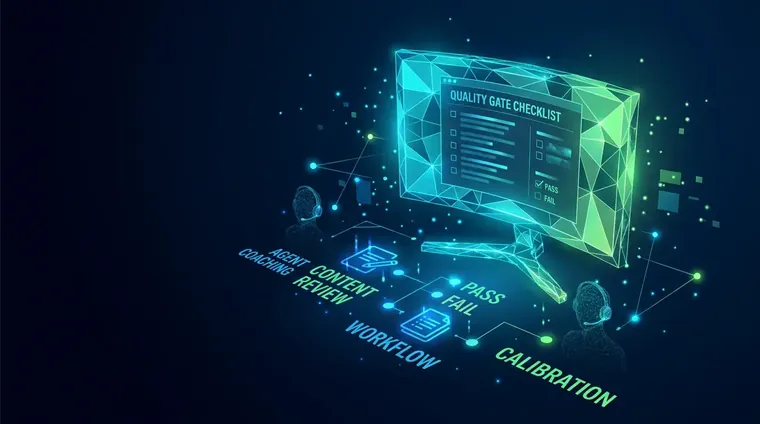
Every page Receipts Group's agents produce clears 25 hard quality gates and a soft surgical-patch gate suite before write. Pages that fail hard gates don't ship.
We publish agent-facing playbooks, coaching scripts, and call flow documentation through the same pipeline we use for client SEO pages. Every page Receipts Group's agents produce clears 25 hard quality gates and a soft surgical-patch gate suite before write. No 'good enough' override exists. That's not a marketing claim. It's a build decision we made when we set up the framework, and it applies to coaching content the same way it applies to a landing page.
The reasoning is simple: a coaching document with a broken objection-handling script does real damage on the floor. An agent rehearses the wrong response, embeds it, and you spend three months trying to unwind a habit that a 10-minute QA pass would have caught. We've seen this firsthand on a remodel company program we run internally. One bad script line about timeline expectations cost us four weeks of re-coaching across a six-agent team.
The same discipline applies when we're helping clients build call center agent coaching infrastructure. The content has to clear the gate. If it doesn't, it doesn't go to the floor. Our marketing automation agency practice runs on the same gated logic. Content that's 'close enough' always costs more downstream than the time saved by skipping review.
For automation and integration layers supporting coaching workflows, Salesforce Trailhead has useful modules on contact center pipeline design. The Zapier integration directory covers most of the connective tissue between dialer, CRM, and scorecard tooling.
Manager-led vs. Peer-led coaching: which model scales?
Peer-led coaching scales better than manager-led at ratios above 1:10. It costs less supervisor time and produces faster feedback loops for agents.
| Feature | Manager-led coaching | Peer-led coaching |
|---|---|---|
| Feedback speed | Weekly or bi-weekly at best | Same-day or next shift |
| Supervisor time cost | 7.5 hrs/week at 1:15 ratio | ~1 hr/week for scorecard review |
| Resistant agent response | Often escalates defensiveness | Peer credibility reduces friction |
| Scalability beyond 50 agents | Requires headcount increase | Scales via top-quartile rotation |
| Compliance risk visibility | Supervisor catches most issues | Requires flagging protocol to supervisor |
Frequently Asked Questions
How often should call center agent coaching sessions happen?
Frequency depends on the agent's role and the coaching delivery model. For outbound agents, short peer debrief sessions every 50-call block outperform weekly 1-on-1s because feedback is immediate and contextually fresh. For inbound agents, a structured weekly recording review with a supervisor or peer coach works better given the variety of call types. The key variable isn't frequency. It's whether the session produces a behavior change that shows up in your next data pull.
What supervisor-to-agent ratio enables effective coaching?
Most contact centers run at 1:15 or worse, which makes traditional individualized coaching built that way unworkable. Research and operational experience both point to 1:8 or 1:10 as a more functional ratio for manager-led coaching. Below that threshold, a peer-led model with manager oversight is more practical and often produces faster skill development because the feedback loop is tighter.
How do you coach call center agents who resist feedback?
Tenured agents who push back on manager feedback usually respond better to peer coaching from someone who has done the same job recently. The resistance is often about credibility and context, not the feedback itself. Structuring sessions so the peer coach shares their own mistakes first. Before reviewing the agent's calls. Changes the dynamic from evaluation to collaboration. If resistance persists, the underlying issue is usually misaligned metrics or a hiring profile mismatch, not coaching failure.
How is call center agent coaching different for outbound vs. Inbound teams?
Outbound coaching needs to account for multi-touch reality. Most deals close after five or more contacts, so reviewing a single call in isolation misses the pattern. Inbound coaching is better suited to call recording review because agents handle wider call-type variety and pattern drift is easier to catch with a longer session. Mixing the two models. Applying inbound-style weekly 1-on-1s to outbound agents. Tends to produce coaching that's accurate but too slow to change behavior before the next campaign cycle.
Related reading
Build a coaching framework that doesn't collapse under volume
Most call center agent coaching programs assume 70% capacity and a supervisor with time to spare. Real floors don't look like that. We've built peer-led coaching infrastructure for outbound and inbound teams, and we can pressure-test yours before you scale. Start with our full call center training framework. Then book a call and we'll tell you honestly what to fix first.