

Best AI SEO Tools for 2026: Buy in the Right Order
75% of SEO tool budgets are wasted on redundant stack overlap — that's not a vendor stat, it's the quiet conclusion you reach when you map five tools onto the same campaign and realize three of them are measuring the same keyword universe from slightly different angles. Most 'best AI SEO tools' roundups accelerate exactly that problem by treating traditional SEO platforms and new GEO/AEO visibility trackers as one interchangeable category. They're not. If you're serious about building organic traction in 2026, the place to start is understanding *which type* of tool you actually need right now — and which ones require a content foundation before they'll give you a single meaningful number. Our AI SEO agency team has built this guide around that sequencing logic, not another ranking table that sends you home with a six-tool subscription bill.
Why do most AI SEO tool lists create expensive, redundant stacks?
Most lists merge two incompatible tool categories — traditional SEO platforms and GEO trackers — causing teams to buy overlapping tools that measure things they can't yet act on.
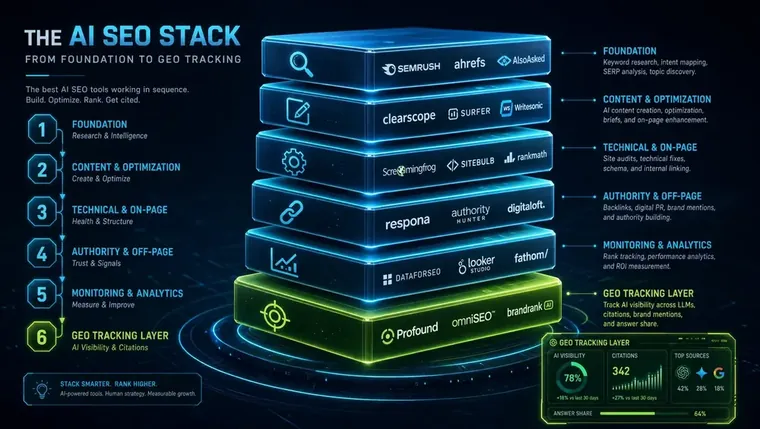
Here's the core problem: the phrase best ai seo tools quietly bundles two fundamentally different product categories. On one side you have mature platforms like Semrush, Ahrefs, and Surfer SEO — tools that were built for keyword research, backlink analysis, and on-page optimization, and have since bolted AI features onto existing infrastructure. On the other side are a new class of GEO (Generative Engine Optimization) and AEO (Answer Engine Optimization) trackers — tools purpose-built to measure how often your brand appears in ChatGPT, Perplexity, Google AI Overviews, and similar answer surfaces.
According to Search Quality Rater Guidelines, authority signals and content quality remain the upstream input for *all* answer engines — which means GEO visibility scores are a lagging output of the content and authority work you've already done. Buying an AI visibility tracker before you have consistent brand mentions to track is like buying an analytics platform before you have traffic. The data will be real, and entirely unactionable.
This distinction matters practically. Monthly searches for 'generative engine optimization' grew from 93 in January 2024 to over 13,000 by mid-2026 — a 140-fold jump, per Searchbloom's original tracking data. That surge has flooded the market with GEO tools that teams are rushing to adopt *before* they've established the content baseline those tools require. The result: expensive confusion. A smarter approach is to sequence your stack.
What separates the two AI SEO tool categories?
Traditional SEO platforms build your ranking foundation; GEO/AEO trackers measure AI answer-surface visibility — only useful once you have brand presence to measure.
- Traditional SEO platforms (Foundation layer) Tools like Semrush, Ahrefs, and Surfer SEO use AI as a feature layer on top of established crawl, index, and keyword infrastructure. They're the right starting point for any site that doesn't yet rank consistently. If your SEO audit surfaces thin content or broken crawl paths, this is where budget goes first.
- GEO / AEO visibility trackers (Amplification layer) Tools like Profound, Peec AI, and Otterly AI track how frequently your brand appears in AI-generated answers across ChatGPT, Perplexity, Gemini, and others. Profound tracks 10+ platforms from ~$499/month; Peec AI covers 7 platforms at EUR 85/month (~$91). The price gap is real — but both are only useful if you have brand mentions worth tracking.
- Niche utility tools (Specific job layer) Tools like Rankability (content decay tracking, built by Nathan Gotch), Keywordly (Reddit-native keyword research), Alli AI (~$169/month for schema markup automation), and Yext (~$199/year for voice search optimization) solve narrow, specific problems. They belong in a stack only when that specific problem is confirmed — not by default.
- General-purpose LLMs (Research assistants, not SEO tools) ChatGPT and Perplexity are research and drafting assistants — listing them as 'AI SEO tools' alongside purpose-built platforms misrepresents what they do. They have no index access, no keyword data, and no site crawl capability. Useful? Yes. SEO tools? No.
Lock in your content and technical SEO foundation first — consistent rankings, clean crawl, structured data via Schema.org — then add GEO/AEO tracking once brand mentions are measurable. Reverse that order and you're paying to watch a scoreboard for a game you haven't started playing yet.
How do GEO visibility scores actually work — and why do two tools disagree?
GEO scores differ across tools because each uses different prompt sets, AI platform coverage, and sampling methods — real consumer app data vs. API samples produce materially different results.
One of the most practical questions teams never think to ask before buying a GEO tracker: how does this tool actually generate its visibility score? The answer varies significantly, and the difference has direct consequences for how much you should trust the number.
Tools in this space construct a prompt library — typically hundreds to thousands of queries relevant to your category — then fire those prompts at AI platforms and record whether your brand is mentioned, how prominently, and in what context. The score you see is a function of: (a) which AI platforms are included, (b) how the prompt set is constructed and updated, (c) whether the tool queries the real consumer app or a sampled API endpoint, and (d) how mention frequency is aggregated into a single index number.
The consumer-app vs. API distinction matters more than most buyers realize. Consumer-facing AI apps often apply different RLHF tuning, safety filters, and retrieval configurations than developer API access — meaning a tool that queries GPT-4 via API may show systematically different brand visibility than what real users actually see in ChatGPT.com. Searchbloom evaluated 12 GEO tools on a 50-point scale across five criteria (AI platform coverage, data quality and method, actionability, workflow fit, and value) — Profound and Peec AI tied at 45/50, largely because of their data sourcing methodology.
Before buying any GEO tracker, ask the vendor directly: *do you query live consumer apps or developer APIs?* If they can't answer clearly, treat the scores as directional, not precise. And always cross-reference against Google Search Central data and your own GSC performance to triangulate what's real.
What's the real cost of AI SEO tool sprawl?
A typical 5-8 tool stack built from roundup lists can cost $700–$2,500/month with significant feature overlap — auditing for redundancy before buying is essential.
Let's run the numbers that no roundup ever publishes. A team that follows a typical 'best AI SEO tools' list and adopts the full recommended stack might land here: Semrush (~$120–$450/month) for keyword and backlink work, Surfer SEO (~$89/month) for on-page, a GEO tracker like Profound (~$499/month) or AirOps Pro (~$2,000/month at the high end), Alli AI (~$169/month) for schema, and a content monitoring tool for decay tracking. That's $877–$3,000+/month before anyone has asked whether Surfer and Semrush's content scoring features already overlap, or whether Alli AI's schema output duplicates what your SEO website design CMS already handles at the template level.
Tool sprawl also creates a measurement problem. When you're running five platforms simultaneously, it becomes genuinely difficult to attribute ranking improvements to the right input — which undermines the core claim that these tools are 'data-driven.' A tighter stack with two or three non-overlapping tools, combined with a baseline from Core Web Vitals and PageSpeed Insights for technical performance, will generate cleaner signal and clearer ROI.
The source-1 methodology from OneLittleWeb is worth adopting as a personal standard: test tools for a minimum of three months on live accounts, use GSC as the ground truth, and disqualify any tool showing more than a 15–20% variance against GSC keyword volume data. That filter alone would eliminate a significant portion of the tools that appear on most recommended lists.
Foundation tools vs. GEO trackers: when to buy each
Buy foundation tools when you need rankings; buy GEO trackers only after you have consistent organic visibility and brand mentions worth monitoring.
| Feature | Foundation SEO Tools | GEO / AEO Visibility Trackers |
|---|---|---|
| Primary job | Build rankings, audit crawl, research keywords | Measure brand presence in AI-generated answers |
| When to buy | Day one — before you have traffic | After you have consistent organic visibility |
| Data source | Search index, crawl data, backlink graphs | AI platform prompt sampling (app vs. API varies) |
| Price range | $89–$450/month for core platforms | $29/month (Otterly) to $2,000/month (AirOps Pro) |
| Risk of early adoption | Low — data is actionable from day one | High — scores are unactionable without brand presence |
No AI SEO tool is perfectly accurate — always cross-reference outputs against Google Search Console before making decisions based on tool-generated keyword or visibility data.
Every tool recommendation comes with a caveat the vendor won't put in the demo: AI-generated content scores, keyword volume estimates, and GEO visibility indexes are probabilistic, not precise. The three-month testing window and 15–20% GSC variance threshold isn't just good practice — it's a filter that separates tools worth paying for from tools worth trialing free. Apply it before you commit budget, not after. For related guidance on getting technical foundations right before layering in tools, see our Technical SEO Audit Services breakdown.
Frequently Asked Questions
What's the best AI SEO tool to start with if my site has no organic traffic yet?
Start with a traditional SEO platform like Semrush or Ahrefs before anything else. These tools provide keyword research, crawl audits, and backlink data that are actionable from day one — before you have the content baseline or brand presence that GEO/AEO trackers require to produce meaningful scores.
Does a GEO tracker use real consumer app data or API samples?
Ask the vendor directly before purchasing. Consumer-facing AI apps like ChatGPT.com apply different tuning and retrieval configurations than developer API endpoints, which can produce materially different brand visibility scores. If a vendor can't clearly explain their data sourcing method, treat their scores as directional estimates rather than precise measurements.
How much should a complete AI SEO tool stack realistically cost in 2026?
A non-redundant three-tool stack covering keyword research, on-page optimization, and technical monitoring can run $250–$600/month depending on the platforms you choose. GEO trackers range from $29/month (Otterly AI, 4 platforms) to $499/month (Profound, 10+ platforms) to $2,000/month (AirOps Pro) — add these only after your content foundation is established, or the spend generates no actionable insight.
Related reading
Build the right stack — not the biggest one
The best AI SEO tools aren't the ones with the longest feature list or the highest roundup score — they're the ones that match your current stage of growth and don't overlap with what you already have. Our AI SEO agency team starts every engagement with a stack audit: identifying what's redundant, what's missing, and what you should sequence next. If you want a second set of eyes on your current toolset — or a clear plan for building one that actually compounds — get in touch with Receipts Group and let's map it out.