
How Much Do Facebook Ads Cost in 2026?
If you've searched *how much do Facebook ads cost* in 2026, the SERP is a wall of benchmark tables that tell you Finance CPCs are $3.77 and Entertainment CPCs are $0.39 — and then leave you no closer to knowing what to actually type into Ads Manager. Those numbers aren't wrong; they're just the least useful thing for your business. What determines your real cost isn't what your industry peers are paying — it's your own customer lifetime value, your conversion rate, and how well your creative and landing page perform in the auction. Our Facebook Ads Agency team works through this math with clients every week, and this guide covers the cost levers that every other page skips.
Below, you'll find the real drivers of Facebook ad costs, what Advantage+ is doing to cost dynamics in 2025–2026, and the minimum viable budgets by objective that no other guide bothers to publish.
Why benchmark CPCs are the wrong starting point
Your maximum allowable CPC is set by your LTV and conversion rate, not by what industry averages are paying.
Here's the contrarian position worth sitting with: a $3.77 CPC is cheap if your product sells for $2,000 and converts at 4%. A $0.45 CPC is ruinously expensive if your margins are 10% and your landing page converts at 0.5%. The question of *how much do Facebook ads cost* only becomes answerable once you know your maximum allowable cost-per-acquisition — which flows backward from lifetime value, not forward from a benchmark table.
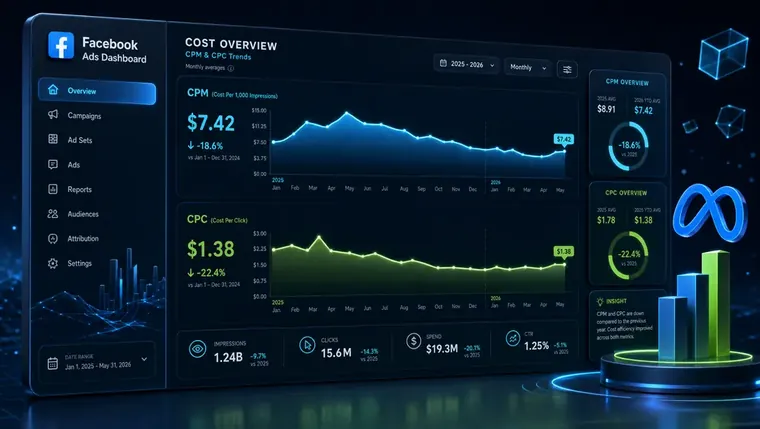
With that framing established, the real data does matter as a sanity check. Vaizle's dataset of 5,200+ Meta ad accounts shows a global median CPC of $0.82 and a median CPM of $5.97. But US advertisers are living in a very different market: US CPMs surged 81.5% year-over-year, from $10.84 in 2024 to $19.66 in 2025, while US click-through rates improved from 2.73% to 3.49% over the same period — meaning the audience is more engaged even as inventory got more expensive.
The SuperAds benchmark adds seasonal texture: US CPMs started 2025 at $20.41, peaked at $28.09 in November, then dropped to $17.12 in January 2026. That's a $10.97 swing in three months. For anyone planning annual budgets, that volatility matters far more than any annual average. If you're also running search alongside social, our partners at Google Ads Agency see similar seasonal pressure on paid search CPCs — coordinating both channels around Q4 is a real budget lever.
Cold audience vs. retargeting: the cost split nobody explains
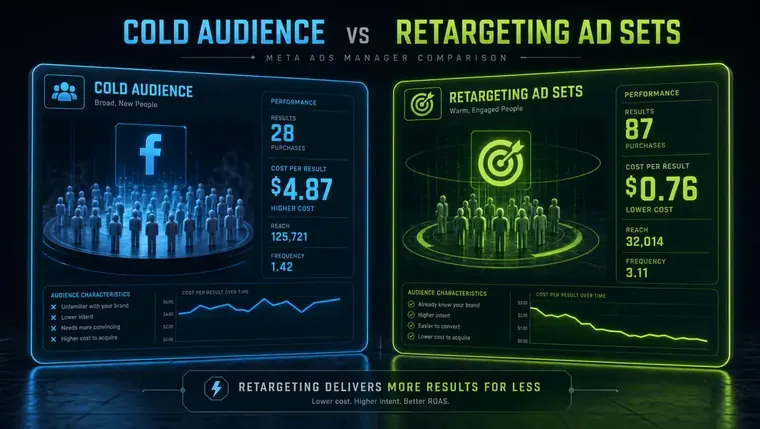
Retargeting audiences typically cost 30–60% less per conversion than cold prospecting because Meta's estimated action rate is far higher.
One of the most actionable — and most ignored — cost levers in Facebook advertising is the split between cold prospecting audiences and retargeting audiences. When you ask *how much do Facebook ads cost* for a retargeting campaign versus a cold-traffic campaign, you're asking about two fundamentally different auctions. Meta's ad ranking system factors in estimated action rate — the platform's prediction of whether a given user will take the desired action. Website visitors, video viewers, and past purchasers carry a much higher estimated action rate than cold lookalike audiences, which means Meta can show your retargeting ads at a lower effective CPM without sacrificing its own revenue.
In practice, this means a well-structured retargeting campaign can deliver CPAs 30–60% lower than prospecting, using identical creative. The mistake most advertisers make is treating the two as the same campaign type and then wondering why their blended CPA is erratic. Segment them, budget them separately, and set separate CPA targets for each — your cold audience budget should absorb the higher cost of acquiring new attention, while retargeting mops up the intent that prospecting creates.
Landing page quality feeds directly into this same mechanism. Meta's estimated action rate is partly informed by post-click behavior — bounce rates, time-on-site, and conversion signals all flow back into the auction. A slow or poorly converting landing page doesn't just hurt your Google Quality Score; it quietly raises your Facebook CPM too. For a deeper look at how post-click experience affects paid performance across channels, What an Ecommerce PPC Agency Should Actually Do for You is worth a read.
What drives Facebook ad costs up as you scale budget
Scaling budget exhausts your best-fit audience first, pushing Meta to expand into lower-intent segments and driving CPMs higher.
- Audience saturation kicks in fast Meta serves your ad to the highest-probability converters first. Once that pool is saturated — often within days at aggressive budgets — the algorithm expands to lower-intent users, and CPMs climb. Frequency caps and audience rotation are your primary tools against this.
- Video creative buys you room to scale Video CPCs run **30–40% lower** than static image ads on average. Video also refreshes perceived novelty for users who've seen your brand before, slowing the frequency-driven CPM spike that kills many scaling campaigns.
- Advantage+ shifts cost dynamics significantly Meta's Advantage+ campaigns (its AI-driven format) are changing how costs behave at scale in 2025–2026. Advantage+ pools your audience signals and optimizes placement and targeting automatically — early data suggests lower CPAs for e-commerce, but reduced transparency over where spend goes. Test it as a parallel campaign before migrating full budget.
- Q4 requires its own budget envelope Q4 CPC increases run **20–40% in October** and **30–60% in November–December**. Treating Q4 as a normal quarter is how brands blow their annual ROAS targets. Build a dedicated Q4 budget 40–50% above your Q2 baseline and plan creative refreshes before October.
Before asking *how much do Facebook ads cost*, calculate your maximum allowable CPA: take your average order value (or customer LTV), multiply by your target margin, and that's the ceiling. Every benchmark in this guide is only meaningful relative to that number — not in isolation.
How to set a minimum viable daily budget by objective
Meta needs roughly 50 conversion events per week to exit the learning phase — work backward from your CPA target to set the right daily budget.
- 1Pick your campaign objective firstThe Leads objective averages **$1.92 CPC** — about 20% higher than 2024 and nearly 3× the Traffic objective average of $0.70. Choose the objective that maps to your actual business goal, not the cheapest click type. Cheap Traffic clicks that never convert cost more than expensive Leads clicks that do.
- 2Calculate the budget Meta needs to learnMeta's algorithm requires approximately **50 conversion events per week** to exit the learning phase and optimize effectively. Multiply your estimated CPA by 50, then divide by 7 — that's your minimum daily budget per ad set. If your target CPA is $20, you need at least $143/day. Underfunding the learning phase is the most common reason new campaigns underperform.
- 3Add a scaling buffer for audience expansionOnce out of learning, plan to increase daily budgets by no more than **20% every 3–5 days**. Larger jumps reset the learning phase and temporarily spike CPMs. Slow, consistent scaling preserves the algorithm's optimization gains.
- 4Set separate budgets for cold and retargetingA common starting split is 70% prospecting / 30% retargeting for early-stage advertisers, shifting to 60/40 as your pixel accumulates data. Track blended CPA but optimize each campaign type against its own CPA target — blending the two masks where your money is actually working.
Advantage+ and what AI-driven campaigns mean for your costs
Advantage+ campaigns can lower CPAs for e-commerce advertisers but reduce audience transparency — test in parallel before committing full budget.
The question of *how much do Facebook ads cost* in 2026 can't be answered without addressing Advantage+ Shopping Campaigns (ASC). Meta has been aggressively pushing ASC as its default recommendation for e-commerce advertisers, and for good reason — internal Meta data suggests ASC delivers lower CPAs than manual campaigns for accounts with sufficient pixel data. The mechanism is similar to Smart Bidding on Google: the algorithm aggregates more signals than a human campaign manager can process and optimizes placement, audience, and creative weighting simultaneously.
The catch is transparency. With ASC, you lose granular control over audience segments, placement breakdowns become harder to act on, and the creative rotation logic is a black box. For advertisers who rely on audience exclusions — like suppressing existing customers from acquisition campaigns — ASC requires careful setup to avoid wasted spend. The practical recommendation: run ASC as a parallel campaign at 20–30% of your budget and compare blended CPA against your manual campaigns over a 4-week test window. Don't let Meta's push toward automation override your need for cost accountability.
For further context on how AI-driven automation is reshaping paid acquisition across channels — not just Meta — see Google Search Central for the search-side equivalent, and our own What a Dental PPC Agency Actually Can't Fix for You for a real-world case study on automation limits.
Frequently Asked Questions
How much do Facebook ads cost for a small business in 2026?
For a small business in 2026, a minimum viable daily budget is roughly $15–$50 per ad set depending on your target CPA and campaign objective. The Leads objective averages $1.92 CPC while Traffic clicks average $0.70 — but the objective you choose should match your actual goal, not the cheapest click. Start with enough daily budget to generate at least 50 weekly conversions once your campaign exits Meta's learning phase.
Why did my Facebook ad costs increase mid-campaign?
Mid-campaign CPM spikes almost always mean audience saturation — Meta has served your ad to the highest-probability converters in your target pool and is now expanding to lower-intent users. Refreshing creative, broadening your audience, or introducing video ads (which run 30–40% cheaper per click than static images) are the most effective ways to reverse a mid-campaign cost spike.
Do Facebook ad costs differ between cold audiences and retargeting in 2026?
Yes — significantly. Retargeting audiences (website visitors, video viewers, past customers) carry a much higher estimated action rate in Meta's auction, which typically translates to CPAs 30–60% lower than cold prospecting campaigns. Budget and optimize them separately rather than blending them into a single campaign, or you'll mask where your spend is actually efficient.
How much do Facebook ads cost during the holiday season?
Q4 costs surge considerably: expect CPC increases of 20–40% in October and 30–60% in November–December. US CPMs peaked at $28.09 in November 2025 before dropping to $17.12 in January 2026 — a nearly $11 swing in three months. Plan Q4 Facebook ad budgets 40–50% above your Q2 baseline and prepare creative refreshes before October to avoid learning-phase resets during the most expensive inventory window of the year.
Related reading
Stop guessing — get a Facebook ad cost audit
Now that you know what actually drives *how much Facebook ads cost* for your specific business — audience type, landing page quality, objective choice, and scaling strategy — the next step is applying that framework to your own account. Our Facebook Ads Agency team audits your current CPMs, CPAs, and budget allocation to find the cost levers you're leaving on the table. No benchmark tables. Just your numbers, your margins, and a clear scaling plan.