

Lead Scoring Models That Actually Hold Up in 2026
The conventional advice is to build a lead scoring model once, set your MQL threshold, and let it run. That advice is wrong. A miscalibrated model with stale behavioral weights does more damage than having no score at all. It creates false confidence in the queue. It sends your best reps after leads who haven't been close to buying since Q3. Our marketing automation agency has rebuilt scoring systems from scratch for clients who were losing pipeline to a model they trusted too much. This is how you stop that from happening to you.
Why do most lead scoring models break within 90 days?
Lead scoring models decay because point weights are calibrated against old closed-won data and never re-audited as buyer behavior shifts.
Scoring models are calibrated against historical conversion data. The problem: that data is already 60–90 days old by the time the model goes live. Markets move faster than that. A weight of +15 for multiple pricing-page visits made sense when your average deal cycle was 30 days. If that cycle stretches to 75 days. Because you added an enterprise tier or the economy got weird. That same weight now surfaces leads who are just comparison shopping.
We ran into this head-on with a client in the home-services vertical. Their model flagged form fills from a specific job-title field as high-value. Six months after launch, 80% of those flagged leads were vendors posing as prospects. Nobody had checked the closed-won data since day one. The model was confidently wrong.
The HubSpot CRM documentation covers the mechanics of scoring setup. It does not tell you when to tear the model down and rebuild. That cadence is what nobody writes about. We recommend quarterly audits against fresh closed-won and closed-lost data. That habit is what separates a scoring model from a scoring system.
What should negative scoring filter out before positive scoring runs?
Negative scoring should strip competitor employees, student email domains, and wrong-segment company sizes before any positive weights are applied.
- Competitor employee signals Flag and suppress anyone whose LinkedIn title or company domain matches a known competitor. This alone can remove 8–12% of false positives from a mid-market SaaS funnel.
- Personal email domains Gmail, Yahoo, Hotmail. Subtract hard points before positive scoring runs. Per the Default scoring framework, a -10 for personal email domain is a standard baseline.
- Wrong company size If you sell to companies with 50–500 employees, a five-person LLC and a Fortune 500 are both disqualifying. Build company size bands into your lead scoring models as hard gates, not soft weights.
- Student or .edu domains Research traffic is real and not rare. Students convert at under 1% from our data across three different B2B clients. They score beautifully on behavioral engagement and close almost never.
Adobe reports that 96% of website visitors aren't ready to buy. Invesp puts the close rate among leads that do convert at roughly 20%. If your MQL threshold is set wrong. Either direction. You're not filtering signal from noise. You're creating a problem for your sales floor. We've seen thresholds set at 40 points when the real conversion floor was 65. That flooded reps with bad leads. They lost confidence in the model entirely within six weeks.
How do you handle multi-segment scoring without breaking the model?
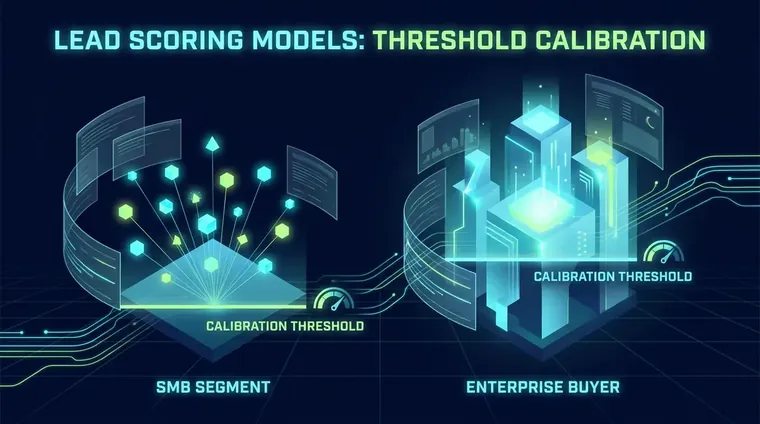
Multi-segment lead scoring models need separate score tracks per segment. One shared model produces contradictory MQL signals across SMB and enterprise.
One scoring model for SMB and enterprise is a guarantee of pipeline confusion. The behaviors that predict a $2,000 SMB close. Repeat pricing page visits, short email sequences, a single decision maker. Are almost the inverse of what predicts an enterprise deal. Enterprise leads take longer, involve more contacts, and show weaker early behavioral engagement. Run them through the same model and your SMB leads will outscore your best enterprise prospects every time.
The fix is separate score tracks per segment, triggered at form fill or first CRM classification. Salesforce Trailhead has solid documentation on object-level scoring rules that make this workable without doubling your admin overhead. The Zapier integration directory can bridge scoring outputs across tools if your CRM and MAP live in different stacks.
For clients running both predictive dialer sequences and inbound nurture tracks at the same time, segment-split scoring is not optional. It's the only way to keep the dialer queue from filling up with enterprise lookalikes who need six months of nurture before they're call-ready.
We audit your lead scoring models against closed-won data to pinpoint which weights are misdirecting reps. No retainer needed for the first session.
We pull your current lead scoring models against closed-won data and show you exactly which weights are sending your reps the wrong direction. No retainer required for the first session. Book the call →
What do you do in the first 90 days with no conversion data?
In the cold-start period, use ICP-fit signals and external firmographic triggers as proxy weights until you have 30+ closed deals to validate against.
The cold-start problem is real. Almost nobody addresses it. You need conversion data to calibrate lead scoring models. You need a calibrated model to start generating quality conversions. That loop has to be broken by hand. The way to break it is with ICP-fit proxies.
In the first 90 days, we weight external firmographic signals heavily: company growth rate, recent funding rounds, new leadership hires, M&A activity. HubSpot's own documentation flags these external signals as scoring inputs. They're noisier than behavioral data. But they're available before you have a single closed-won record to work with.
We also run tight negative scoring from day one to keep the queue clean. Wrong industry, wrong size, personal email. Costs nothing. Buys you time while the positive weights get validated. Before the Cash Buyers and Safeguard Impact chapters, our founder built and exited DeliveryLean. Still operating today as one of Florida's earliest food-service operators. That exit taught us that systems built for the first 90 days of data-scarcity are almost always different from systems built for steady state. Trying to run one model through both phases is where the debt accumulates.

Audited vs. Unaudited lead scoring models: what breaks
Audited lead scoring models surface higher close rates and fewer rep complaints; unaudited models generate false MQLs and erode sales trust within two quarters.
| Feature | Audited Quarterly | Set-and-Forgotten |
|---|---|---|
| Weight accuracy | Calibrated to last 90 days of closed-won data | Calibrated to launch-day assumptions |
| MQL threshold | Reviewed and adjusted per segment | Static — often wrong within 60 days |
| Negative scoring | Updated as new disqualifiers emerge | Usually missing or never expanded |
| Multi-segment handling | Separate score tracks per ICP | Single model, contradictory outputs |
| Rep trust in queue | High — model matches actual closers | Low — reps stop trusting scores by Q2 |
How should scoring models connect to your outreach stack?
Lead scoring models should gate CRM handoff, trigger dialer enrollment, and suppress nurture sequences. Not just produce a number that sales ignores.
A score that sits in the CRM and triggers nothing is a vanity metric. The real question is: what does the score actually fire? In our setups, crossing the MQL threshold kicks off three things at once. A CRM task for the assigned rep, enrollment in a predictive dialer sequence, and a suppression flag that pauses marketing nurture so the lead isn't getting cold emails while a rep is mid-call.
That three-way handoff requires your scoring tool, CRM, and dialer to talk in real time. Twilio Voice Programmable handles the telephony layer in most of our stacks. The Zapier integration directory fills the gaps where native connections don't exist between tools. TCPA compliance rules apply the moment a dial is triggered. We pull FCC TCPA guidance into every dialer enrollment workflow as a hard gate before the number hits the queue.
For a closer look at how this connects to the full automation picture, our marketing automation consultant breakdown and the CRM implementation services post cover the data-layer decisions that make or break scoring.
Frequently Asked Questions
How often should I audit my lead scoring models?
Quarterly is the minimum. Ideally every 60–90 days if your deal volume is high enough to generate fresh closed-won data. Markets and buyer behaviors shift faster than most teams update their weights. An unaudited lead scoring model becomes a liability within two quarters.
What's the biggest mistake companies make when setting an MQL threshold?
Setting it once and never revisiting it. The threshold that made sense at launch. Based on limited early conversion data. Is almost always wrong within 90 days. Too low and your sales team gets flooded; too high and your pipeline starves. Lead scoring models need threshold reviews tied to closed-won analysis, not gut feel.
Can one lead scoring model work for both SMB and enterprise leads?
Rarely. SMB leads show strong early behavioral engagement and convert faster; enterprise leads show weaker early signals and take significantly longer to close. Running both through a single set of lead scoring models produces contradictory MQL outputs. Separate score tracks per segment is the only clean fix.
What should I do with lead scoring models before I have enough conversion data?
Use external firmographic signals. Company growth, recent funding, new leadership hires. As proxy weights while you accumulate closed-won records. Pair that with aggressive negative scoring to strip obvious mismatches from the queue. Most lead scoring models should be considered provisional for the first 60–90 days and rebuilt once you hit 30+ closed deals.
Related reading
Ready to fix your lead scoring models?
We audit your existing lead scoring model against closed-won data, reset the thresholds, and build the multi-segment score tracks your pipeline is missing. It starts with one conversation. Our marketing automation agency runs the whole system. Not just the score. Book a call and bring your current model →