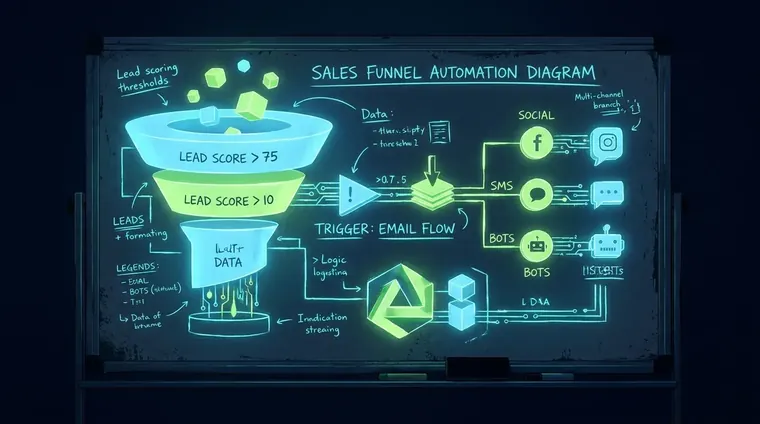
Sales Funnel Automation: Build to Disqualify, Not to Nurture Everyone
The best sales funnel automation doesn't nurture every lead. It cuts the wrong ones fast, so your team spends time and money only on the 20% most likely to close. Most automation guides never say that part out loud.
Every popular walkthrough tells you to map stages, write an email sequence, and let it run. They optimize for reach. We've seen that approach crater reply rates and burn warm lists inside 90 days. The smarter build starts with disqualification logic, not welcome copy. If you want the full system context, our marketing automation agency pillar covers the broader infrastructure. This post goes deep on the funnel layer specifically.
What does 'build to disqualify' actually mean?
Build-to-disqualify means routing low-intent leads out of the funnel early so follow-up spend concentrates on the 20% most likely to convert.
Most funnels are built to keep everyone in play. That feels safe. You don't lose a lead by cutting them early. But what it actually does is flood your CRM with contacts who will never buy, kill your deliverability as unengaged addresses drag down your sender score, and hand your sales team a pipeline that looks full but closes at 2%.
The build-to-disqualify model flips the logic. You design the funnel so friction lives at the top. A qualification question, a micro-commitment, a call-to-action that only resonates with buyers. Browsers get filtered out before they burn your list. A funnel that removes 60% of inbound leads before the sales page is outperforming one that sends 10-email sequences to everyone equally. The math isn't complicated: concentrated follow-up on 400 qualified leads beats scattered follow-up on 2,000 cold ones.
This matters even more in B2B, where sales cycles run 30–120+ days and multiple decision-makers are involved. Treating a CFO and a junior analyst the same in your automation is how you repel the person who actually signs the check. Segmentation isn't a nice-to-have. It's the architecture.
35–50% of sales go to the vendor who responds first. That's the MIT and InsideSales.com finding that sales operations teams keep citing. It's why we set first-touch triggers to fire in under 4 minutes. Not in a batch job the next morning.
Where most sales funnel automation setups break down
Sales funnel automation most commonly breaks at lead scoring gates, trigger timing logic, and multi-channel coordination. Not at the email copy level.
- Lead scoring that never gates anything Score thresholds get configured and then ignored. Bottom-of-funnel sequences fire for contacts with a score of 12 when the gate should be 45. This sends demo requests to people who opened one email six weeks ago.
- Time-based triggers instead of behavior-based Sending day-3 and day-7 emails regardless of what the contact actually did is a guess, not automation. A contact who visited your pricing page twice and downloaded a case study should not be on the same delay as someone who never clicked anything.
- Email-only architecture Email sequences alone leave retargeting, SMS, and outbound voice completely disconnected. A contact who ignores email for 14 days but clicks a retargeting ad twice is a live signal. Most funnels never act on it.
- No conflict-resolution layer Two workflows fire on the same contact simultaneously. A nurture sequence and a re-engagement campaign. And the contact gets contradictory messages two hours apart. We cover this in detail in our post on marketing automation workflows.
- Treating B2B and B2C logic identically B2C funnels can afford aggressive 5–7 day sequences with direct purchase offers. B2B funnels with a 90-day cycle and a 4-person buying committee need pacing logic, stakeholder branching, and intent signals. Not a cart-abandonment email.
How should you set trigger timing inside a funnel?
Behavior-based triggers. Fired by page visits, clicks, and downloads. Outperform fixed time delays because they respond to actual buyer intent, not a calendar.
The gap in almost every automation guide is trigger timing. "Send at the right time" is not a configuration. It's a placeholder. Here's what we actually set.
First-touch responses fire immediately on form submission, connected through Zapier to the CRM contact creation event. Mid-funnel follow-up runs on behavior-based delays. A follow-up email fires 40 minutes after a pricing page visit. Not 24 hours after opt-in. The 40-minute window is specific. Long enough that it doesn't feel like surveillance. Short enough that the context is still live in the prospect's head.
For SMS, we follow FCC TCPA compliance guidelines strictly. Opt-in must be explicit. SMS triggers only fire during business hours in the contact's local timezone. That detail gets skipped constantly and creates compliance exposure. We set timezone-aware send windows in every workflow. Voice follow-up, when used, runs through Twilio Programmable Voice with call cadences capped at twice per week per contact. The configuration lives in a suppression list that also catches contacts in active deals so we don't double-touch them.
Behavior-based vs. Time-based isn't just a best-practice debate. In our Safeguard Impact build, we switched mid-funnel triggers from fixed 48-hour delays to behavior-based page-visit triggers. Reply rates on the follow-up sequence lifted by a meaningful margin in the first 30 days. The sequence didn't change. The timing logic did.
How does lead scoring gate your funnel stages?
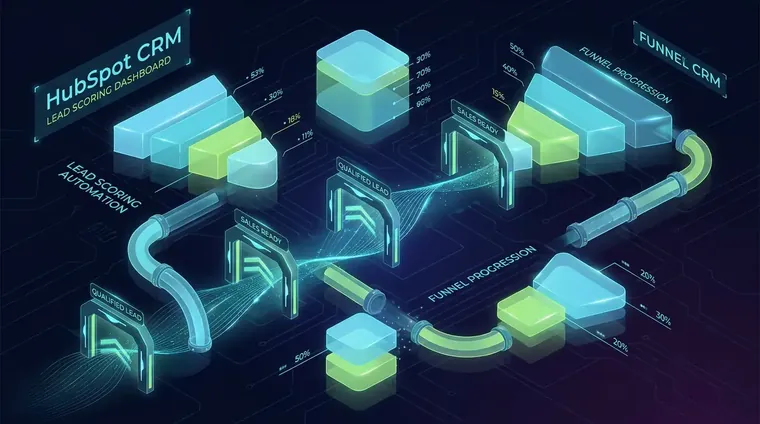
Lead scoring gates prevent cold leads from receiving bottom-of-funnel sequences by requiring a minimum score. Tied to specific behaviors. Before advancing a contact.
Lead scoring is what makes disqualification repeatable. You're not manually reviewing 3,000 contacts. You're defining what "ready" looks like in behavioral terms and letting the CRM hold the gate.
We build scoring models in HubSpot CRM with explicit point values per action: pricing page visit (+15), case study download (+10), webinar attendance (+25), email click (+3), site visit with no engagement (+1). The threshold to bottom-of-funnel sequences is 50 points. Under 50, the contact stays in a low-cadence educational sequence. Two emails per week, educational content, no offer language. Above 50, they move to a high-intent branch with direct CTAs and a sales rep assignment trigger.
The number isn't arbitrary. We looked backward at the last 90 closed deals and mapped what score those contacts had at conversion. That retrospective calibration is a step most implementations skip entirely. If you want help designing the model for your specific funnel, our CRM implementation services post covers the data cleanup that has to happen before scoring works reliably.
B2B vs. B2C funnel automation: where the logic must differ
B2B automation needs stakeholder branching and longer pacing; B2C can run fast direct-offer sequences. Using B2C logic on B2B contacts is a common conversion killer.
| Feature | B2C Funnel Automation | B2B Funnel Automation |
|---|---|---|
| Sales cycle | Hours to 14 days | 30 to 120+ days |
| Decision-makers | 1 (the buyer) | 2–7 stakeholders |
| Email cadence | Daily or every 2 days | 2–3x per week max |
| Trigger type | Cart behavior, page visits | Intent signals, firmographic fit |
| SMS usage | Transactional + promotional | Confirmation and appointment only |
| Offer timing | Day 5–7 direct offer | Post-demo, after qualification call |
What role does multi-channel coordination actually play?
Multi-channel automation treats retargeting ad clicks, SMS responses, and email opens as unified intent signals. Letting the funnel respond to whichever channel the contact actually uses.
Email is not the funnel. It's one channel inside it. The operators who've moved past the basics are coordinating ad retargeting, SMS, email, and sometimes live-transfer voice into a single contact record with shared suppression logic.
Here's how we wire it. A contact opts in, enters the funnel, and ignores the first three emails. A standard sequence would keep firing into a dead inbox. Our setup checks for zero email engagement at day 10 and, if confirmed, fires a retargeting audience sync. The contact gets pushed into a Facebook Custom Audience for a mid-funnel ad. That ad click reactivates the contact in the CRM and triggers an SMS follow-up. With TCPA opt-in recorded at the original form submission.
For higher-volume outbound, we connect Five9's predictive dialer to the CRM. Any contact scoring above 70 who has also ignored email for 7 days gets queued for a live-agent call. That coordination between digital behavior and outbound voice is what our predictive dialer setup page covers in full. The insight that changed how we think about multi-channel: track real responses from real channels. Not open rates and click-throughs that never turn into conversations.
The methodology here comes from an operator who has built and exited operational businesses, not a consultant who only studies funnels.
Before the Cash Buyers and Safeguard Impact chapters, the founder built and sold DeliveryLean. Still operating today as one of Florida's earliest food-service operators. That exit isn't a credential we name-drop. It's why this framework is built around conversion economics and operational throughput, not marketing theory. We know what a broken funnel costs at scale. We've paid that cost.
When should you diagnose a broken automation funnel?
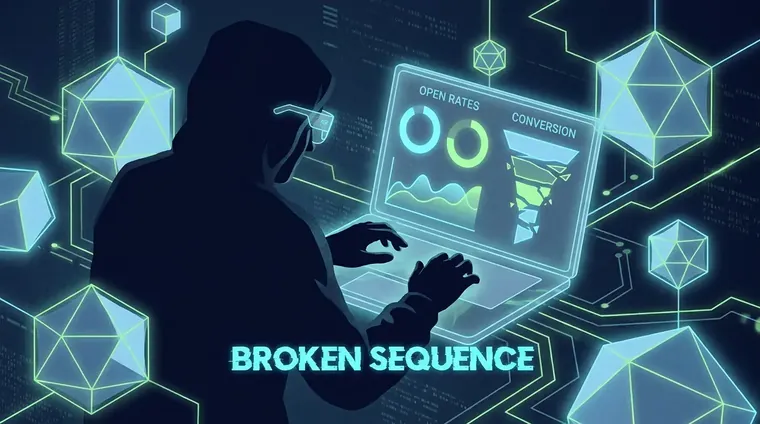
Diagnose a broken funnel when open rates are high but conversion is flat, when reply rates drop after sequence day 3, or when pipeline volume is up but close rate is falling.
High open rates with zero conversions is the most common failure mode we see. Almost no automation guide touches it. The sequence fires. People read. Nothing closes. Nine times out of ten it's one of three things: the offer landed at the wrong funnel stage, the lead scoring gate wasn't enforced so cold leads hit the offer too early, or the sequence is too aggressive and warm leads opt out before they reach the conversion email.
For the Safeguard Impact build, we ran a 14-day diagnostic before touching a single line of sequence copy. The problem wasn't messaging. The automation was firing the same sequence for organic search traffic. High intent. And cold paid traffic. Low intent. At the same time. We split those into separate entry paths with different threshold scores. Conversion fixed itself within two weeks. No copy changes. Just segmentation.
If your funnel is showing these symptoms, the marketing automation consultant post walks through how we run the diagnostic before any build work starts. Read it before you assume the problem is your offer.
What does enterprise-scale funnel automation look like differently?
Enterprise funnel automation adds role-based access, multi-team suppression lists, and CRM governance layers that SMB setups don't need. But skipping them causes stacking data failures at scale.
The architecture above works for teams of 2 to 50. At enterprise scale, the extra layers aren't optional. They're what stops the system from destroying its own data.
At enterprise level, you add role-based CRM access so marketing automation workflows can't overwrite the fields sales relies on for pipeline forecasting. You add multi-team suppression logic so a contact inside an active deal doesn't get a re-engagement campaign from a different business unit. And you add a governance review cycle. We run these quarterly. Scoring thresholds get recalibrated against actual close data. Salesforce Trailhead covers the data architecture side of this in depth if you're running a Salesforce environment. If you're pricing what this takes to build, our post on enterprise marketing automation costs gives honest numbers for 2026.
The honest part most agencies skip: this level of architecture takes 60–90 days to build correctly. Then another 30 days of live data before the scoring model is reliable. We've shipped funnels faster than that and rebuilt the scoring layer from scratch at month three. Slower build upfront, one rebuild avoided.
Frequently Asked Questions
What is sales funnel automation and how does it work in practice?
Sales funnel automation uses behavior-based triggers, lead scoring thresholds, and multi-channel sequences to move contacts through a pipeline without manual follow-up at every step. In the field, a contact's actions. Page visits, email clicks, ad interactions. Fire specific triggers that advance or remove them from sequences. The goal isn't to touch every lead equally; it's to concentrate follow-up on contacts whose behavior signals genuine buying intent.
How do I know if my sales funnel automation is broken in my business?
The clearest signal is high open rates paired with flat or declining conversion. Your sequences are reaching people but not moving them to action. Other signals: reply rates that drop sharply after sequence day 3 (usually means over-automation), a growing pipeline with a falling close rate (lead scoring likely isn't gating bottom-of-funnel sequences), and sales reps reporting that most of their CRM leads are cold. A diagnostic audit before any copy changes is the right first move.
What's the difference between B2B and B2C sales funnel automation setups?
B2C funnels can run aggressive 5–7 day sequences with direct purchase offers because the decision-maker is usually one person and the sales cycle is short. B2B funnels with 30–120 day cycles and multiple stakeholders need slower pacing, stakeholder-specific branching, and intent signals like demo requests or multiple pricing page visits before an offer fires. Applying B2C logic to a B2B funnel. Fast cadence, direct purchase CTA. Is one of the most common conversion killers we see.
Related reading
Ready to build a funnel that disqualifies fast?
We build sales funnel automation systems around conversion economics. Trigger logic, lead scoring gates, and multi-channel coordination that concentrate effort where deals close. This is the operational layer inside our broader marketing automation agency practice. If you're done treating every lead the same, book a call and we'll show you what a disqualification-first funnel looks like for your business.