B2B PPC Strategy That Actually Closes Deals
98% of B2B advertisers run Google Ads. Most of them can't tell you whether a single closed deal traced back to a paid click. That's the real problem with the conventional b2b ppc strategy playbook. It optimizes for clicks and leads while the revenue outcome stays invisible.
This is the operator-level answer. We've built paid programs for businesses running mid-market and enterprise sales cycles. The default "start with Google Search, layer in LinkedIn later" sequence burns cash on intent signals that don't convert. If you want the full picture on how we run paid acquisition end-to-end, start at our Google Ads Agency pillar. This post goes deep on B2B-specific execution.
Why does the standard B2B PPC sequence burn budget?
Starting with Google Search on B2B terms means paying for clicks from job seekers, students, and researchers who will never buy. Before you've validated a single message.
The average B2B buying cycle runs 11.3 months. The average buying group includes 11 decision-makers. And 70% of B2B research happens before a buyer ever contacts a vendor. None of those facts are compatible with a last-click Google Search campaign that calls itself a success when it generates a 'lead.'
Here's what the standard playbook misses. Google Search on B2B terms is flooded with non-buyer traffic. Job seekers searching 'enterprise procurement software' look identical to a VP of Operations ready to sign a contract. You pay the same CPC for both. We've seen clients burn 40–60% of their Search budget on non-ICP traffic before we got involved.
The smarter default. And I'll defend this in any room. Is to start with a tightly scoped LinkedIn ABM list to validate ICP messaging first, then port those proven messages into your Google Search copy and landing page architecture. Reverse the sequence. Stop letting Google Search set your messaging strategy.
LinkedIn ABM should precede Google Search in most mid-market B2B programs. Not follow it.
Most B2B PPC guides treat LinkedIn as a supplement to Google. That's backward. Run your ICP messaging on a controlled LinkedIn audience first. Find out what converts. Then take it to Search and scale.
How should you allocate budget across funnel stages?
A working B2B PPC budget typically splits 20% awareness, 40% consideration, and 40% decision. Adjusted based on deal velocity and pipeline data, not platform defaults.
None of the top-ranking B2B PPC guides touch this. They list platforms, pick Google and LinkedIn, and leave you guessing. Here's how we actually split spend for a client with a 6–12 month sales cycle.
Awareness (roughly 20% of budget): Performance Max campaigns and LinkedIn Sponsored Content aimed at target account lists. Goal: impressions and dark-funnel conditioning, not form fills. Consideration (roughly 40%): Google Search on high-intent, tightly-filtered keywords plus LinkedIn retargeting to the same account list. Decision (roughly 40%): Branded Search, competitor conquesting, and deep retargeting sequences with frequency caps set manually. Not left to platform defaults.
These splits move with your data. If pipeline velocity slows, shift consideration budget into decision-stage sequences and cut awareness entirely. Every dollar needs a rationale before it's spent. That's not Google's Recommendations tab talking. That's the job.
What does a tight negative keyword list look like for B2B?
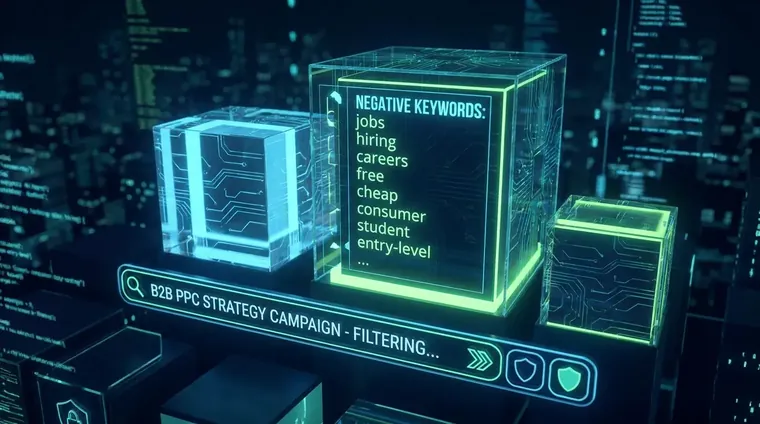
B2B negative keyword lists must block job seeker, student, and consumer-intent queries. Often 200–400 negatives before a campaign goes live.
- Block job-seeker traffic first Add 'jobs', 'career', 'salary', 'resume', 'intern', 'entry level', and 'hiring' as exact and phrase-match negatives before launch. A single mid-market B2B term can attract more job seekers than buyers.
- Filter student and research intent Terms like 'what is', 'definition', 'how does', 'essay', 'case study', and 'university' pull in researchers with zero purchase intent. They inflate click volume and tank your conversion rate.
- Remove consumer-grade modifiers Words like 'free', 'cheap', 'DIY', 'template', and 'small business' often signal a buyer who can't afford your product. If your ACV is $50K+, these are budget leaks, not prospects.
- Audit search terms weekly for the first 60 days We pull Google Ads Editor search term reports every Monday for the first two months of any new campaign. New pollution queries show up constantly. The list is never done.
- Separate branded and non-branded negatives Keep your negative keyword lists in separate shared libraries by category. Job terms, education terms, consumer terms, competitor terms. Mixing them makes audits a mess.
Why does bid strategy choice make or break B2B campaigns?
Target CPA bidding requires 30–50 conversions per month to exit learning phase. Most B2B campaigns never hit that volume, making manual CPC or Target Impression Share safer defaults.
This is the one that quietly kills B2B programs. Smart Bidding strategies like Target CPA work beautifully when you have conversion volume. They're destructive when you don't.
Google's own documentation says Target CPA needs 30–50 conversions per month to stay out of learning phase. Most B2B campaigns generate 5–15 leads per month on a good day. Half of those aren't SQLs. Running Target CPA in that environment means the algorithm optimizes on noise. It finds the cheapest form fills, not the most valuable prospects.
Our default for new B2B campaigns: manual CPC for the first 60–90 days while we build conversion history. Then we layer in Target Impression Share on branded and competitor terms. We only move to Target CPA after we've imported offline conversions tied to closed-won deals. Not form submits.
How do you actually close the loop with offline conversion import?
Offline conversion import lets you feed closed-deal data from your CRM back into Google Ads so Smart Bidding optimizes on revenue, not form fills. Most B2B teams never set this up.
Everyone says "connect your CRM." Nobody explains what that actually means.
Enhanced Conversions and offline conversion import are the mechanism. Short version: a lead submits a form, your CRM captures the Google Click ID (GCLID). That lead closes into a deal. 90, 180, 270 days later. You upload that GCLID back to Google Ads with a conversion value. Google's bidding algorithm now knows that this keyword, this ad, this audience segment produced revenue. Not just a lead.
We've run this for clients with 9-month average sales cycles. The signal lag is brutal. But without it, you're asking Smart Bidding to optimize on form submissions. Many of those are job seekers or tire-kickers. CPCs drift toward low-quality, high-volume queries fast. The setup is a one-time engineering project. 4 to 8 hours. It pays for itself in the first month of cleaner bid signals.
For more on how our paid and organic programs run in parallel, our Facebook Ads Agency page covers the social side of the same attribution problem.
We review your current campaign structure, conversion tracking, and bid strategy before touching spend. So nothing breaks during the transition.
Clicks without closed deals means the problem is upstream of the ads. Book a strategy call and we'll go through your tracking setup, bid strategy, and negative keyword coverage before we touch the spend.
What is the 'dark funnel' and why does it wreck attribution?
The dark funnel is B2B research that happens in Slack communities, analyst reports, and peer recommendations. It influences buying decisions but never appears in your ad attribution data.
Dennis F., PPC Team Lead at NinjaPromo, said it plainly: *'In B2B, you're guiding the user through 45 touchpoints before they even consider a decision.'* The problem is that roughly half those touchpoints are invisible to your ad platform. A buyer reads a G2 review. They see your brand in a Slack community. A peer sends a referral. Six weeks later they click your branded Search ad and convert. Last-click credits the Search ad. The Slack mention gets nothing.
This is why branded Search volume is a leading indicator of dark funnel health. When our content programs or LinkedIn campaigns are working, branded Search volume climbs. Usually with a 30–60 day lag. We track that correlation manually in Google Search Central data alongside our paid dashboards. It's not a perfect signal. But it's the closest proxy we have for upper-funnel influence on closed deals.
The agent stack Receipts Group ships isn't a 2024 ChatGPT wrapper. It's a decade of operator-built programmatic SEO infrastructure. That matters here because dark-funnel conditioning runs on content velocity and brand presence, not just ad impressions. Paid and organic have to run together, or the attribution gap stays broken. See what that looks like in the field at our ecommerce PPC breakdown.

LinkedIn ABM-first vs. Google Search-first: which wins for B2B?
LinkedIn ABM-first validates ICP messaging at lower risk before scaling into Search. Google Search-first spends budget proving what LinkedIn would have shown you for less.
| Feature | LinkedIn ABM-First | Google Search-First |
|---|---|---|
| Message validation | Test 3–5 angles against a known ICP list before spending on Search | Let Search query intent dictate messaging — reactive, not strategic |
| Non-ICP traffic risk | Low — you define the audience by company, title, and seniority | High — job seekers, students, and researchers pollute early data |
| Bid strategy risk | CPM-based — no learning phase dependency on conversion volume | CPC/CPA bidding needs conversion volume B2B rarely achieves early |
| Attribution clarity | Account-level engagement maps to target account list — auditable | Last-click attribution hides the actual influence chain |
| Cost to validate | $3K–$8K to validate ICP messaging across a 500-account ABM list | $10K–$30K+ to gather enough Search data to trust the signals |
Frequently Asked Questions
What makes a B2B PPC strategy different from a B2C one in practice?
In B2B, you're optimizing for a buying group of 6–11 people across an 11-month sales cycle. Not a single impulse buyer. That means bidding strategies that need high conversion volume (like Target CPA) often fail, and tactics like flash discounts can actually damage your brand perception with enterprise buyers. The mechanics of keyword targeting, bid management, and attribution all need to be rebuilt around a long sales cycle, not borrowed from B2C playbooks.
How much should I budget for a B2B PPC strategy to start seeing results?
There's no universal number, but $5,000–$10,000 per month is typically the floor for generating enough conversion data to make bid optimization meaningful. Below that, you're often in perpetual learning phase. The more important question is budget allocation: how much goes to awareness, consideration, and decision-stage campaigns? A $5K budget split 20/40/40 across funnel stages will outperform a $15K budget dumped entirely into broad-match Search.
When should a B2B company in the mid-market use LinkedIn Ads vs. Google Ads?
LinkedIn is better for message validation against a known ICP before you've proven what works. Google Search is better for capturing buyers who are already in active evaluation mode. For most mid-market B2B deals, we recommend running a LinkedIn ABM campaign first. Even for 4–6 weeks. To validate messaging, then porting the angles that generate engagement into Google Search ad copy and landing pages. Running both from day one without a validation layer usually means Search inherits untested messaging.
How do I set up offline conversion import for a B2B Google Ads campaign?
The process requires capturing the Google Click ID (GCLID) in your CRM at form submission, then uploading that GCLID back to Google Ads when the deal closes. Along with a conversion value. Google's Enhanced Conversions documentation covers the API approach. In the field, it's a 4–8 hour engineering project involving your CRM, your website's form handler, and a scheduled data upload or Zapier-style automation. Most B2B teams skip this step and end up with Smart Bidding optimizing on form fills. Many of which are non-buyers.
What bid strategy suits a B2B PPC campaign with low conversion volume?
Start with manual CPC or Target Impression Share. Not Target CPA. Google's Smart Bidding needs 30–50 conversions per month to exit learning phase. Most B2B campaigns generate 5–15 leads per month at best, and many of those aren't sales-qualified. Running Target CPA before you have that volume means the algorithm optimizes on noise. Manual CPC gives you control while you build conversion history, and Target Impression Share works well for branded and competitor terms where volume isn't the goal.
Related reading
Ready to build a B2B PPC strategy that ties to closed revenue?
We audit your conversion tracking, rebuild your campaign structure around your actual sales cycle, and set up offline conversion import so your bidding optimizes on deals. Not form fills. Every move is backed by screenshots from tools we don't own.
Start with our Google Ads Agency overview to see the full program. Or book a strategy call and we'll walk through your current campaigns in the first 30 minutes.