

How to Choose a Law Firm PPC Agency That Doesn't Burn Budget
If you've searched *law firm ppc agency* in 2026, the SERP is a wall of generic agency landing pages without an actual definition of what makes one good. Every page claims 'legal industry expertise.' None of them show you the account structure, the keyword match-type logic, or the negative keyword lists that separate agencies that compound returns from agencies that quietly hemorrhage 40–60% of your monthly budget on irrelevant clicks. This post is the canonical answer that SERP is missing — grounded in real practice-area economics, account architecture decisions, and the KPIs your agency should be reporting before you ever sign a retainer. For the broader picture of how paid acquisition fits your firm's growth stack, start with our Google Ads agency guide.
Why Does Account Structure Matter More Than 'Legal Experience'?
Poor match-type settings and under-segmented ad groups waste 40–60% of legal ad spend before a single qualified lead is reached.
The contrarian truth most law firm ppc agency pitches skip: the reason legal PPC underperforms is almost never a lack of industry knowledge. It's a structural problem. Specifically, it's agencies running broad match keywords — terms like *lawyer* or *attorney* — inside monolithic ad groups that mix high-intent queries ("car accident attorney near me") with no-intent queries ("what does an attorney do") and serve the same ad copy to both.
Legal CPCs on Google Search are among the highest across all advertising sectors. Personal injury keywords routinely hit $50–$200+ per click in major metros. When a broad match keyword pulls in irrelevant traffic at $150 a click, the damage is invisible unless you're auditing search term reports weekly. Most firms aren't — and most agencies aren't volunteering that data.
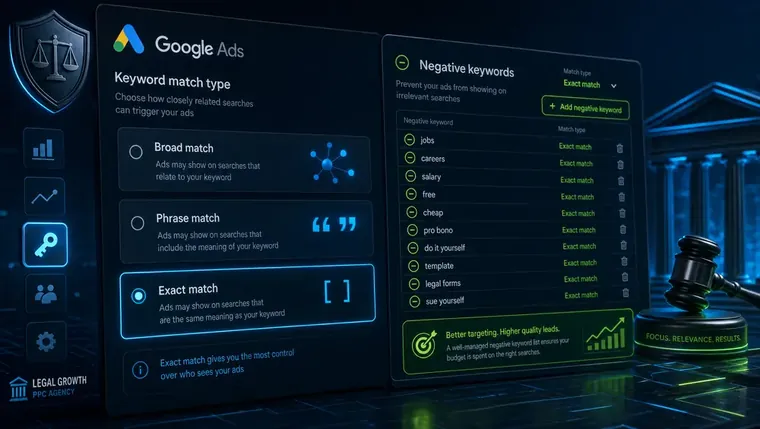
The fix is account architecture: exact match and phrase match keywords segmented into tightly themed ad groups by intent stage (awareness vs. ready-to-hire), supported by an aggressive negative keyword list that excludes terms like *pro bono*, *law school*, *paralegal jobs*, and *free consultation template*. Smart Bidding strategies like Target CPA only work correctly when the underlying signal — the clicks feeding the algorithm — is clean. Garbage-in, garbage-out applies as much to machine learning as it does to a spreadsheet.
- Search Term Report Analysis Pull 90 days of actual search terms triggering your ads. Any agency worth hiring will show you the percentage of spend going to non-practice-area queries — a healthy account keeps this below 10%.
- Match Type Distribution A well-structured legal account leans on exact and phrase match for high-CPC terms and uses broad match sparingly, only with robust negative lists and Smart Bidding targets already tuned.
- Ad Group Segmentation by Intent Separate campaigns for branded, competitor, practice-area generic, and geo-modified terms. Mixing these collapses Quality Score and makes budget allocation impossible to optimize.
- Negative Keyword List Depth Legal accounts should carry 300–600+ negatives at launch: job-seekers, students, DIY legal, and out-of-jurisdiction geography terms. Ask any prospective agency to share their starter list.
- Conversion Tracking Integrity Verify that form fills, phone calls, and chat interactions are all firing separately — and consider Enhanced Conversions to recover the signal lost from cookie-blocking and iOS privacy changes.
How Should PPC Strategy Differ by Practice Area Economics?
A PI firm on contingency can sustain a $500 CPL; an hourly family law firm often cannot exceed $150 — the math should drive every budget decision.
One gap no competitor page addresses: the math is different depending on how your firm makes money, and that math should be the foundation of every budget and bidding decision a law firm ppc agency makes on your behalf.
A personal injury firm operating on contingency fees can absorb a $400–$600 cost-per-lead because a single signed case worth $50,000 in fees justifies months of ad spend. That same CPL would be catastrophically expensive for a family law firm billing at $300/hour, where a typical case generates $3,000–$8,000 in total fees. The right agency maps your lifetime case value by practice area before setting a Target CPA in any Smart Bidding strategy — not after.
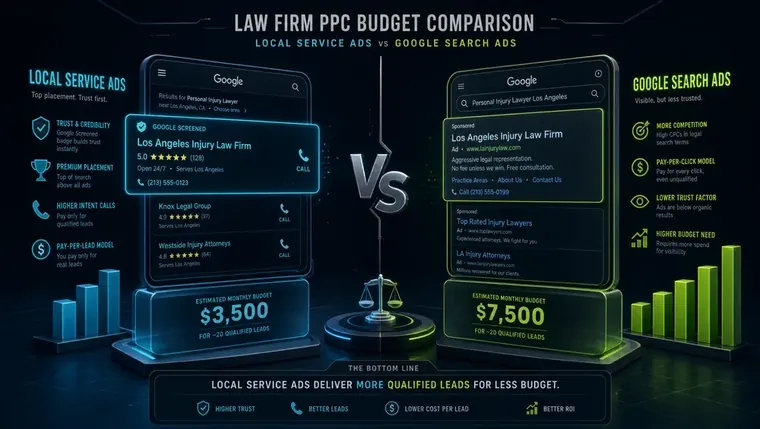
This practice-area economics lens also determines which ad product to deploy. Local Service Ads charge per verified lead (not per click), require Google Screened background verification, and appear above standard Search ads in the SERP. For high-volume, lower-case-value practices like immigration or family law, LSAs can deliver leads at $40–$120 each — a fraction of Search Ads CPL in competitive markets. For personal injury, where a single qualified lead warrants a $150+ CPC, branded Search campaigns with tightly controlled geo-targeting typically outperform LSAs on case quality even when LSAs appear cheaper on a per-lead basis.
The Sobo & Sobo case study from Digital Silk demonstrates exactly this kind of structural clarity: by syncing Google Ads with HubSpot and refining geographic targeting — rather than just increasing spend — the firm achieved a 430% return on media spend and 100% tracking accuracy within 90 days. The lever wasn't budget. It was attribution and geography. See how this dovetails with our broader Facebook Ads agency strategy for firms running multi-channel acquisition.
Local Service Ads pay-per-lead model sounds cheaper — until you factor in that Google controls lead quality, and you can't A/B test landing pages or messaging. Search Ads give full creative and bidding control but require disciplined negative keyword management to justify $50–$200 CPCs. The right answer is almost always both — with separate budgets and separate KPIs for each.
Local Service Ads vs. Google Search Ads for Law Firms
LSAs suit high-volume, lower-margin practices; Search Ads suit PI and complex litigation where case value justifies high CPCs.
| Feature | Local Service Ads (LSAs) | Google Search Ads |
|---|---|---|
| Billing model | Pay per verified lead | Pay per click |
| Typical cost range | $40–$120 per lead | $50–$200+ per click |
| Creative control | None — Google sets format | Full headline, description, extension control |
| Landing page testing | Not applicable | Full A/B and multivariate testing |
| Verification requirement | Google Screened background check required | No verification — faster to launch |
| Best practice area fit | Family law, immigration, estate planning | Personal injury, mass tort, criminal defense |
How Do You Evaluate Whether Your PPC Agency Is Actually Performing?
Demand search term reports, CPL by practice area, and impression share data weekly — any agency that resists is hiding performance problems.
Most firms evaluate their law firm ppc agency by checking whether the phone rings more this month than last. That's a dangerous proxy. Here's what your monthly reporting should actually contain — and what red flags look like when it doesn't.
Demand these five report elements every cycle: (1) Search term report with spend distribution by query — you want to see what you're actually paying for; (2) CPL broken out by campaign and practice area, not blended across the account; (3) Impression share and lost impression share by reason (budget vs. rank) — this tells you whether you're competitive or just underbudgeted; (4) Conversion event breakdown — form fills, tracked calls, and chat interactions should be reported separately, not lumped into a single 'conversion' number; (5) Geographic performance — spend and lead volume by city or zip, especially relevant if bar admission limits your serviceable area.
A tool like Google Ads Editor gives any sophisticated agency the ability to pull and share clean account-level exports — if your agency can't produce this data on request within 24 hours, treat that as a structural red flag, not an administrative delay.
For reference: FirmPilot's proprietary *competitive blueprinting* approach — analyzing how competitors in a firm's local market are positioning ads — is one concrete example of what differentiated agency methodology actually looks like in practice, even if their AI-managed model isn't right for every firm. The principle applies regardless of platform: your agency should be studying competitor ad positioning in your geography, not just managing your keywords in isolation. For further reading on attribution methodology that applies across channels, Google Search Central covers the technical foundations that any agency's tracking setup should be built on. You can also benchmark your paid acquisition expectations against what a specialist ecommerce PPC agency and a dental PPC agency are expected to deliver — the structural principles transfer even when the verticals differ.
Ask any prospective law firm ppc agency: *Can you show me a redacted search term report from a current legal client account?* A confident, well-run agency will pull one in under five minutes. An agency that deflects, explains why that's proprietary, or schedules a follow-up to provide it is telling you exactly how much visibility you'll have into your own budget once you sign.
Frequently Asked Questions
What does a law firm PPC agency in 2026 actually manage day-to-day?
A law firm PPC agency should be managing keyword match types, negative keyword lists, ad group segmentation by intent, bid strategy tuning via Smart Bidding, and weekly search term report review. In practice, many agencies set campaigns live and make minimal adjustments — ask any prospective agency to describe their weekly optimization cadence in specific terms before signing a contract.
How much should a law firm expect to spend on PPC advertising?
Budget depends heavily on practice area. Personal injury firms in major markets routinely spend $10,000–$50,000+ per month on Google Search Ads given $50–$200+ CPCs. Family law and immigration firms can compete meaningfully at $3,000–$8,000/month by combining Local Service Ads (pay-per-lead at $40–$120) with tightly geo-targeted Search campaigns.
Are Local Service Ads or Google Search Ads better for law firms?
It depends on your practice area economics. Local Service Ads charge per verified lead ($40–$120 typically) and suit high-volume, lower-margin practices like family law or immigration. Google Search Ads offer full creative control and suit personal injury or complex litigation where case value justifies $100–$200+ CPCs. Most law firms benefit from running both with separate budgets and separate KPIs.
What red flags should a law firm watch for in PPC agency reporting?
Watch for blended 'conversion' numbers that don't break out calls vs. form fills, CPL reported as an account average rather than by practice area, absence of search term reports in monthly updates, and geographic performance data withheld as 'proprietary.' Any agency that can't produce a clean search term export via Google Ads Editor within 24 hours of a request is a structural concern.
Related reading
Ready to Audit Your Legal PPC Account?
Receipts Group audits law firm PPC accounts against the structural criteria outlined on this page — match types, negative lists, intent segmentation, and attribution integrity. If your current agency can't explain their account structure in plain terms, it's time for a second opinion. Start with our Google Ads agency overview to understand the full framework, then book a free account audit and we'll show you exactly where your budget is going.