

A Competitor SEO Analysis Framework Built on Retreat Signals
Last month we audited 12 home-services sites — HVAC, roofing, plumbing — all chasing overlapping keyword sets in mid-size metros. The pattern that emerged wasn't about who had the best content or the most backlinks. It was about timing. In every market where a client had made meaningful organic gains in the previous quarter, we found the same thing upstream: a competitor's previously top-10 page had been slipping for 60–90 days on a keyword the client also targeted. The seat wasn't empty — it was being vacated. That observation reframes the entire discipline. Competitor SEO analysis isn't a one-time audit you run before writing a content calendar; it's a continuous monitoring loop designed to catch those retreat signals before anyone else does. If you haven't stress-tested your current SEO strategy against this lens, start with our SEO Audit service — it's the diagnostic foundation this framework builds on.
Why does a competitor's declining page beat a keyword gap?
A competitor's declining page is a higher-conviction opportunity because the ranking seat is already warm and actively being vacated, reducing displacement risk.
Keyword gap tools are genuinely useful — Semrush's Keyword Gap tool lets you paste up to five competitor domains simultaneously for bulk comparison, and Ahrefs' Content Gap report with the 'Main positions only' toggle strips out SERP feature rankings (Top Stories, Image Packs) to surface only true organic position gaps. Both are worth running. But the output they produce is a list of places you *aren't* — it tells you nothing about the cost of entry or how stable that opportunity is.
A competitor's page-level ranking decline is structurally different. When a page that held position 4 for a keyword you both target has drifted to position 11 over 90 days, you're not displacing an entrenched incumbent — you're filling a vacuum. The keyword has demonstrated commercial intent, the SERP has already decided that topic deserves a result, and the current occupant is losing grip. That is a materially lower-risk entry point than any gap a tool surfaces cold.
The signal to watch isn't just rank movement in isolation. Cross-reference with traffic: Semrush's Traffic & Market Toolkit breaks traffic out by channel — organic, paid, AI referrals, social, email, display — so you can confirm whether a ranking drop is translating into real traffic loss for that competitor. If their organic share is declining on a keyword cluster while their paid spend on those same terms is flat or rising, they've likely decided the organic fight isn't worth the investment anymore. That's your green light.
Most competitor SEO analysis frameworks are built around imitation — find what ranks, replicate the format, acquire similar links. The faster path is inversion: find what competitors have stopped investing in, and move into that space before the SERP resets. A warm seat fills faster than a cold one.
How do you triage gaps you can't realistically close?
Use a two-axis triage — Domain Rating disparity versus content investment required — to decide whether to attack, avoid, or wait on each gap.
Not every gap you find is actionable. One thing no standard competitor analysis framework addresses is what to do when the data shows an opportunity that's technically real but practically out of reach — a term dominated by a site with a Domain Rating 40 points above yours, requiring a 3,000-word authoritative guide plus significant link acquisition to compete.
Attack vs. Avoid vs. Wait is the triage decision every operator needs to make explicitly. Here's the framework we use:
- Attack: DR disparity ≤15 points, competitor page has declining rankings, content format gap exists (e.g., they have a blog post, no interactive tool or video). Act within 30 days. - Wait: DR disparity 16–30 points, competitor traffic is flat but not declining. Monitor monthly; act when the decline signal appears. - Avoid (for now): DR disparity >30 points, competitor has deep topical authority and a growing backlink profile on that cluster. Redirect resources to flanking keywords.
This approach pairs naturally with architecture-level analysis. Ahrefs' Site Structure report, for instance, showed that Venngage directs 260,000 estimated monthly visits — 9.9% of total organic traffic — to its /templates subfolder alone. That kind of architecture data tells you which content categories a competitor is doubling down on and where their internal linking is channeling PageRank. If they're pushing link equity toward /templates and away from /blog, they're signaling a strategic bet you can factor into your own triage.
For the technical foundation of this kind of architecture work, our SEO Website Design service covers how site structure decisions affect crawlability and PageRank distribution at the build level.
What signals trigger an unscheduled re-analysis?
Algorithm updates, a competitor site relaunch, or a sudden traffic shift of 20%+ on shared keywords are the three triggers for an immediate unscheduled re-analysis.
- Core algorithm update confirmed When Google Search Central confirms a core update rollout, re-run your competitor ranking snapshots within 72 hours of stabilization — volatility during the rollout makes early data misleading.
- Competitor site relaunch or migration A URL structure change, domain migration, or major redesign often causes temporary ranking disruption. That window — typically 4–12 weeks — is when competitors are most vulnerable on terms you share.
- Sudden traffic shift on shared keywords A 20%+ organic traffic swing on keywords you both target (visible via Semrush Traffic Analytics or PageSpeed Insights anomaly flags) warrants an immediate look at what changed in their on-page or technical setup.
- Competitor acquires a high-DA linking domain If their backlink profile shows a sudden influx of high-authority links — use Semrush Bulk Backlink Analysis to check Authority Score shifts — the competitive gap may be widening faster than your scheduled cadence would catch.
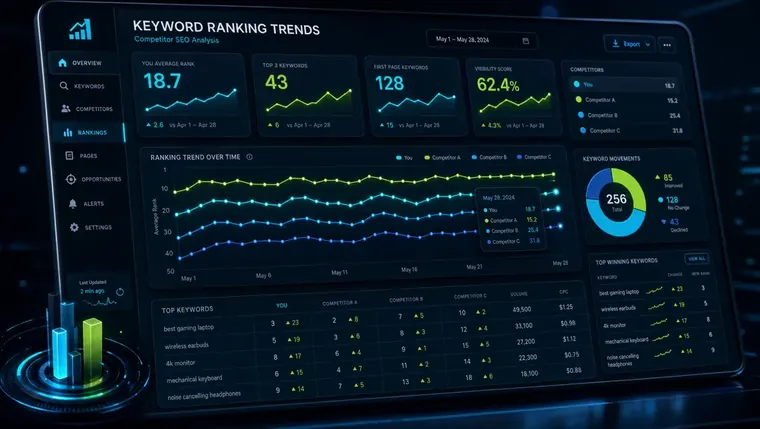
Scheduled cadence vs. trigger-based re-analysis: when to run what
Run keyword gap analysis monthly, backlink gap quarterly, and architecture analysis twice yearly — then override with trigger-based checks when a competitor signal fires.
| Feature | Scheduled Analysis | Trigger-Based Analysis |
|---|---|---|
| Keyword gap (ranking declines) | Monthly snapshot | Immediately after confirmed core update |
| Backlink gap (Ahrefs Link Intersect) | Quarterly | After competitor acquires 10+ high-DA links in 30 days |
| Site architecture & internal linking | Twice yearly | After competitor publishes a new subfolder or silo |
| Content format audit | Quarterly | After competitor launches a new tool or video series on shared topics |
| Traffic source mix (AI referrals, organic, paid) | Monthly via Semrush Traffic Toolkit | After a competitor announces a paid media strategy shift |
How does content format analysis fit into competitor SEO?
Analyzing the formats competitors use — not just the topics — reveals structural gaps where a different content type can outrank an established page.
Most analyses stop at topic gaps. Format gaps are rarer to find but faster to act on. The logic is simple: if a competitor dominates a cluster of informational keywords with long-form blog posts but has zero video, interactive tools, or structured-data-rich pages in those same SERPs, the format distribution in those results is lopsided. Google's Search Quality Rater Guidelines emphasize serving user intent in the most useful format — and 'most useful' is partly a function of what's already available.
A practical workflow: pull the top 20 ranking URLs for a competitor's core keyword cluster. Classify each by format — article, tool, video embed, template, comparison table. If 18 of 20 are standard articles with no structured markup (check against Schema.org standards for the content type), you have a format arbitrage opportunity that doesn't require a DR edge to win.
This also connects to the Ahrefs Featured Snippet gap workflow: set the target's domain as competitor input, your domain as the main domain, filter SERP features to 'Featured snippet' under 'Where target ranks.' Any snippet your competitor holds that your pages are eligible for — based on topical proximity — is a format-level optimization problem, not a content gap problem. Restructuring an existing page to answer the implied question directly often moves faster than publishing new content. For a deeper technical walkthrough of how on-page structure affects these outcomes, see our article on Technical SEO Audit Services That Actually Get Fixed.
For operators who want to connect this analysis to broader keyword strategy decisions, our overview of the Best AI SEO Tools for 2026 covers which tools handle format and SERP feature analysis most reliably at scale.
Crawl a competitor's site with any standard crawler and sort pages by inbound internal links. The pages sitting at the top of that list aren't accidents — they're the bets that team has decided are worth winning. If those pages overlap with your target keywords, you're in a direct competition for PageRank distribution, not just content quality. Cross-reference with our SEO Audit Checklist That Starts With a Hypothesis for a structured way to document what you find.
Frequently Asked Questions
How often should I run a competitor SEO analysis for a small business?
For most small businesses, a monthly keyword-gap check and a quarterly backlink and content format review is sufficient. If a core algorithm update rolls out or a competitor relaunches their site, run an unscheduled analysis within a week of the event stabilizing — those windows often produce the clearest signals.
What's the fastest signal that a competitor is retreating from a keyword?
Page-level rank decline on a keyword you both target, sustained over 60–90 days, combined with a drop in estimated organic traffic to that specific URL. If their paid spend on those same terms is flat or increasing while organic slips, that's a strong indicator they've deprioritized the organic fight — your clearest entry signal.
Can I run a useful competitor SEO analysis without a paid tool subscription?
You can get meaningful directional data using Google Search Console (for your own performance), Google's site: operator for indexation checks, and free tiers of tools like Ahrefs or Semrush for limited keyword and backlink lookups. For the traffic-source and bulk-domain analysis described in this framework, a paid tier becomes necessary — but even free data surfaces retreat signals if you're tracking consistently.
How do I analyze a competitor's internal linking structure?
Use Ahrefs' Site Explorer or Screaming Frog (with JavaScript rendering enabled) to crawl any public domain and sort pages by inbound internal link count. The top pages in that list reveal where the competitor is concentrating PageRank — which is a direct read on their content prioritization. If those pages overlap with your target keywords, treat them as primary competitive targets, not secondary ones.
Related reading
Ready to build this into your growth process?
Competitor SEO analysis is only as useful as the infrastructure you use to act on it. The Receipts Group SEO Audit gives you a hypothesis-driven baseline — the documented starting point that makes every future round of competitor monitoring faster and more precise. If you want to connect your competitor findings to a site structure that's actually built to capture retreating rankings, explore our SEO Website Design service. Both are designed to work together. Start with the audit — it tells you where to point everything else.