

The SEO Audit Checklist That Starts With a Hypothesis
63% of pages that pass a standard technical SEO audit still have zero organic traffic after six months. They're indexed, they're crawlable, their Core Web Vitals are green — and yet nothing moves. That number isn't a fluke; it's the predictable outcome of running a checklist in the wrong direction. Most SEO audit checklists are organized the way a filing cabinet is organized: logical, comprehensive, and completely indifferent to what actually matters for *your* site right now. Our full SEO Audit methodology flips the sequence — and this post breaks down the exact checklist we use when we do it.
Why Does the Standard SEO Audit Checklist Fail?
The standard checklist fails because it treats all findings as equal, burying high-impact fixes under low-stakes hygiene tasks.
Here's the trap every conventional seo audit checklist sets: it opens with crawlability, marches through on-page signals, then arrives at content depth and authority somewhere around hour three. By the time you're looking at the items that actually explain why a site isn't ranking, you've burned half the budget on confirming that the XML sitemap is valid.
According to PFP Marketing's 2026 audit research, 'most ranking problems live in Layers 4 and 5' — content depth and AI visibility — not in the crawl-and-index layer where every standard checklist begins. A 100-page site takes 8–12 hours of senior strategist time to audit properly; a 1,000-page site takes 20–30 hours. Running that clock through low-stakes items first is how audits become expensive reports that collect dust.
The contrarian framing we use at Receipts Group: form a hypothesis before you open a single tool. Why do you think this site isn't ranking? Thin content competing against established topical authorities? A botched migration that left redirect chains longer than two hops? Keyword cannibalization across a blog archive? Your hypothesis determines which layer of the checklist you attack first — and which layers you can safely skim or skip entirely for this cycle.
Write your hypothesis in one sentence before touching any tool: *'This site isn't ranking because [specific reason].'* Every item on your seo audit checklist should either strengthen or eliminate that hypothesis. If a checklist item can't do either, it goes to the backlog — not the sprint.
What Does a Hypothesis-First Audit Actually Check?
A hypothesis-first audit prioritizes the specific failure layer — content, cannibalization, migration damage, or technical — based on site symptoms before any tool is opened.
- Keyword Cannibalization Mapping Export all ranking URLs from Google Search Console, then group by root keyword intent. If two or more pages share near-identical primary queries, you have cannibalization — consolidate or differentiate before any on-page work. None of the standard checklists give you a method for this; they just name it.
- Post-Migration Redirect Audit Recently redesigned or migrated sites have a distinct failure pattern: redirect chains longer than two hops, orphaned pages that lost their canonical equity, and 301s pointing to soft-404s. Audit these as a dedicated pass — the steady-state checklist will miss the scope. Check crawl depth too: no important page should be more than **4 clicks from the homepage**.
- Indexed-But-Dark Page Diagnosis When Google Search Console shows a URL as 'indexed' but organic traffic is zero, you're not dealing with a crawl problem. You're dealing with relevance, authority, or — increasingly — AI-visibility collapse. Use the URL Inspection Tool (not `site:` searches, which return pattern matches, not exact URL status) to confirm index status, then pivot to content and schema signals.
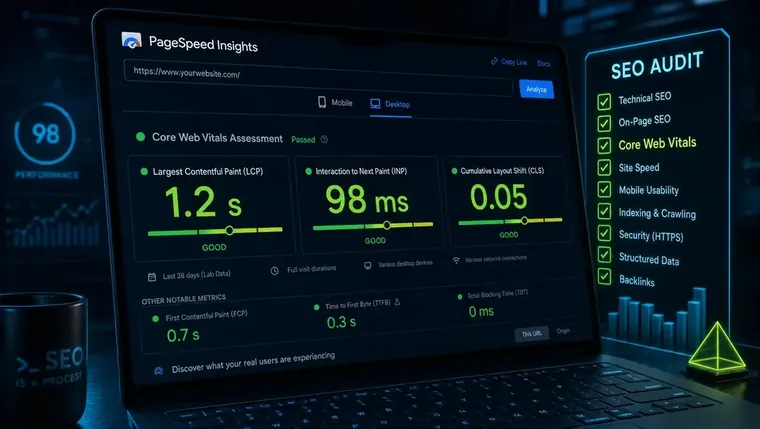
- Core Web Vitals Threshold Check Passing means hitting the 75th-percentile threshold on all three metrics across real-user data: **LCP ≤ 2.5s, CLS ≤ 0.1, INP ≤ 200ms**. Run PageSpeed Insights on your top 10 revenue pages first — not site-wide averages. A single high-traffic page failing INP can suppress the entire domain in mobile rankings.
- AI Visibility Layer ChatGPT, Perplexity, Claude, and Google AI Overviews now cite sources directly. Audit whether your brand appears in AI-generated answers for your core queries. Operationalize this by checking `sameAs` links, `knowsAbout` schema on Schema.org, and whether your structured data passes Google's Rich Results Test. This is the audit layer every standard checklist ignores entirely.
How Should You Triage Findings After the Audit?
Triage audit findings using a two-axis grid: rank items by ranking impact first, then by implementation effort — fixes that score high on both axes go into sprint one.
No SEO audit produces a perfectly executable punch list. A 1,000-page e-commerce site will surface 200+ findings; a 20-page local business site might surface 30. The triage framework is the same in both cases — but the thresholds are radically different, which is why audit scope must match site size.
We use a two-axis prioritization grid. Axis one: ranking impact — how directly does this finding explain the site's underperformance against the hypothesis? Axis two: implementation effort — how many engineering or content hours does a fix require? High-impact, low-effort fixes (a misconfigured canonical on a top-10 revenue page; a missing `H1` on a pillar page) go into sprint one. High-impact, high-effort fixes (a full content depth rebuild for a thin category; a sitewide schema implementation) get scoped and resourced before the next sprint. Low-impact findings of either effort level go to the backlog or get dropped entirely.
For sites with a recent redesign or migration, add a third axis: recency. A redirect chain introduced three weeks ago is not just a technical issue — it's actively decaying canonical equity that was built over years. These findings skip the triage queue and go directly into an emergency sprint, regardless of effort. For a deeper look at how this intersects with your site's structure, our SEO Website Design practice covers how build decisions upstream prevent the worst audit findings from occurring at all.
For technical implementation questions on what 'fixed' looks like — especially around Core Web Vitals thresholds and structured data — the Google Search Central documentation is the authoritative source. The Search Quality Rater Guidelines are equally essential reading for understanding how content depth is evaluated beyond keyword presence.
Quality seo audit checklist execution from a senior strategist runs $500 for productized engagements and $5,000–$15,000 at the enterprise tier. Anything priced under $200 is a Screaming Frog export with a logo on it. You're buying the tool output, not the diagnosis. Related reading: Technical SEO Audit Services That Actually Get Fixed.
How Does Audit Scope Change for Different Site Sizes?
Small sites (under 50 pages) need depth audits on every URL; large sites (50k+ pages) need sampling methodology and template-level fixes, not URL-by-URL review.
A 20-page local business site and a 50,000-page e-commerce site share the same seo audit checklist categories but require entirely different execution. For a small site, you can — and should — inspect every URL manually. Keyword cannibalization is usually obvious at this scale (two blog posts targeting the same query). The redirect audit is fast. The AI-visibility layer is the highest-leverage item because the domain likely has thin topical footprint.
For large sites, manual URL inspection is impossible. The methodology shifts to sampling and template auditing: pull a statistically representative sample of each page template (PDPs, category pages, blog posts, landing pages), audit the template logic, and extrapolate findings sitewide. Crawl depth becomes critical at scale — if your most important category pages are six clicks from the homepage because of poor internal linking architecture, that's a template fix that fixes thousands of pages at once, not a page-by-page remediation.
Cannibalization audits at scale require tooling. Export your full GSC performance data, cluster by landing URL, then run a deduplication pass on keyword-to-URL mappings. Pages competing within the same cluster need either consolidation (301 the weaker page to the stronger) or differentiation (reposition one page to serve a distinct intent). The Best AI SEO Tools for 2026 covers which tools handle this clustering at scale without turning it into a manual spreadsheet exercise.
Frequently Asked Questions
How long does a proper SEO audit take for a small business site?
A 20-page small business site typically requires 4–6 hours of senior strategist time for a hypothesis-driven audit — shorter than the 8–12 hours a 100-page site demands, but still far beyond what any automated software report can replicate. Skimping on time means skimping on diagnosis, which means the findings won't explain why the site isn't ranking.
What's the single highest-impact item on any SEO audit checklist?
It depends entirely on your hypothesis, but keyword cannibalization is the most consistently overlooked high-impact finding — especially for sites with active blogs. Two pages splitting the same query signal can suppress both from ranking well, and fixing it (consolidation or differentiation) often produces ranking movement faster than any technical fix.
Does an SEO audit checklist need to include AI visibility checks in 2026?
Yes. ChatGPT, Perplexity, Claude, and Google AI Overviews now influence how users discover brands before they even reach a search results page. A complete 2026 audit checks whether your brand appears in AI-generated answers for core queries, whether your structured data includes sameAs and knowsAbout schema properties, and whether your content depth is sufficient to earn citation in AI responses.
Related reading
Ready to Run an Audit That Actually Moves Rankings?
The seo audit checklist is only as useful as the hypothesis it's testing. Our full SEO Audit service starts with a documented hypothesis, uses the checklist to confirm or kill it, and hands you a prioritized sprint plan — not a 40-page PDF of software output. See how the audit connects to build decisions in our Website Design and SEO Services overview, or book a strategy call and we'll scope the right audit for your site size.