
Faceted Navigation SEO: Stop Over-Blocking Your Filters
About 60% of e-commerce and directory sites we audit have every faceted filter URL either noindexed or canonicalized to the parent category. Nearly half of those are leaving real, rankable long-tail pages completely invisible to Google. That's the actual problem with faceted navigation SEO. It's the opposite of what most guides say. The default advice tells you to suppress. Our SEO website design framework starts from a different question: what should we open up first?
Why is most faceted navigation SEO advice backwards?
Most guides treat faceted navigation as a containment problem, but the real opportunity is identifying which filter pages have genuine search demand and opening them up.
The standard playbook. Block facets in robots.txt, canonical every filter URL, noindex the whole parameter space. Was written for sites drowning in genuinely redundant pages. That's a real problem. It's just not the only problem, and for most mid-size sites it's not even the primary one.
The Ahrefs piece on faceted navigation cites currys.co.uk's '4K monitors' filter as an example of duplicate content ballooning across variants. Fair. But that same logic gets applied wholesale to filter pages that actually carry distinct search demand. As one commenter put it on Hacker News, 'the web is no longer for humans or for finding information'. And Google's crawl behavior is partly to blame when sites train themselves to hide everything.
The Inspace classification framework is more useful: sort filter pages into those worth indexing, those worth crawling but not indexing, and those that shouldn't be crawled at all. That's the right mental model. The mistake is defaulting every unknown facet to the third tier. Start from 'should this rank?' Work backward from demand data. Not from fear of crawl waste.
What signals tell you a facet page is worth indexing?
A facet page earns indexation when it has measurable search demand, a result set stable enough to cache, and content distinct from the parent category.
- Keyword demand above zero Pull the exact filter string into Ahrefs or Search Console. 'Freestanding washing machines' gets ~90 searches/month in the UK. Thin, but real. A facet with zero search volume in any tool is not a candidate.
- Stable, distinct result set If the filtered page returns the same 12 products every time and those products don't appear together on the parent category, the page is meaningfully different. If the result set shifts daily, it's not stable enough to index.
- No competing page already ranking Check whether a blog post or PDP is already capturing the query. Indexing a facet URL that cannibalizes a stronger page is counterproductive. Consolidate instead.
- Crawlable anchor link, not a JS handler Before any indexation decision matters, confirm your filter controls render as crawlable anchor tags. Buttons and JavaScript event handlers are invisible to Googlebot. The Google Search Central rendering documentation covers this distinction explicitly.
How do you sequence a faceted navigation SEO rollout?
Start with single-dimension facets that map to known search queries, measure indexation rate in Search Console after 60 days, then expand to two-dimension combinations with confirmed demand.
Neither of the top-ranking guides on this topic gives you a rollout order. We had to build one ourselves through trial and error. Mostly error at first.
Start with single-dimension facets that map directly to head or body keywords. Think "brand + category" or "color + category" where the brand or color term has documented search volume. Open those for indexation first. Submit them via XML sitemap. Then watch Google Search Console for two signals: the ratio of "discovered but not indexed" pages versus indexed pages, and the crawl rate on the newly submitted URLs. Give it 60 days before drawing conclusions.
Only after single-dimension facets are indexing cleanly should you look at two-dimension combinations. The AO.com example from Ahrefs. Brand + Wash Load + Colour + Features + Energy Rating on a single washing machine category. Shows the ceiling clearly. Five-dimension facet combinations will almost never have search demand. Two-dimension combinations occasionally do. Three or more almost never do. That heuristic alone cuts 80% of the decision space. For a more complete indexation audit workflow, our SEO audit service covers exactly this kind of parameter-level crawl analysis.
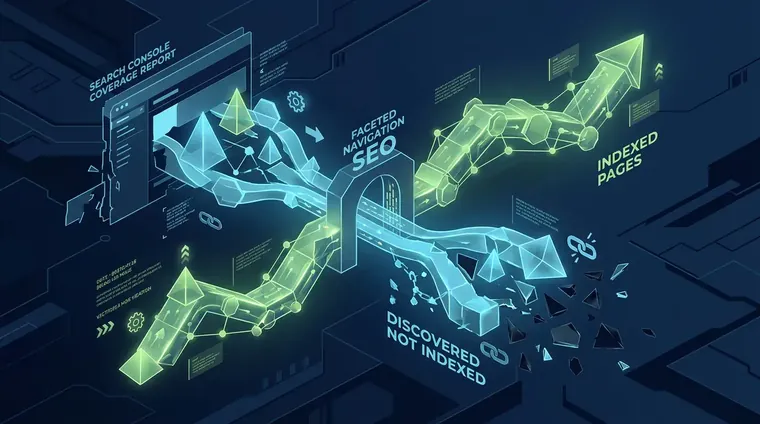
Watch the sitemap vs. Index count in Search Console. Submit 400 facet URLs and get 380 back as "discovered but not indexed". Google is telling you the pages aren't passing its quality bar. Not that it can't find them. That's a content problem. Not a technical one. Thin result sets and missing on-page context. H1, meta, structured data via Schema.org. Are the usual culprits.
How does a platform migration affect existing facet URLs?
During a replatform, existing indexed facet URLs need 301 redirects to the new equivalent or to the parent category. Missing this step causes sudden ranking losses that are hard to recover.
Nobody writes about this one. You replatform from Magento to Shopify. Or from a custom CMS to a headless stack. And your facet URL structure changes entirely. The old URLs were `/category?color=red&size=large`. The new ones are `/category/red/large`. Every indexed facet page from the old structure is now a dead end.
The fix is mechanical. But timing matters. Before launch, export every indexed facet URL from Search Console. Filter by 'Indexed' status in the Coverage report, then cross-reference with your sitemap. Map each one to its new equivalent URL and set up 301 redirects. If the new platform doesn't support parameter-style URLs at all, redirect to the parent category. Losing a facet page that ranked for 'freestanding red washing machines' is a recoverable loss. Losing 200 of them at once is a traffic event.
We rebuilt the Cash Buyers Network site from a dead domain to recover backlink equity without losing the URL map. That project is exactly why migration planning and faceted navigation SEO need the same pre-launch audit. For the broader architecture decisions that keep these migrations from becoming emergencies, the website design and SEO services guide is where to start.
If your facets update the page via JavaScript without changing the URL, Googlebot sees one page. It doesn't matter how many filter states exist. Validate with the URL Inspection tool in Search Console. Paste the filter URL and check whether the rendered HTML includes the filtered product list. If it doesn't, no canonical or noindex configuration will fix it. The page doesn't exist to the crawler. PageSpeed Insights won't catch this. You need the URL Inspection rendering view specifically.
Over-blocking vs. Selective indexation: real trade-offs
Over-blocking is safe but leaves long-tail traffic on the table; selective indexation captures demand but requires ongoing Search Console monitoring to stay clean.
| Feature | Over-Blocking (Default Stance) | Selective Indexation (Our Approach) |
|---|---|---|
| Setup effort | Low — noindex everything filtered | Medium — map demand per facet type |
| Long-tail traffic capture | None — all facets suppressed | High — demand-matched facets rank |
| Index bloat risk | Minimal | Managed with sitemap + SC monitoring |
| Migration complexity | Low (nothing indexed to redirect) | Higher — requires URL mapping pre-launch |
| Search Console signals | Flat — no new data | Active — discovered/indexed ratio tracked |
Does faceted navigation SEO interact with site search?
Internal site search results pages compound the same crawl and index problems as facets and should be excluded from indexation entirely via noindex or robots disallow.
Most site search result pages are dynamically generated from a query string. `/search?q=red+sofa`. And they carry every problem faceted filter URLs have. Except they almost never have search demand worth capturing. Noindex them by default. That's the one case where blanket suppression is the right call.
The deconfliction problem is subtler. If your site search and your faceted filters produce overlapping URL patterns. Both using `?q=` or both using path segments. Crawlers conflate the two systems. The fix is naming discipline at the URL level, enforced before launch. Site search lives under `/search/`. Facets live under path segments or a documented parameter set. Robots.txt rules are written to match those paths exactly. Keep the systems separate and your Search Console data stays clean enough to act on. Technical SEO Audit Services That Actually Get Fixed covers how we separate these signals in a crawl log analysis.
Frequently Asked Questions
What is faceted navigation SEO?
Faceted navigation SEO is the practice of managing which filter-generated URLs on a site get crawled, indexed, and ranked by search engines. The goal is to expose filter pages with real search demand while preventing low-value URL variants from diluting your site's overall index quality.
Should I noindex all faceted filter URLs?
No. Noindexing every filter URL is the over-blocking mistake most sites make. Filter pages that map to real search queries. A specific brand plus category, or a color plus product type. Can rank and drive long-tail traffic. Audit demand first, then decide per facet type.
How do I know if my facets are hurting crawl quality?
Open Google Search Console and check the Coverage report for a high 'discovered but not indexed' count, unexpected parameter URLs appearing in the index, and a mismatch between your sitemap count and your indexed page count. These three signals together indicate a facet indexation problem.
How does a site migration affect indexed facet pages?
When your platform changes and facet URL structures change with it, every previously indexed facet URL becomes a dead end. Export all indexed facet URLs from Search Console before launch, map each to its new equivalent, and set 301 redirects. Skipping this step causes measurable ranking drops that can take months to recover.
Can JavaScript-rendered facets rank in Google?
Only if the filtered URL is distinct and the page content is accessible in the rendered HTML that Googlebot receives. Use the URL Inspection tool in Search Console to check what Googlebot actually sees at a given filter URL. If the filtered product list isn't in the rendered output, the page won't rank regardless of how you configure canonicals or noindex tags.
Related reading
Ready to audit your facet strategy?
Faceted navigation SEO isn't a one-time config. It's an architecture decision that belongs in your site design before the first filter is built. Not retrofitted after launch. Our SEO website design framework treats facet indexation as a first-class choice from the start, not an afterthought bolted on later. If your filters are over-blocked or your crawl logs are full of noise, book an SEO audit and we'll show you exactly what to open up and in what order.