
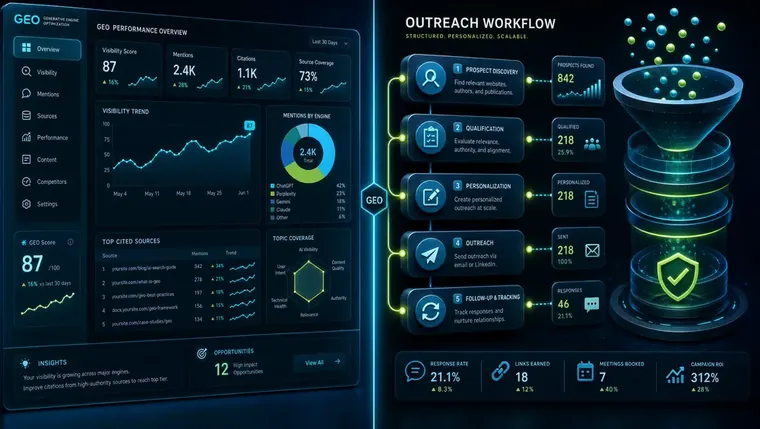
Generative Engine Optimization Tools: Beyond the Dashboard
Last month we audited 12 home-services sites — HVAC, plumbing, roofing, and one pest control franchise. The pattern that emerged wasn't about keyword rankings or even traffic. It was about citations: every site owner had heard that AI assistants were sending buyers somewhere, but none of them could tell us *who was getting cited instead of them*, let alone what to do about it. They'd heard the pitch for generative engine optimization tools, bought a dashboard, stared at a gap report, and then... stopped. The tool gave them a score; no one gave them a workflow. That gap between measurement and action is where most GEO investments fail. If you're still building the strategic foundation, our AI SEO agency guide covers the broader framework — but this post is about the tools layer specifically: how they actually work, where the data is unreliable, and what a closed-loop outreach process looks like in practice.
How Do Generative Engine Optimization Tools Actually Collect Data?
GEO tools split into two camps: on-demand LLM querying and passive observation of real user prompts — a methodological difference that dramatically affects data freshness and reliability.
This distinction almost never appears in tool roundups, but it's the first question a serious buyer should ask. On-demand querying tools send pre-written prompts to ChatGPT, Perplexity, Gemini, and other engines on a schedule — hourly, daily, or weekly — and scrape the citations in the responses. The advantage is repeatability: you control the prompt, so you can track the same question over time. The risk is that the prompts your tool fires may look nothing like the actual questions real users are typing. You're optimizing for a synthetic dataset.
Passive observation tools attempt to infer AI behavior from clickstream data or partnerships with browser extensions and ISPs. Profound's Conversation Explorer — the most-funded tool in the category after the company raised $155M total, including a February 2026 Series C led by Lightspeed that pushed it to unicorn valuation — is explicitly described by independent testers as producing *'estimates, not verified counts'* from a clickstream panel. That caveat doesn't appear in most published reviews of the tool. It matters enormously if you're making budget decisions off the numbers.
For context on what reliable structured data looks like in a broader web quality context, Google Search Central remains the benchmark for how a major AI-powered search system actually signals content quality — and its emphasis on verifiable, first-party signals is instructive when evaluating whether a GEO tool's sourcing methodology holds up under scrutiny.
What Should a GEO Tool Actually Deliver?
A complete GEO tool delivers prompt monitoring, third-party citation mapping, structured outreach, and post-fix impact tracking — not just a share-of-answer score.
- Third-Party Citation Mapping AI engines pull more than 90% of their citations from third-party sources — review sites, industry publications, directories — not from your own domain. A tool that only tracks your site misses the majority of where AI answers actually originate.
- Author-Level Outreach Data Knowing that a competitor appears on 40 third-party pages is useless without knowing who wrote those pages, whether they accept pitches, and what their contact details are. Only one tool tested in independent reviews — Writesonic's Action Center — surfaces author name, LinkedIn, and email inside a Linear-style status workflow.
- Methodology Transparency Ask every vendor whether their citation counts come from on-demand queries, a clickstream panel, or direct API access. The answer changes how much confidence you can place in a weekly report.
- Compliance Posture Healthcare and finserv buyers should know that HIPAA + SOC 2 Type II requirements eliminate the majority of GEO tools on the market today. Verify certifications before any data-sharing agreement is signed.
- Genuine Trial Access As of Q2 2026, 8 of 9 major GEO tools that previously offered free trials now require a credit card upfront. Promptwatch is the lone exception with a genuine no-card tier — worth starting there if budget approval takes time.
Most GEO tools sell a better score when what operators need is a closed outreach workflow that moves from gap detection to published fix to measured lift.
Most generative engine optimization tools sell you a better score. What you actually need is a closed workflow: gap detected → third-party author identified → pitch sent → placement confirmed → citation shift measured. Without that loop, you're paying a monthly subscription to feel informed while a competitor's PR team quietly earns the citations you're watching disappear.

How Do You Fix a GEO Gap Once You've Found It?
Fixing a GEO gap takes four steps: triage the gap, identify the third-party author, pitch a specific content update, then re-query to confirm citation lift.
- 1Triage by Impact, Not VolumeSort citation gaps by the authority and traffic profile of the third-party source, not by how many gaps exist. A single high-authority industry guide that AI engines consistently pull from is worth ten low-traffic listicles. Run the gap list through your SEO audit service framework to prioritize by domain authority and topical relevance.
- 2Identify the Author and Contact PathFor each priority gap, locate the specific author or editor responsible for the page. Writesonic's Action Center surfaces author name, LinkedIn profile, and email in the same interface — if you're using a tool that doesn't do this, export the gap list and run it through Hunter.io or a LinkedIn Sales Navigator export manually.
- 3Pitch a Specific, Additive ChangeDon't pitch 'mention our brand.' Pitch a concrete update: a stat you can contribute, a comparison row the article is missing, or a case study that makes the existing article more useful to its readers. Editors accept additions that serve their audience; they ignore self-promotional requests.
- 4Re-Query and Measure LiftTwo to four weeks after a confirmed placement, re-run the same prompts your tool uses to track that topic. Record the before/after citation rate for that third-party URL and for your own domain. This is the closed-loop measurement step that most operators skip — and it's the only way to build internal confidence that the GEO investment is producing a return.
How Do GEO Tools Compare on Pricing and Data Quality?
GEO tool pricing ranges from free to nearly $1,000/month per 1,000 prompts, with significant variation in whether the underlying data is verified or estimated.
Pricing in this category escalates quickly once you move past vanity-tier prompt volumes. Otterly's published pricing runs from $29/month for 10 prompts to $989/month for 1,000 prompts — a useful illustration of how prompt-volume costs compound when you're tracking dozens of topics across multiple engines. That math changes the ROI calculus entirely for multi-location businesses that need city- and service-level coverage.
On the data quality side, the more important variable is *what the number actually means*. A tool reporting that your brand appears in 22% of AI answers for a given query sounds precise. But if that figure is derived from a clickstream panel producing estimates rather than verified API responses, the confidence interval is wide enough to drive a truck through. Always ask vendors for their methodology documentation before treating a dashboard number as a KPI.
For a deeper look at the technical infrastructure that makes content citation-worthy in the first place — structured data, page experience signals, E-E-A-T signals — the Search Quality Rater Guidelines are still the clearest public articulation of what AI-adjacent systems are rewarding. Pairing that with Schema.org markup implementation gives your content the machine-readable structure that LLMs can parse and attribute reliably.
If you're working on the content infrastructure side of this problem — the pages and signals that earn citations rather than the tools that track them — our SEO website design resource covers how content architecture and technical structure intersect with AI citation behavior.
Which Generative Engine Optimization Tools Close the Full Loop?
Writesonic Action Center is currently the only tested tool that combines gap detection, author-level outreach data, and post-fix impact tracking in a single workflow.
Independent testing across ten tools identified one that meaningfully separates itself from the monitoring-dashboard category: Writesonic's Action Center. It's the only tool in that cohort that delivers gap detection, third-party author contact details (name, LinkedIn, and email), a Linear-style status tracker for outreach, and post-publication impact measurement on citation share — all within a single interface. That matters because the alternative is stitching four separate tools together: a GEO monitor, a contact enrichment tool, a CRM or project tracker, and an analytics layer. That stack costs more, breaks more often, and introduces attribution gaps at every handoff.
For operators who don't need the full outreach workflow yet — early-stage businesses building their citation baseline — the lighter monitoring tools are fine as long as you understand what the data represents. Use them to generate a hypothesis about which third-party sources matter most, then build or commission the content and outreach process manually. Our Best AI SEO Tools for 2026 post maps the broader tooling stack if you're deciding what to buy in which order.
The generative engine optimization tools category is maturing fast, but the tooling is still ahead of the operational playbooks most teams are running. The operators who win won't necessarily have the most sophisticated dashboard — they'll be the ones who built the workflow that turns a citation gap into a published fix into a measurable shift in how AI engines answer questions in their category.
Frequently Asked Questions
What is the difference between on-demand and passive GEO tools?
On-demand generative engine optimization tools send pre-written prompts to AI engines on a schedule and record the citations that appear. Passive tools attempt to infer citation patterns from clickstream data or browser extension panels. The key difference is data reliability: on-demand tools give you consistent, repeatable results from controlled prompts but may not reflect actual user query patterns. Passive tools like Profound's Conversation Explorer sample real-world behavior but are described by independent testers as producing estimates rather than verified counts — a distinction most published reviews omit.
Do GEO tools work for regulated industries like healthcare?
Most do not, without additional due diligence. As of 2026, HIPAA and SOC 2 Type II compliance requirements eliminate the majority of GEO tools from consideration for healthcare and financial services buyers. Before signing any data-processing agreement, request the vendor's compliance certifications directly. Profound and a small number of enterprise-tier tools have published compliance documentation; the majority of mid-market GEO tools have not pursued these certifications, which means they cannot legally process patient or client data in most regulated contexts.
Can I try generative engine optimization tools for free before buying?
Genuine free access is now rare in this category. As of Q2 2026, eight of the nine major GEO tools that previously offered no-commitment trials now require a credit card before you can access any data. Promptwatch is the lone exception with a real free tier that does not require payment information. If your procurement process or budget cycle makes upfront commitment difficult, start with Promptwatch to build a citation baseline, then evaluate paid tools once you have internal buy-in for the investment.
Related reading
Ready to Build a GEO Workflow That Actually Moves the Needle?
Dashboards are a starting point, not a strategy. Our AI SEO agency team specializes in building the full loop — from citation gap identification through third-party outreach to post-fix measurement — so your investment in generative engine optimization tools produces revenue signals, not just score improvements. Talk to us about your GEO audit and we'll show you exactly where your category citations are going and how to reclaim them.