

The Local SEO Audit That Prioritizes Risk Over Checklists
76% of people who run a 'near me' search visit a business within 24 hours — yet most local SEO audits hand you a 21-column spreadsheet and leave you guessing which row to tackle first. That gap between finding problems and knowing which ones actually cost you customers is exactly where rankings stall. Our full SEO Audit framework treats every finding as a risk-weighted item, not a bullet point on an infinite list. This post applies that same logic specifically to local search: how to run a local seo audit that surfaces your highest-leverage problems first and earns back map-pack visibility faster.
Why does most local SEO audit advice leave you stuck?
Most local audit guides list every signal as equally important, producing a to-do list with no triage — so high-risk issues get buried under low-impact fixes.
The top-ranking guides on this topic share a common flaw: they present every audit component — schema, citations, photos, review velocity — at the same priority level. The result is a flat list that obscures the difference between a suspension-risk GBP (which can erase your local visibility overnight) and a slightly inconsistent phone number on a directory nobody uses.
Google's three map-pack ranking factors — Relevance, Distance, and Prominence — actually map to very different audit priorities. Distance you can't change. Relevance is about category targeting and on-page signals. Prominence is where your reputation, links, and entity authority live. A triage-first local seo audit asks: which of these three factors is the binding constraint for *this specific business right now*? That question alone re-orders your entire work queue.
For a single-location service-area business (SAB), the binding constraint is almost always Relevance — the GBP service area is misconfigured or the landing pages don't signal the right service-city combinations. For a multi-location chain, Prominence fragmentation is usually the culprit: each location has inconsistent entity signals, diluting the brand's aggregate authority. These are not the same audit. Treating them identically is why generalist guides stall.
What audit priorities differ by business type?
Business type fundamentally changes audit priority order: SABs need Relevance fixes first, chains need Prominence consolidation, and retail shops need conversion-signal audits.
- Single-location SAB Prioritize service-area configuration and landing page Relevance signals. Suspension risk is also elevated because SABs hide their address — a profile that looks 'incomplete' to Google's quality reviewers can trigger a suspension flag.
- Multi-location chain Lead with Prominence fragmentation: duplicate listings, inconsistent category targeting across locations, and brand-level entity signals (Wikipedia, Wikidata, press coverage) that dilute rather than consolidate authority.
- Brick-and-mortar retail Conversion-signal gaps are the highest-leverage finding — hours accuracy, product schema, and Q&A quality directly affect whether a 'near me' searcher clicks through or bounces to a competitor.
- High-competition service verticals Competitor GBP spam — keyword-stuffed business names, fake service-area listings — is often the reason legitimate businesses rank 4th. Auditing the competitive landscape for spam and reporting it is a higher-ROI action than cleaning your own citations.
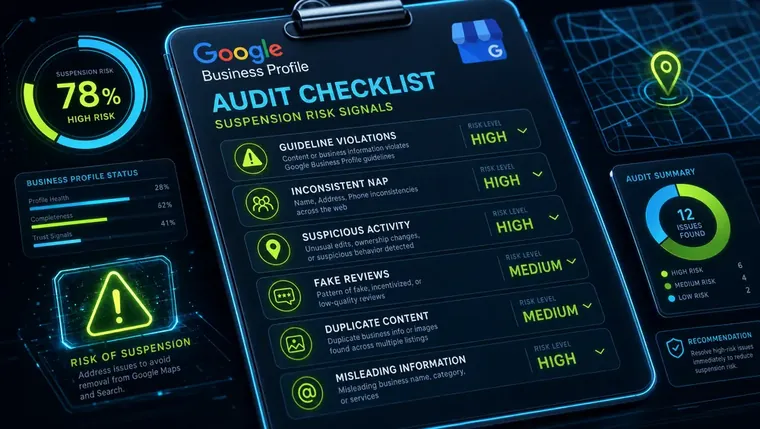
GBP suspension is the silent killer of local visibility. A suspended profile drops out of the map pack with zero ranking warning — no gradual decline, no Search Console alert. Yet none of the major audit guides include a proactive suspension-risk check. Red flags to audit now: mismatched business category vs. storefront type, address that doesn't resolve cleanly in Street View, recent bulk edits from unverified contributors, and a phone number that routes to a call center rather than the listed location. Catching these before Google's quality reviewers do is worth more than any citation cleanup project. Google Search Central documents the quality guidelines that underpin these checks.
How do you audit competitor GBP spam effectively?
Search for your primary keyword + city, then cross-check each competitor listing for keyword-stuffed names, mismatched addresses, and service-area abuse — then file a Business Redressal Complaint.
Competitor spam auditing is a local seo audit task that pays outsized dividends in high-competition verticals, yet almost no published guide walks through it. The process is straightforward: run your core keyword + city combination in Google Maps and pull the top 10 results. For each listing, check whether the business name contains keywords not in the legal entity name (a direct policy violation), whether the address resolves to a real commercial location in Street View, and whether the service-area settings appear to claim unrealistically broad geography.
When you find violations, Google's Business Redressal Complaint form is the right escalation path — not ignoring it and hoping the algorithm self-corrects. Document each spam listing in your audit register with a screenshot and submission date so you can track whether the report triggered a re-evaluation. Tools like Whitespark's local rank tracker let you monitor whether your map-pack position improves post-report by emulating searches from specific geographic locations — a more accurate signal than standard rank tracking.
For grid-level visibility, Semrush's Maps-based gridded ranking tool shows you exactly which cells in your service area you're winning versus losing, and which competitor is beating you in each cell. Pairing that data with your spam audit findings often reveals that the business beating you in the southeast quadrant of your city is a fake listing — one Redressal report away from removal. See our related piece on Technical SEO Audit Services That Actually Get Fixed for how to document and action these findings systematically.
How should you interpret GBP Insights during an audit?
GBP Insights become actionable when you benchmark Search vs. Maps discovery ratio and track direction-request rate as a conversion proxy, not just total views.
GBP Insights data is regularly listed as an audit input but almost never explained. Raw impression counts mean little without context. The metrics that actually signal problems are the ratio of Search impressions to Maps impressions (a low Maps share relative to Search suggests your Prominence signals aren't strong enough to surface in pack results), the direction-request rate per 1,000 profile views (a leading indicator of intent-to-visit conversion), and the query breakdown showing whether branded vs. discovery searches dominate your traffic.
A healthy local profile in a competitive category typically generates 60–70% of its profile views from discovery searches (non-branded queries). If your ratio is inverted — most views coming from people who already know your name — that's a Prominence audit finding, not a win. It means you're invisible to the high-intent segment that doesn't already know you exist. Cross-reference this against PageSpeed Insights data for your local landing pages: slow-loading pages suppress the click-through rate that GBP Insights measures, creating a feedback loop that further suppresses your Prominence score.
Schema markup is the technical layer that ties your on-page signals back to your GBP entity. Use Schema.org as your reference for `LocalBusiness`, `Service`, and `Review` types — and validate every implementation with Google's Rich Results Test. The Search Quality Rater Guidelines make clear that E-E-A-T signals (experience, expertise, authority, trustworthiness) are evaluated at the entity level, which means your schema, GBP, and on-page content need to tell a consistent story about the same entity.
Triage-first audit vs. traditional checklist audit: what changes?
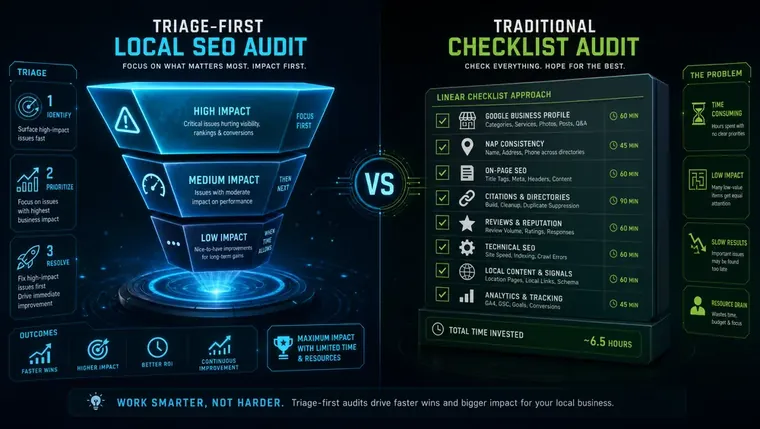
A triage-first local SEO audit fixes high-risk items in days; a traditional checklist audit scatters effort across weeks with low-impact tasks mixed in.
| Feature | Triage-First Audit (RG Approach) | Traditional Checklist Audit |
|---|---|---|
| First item addressed | GBP suspension risk scan | NAP consistency check |
| Competitor analysis | Spam detection + Redressal filing | Category comparison only |
| Priority framework | Risk-weighted by business type | Same order for every business |
| GBP Insights usage | Discovery ratio + conversion proxy metrics | Listed as a data source, rarely interpreted |
| Time to first fix | High-risk items resolved in 1–3 days | Effort spread across 2–4 weeks uniformly |
| Schema validation | Entity consistency across GBP + on-page | Rich Results Test only, no entity cross-check |
If your local seo audit surfaces landing-page Relevance gaps — service pages that don't rank for the city-service combinations you're targeting — the underlying fix is usually architectural. Our SEO Website Design framework explains how to build location and service pages that satisfy both Relevance and Prominence signals from day one, rather than patching them after the fact. Also worth reading: Best AI SEO Tools for 2026 for tooling that automates the audit data-gathering phase.
What does a triage-first audit actually produce?
A triage-first local SEO audit produces a risk register ranked by revenue impact, not a flat list — so your team knows exactly what to fix in week one versus month two.
The output of a well-run local seo audit isn't a spreadsheet with 21 columns weighted equally. It's a risk register with three tiers: items that pose an active threat to existing visibility (suspension risk, competitor spam suppression, broken schema), items that limit growth in the near term (Relevance gaps on landing pages, GBP Insights conversion signals), and items that compound over time but won't move the needle this quarter (citation coverage on long-tail directories, photo freshness, legacy review response gaps).
For a single-location business, a thorough triage audit can realistically be completed in 4–8 hours, including the competitive spam scan and GBP Insights interpretation. For a multi-location brand, budget 2–3 weeks — not because the individual tasks are harder, but because each location needs its own suspension-risk profile and Prominence benchmark before you can prioritize across the portfolio. DIY is viable for single-location businesses with a clear operator who can act on findings immediately; for chains, the coordination overhead typically justifies specialist involvement.
Google Lighthouse rounds out the technical layer — it surfaces mobile UX and Core Web Vitals issues that Search Console misses and that directly suppress click-through from your map-pack listings. Pair Lighthouse data with your GBP Insights direction-request rate and you have a complete picture of where searchers are dropping off between discovery and conversion. For more on structuring findings into an actionable system, see The SEO Audit Checklist That Starts With a Hypothesis.
Frequently Asked Questions
How long does a local SEO audit take for a single-location business?
A scoped local SEO audit for a single location typically takes 4–8 hours when structured around triage priorities: GBP suspension risk, competitor spam detection, Insights interpretation, and landing-page Relevance gaps. Adding citation and schema validation extends the timeline by 1–2 hours. Multi-location brands should budget 2–3 weeks to score each location independently.
What is the most dangerous finding a local SEO audit can uncover?
GBP suspension risk is the highest-severity finding because a suspended profile is removed from the map pack instantly — with no gradual ranking decline and no Search Console warning. A local SEO audit should scan for suspension triggers first: address-to-Street-View mismatches, category inconsistencies, and phone numbers that route to a call center rather than the listed location.
Should a local SEO audit differ for a multi-location chain vs. a single-location business?
Yes — significantly. A single-location service-area business usually has a Relevance problem: the GBP service area or landing pages don't match the service-city combinations being targeted. A multi-location chain typically has a Prominence fragmentation problem: inconsistent entity signals across locations dilute the brand's aggregate authority. Running the same audit for both business types wastes time on low-priority findings.
Related reading
Ready to run a local SEO audit that actually moves the needle?
A flat checklist won't tell you whether your GBP is a suspension away from disappearing, which competitor is gaming the map pack in your city, or why your direction-request rate is half the category benchmark. Our SEO Audit service builds the risk register for you — triage layer included — so your team works the right problems in the right order from day one. Get your prioritized local audit and stop guessing which row to fix first.