

SEO Keyword Research: Start With Probability, Not Volume
If you've searched *seo keyword research* in 2026, the SERP is a wall of generic agency landing pages without an actual definition — certainly without a framework that accounts for the site you actually have, the domain authority you realistically hold, or the AI-driven results page your content will land on. This post is the canonical answer to that gap. It's written as a companion to our full SEO audit methodology and it diverges sharply from the advice you've already read elsewhere: the 'high volume, low competition' filter is a trap, and the sooner you replace it with a ranking-probability filter, the sooner your keyword list becomes a growth asset instead of a wish list.
Why Does the Standard Keyword Framework Fail Most Sites?
Most keyword frameworks optimize for volume, not ranking probability — making targets look attractive but impossible to win within a realistic timeframe.
The standard seo keyword research playbook — find a seed keyword, run it through a tool like Ahrefs Keywords Explorer or Semrush Keyword Overview, filter for high volume and low difficulty — produces a list that looks impressive in a slide deck and performs poorly in practice. Here's why: keyword difficulty scores are blunt instruments. A KD of 35 on a term dominated by Healthline, Forbes, and NerdWallet is not an opportunity for a 6-month-old site. What the score doesn't tell you is whether any page on *your* domain, at *your* current authority level, has a realistic shot at page one in the next 12 months.
This is the ranking-probability filter: before a keyword earns a place on your target list, it must pass a domain-context check. That means cross-referencing difficulty against your current rankings, your internal link equity, and whether you have existing content that's already indexed for adjacent terms. Google Search Central provides clear guidance on how crawl authority and internal linking shape ranking outcomes — keyword strategy that ignores those signals is planning in a vacuum.
A keyword with 200 monthly searches and unambiguous commercial intent — one where your existing posts, backlink profile, and topical depth give you a genuine path to rank — will generate more revenue than a 10,000-search target you can't realistically reach in under 18 months. The goal of seo keyword research isn't to build the longest possible keyword list. It's to identify the shortest list of winnable, revenue-relevant targets.
What Makes a Keyword Actually Winnable?
A winnable keyword combines realistic domain authority alignment, clear commercial intent, and a funnel stage match with existing content assets.
- Domain Authority Alignment If the top 5 results for a term all have DR 70+, a DR 28 site isn't competing there — regardless of what the difficulty score says. Filter for terms where at least 2 of the top 10 results come from sites with comparable authority.
- Funnel Stage Clarity Awareness keywords ("what is X") build topical authority but rarely convert directly. Decision keywords ("X service near me" or "X pricing") convert but are fiercely guarded by established players. The highest-ROI targets are usually **consideration-stage** keywords — comparison, alternative, and use-case queries — where intent is clear but competition hasn't fully saturated the SERP.
- Cannibalization Check Before adding any keyword to your target list, check whether two or more of your existing pages already rank for it — even weakly. Cannibalization splits crawl equity and dilutes ranking signals. Google Search Console's Search Results > Queries tab is the fastest way to surface these conflicts before you compound them by publishing more content.
- AI Overview Exposure Queries with 8 or more words trigger an AI Overview 57.3% of the time, according to SEO.com's AI Overviews Impact Study. For those terms, ranking position matters less than whether your structured content can be **cited inside the AI snippet** — which means optimizing for answer extraction, not just organic placement.
- Content Asset Match Every target keyword should map to either an existing page that can be updated or a net-new page that fits a defined content template. Orphan keywords — terms with no clear home — generate planning debt, not rankings.
Not sure which keywords your site can actually win? Book a 30-minute keyword strategy call and we'll cross-reference your current GSC data against a ranked list of winnable targets for your vertical. Book now →
How Should You Map Keywords to Funnel Stages?
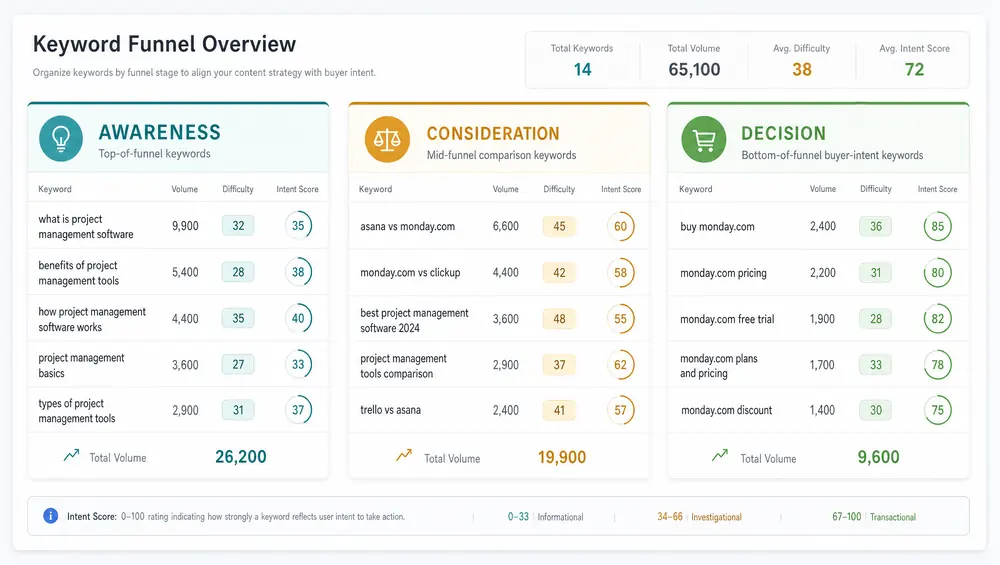
Map keywords to awareness, consideration, or decision stages based on search intent signals — not just volume — to align content with where buyers actually are.
Most seo keyword research guides mention 'search intent' and move on. The practical framework is more specific: every keyword on your target list belongs to one of three funnel stages, and that stage determines the content format, the conversion goal, and the success metric.
Awareness-stage keywords are informational. They tell you someone is researching a problem, not buying a solution. These terms build topical authority and feed your internal linking structure, but measuring them by conversion rate is the wrong benchmark. Measure them by page-level engagement and whether they funnel visitors toward consideration-stage content.
Consideration-stage keywords are the most underutilized category in SEO. These are comparison queries, alternative searches, "best X for Y" constructions, and use-case-specific questions. The Search Quality Rater Guidelines reward content that demonstrates real-world expertise and specificity — exactly what consideration-stage pages, done well, can deliver. These terms also tend to sit in a competitive sweet spot: intent is strong, but the SERP isn't as locked-in as it is for pure transactional terms.
Decision-stage keywords carry the highest commercial intent and, consequently, the most entrenched competition. For these terms, paid search often delivers faster ROI than organic — and a well-structured seo keyword research process should explicitly flag which targets belong in your PPC budget rather than your content calendar. That boundary is something generic keyword tools don't draw. It requires a judgment call based on your margin, your sales cycle, and how quickly you need results. For a deeper look at how keyword strategy intersects with site architecture, see our SEO Website Design framework, which covers how page hierarchy and internal links distribute keyword equity across the funnel.
How Do You Prioritize 50 Keyword Candidates Down to 10 Targets?
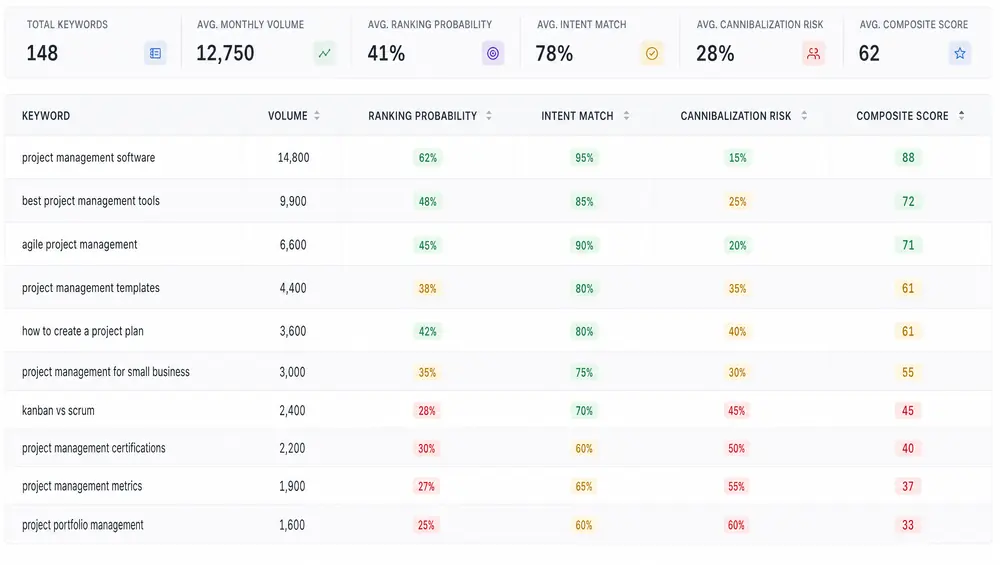
Score each keyword candidate against five weighted criteria — ranking probability, intent match, cannibalization risk, AI exposure, and asset readiness — then cut the bottom 80%.
- 1Pull Your Existing Rankings FirstOpen Google Search Console > Search Results > Queries. Filter for positions 6–20. These are keywords your site already has signal for — promoting them to page one requires optimization, not a new content investment. These should be your first-tier targets.
- 2Score Each Candidate on Five CriteriaFor every keyword candidate, score 1–3 on: (1) ranking probability given your DR, (2) funnel-stage alignment with your revenue goals, (3) cannibalization risk, (4) AI Overview exposure vs. snippet-optimization readiness, and (5) whether a content asset already exists or can be built within one sprint. Sum the scores.
- 3Cut Everything Below the Median ScoreIf you have 50 candidates, the bottom 25 by score get archived, not deleted. Revisit them in 90 days when your authority, content library, or competitive landscape may have shifted.
- 4Assign Stage and Owner to Each Remaining KeywordEvery keyword that survives the cut gets a funnel stage label, a content owner, and a production quarter. Keywords without an assigned owner don't ship — they become backlog debt.
- 5Flag PPC vs. SEO OwnershipDecision-stage terms with high commercial value but low organic probability in the next 12 months get routed to your paid search plan, not your editorial calendar. This is where SEO and PPC strategy should formally intersect, not run in parallel silos.
How Does Keyword Research for SEO Differ From Keyword Research for PPC?
SEO keyword research optimizes for long-term ranking probability and topical authority; PPC keyword research optimizes for immediate conversion margin and bid efficiency.
The overlap between SEO and PPC keyword research is real but smaller than most tools imply. Both disciplines start with the same universe of queries, but the selection criteria diverge quickly. In seo keyword research, you're betting on a 6–18 month investment in content, links, and technical signals. The payoff is compounding: a well-ranked page earns clicks indefinitely. In PPC, you're buying discrete traffic at a cost-per-click that's fully visible from day one. The evaluation framework is different: margin per conversion vs. cost-per-click, not domain authority vs. keyword difficulty.
Generic keyword tools — even those that filter by industry vertical or geography (WordStream, for instance, filters across 24 business verticals and 23 countries) — don't make this distinction automatically. They return a flat keyword list and leave the SEO-vs-PPC routing decision to the user. Without an explicit routing step in your seo keyword research process, high-intent commercial terms that you can't rank for organically in a reasonable timeframe consume content budget they shouldn't be touching.
The practical rule: if a keyword has an average CPC above $15 and your site has less than a 40% probability of ranking on page one in 12 months (based on your DR and the competing domain profiles), route it to paid search and measure it there first. Once paid data confirms the conversion rate justifies the organic investment, add it to the SEO roadmap. This avoids the common trap of spending 6 months producing content for terms that a single well-targeted paid campaign could have validated in 3 weeks. For a complete picture of how keyword signals integrate with on-page and technical factors, the SEO Audit Service we offer covers exactly this intersection — including how to surface the cannibalization conflicts and gap terms that a keyword tool alone will never catch. See authoritative references: Schema.org.
Keyword cannibalization is the silent budget drain most sites never diagnose. If two or more pages on your site already rank — even at position 40 — for the same target term, publishing a third page doesn't triple your chances. It divides your crawl equity three ways. Run a cannibalization audit before your next content sprint. Our Technical SEO Audit Services post covers exactly how to find and resolve these conflicts.
Frequently Asked Questions
How is seo keyword research different in 2026 compared to previous years?
In 2026, seo keyword research must account for AI Overviews — queries with 8 or more words now trigger an AI-generated result 57.3% of the time. That changes the optimization target: for long-tail terms, you're not just ranking for a blue link, you're competing to be cited inside an AI snippet. This requires structured, answer-extraction-ready content, not just high word counts and backlinks.
What is keyword cannibalization and why does it matter?
Keyword cannibalization happens when two or more pages on your site compete for the same search query. Instead of one strong page winning the ranking, both pages split the crawl equity and ranking signals, suppressing each other. Before you add any new keyword to your seo keyword research target list, check Google Search Console's Queries tab to confirm no existing page already has signal for that term.
How many keywords should I be targeting at once as a small or mid-size site?
Most small and mid-size sites should actively target 10–15 keywords per content quarter — not 50. The seo keyword research process should include a scoring step that cuts your candidate list down to the highest-probability, highest-intent targets that match your current domain authority. A focused list of 10 winnable keywords will outperform an unfocused list of 100 aspirational ones every time.
Should I use the same keywords for SEO and Google Ads?
Start with a shared keyword universe, then apply different filters for each channel. Seo keyword research filters for ranking probability, topical authority, and long-term content ROI. PPC keyword research filters for conversion margin and cost-per-click efficiency. High-intent terms where organic ranking is unlikely in the next 12 months should be routed to paid search first — use paid performance data to validate commercial value before committing an organic content investment.
Related reading
Ready to Build a Keyword List Your Site Can Actually Win?
Generic keyword research produces generic rankings. The seo keyword research process that actually moves revenue starts with a ranking-probability filter, maps every target to a funnel stage, and draws a clean line between SEO and PPC ownership before a single word gets written. Our SEO audit service is the diagnostic layer that makes this process data-driven rather than directional — surfacing your existing ranking signals, cannibalization conflicts, and high-probability gaps in a single structured report. Book a strategy call today and we'll show you the 10 keywords your site can realistically win in the next 90 days.