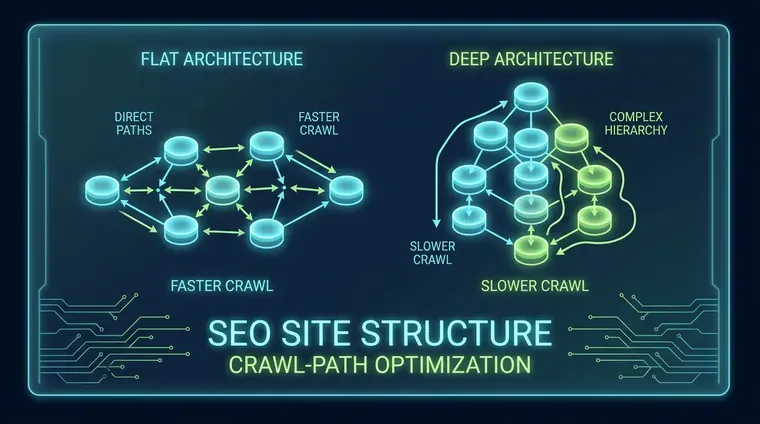
Site Architecture for SEO: Ditch the Click-Depth Rule
The conventional advice is to keep every page within three clicks of the homepage. The conventional advice is wrong — because click depth is a proxy metric, not the actual mechanism. Site architecture for SEO lives or dies on whether Googlebot can reach a page within its allocated crawl budget, and for most mid-size sites, a well-configured sitemap plus strong internal linking from high-traffic pages does more practical work than obsessing over folder depth. Our SEO website design work keeps returning to this same lesson: over-engineered navigations built to satisfy the 3-click rule consistently hurt performance more than they help it.
Why does the click-depth rule mislead SEOs?
Click depth is a shortcut heuristic — crawl budget allocation and internal link velocity are the real mechanisms that determine whether Google indexes a page.
PageRank dilutes with every hop. That's real. But the logical leap — that fewer hops always wins — ignores the fact that Googlebot doesn't treat all hops equally. A page linked from five high-traffic posts with strong topical relevance gets crawled faster and ranked more confidently than a page one click from the homepage with no internal link context pointing at it.
As one practitioner put it bluntly on r/bigseo: *"You can't take a domain with nothing and just put in internal links and change titles"* — meaning link architecture without underlying topical authority is just furniture rearrangement. The structure needs content density behind it to work.
Google Search Central documents crawl budget explicitly: larger and frequently updated sites get more budget, but the allocation is dynamic. A flat six-level navigation that dumps 800 links into the global header actually compresses signal — Google sees it as noise and deprioritizes accordingly. We've watched sites with nominally 'flat' structures sit unindexed for weeks on pages that were two clicks from home.
What does good site architecture for SEO actually optimize for?
Strong site architecture optimizes crawl prioritization, topical clustering, and semantic signal — not folder depth or click count.
- Crawl budget allocation Internal links from high-traffic, frequently crawled pages act as crawl-priority votes. Cluster your most important pages behind those hubs, not just behind the homepage.
- Topical cluster integrity Group service pages, blog posts, and landing pages by semantic intent. A law firm's hierarchy — Homepage → Practice Areas → Family Law → Child Custody — works because the topic graph is tight, not because it's flat.
- Canonical signal clarity When a service page and a blog post both target the same keyword cluster, one of them needs a clear canonical or a content differentiation strategy. Structural overlap without disambiguation creates internal competition — and neither page wins.
- Orphan page resolution Orphan pages have zero internal links pointing at them. Tools like Screaming Frog surface them quickly. The fix isn't just adding a link — it's deciding whether the page deserves to exist in your topical map.
How do you restructure a live site without tanking rankings?
Restructure live sites by auditing redirect chains first, staging changes in batches, and monitoring crawl coverage in GSC before touching high-traffic URLs.
This is the question neither SEOSherpa nor Backlinko answer — and it's the one every operator actually faces. Rebuilding site architecture for SEO on a domain with existing traffic is a different problem than building from scratch. Redirect chains are the main killer. Every hop in a 301 chain bleeds a fraction of link equity, and chains of three or more hops are effectively invisible to many crawlers.
Our process: run a full crawl with Screaming Frog or Ahrefs before touching a single URL. Map every existing inbound link against the proposed new structure. Stage changes in batches of 20-30 URLs rather than a site-wide cutover. Then watch Google Search Console's Coverage report for 72 hours after each batch — not for a week, 72 hours. GSC's cache is faster than most SEOs assume.
The concept of *structural debt* — skipping architecture planning early and paying for it in crawl chaos later — is real. We've inherited client sites where 40% of indexed URLs were redirect hops to other redirect hops. Cleaning that up is months of work. Build the structure right the first time, and a technical SEO audit becomes a tuning exercise rather than a rescue operation.
For JavaScript-heavy sites, the risk compounds. If your primary navigation renders client-side, Googlebot may encounter it on a second wave crawl — sometimes days after the initial fetch. That delay cascades through every page the nav links to. Google Search Central confirms that server-rendered HTML navigation is processed faster and more reliably than JS-injected menus.

Receipts Group's Safeguard Impact case study site achieved 100/100 desktop PageSpeed — built on Next.js + Supabase with no client-side analytics on the critical render path.
Receipts Group's case study site achieved 100/100 desktop PageSpeed in Google's tool — the build runs on Next.js + Supabase with no client-side analytics on the critical render path. Architectural decisions like server-side rendering and zero third-party scripts in the render-blocking zone aren't cosmetic. They're structural. Core Web Vitals are a ranking signal, and they're directly downstream of how your site is built.
How does structured data fit into site architecture?
Structured data is an architecture layer — it tells crawlers what a page is about when content alone is ambiguous, improving how pages are categorized in the index.
Most treatments of site architecture for SEO stop at URL structure and internal links. That's half the picture. Schema.org markup is an architectural signal — it defines the semantic type of a page for crawlers who can't infer it from content alone. A page without schema on a JavaScript-heavy stack might render correctly for humans and still be miscategorized in the index.
The practical step: cross-check your schema implementation in the Next.js renderer against the current Schema.org spec after any major Google structured data update. Fields get deprecated. Required fields get added. An outdated `@type` on a service page can suppress rich results and weaken the topical map signal that connects your pages.
For multi-service or multi-location sites, schema also resolves the content intent overlap problem. A `Service` schema on a service page and an `Article` schema on a supporting blog post tell Googlebot they're related but different — one is transactional, one is informational. That distinction lives in the Search Quality Rater Guidelines as the E-E-A-T hierarchy, and your architecture should reflect it. See our website design and SEO services breakdown for how we wire schema into the build from the start, not as a retrofit.
Crawl-first vs. click-depth-first architecture: what's the difference?
Crawl-first architecture prioritizes internal link velocity and sitemap configuration; click-depth-first optimizes folder depth and navigation flattening — and often produces over-engineered menus.
| Feature | Click-Depth-First (Conventional) | Crawl-First (What We Do) |
|---|---|---|
| Primary goal | Keep all pages ≤3–4 clicks from homepage | Ensure Googlebot reaches priority pages within crawl budget |
| Navigation approach | Flat menus with many top-level links | Focused menus + strong contextual internal links from high-traffic pages |
| Sitemap role | Added as a technical checkbox | Used as a diagnostic tool and crawl-priority signal |
| JS nav handling | Often ignored — click depth is measured in HTML | Server-rendered navigation required; JS nav creates crawl lag |
| Risk during restructure | Rarely discussed | Staged batches, redirect chain audit, 72-hour GSC monitoring |
Frequently Asked Questions
What is site architecture for SEO?
Site architecture for SEO is the structural organization of a website's pages, URLs, and internal links in a way that helps search engines crawl, index, and prioritize content efficiently. It includes URL hierarchy, internal linking patterns, navigation structure, and how semantic topics are grouped across the site.
Is the 3-click rule for site architecture actually valid?
The 3-click rule is a useful shortcut but not a ranking law. What matters is whether Googlebot can reach a page within its crawl budget — that's driven by internal link velocity from high-traffic pages and a well-configured XML sitemap, not folder depth alone. Sites can rank pages that are 5+ hops from the homepage if those pages have strong contextual links pointing at them.
How do you fix site architecture on a live site safely?
Start with a full crawl to audit redirect chains before touching any URLs. Stage changes in batches of 20-30 URLs, map all inbound links against the new structure, and monitor Google Search Console's Coverage report within 72 hours of each batch. Never do a site-wide URL migration in a single cutover — the ranking volatility can last months.
What causes orphan pages and how do you find them?
Orphan pages have no internal links pointing at them — they exist in the index but have no place in your topical map. Run a crawl with Screaming Frog and cross-reference against your XML sitemap to surface them. For each one, decide whether to integrate it into a content cluster, consolidate it into a stronger page, or remove and redirect it.
Does JavaScript navigation hurt site architecture for SEO?
Yes. If your primary navigation renders client-side, Googlebot may only encounter it during a second-wave crawl — sometimes days after the initial fetch. Every page that navigation links to inherits that delay. Server-rendered HTML navigation is processed faster and more reliably, which is why our architecture default is Next.js with server-side rendering for all nav elements.
Related reading
Ready to build an architecture that actually gets indexed?
Site architecture for SEO isn't a one-time decision — it's a system. If your current structure has redirect chains, orphan pages, JS-rendered navigation, or competing content intent across similar URLs, the fix starts with a proper audit. Our SEO website design practice builds architecture that Googlebot can actually process — and our SEO audit service maps the gap between where your site is today and where it needs to be. Start there.