
Contractor Answering Service: The Operator's Guide
Search 'contractor answering service' in 2026 and you get a wall of agency landing pages. None of them define what a real inbound floor does differently from a bargain virtual receptionist. None of them explain why most answering services bleed contractor leads at the handoff, or what it actually takes to build a call center that sets appointments instead of just taking messages. This guide covers the mechanics, the math, the compliance traps, and the moments when you should build your own floor instead of outsourcing. We run an outbound call center for our own windows and roofing company, and we build outbound and inbound call centers for other contractors. Everything here comes from doing it, not reading about it. The difference between message-taking and appointment-setting is not a marketing nuance. It's the difference between a cost center and a revenue driver. A virtual receptionist who logs a name and number has a job measured in seconds per call. A trained inbound setter who qualifies scope, confirms decision-makers, and drops a confirmed appointment into your CRM has a job measured in revenue per sit. This guide is written for contractors who want the second thing and need to know exactly what it takes to get there.
What Is a Contractor Answering Service, Actually?
A contractor answering service is a staffed or automated system that answers inbound calls, qualifies the homeowner, and routes or books them, the key word is 'qualifies', not just 'answers'.
A contractor answering service is any system, human, automated, or hybrid, that picks up inbound calls when your field crew can't. That's the textbook definition. Here's the one that matters: it's the layer between a homeowner who just searched for a roofer and the appointment on your calendar. Most services stop at answering. They take a name and number, send you a text, and call it done. That's a message-taking service. A real contractor answering service qualifies the caller, homeowner or renter, scope of work, decision-makers in the home, urgency, and either books the appointment directly into your CRM or routes to a closer who can. The gap between those two models is where revenue is lost. A homeowner who calls at 7 PM on a Tuesday and hears a voicemail moves to the next contractor in the map pack. No callback the next morning recovers that lead at the same close rate. Speed to answer is the first variable. Quality of the conversation is the second. Most answering services optimize for neither. Qualification on the first call also protects your closers' calendars. A setter who confirms that all decision-makers will be present before the appointment goes on the books saves your sales rep from driving forty minutes to a homeowner whose spouse holds the checkbook and isn't home. That one step, confirming decision-makers during the inbound call, is something most generic answering services skip entirely because their scripts were written for industries where it doesn't matter.
- Speed to answer Every minute a call goes unanswered, the homeowner's intent cools. Picking up live, or within seconds via an IVR that routes to a human, is the minimum bar.
- Live qualification Agents should confirm: is the caller the homeowner, are all decision-makers available for the appointment, what's the scope, and what's the urgency? Without these, you're booking bad sits.
- Direct CRM booking The appointment goes straight into your calendar with the caller's answers attached, not into a spreadsheet someone emails you in the morning.
- Call recording and QA Every call should be recorded. Every appointment that counts should be reviewed by a person before it hits your calendar. This is the QA step most outsourced services skip.
- Compliance posture Inbound calls from homeowners who dialed you are generally lower-risk legally, but outbound follow-up calls must comply with the FCC's TCPA rules and the National Do Not Call Registry.
Why Most Contractor Answering Services Fail at Handoff
Most answering services fail at handoff because they treat the call as a message, not a sale, the appointment is never booked, only promised, and the homeowner goes cold before a closer calls back.
Here's the handoff problem in plain terms. A homeowner calls. The answering service agent takes their information and tells them someone will call back. The agent sends an email or a Slack to your office. Your office sees it three hours later. They call back. The homeowner has already booked with someone else. This isn't a hypothetical. It's the default workflow for most answering services marketed to contractors. They were built for medical offices and law firms, environments where a morning callback is acceptable. In contractor sales, it isn't. The fix starts with the system architecture. Your answering service needs direct write access to your scheduling tool, whether that's Jobber, ServiceTitan, or a plain Google Calendar with a booking layer on top. The agent doesn't take a message. They book the appointment, read it back to the homeowner, and send a confirmation text. That's a different job description, a different training program, and a different price point than what most generic answering services offer. The script matters less than the system. If the agent can't book directly, the lead is already at risk. Press the integration question before you sign with any vendor. Ask them to walk you through exactly what happens between the moment the call ends and the moment your closer sees the appointment. If the answer involves an email, a forwarded voicemail, or a shared spreadsheet anywhere in that chain, the handoff is broken, not by accident, but because the system was never built to close.
Our own outbound floor books about 650 in-home appointments a month for our windows and roofing company. That's not an answering service. That's a full outbound call center. It's also the machine that proved what a well-staffed, well-scripted, CRM-integrated floor can actually do. Everything we build for other contractors runs on that same architecture.
Inbound vs. Outbound: Which Model Do You Actually Need?
Most contractors need inbound first, to stop bleeding leads, then outbound when they're ready to generate demand proactively rather than just respond to it.
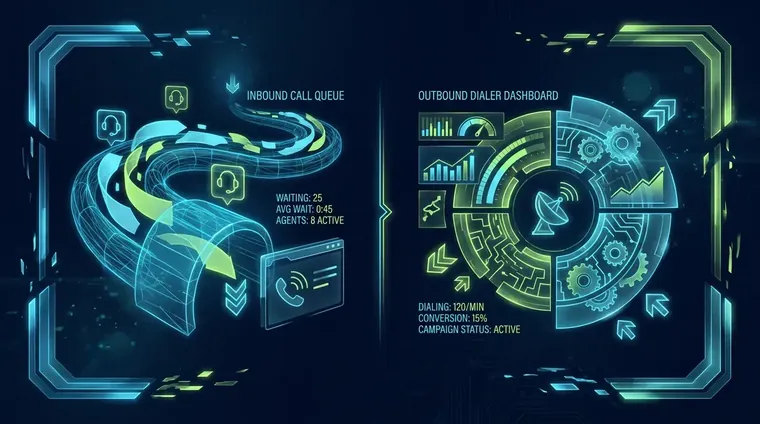
Contractors mix these two up constantly. Inbound answering is reactive, a homeowner calls you, and the service picks up. Outbound calling is proactive. Your agents dial homeowners who have expressed interest, entered a funnel, or are on a list you purchased or built. A contractor answering service, in the strict sense, is inbound. You're paying someone to catch the calls your crew can't answer. In our view, that's the right starting point for most smaller contractors. Stop the bleeding before you invest in an outbound engine. Outbound is a different animal. It requires a dialer, a CRM with lead-status tracking, a scripted cadence, and agents trained to handle objections rather than just schedule appointments. It's also where compliance exposure is highest. Outbound telemarketing is regulated under the FTC's Telemarketing Sales Rule. Violations carry real consequences. TCPA private damages run $500 per violation, up to $1,500 if the violation is willful, per 47 U.S.C. § 227. For appointment setting for contractors, the outbound model is more relevant. For answering service, start with inbound. Know which problem you're actually solving. A practical sequence: fix inbound first so you stop losing calls you've already paid to generate. Then layer outbound once your CRM, your calendar, and your closers can handle the volume. Adding outbound dials before inbound is airtight just accelerates the leak. More calls land in a broken handoff, and you pay for both the lead and the lost conversion.
Contractor Answering Service vs. Building Your Own Call Center
An outsourced answering service is faster and cheaper to start but gives you less control; building your own floor costs more upfront but owns the data, the agents, and the outcome.
| Feature | Outsourced Answering Service | Your Own Call Center Floor |
|---|---|---|
| Setup time | Days to a week | Months, not days, to build and staff |
| Upfront cost | Low, often monthly flat fee | Higher, infrastructure, training, QA systems |
| Agent knowledge of your trade | Generic scripts, often thin | Trained on your products, objections, and calendar |
| CRM integration | Limited or manual handoff | Direct write access, call recordings attached |
| QA on each appointment | Rarely, volume-based billing incentive | Every sit reviewed before it counts |
| Data ownership | Often locked in the vendor's system | You own everything |
| Scalability | Easy to add seats (theirs, not yours) | You control headcount and hours |
| Compliance liability | Shared, read your contract carefully | Yours, but you control the safeguards |
What Does a Contractor Answering Service Actually Cost?
Contractor answering service pricing ranges from flat monthly fees for basic call-answering to per-minute or per-appointment models, the cheapest option almost always costs you the most in lost leads.
Pricing models in this space vary enough that direct comparisons break down fast. Here's what the landscape actually looks like. Flat monthly plans cover a set number of minutes or calls per month. They're predictable. They're also the model most likely to produce message-takers instead of appointment-setters, because the vendor has no financial stake in whether your leads convert. Per-minute billing means you pay for talk time. The vendor's incentive is to stay on the phone, not to qualify quickly and book the job. Some contractors burn real budget on long calls that produce no appointment. Per-appointment models align incentives better. The vendor books or they don't get paid. That model makes the most sense for high-ticket contractor services, but it requires agents who can actually sell a sit, not just collect information. When evaluating any contractor answering service, ask these three questions before you sign: Does the agent book directly into your CRM? Are calls recorded and reviewed before the appointment counts? Who owns the data, you or the vendor? If the answers are no, no, and them, you're renting a message pad, not buying a call center. Pricing for our own inbound and answering-service builds is set on the call. There's no published rate sheet. One more question worth asking any vendor: what happens to your data if you cancel? Some flat-rate answering services store call recordings and contact logs in proprietary systems you can't export. When you leave, you leave empty-handed. On every call center we build, the contractor owns the accounts and the data from day one. That's a requirement of how we build, not a feature we bolted on later.
Compliance: What Every Contractor Answering Service Must Handle
Every contractor answering service doing outbound calls must screen against the Do Not Call Registry, comply with TCPA consent rules, and follow the FTC's Telemarketing Sales Rule, skipping any of these creates legal exposure.
Compliance is the part most contractor answering service vendors skip on the sales call. It matters more than the script. For inbound calls, the exposure is relatively low. The homeowner called you, which establishes consent for that conversation. The risk shows up when you follow up with texts or additional calls after the initial inquiry and you have no documented consent on file. For outbound calls, the rules are unambiguous. Scrub your lists against the National Do Not Call Registry before you dial. Comply with the FTC's Telemarketing Sales Rule, which covers disclosure requirements, prohibited practices, and record-keeping. The FTC's Q&A for telemarketers on DNC provisions is the clearest plain-language breakdown of what you must do and what you can't. TCPA violations, unwanted calls or texts to cell phones, carry $500 in private damages per violation, up to $1,500 if willful, per 47 U.S.C. § 227. That's per call. A dirty outbound list dialed at volume turns into a real legal problem fast. Ask any contractor answering service vendor these questions directly: How do you scrub your outbound lists? Who owns TCPA compliance, you or them? Get the answer in writing before you start. For outbound, every list should be scrubbed before a single dial goes out. That is a required process step, not a bonus feature. Documented consent for follow-up texts deserves its own paragraph because that is where inbound compliance most often breaks down. A homeowner calls about a roof estimate. The agent books the appointment. Then your CRM fires an automated SMS sequence without explicit written consent for text contact. That sequence creates TCPA exposure even though the original call was inbound and consensual. The fix is not complicated, capture written or recorded verbal consent during the call and log it against the contact record, but most generic answering services don't train for it. They are not thinking about your downstream marketing workflow.
A bargain virtual receptionist loses you money the first time it fumbles a high-ticket roofing lead. The math is simple: a few missed closes cost more than whatever you saved on the cheap service. Contractors who resist paying for a proper answering setup are almost always the ones who can't figure out why their lead costs keep climbing. They're buying leads they're losing on the phone.

- 1Call them anonymously firstBefore you sign anything, call their service as a mystery homeowner. Count the seconds to answer. Listen to the script and pay attention to whether the agent qualifies you or just takes your name and number. The answer tells you everything about how your leads will be handled.
- 2Demand a live CRM demoAsk them to show you, in a screen share, exactly how a booked appointment lands in your CRM. If they can't demo it live, or if the 'integration' is actually a forwarded email, the handoff will leak leads.
- 3Ask who QAs the appointmentsSpecifically: Is every appointment reviewed by a human before it hits your calendar? Who confirms homeowner status, decision-maker availability, and scope? If the answer is 'our system flags issues automatically,' the QA is not real QA.
- 4Get the compliance answer in writingFor any outbound work, ask how they scrub lists against the Do Not Call Registry and who holds TCPA liability, you or them. If it's not in the contract, assume it's you.
- 5Confirm data ownershipCall recordings, contact data, appointment history, who owns it when you leave? You should own all of it, with full export rights on day one. If the vendor controls your data, they control your business.
When to Build Your Own Floor Instead of Outsourcing
Building your own call center floor makes sense when you're doing enough volume that a staffed, trained, CRM-integrated floor will pay for itself faster than the leads you're losing to a generic answering service.
Most call center vendors won't say this out loud. Outsourcing your answering service is the right move at one company size and the wrong move at another. For smaller contractors, a well-configured outsourced contractor answering service, one that books directly into your CRM and QAs its calls, is usually enough. The volume doesn't justify hiring, training, and managing your own agents. The math doesn't favor it. Above that threshold, the calculus shifts. It shifts faster if you're running aggressive lead generation through roofing leads or Google Ads. A shared answering floor doesn't know your product. It doesn't know your market. It can't handle objections specific to impact windows in South Florida or metal roofing in Texas the way a trained, dedicated agent can. We build call centers for contractors in two models. Full Management: we build it, staff it, and run it. Build-for-You: we build it on our stack, staff it, and your team takes the wheel. The infrastructure, dialer, CRM, calendar, and payroll are integrated on one platform. You own the accounts and the data from day one. The $15,000 build can be financed at $1,250 a month over 12 months at 0% through a third-party lender, subject to approval. The full three-month Full Management package is $30,000. Here's what a dedicated floor actually produces. Our own outbound floor sets about 650 in-home appointments a month for our own windows and roofing company. Its best month generated $700K in sales. We also built a call center from $0 to $426K a month in nine months. Those numbers exist because the agents know the product, know the objections, and run on a single integrated stack. The technology isn't exotic. The focus is. The Air Conditioning Contractors of America and the National Roofing Contractors Association both publish operational benchmarks for member companies. If you're sizing your call center investment against industry norms, their member resources are a reasonable starting point for overhead ratios.
Most contractor answering services are medical office answering services with a new landing page. The scripts were written for appointment reminders, not for selling a high-ticket window package. The agents are trained to take messages politely, not to handle a homeowner's "I need to think about it." If you're a roofing or windows contractor and your answering service has never heard of a ridge cap or an impact-rated IG unit, your leads are in worse hands than you think.
What a QA-Checked Appointment Actually Looks Like
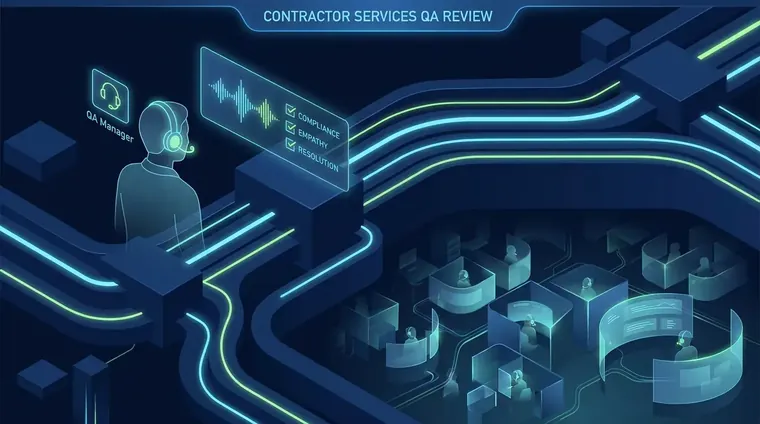
A QA-checked appointment has the homeowner confirmed, all decision-makers available for the sit, scope verified, and the time re-confirmed by a person, not just logged by software.
This is one of the operational details that separates a real call center from a message-taking service, so it's worth being specific.
Every appointment our floor sets for our own company, and every appointment we sell per sit to contractors outside our market, goes through a human QA check before it counts. The checker confirms: the person who answered is the homeowner, all decision-makers will be present at the appointment time, the product and scope match what the agent logged, and the time has been re-confirmed with the homeowner.
That's four checkpoints, not an automated rule in a CRM. A person verifies each point. If any of the four fail, the appointment doesn't count. No-shows and reschedules are replaced.
The reason this matters: a sit rate of 55 to 60%, which is what our appointments run, is only achievable when the appointments are real. An unqualified appointment that no-shows doesn't just waste a closer's afternoon. It warps your pipeline data, inflates your cost per sit, and makes it harder to evaluate whether your answering service is actually working.
When you evaluate any contractor answering service, ask them to describe their QA process in detail. If they describe software flags rather than human review, the process is not what they're calling it.
Every appointment we deliver also comes with the call recording and the homeowner's answers logged in the CRM, so the closer can review the conversation before they pull into the driveway. That context, knowing the homeowner mentioned a recent storm, or asked about financing, or said their neighbor just got the same product, changes how the closer opens the in-home presentation. A message-taking service can't provide that because there's no qualifying conversation to record.
How Contractor Answering Service Fits a Broader Lead System
A contractor answering service is the catch layer in a lead system, it only pays off if the upstream lead generation is consistent and the downstream CRM and closer process is ready to convert.
An answering service alone is not a growth plan. It's a patch. If your lead flow is inconsistent, feast-or-famine Google Ads, no organic traffic, no outbound, a better answering service just slows the drain. The bucket is still mostly empty. The systems that work are layered. Inbound leads from SEO, Google Ads, and Local Services Ads flow into a CRM. The answering service catches and qualifies the calls. A setter runs the appointment. QA checks the sit before it counts. The closer runs the in-home presentation. Each layer has to be working before the next one matters. A premium call center does nothing if your SEO produces zero organic leads, because there are no calls to answer. And solid organic traffic does nothing if every after-hours call goes to a personal voicemail. For roofing and windows contractors in coastal markets, our appointment setting for contractors program plugs directly into the setter layer. Our outbound floor sets the sit, QA checks it, and it lands in your CRM. The answering service layer handles your inbound. Together, they cover both sides of the phone. The SEO layer matters more than most contractors expect when they're first building this out. Our own site went from 600 to 1,300 organic clicks a month in 90 days after we fired our SEO agency. More organic clicks mean more inbound calls, which means the answering service layer has more volume to convert. Getting lead generation working first is what makes every downstream investment, answering service, call center, closers, worth the overhead.
Frequently Asked Questions
What is a contractor answering service vs. a virtual receptionist?
A contractor answering service answers inbound calls, qualifies the homeowner, confirming ownership, scope, and decision-makers, and books an appointment directly into your CRM. A virtual receptionist typically takes a message and routes it to you. The difference is whether a lead is booked or just logged. For contractors in Florida and other coastal markets, that gap is where revenue leaks.
How much does a contractor answering service cost?
Pricing ranges from flat monthly plans for basic call-answering to per-minute or per-appointment models. Generic answering services are often inexpensive but lack the trade knowledge and CRM integration that convert contractor leads. Our call center build is $15,000, then a monthly fee for a 2 to 3 month package, and the full three-month Full Management package is $30,000. Pricing for inbound and answering-service scope is set on the call.
Is a contractor answering service TCPA and Do Not Call compliant?
Inbound calls from homeowners who dialed you carry lower compliance risk. Outbound follow-up calls and texts must comply with the FCC's TCPA rules and must be scrubbed against the National Do Not Call Registry before dialing. TCPA private damages are $500 per violation, up to $1,500 if willful. Ask any answering service vendor to confirm in writing who holds TCPA liability, you or them.
Can a contractor answering service book appointments directly into my CRM?
A properly built one can and must. The agent needs direct write access to your scheduling tool, whether that's Jobber, ServiceTitan, or another platform, so the appointment lands with the homeowner's answers and a call recording attached. If the 'integration' is a forwarded email, the handoff will leak leads. Demand a live CRM demo before you sign with any contractor answering service in Florida or elsewhere.
What is a realistic sit rate for a contractor answering service in Florida?
Our own appointments, set by our outbound floor and QA-checked by a person before they count, sit at 55 to 60%. A generic answering service with no qualification process or QA will produce a lower sit rate because unqualified appointments no-show at higher rates. The sit rate you get is largely a function of how rigorously appointments are checked before they hit your calendar.
When should a contractor build their own call center instead of outsourcing?
Outsourcing a contractor answering service makes sense when call volume doesn't justify dedicated staffing, which is usually true for smaller contractors. At higher volume, or when running aggressive lead generation for roofing or windows, a dedicated floor with trade-specific agents, a dialer and CRM on one stack, and human QA on every appointment will out-produce a shared answering service. The $15,000 build cost can be financed at $1,250 a month over 12 months at 0% through a third-party lender, subject to approval.
Do you offer answering services for HVAC and remodeling companies?
Yes. For HVAC and remodeling companies, we build call center infrastructure, dialer, CRM, calendar, payroll on one stack, with trained agents and QA. We build inbound call centers as well as outbound, and inbound and answering-service pricing is set on the call. Our leads, appointments and rev share are for impact windows and roofing only. For HVAC and remodeling, the call center build, contractor SEO, and paid ads are the right starting points.
Free guides on this, step by step:
Ready to Stop Losing Leads After Business Hours?
We build contractor call centers on the same stack as the floor that sets about 650 in-home appointments a month for our own windows and roofing company. Inbound answering, outbound appointment setting, dialer, CRM, QA, and payroll, one stack. Two models: we run it for you, or we build it and you run it. You own the accounts and the data. Book a call and we'll walk you through what the build looks like for your market and your volume.