
Roofing Leads: A Field Guide for Contractors
Most roofing companies buy the wrong leads, from the wrong source, at the wrong stage of their growth. Then they call it a marketing problem. The real issue is channel selection. Roofing leads are not a commodity. They are a spectrum that runs from shared aggregator listings at one end to in-home, decision-maker-confirmed appointments at the other. Every point on that spectrum has a different cost structure, a different close rate, and a different level of control over your own pipeline. The channel that works for a 12-truck company running a full outbound floor is rarely the right channel for a 3-truck company that can only handle 15 in-home appointments a week. Mixing those two up is how operators burn budget for months before finding the actual problem. This guide covers how each channel works, what it actually costs to run, and which operators should use which combination. Numbers are sourced. Opinions are labeled. Nothing is invented.
What Is a Roofing Lead, Really?
A roofing lead is any contact record where a homeowner has expressed real intent to buy or replace a roof, but 'intent' ranges from a web-form click to a confirmed in-home appointment with all decision-makers present.
The roofing industry has a definitional problem. A 'lead' on paper can mean a homeowner who clicked a Facebook ad and left a phone number, a caller who asked for pricing and hung up, or a confirmed in-home appointment where the spouse, the homeowner, and the decision-maker are all seated at the table. Those three contacts have wildly different close rates, and treating them the same breaks your sales math. A raw click-to-form submission and a fully confirmed in-home sit are not the same unit, running them through the same CRM column and averaging the results will make every channel look worse than it is and make it nearly impossible to know which one is actually working.
The National Roofing Contractors Association (NRCA) is the trade's national association, and the U.S. Census Bureau's Construction Spending data tracks the residential spending that drives roofing demand. In our view, demand is not the constraint for most roofing companies. Contact quality is.
When we talk about roofing leads at Receipts Group, we mean contacts with demonstrable purchase intent, not raw clicks, not name-and-number lists. The source of the contact determines how much work your sales team has to do before a contract is signed. A homeowner who filled out a form at 11 p.m. after a storm rolled through and is now taking calls from several contractors at once is a fundamentally different sales scenario than a homeowner who was qualified, confirmed, and scheduled into a single contractor's calendar. That's the variable most operators underestimate, and it's the variable that determines whether your cost per acquisition is sustainable or a slow bleed.
The Six Main Sources of Roofing Leads
Roofing leads come from six channels: aggregators, pay-per-click search ads, Local Services Ads, organic SEO, outbound call centers, and door-to-door canvassing, each with a different cost and control profile.
- Shared aggregator leads Platforms like Angi and HomeAdvisor sell the same contact to multiple roofing contractors simultaneously. Speed-to-call becomes the main differentiator, because you are competing against companies that received the same lead at about the same time.
- Google Local Services Ads (LSA) LSA ads show at the top of Google search results with a 'Google Verified' badge. You pay per lead, not per click. Getting started with LSA means passing Google's screening and verification, including license or business registration checks, and that verification is what makes the badge meaningful to homeowners.
- Pay-per-click (Google / Bing Search Ads) Paid search puts your ad in front of someone actively searching for a roofer. Cost per click in roofing is high relative to most trades, and converting a click to a booked appointment requires fast follow-up and a well-built landing page.
- Organic SEO City and service pages that rank in organic search produce leads at a near-zero marginal cost once built. The lag time from build to traffic is the trade-off, it takes months, not days, to show results.
- Outbound call center A trained outbound floor contacts homeowners by phone and books in-home appointments directly into your calendar. This is the highest-control source of roofing leads: you control the list, the script, and the qualification criteria.
- Door-to-door canvassing Field reps knock doors in storm-affected or high-density neighborhoods. Labor-intensive and weather-dependent, but effective in post-storm markets where homeowners may not yet be actively searching online.
Why Shared Leads Burn Roofing Companies
Shared roofing leads fail because multiple contractors receive the same contact at the same moment, turning every lead into a speed contest rather than a sales conversation, and speed rarely wins on price or quality.
Shared leads from aggregators get sold to several roofing contractors at once. That's the model. You know it. You've probably paid for it. Operators keep buying them because they're fast to set up and the per-lead price feels manageable on its own. The problem is the math downstream. When the same contact hits several companies at once, the first contractor to call often wins the appointment. That contractor is usually the one willing to offer the lowest price fastest, not the best operator in the market. You're not selling. You're racing. Your close rate on shared leads will almost always trail your close rate on exclusive contacts, and that gap is what makes the per-lead price misleading. Say you buy 40 shared leads at a price that feels reasonable per unit. If your close rate on those is a fraction of what you close on exclusive, confirmed contacts, the effective cost per signed job tells a very different story than the sticker price on the lead. In our view, raw lead volume matters far less than owning the context in which a homeowner first finds you. A homeowner who typed your company name into Google after seeing your truck is a fundamentally different contact than one whose form submission was sold to several businesses. The source determines the sales dynamic before your team ever picks up the phone. Shared leads are not categorically useless, they can fill gaps in a slow week, but they should never be the foundation of a pipeline. A foundation built on contacts your competitors are also calling at the same time trains your closers to race to the bottom on price.
Exclusivity is the single biggest driver of lead quality. One contractor, one contact, one conversation, that structure changes the sales dynamic before anyone says a word.
Google LSA and Paid Search: Fastest to Revenue, Hardest to Sustain
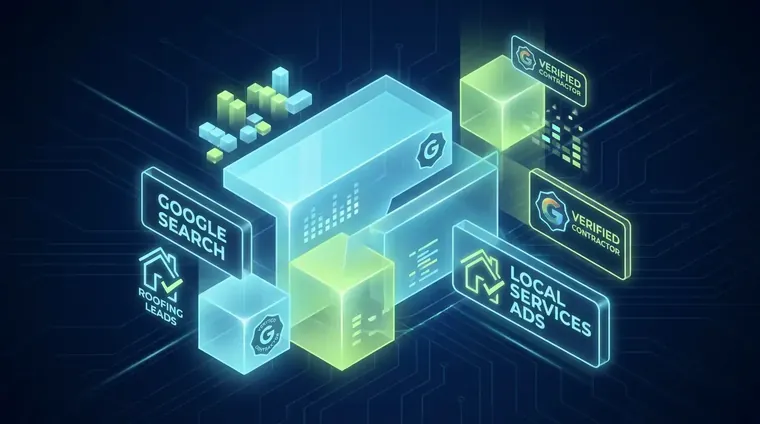
Google LSA and paid search produce roofing leads fast, but both require instant response and ongoing budget, stop spending and the leads stop immediately, with no residual asset left behind.
In our view, LSA and paid-search leads go cold fast if no one picks up. Google's own guidance on Local Services Ads lists responsiveness as a ranking factor inside the platform. Slow answer rates push your ad position down. LSA listings now display a Google Verified badge for businesses that pass Google's screening, not to be confused with older program names. The upside is real. Paid search puts you in front of someone actively searching for a roofer right now. In a post-storm market, that intent is extremely high and the window is short. The downside is equally real. The moment you stop paying, the pipeline stops. No page that ranks. No list that grows. You are renting visibility, not building it. That distinction matters most when you're deciding where to put your next dollar. Every paid-search dollar is an expense. Every well-built SEO page is closer to an asset that grows on its own. For most roofing companies, paid search works best as a complement to a stronger organic or outbound foundation, not as the primary engine. Running ads against a market where you have zero organic presence means you're paying full retail for every contact with no brand signal behind you. The practical move: use paid search to capture demand while your organic foundation builds, and treat it as a dial you turn up in peak season and down in slow months, not as your only source of pipeline.
SEO: The Slowest Start, the Best Long-Term Return
SEO-generated roofing leads have near-zero marginal cost once ranked, but the build phase takes months, operators who treat SEO as a quick fix consistently underinvest and quit before the stacking begins.
Organic search is the channel most roofing companies underinvest in and most SEO agencies oversell. The standard pitch is rankings in 90 days. The reality is that city and service pages need to be built right from the start, URL structure, internal linking, schema, page templates, before any monthly content moves the needle. An agency that skips the architecture phase and goes straight to blog posts is billing you for activity, not results. The architecture work is unglamorous: mapping city-and-service combinations, setting canonical tags, building a silo structure that passes authority from your strongest pages down to newer ones. Most agencies skip it because clients can't see it in a monthly report. Our own site went from 600 to 1,300 organic clicks a month in 90 days after we fired our SEO agency. Every dollar of SEO investment stacks up over time if the foundation is right. It doesn't if the foundation is wrong. That's the variable agencies don't advertise. The BLS Occupational Outlook for Roofers projects continued job growth in the roofing trade. In our view, more roofers means more competition for roofing keywords, and the operators who build strong local SEO now will pay less per lead later than the ones who wait. That's the stacking return agencies should be selling but rarely do.
Our site went from 600 to 1,300 organic clicks a month in 90 days after we fired our SEO agency.
Outbound Call Centers: Highest Control, Real Build Cost
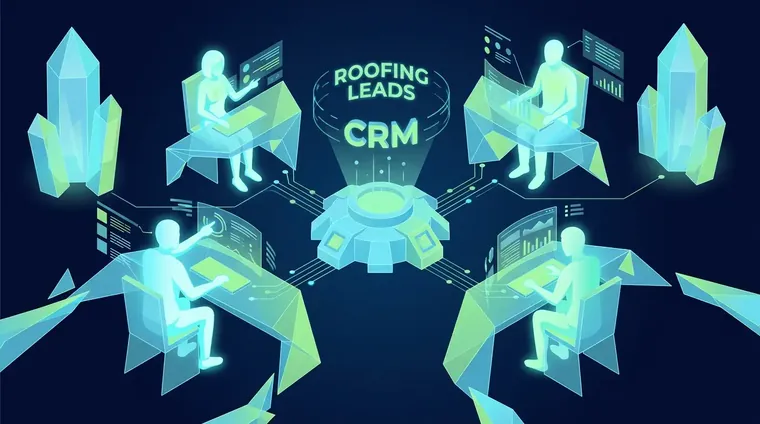
An outbound call center gives roofing contractors the most control over lead volume and quality, but it requires real infrastructure, dialer, CRM, trained agents, and QA, and takes months to reach consistent output.
An outbound call center contacts homeowners directly and books in-home appointments into your calendar. You control the list, the script, the qualification checklist, and the call volume. That control is real. So is the build cost and the ramp time. The infrastructure is not plug-and-play. A predictive dialer needs to be configured for your state's calling-hour rules and your target zip codes. Your CRM needs calendar integration so agents can book directly without a handoff gap. Your QA layer needs to exist before the first appointment is confirmed, not after you've had three no-shows in a row. Our own outbound floor sets about 650 in-home appointments a month for our windows and roofing company. We did not start there. We built a call center from zero to $426,000 a month in sales in nine months. Our floor's best month hit $700,000 in sales. Those numbers are ours, from our own operation, not a client. The infrastructure required is real: a predictive dialer, a CRM with calendar integration, a quality-assurance step before every sit gets confirmed, and agents trained on your specific product and objections. Skipping any of those steps produces a floor that burns contacts fast and demoralizes your sales team. Agent training is where most DIY floors break down. Generic scripts produce generic results. An agent who doesn't understand the product can't handle the objection that comes up on call three of a six-call sequence. This model works above a certain volume threshold. Below it, the overhead may not justify the build. That's the honest trade-off.
Compliance: TCPA and TSR Are Not Optional
Outbound roofing lead generation is governed by the TCPA and the FTC's Telemarketing Sales Rule; TCPA private damages are $500 per violation, up to $1,500 if willful (47 U.S.C. 227), and class-action exposure is real.
Every outbound call your team or your call center makes to a homeowner is governed by federal law. The FCC's TCPA framework covers robocalls and text messages. The FTC's Telemarketing Sales Rule governs outbound calls more broadly. Statutory damages under the TCPA run $500 per violation, up to $1,500 per violation if it is willful (47 U.S.C. 227). Multiply that by a list of 10,000 contacts and the math gets ugly fast. The compliance basics for outbound roofing lead generation: scrub against the National Do Not Call Registry at least every 31 days, honor opt-outs promptly, call only between 8 a.m. and 9 p.m. local time, and never use a pre-recorded message without prior express written consent. These are not bureaucratic suggestions. They are the minimum required to run an outbound floor legally. State rules add another layer. Some states have calling-hour windows narrower than the federal standard, and a handful require additional consent language your script needs to capture and your CRM needs to log. If your floor operates across multiple states, map those rules by state before a single dial goes out. When we build call centers for contractors, QA is part of the build from day one, not something bolted on after a problem surfaces. Every appointment our floor counts has been verified by a human, with the call recording available for review. A recorded and reviewed call is also your documentation if a dispute ever comes up. It is far easier to show compliance when the record exists from the start than to piece it together after the fact.
Roofing Lead Channels: Cost and Control Compared
Outbound appointments deliver the most qualified roofing leads with the highest control, while shared aggregator leads trade quality for speed-to-launch with the least exclusivity.
| Feature | Higher Control / Higher Effort | Lower Control / Faster to Launch |
|---|---|---|
| Exclusivity | Outbound appointments: one contractor per lead | Aggregator leads: sold to multiple contractors at once |
| Qualification | Decision-makers confirmed, scope verified before sit counts | Web form or inbound call, intent unverified |
| Upfront cost | Build cost for call center or per-sit appointment fee | Low per-lead price, but cost rises with required call volume |
| Speed to first lead | A call center needs build and ramp time; buying appointments starts sooner | Fast once an aggregator account is live |
| Asset built | Database of contacted homeowners, recorded calls, CRM data | No lasting asset, stop paying, pipeline stops |
| Close rate driver | Sales skill, no other contractor gets the same appointment | Speed, first caller to the shared lead usually wins the appointment |
The Revenue Stack: How Operators Combine Channels
The most durable roofing revenue stacks pair an organic SEO foundation with either a paid-search layer or an outbound appointment program, using each channel for what it does best rather than relying on any single source.
No single channel produces all the roofing leads a growing company needs. The operators running the most predictable pipelines run two or three channels together, each one doing a specific job. A common and durable stack looks like this. An organic SEO foundation handles low-cost, stacking traffic. A paid-search or LSA layer captures high-intent searches in the short term while SEO builds. An outbound appointment program fills the calendar on a schedule that doesn't depend on how many people happen to search that week. Each channel covers the weaknesses of the others. SEO takes months to build but costs little to maintain once it ranks. Paid search turns on in days but stops the moment the budget does. Outbound gives you a dial you can turn up when the calendar is light and turn down when your closers are full. That kind of control matters to any company that needs to manage crew utilization tightly. The mistake most operators make is treating these channels as substitutes when they are complements. Running only paid search means you stop the moment the budget stops. Running only SEO means a slow start and no lever to pull in a slow month. Running only an outbound floor means high control but limited reach into the homeowners who are already searching. The right combination depends on your market, your team size, and your capacity to run in-home appointments. There is no universal answer, but picking one channel and hoping is never the right call.
How to Evaluate a Roofing Lead Source Before You Buy
Evaluate any roofing lead source across five criteria: exclusivity, qualification method, replacement policy, compliance posture, and the downstream asset it builds, before committing budget.
- 1Confirm exclusivityAsk directly: is this lead sold to other contractors? If the answer is yes or unclear, price the lead accordingly, you're entering a speed contest, not a sales conversation.
- 2Ask how the contact was qualifiedWhat did the homeowner confirm? A name and phone number is not a qualified lead. A confirmed appointment where all decision-makers and the scope are verified is a qualified sit.
- 3Check the replacement policyWhat happens when a lead is a wrong number, a disconnected line, or a no-show? Reputable sources replace or credit those contacts. Get the policy in writing before you pay.
- 4Audit the compliance postureHow were these contacts reached? TCPA and TSR violations attach to the end buyer in some enforcement scenarios. Know whether the contacts were reached legally before your team calls them back.
- 5Measure the asset you're buildingAfter 90 days of buying from this source, what do you own? A CRM full of qualified contacts, a ranked page, a call recording library? If the answer is nothing, factor that into your cost analysis.
Most roofing companies that say they need more leads actually have a qualification and follow-up problem. Doubling your lead spend with a broken sales process doubles your losses, not your revenue.
What We Do at Receipts Group
Receipts Group sells roofing leads and in-home appointments, outbound call center builds, contractor SEO, and paid ads, all built on the same systems running our own $23M-a-year windows and roofing company in Southeast Florida.
Receipts Group is not a generic marketing agency. We sell the systems behind our own $23M-a-year impact windows and roofing company in Southeast Florida to other contractors in roofing, windows and doors, remodeling, and HVAC. The SEO platform, the call center stack and the appointment program are the ones we run for our own company. That operator background is the difference between a vendor who reads about what works and one who has the screenshots to prove it. We do not sell inside our own five counties. The partner we take in for each coastal market gets the appointments we set there on rev share: no cost per lead, and you only pay when you close, if you qualify. Rev share runs for impact windows and roofing in Florida outside our five counties, Texas, Louisiana, Georgia and the Carolinas, and spots per market are limited. Outside our footprint we also sell appointments per sit: the same in-home appointments our own closers run, one contractor per appointment, delivered into your CRM with the call recording and the homeowner's answers. Every sit is checked by a person before it counts, homeowner present, all decision-makers confirmed, product and scope verified, time re-confirmed. On per-sit appointments, no-shows and reschedules are replaced, but we do not guarantee your sit rate. Per-sit appointments run in Florida outside our five counties, Georgia, South Carolina, North Carolina, Texas and Arizona, for windows and roofing. For contractors who want to own their own call center, we build outbound and inbound floors on our own stack: dialer, CRM, calendar, and payroll in one place, trained agents, and QA on every appointment. Two models: we build it and run it, or we build it and your team runs it. For contractors who want roofing leads from organic search, we build and run the same site platform we built for our own company, off WordPress. We also run Google Ads, LSA, and Facebook ads for contractors. I'm Eric Snyder, founder of Receipts Group and Marketing Director at Safeguard Impact, where I grew monthly revenue from $800,000 to $2,000,000 over 15 months. Before Safeguard, I was Operations Director at a Florida fix-and-flip and wholesale real estate company I scaled from zero to $6M a year. The systems we sell are the ones running our own windows and roofing company. Not case studies from a client we managed at arm's length. The actual infrastructure we built and now operate every month.
Frequently Asked Questions
What makes a roofing lead high quality?
A high-quality roofing lead is exclusive to one contractor, has all decision-makers confirmed, includes a verified scope of work, and is backed by a call recording. Shared web-form leads meet none of those criteria.
How much do roofing leads cost in Florida?
Roofing lead costs in Florida vary significantly by channel. Shared aggregator leads are cheaper per contact but require more volume. Exclusive in-home appointments carry a higher per-sit cost, and in our view they usually close at higher rates than shared leads. We do not publish our per-sit price; it is set on the call.
How fast can an outbound floor set roofing appointments?
A properly built outbound floor with trained agents, a predictive dialer, and a clean contact list can start setting roofing appointments once the build is done, but reaching consistent output takes longer. We built a call center from zero to $426,000 a month in sales in nine months, and our own floor sets about 650 in-home appointments a month.
Is SEO worth it for a roofing company?
Yes, if the site architecture is built correctly from the start. Our own site grew from 600 to 1,300 organic clicks a month in 90 days after we fired our SEO agency. SEO builds up over time; it does not produce leads in the first week.
What compliance rules apply to roofing lead generation?
Outbound roofing lead generation is governed by the TCPA and the FTC's Telemarketing Sales Rule. TCPA private damages are $500 per violation, up to $1,500 if willful (47 U.S.C. 227). Contractors should verify that any lead vendor uses legally compliant contact methods before their sales team calls those contacts.
Free guides on this, step by step:
Ready to Talk About Roofing Leads for Your Market?
We take on a limited number of partners per coastal market. If you're a roofing contractor in Florida outside our five counties, Texas, Louisiana, Georgia, or the Carolinas and you want to see how rev share works, or you want to talk about a call center build, book a call. We'll look at your market, your current pipeline, and tell you honestly whether we're the right fit, or not.