

HVAC SEO: The Contractor's Ranking Playbook
Look at enough home-services sites, HVAC, roofing, and plumbing alike, and the same pattern shows up. Thin city pages with swapped city names, a Google Business Profile that hasn't been touched since setup, and a phone system that lets organic leads ring to voicemail at 7 PM. The traffic problem was real, but the conversion problem was worse. HVAC SEO is not complicated, but it does require doing six things at once, and most contractors are doing two. This guide covers all six: the technical foundation, the GBP signals, the content architecture, the schema, the call center that captures what you earn, and the paid layers that buy time while organic matures. We use no agency speak, just what works.
Most HVAC websites rank for nothing. Thin content is the most common reason, but it's rarely the only one. The pattern repeats on site after site: generic service pages written once and cloned across twenty cities, zero structured data, and a GBP account with a handful of old photos. Google is explicit about this. Google's helpful content guidelines define "helpful" as content that satisfies the searcher's actual need, not content that exists only to rank. A page that says "HVAC repair in Tampa" and then describes generic repair steps fails that test every time. The second failure is treating GBP as a profile instead of a signal channel. Google's own ranking guidance for local results names relevance, distance, and prominence as the three ranking factors. You control relevance through your primary and secondary categories, your business description, and your services list. You control prominence through reviews, citations, and the authority of your organic site. Distance is fixed. Most contractors work one lever and wonder why the other two don't move. The third failure is the most expensive: a site that earns organic traffic but can't answer the phone. HVAC is a high-intent vertical. Someone searching "AC not cooling" at 6 PM on a Friday wants a human being within minutes. If your SEO eventually works and your call center doesn't, you've paid for traffic your competitor closes.
Ranking on page one for 'HVAC repair near me' and sending that traffic to voicemail is not an SEO win. It is a lead donation to whoever ranks second and answers.
The Technical Foundation Every HVAC Site Needs. Technical SEO is the floor, not the ceiling. Google's SEO Starter Guide covers the fundamentals: descriptive URLs, clean internal linking, accurate title tags, and pages that load fast. Every one of those points applies to HVAC sites, but there are three that matter most in a local service context.
First, URL structure is where you start. Your service pages should follow a predictable pattern: `/hvac-repair-[city]/`, `/ac-installation-[city]/`, `/furnace-tune-up-[city]/`. Keep them flat, keyword-forward, and free of session IDs or dynamically generated parameters. Crawlers follow predictable structures faster, and predictable structures build internal link equity more cleanly.
Second, Core Web Vitals. LCP (Largest Contentful Paint) is the one to fix first on HVAC sites because most of them lead with a hero image that isn't compressed or lazy-loaded. A slow LCP tanks the user experience score before the page content even matters. Run PageSpeed Insights on your top five city pages right now. If LCP is above 2.5 seconds, that is the first fix.
Third, canonical tags. If your CMS auto-generates `/hvac-repair-miami` and `/hvac-repair-miami/` as two separate URLs, you are splitting equity and confusing the crawler. Set one canonical per page, always pointing to the preferred version. These are table-stakes items. Getting them wrong doesn't just hurt rankings; it makes every other investment in HVAC SEO less effective.
GBP Optimization: The Local Pack Is Won Here
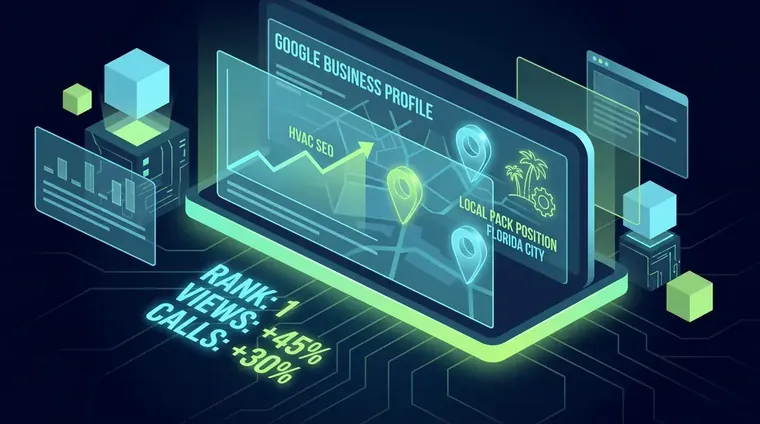
Your Google Business Profile categories, reviews, and completeness drive whether you appear in the Local Pack, which sits above the organic results.
The Local Pack, the three-map result at the top of a local search, is the first thing most homeowners click. Winning it is a GBP problem, not a website problem. The website matters for the organic results below the map. For the map itself, your GBP signals dominate. Start with your primary category. "HVAC contractor" is the correct primary for most companies. "Air conditioning contractor" or "heating contractor" can work depending on your service mix, but the primary should match the broadest, highest-volume service you offer. Secondary categories matter, add them. "Furnace repair service," "air duct cleaning service," and "heating equipment supplier" are all addable secondaries that help you appear in adjacent searches. Google's guidelines for representing your business on GBP are clear about what can and can't go in your business name. Do not keyword-stuff the name field. It is against policy and flags for review. The smarter play is loading your business description and services section with the keyword language your categories don't explicitly cover. On reviews: Google's local ranking guidance is explicit that review count and score factor into prominence. The detail most operators miss is velocity, not total count. Consistent new reviews each month signal an active business to the algorithm. Build a post-service review request into your job-close workflow, a text with a direct link to your GBP review URL, sent within 24 hours of the appointment. One automated review request step in your CRM, fired at close, is worth more than any monthly review campaign.
- Set the right primary category Choose 'HVAC contractor' as your primary unless your revenue is split, in which case pick the highest-volume service category. Changing it later signals inconsistency to the algorithm.
- Fill every service field GBP lets you list individual services with descriptions and prices. Fill all of them. Each service entry is an additional relevance signal for queries you might not rank for organically yet.
- Post weekly with a keyword and CTA A weekly post, one photo, one local keyword, one phone number, keeps the profile active and signals an engaged business owner.
- Add job-site photos monthly Upload real photos taken on your job sites. Service van parked in front of a recognizable local landmark, job completion photos, team shots. Volume and recency both matter.
- Build a review velocity system One CRM-triggered review request sent within 24 hours of job close outperforms any monthly review push. Consistency over time beats a burst of reviews in a single week.
City and Service Pages: How to Build Them Right
Effective HVAC city pages answer the searcher's exact question for that city, they are not cloned templates with a swapped city name.
Most HVAC city pages are doorway pages in thin disguise. Google's spam policies on doorway pages define doorway abuse as sites or pages created to rank for specific, similar search queries, and list pages targeted at specific regions or cities that funnel users to one page as an example. Swapping city names on a template and publishing 50 of them is exactly that pattern. Google's classifiers are catching up to it fast. The right architecture is narrower and deeper. Build city pages only for markets where you actually send technicians. Each page needs the specific neighborhoods and zip codes you serve, the HVAC brands you stock or repair in that market, local climate context ("South Florida heat load means your AC runs most of the year, here's what that does to a system"), a local or tracking phone number, and three to five real reviews from customers in that city. That is a page Google can validate. A reader in that city learns something specific. A search crawler sees signals that match the page's claimed geography. Our own site, on the same platform we offer contractor clients, went from 600 to 1,300 organic clicks a month in 90 days after we fired our SEO agency. We fired our SEO agency and ran it ourselves. The lesson is not that agencies are bad. The structure has to be right before any content strategy builds on top of it.
Our own site grew from 600 to 1,300 organic clicks a month in 90 days after we fired our SEO agency. For HVAC companies in competitive metros, that structure gap is the whole game.
Schema Markup for HVAC Contractors
LocalBusiness schema with HVAC-specific service types and FAQ markup gives Google machine-readable confirmation of what your pages already say.
Structured data does not directly cause rankings. It helps crawlers understand what your pages mean and where you work, but don't count on star ratings or FAQ accordions in the SERP, because Google doesn't show self-serving review stars for a business's own LocalBusiness markup and limits FAQ rich results to authoritative government and health sites. For HVAC contractors, the most useful schema types are `LocalBusiness` (with `areaServed`, `openingHours`, and `priceRange` properties), `Service` for each major service page, and `FAQPage` on any page built around questions and answers. Schema.org has a dedicated HVACBusiness type for this. It sits under `HomeAndConstructionBusiness`, which is itself a subtype of `LocalBusiness`, so it inherits every LocalBusiness property. Use `@type: 'HVACBusiness'` if your schema builder supports it. If not, `LocalBusiness` with an accurate `description` gets the job done. Three implementation details most contractors skip. First, the `areaServed` property should list every city you serve, not just your headquarters city. That tells the crawler exactly which geographic queries the page should match. Second, aggregate `ratingValue` and `reviewCount` must reflect real, verifiable data, never inflated numbers. Third, FAQ schema on city pages should use the actual questions homeowners type, not questions written by an agency. Pull them from your Search Console query report. Those are the real questions your pages are already half-answering.
HVAC SEO vs. Paid Search: When Each One Wins
Paid search wins on speed and targeting control; HVAC SEO wins on cost-per-click at scale, the best programs run both in parallel.
| Feature | HVAC SEO (Organic) | Google Ads / LSA (Paid) |
|---|---|---|
| Time to first lead | 90–180 days to meaningful volume | Days for Search ads; LSA starts after Google's verification clears |
| Cost per click at scale | Near-zero marginal cost once ranked | HVAC CPCs among highest in local services |
| Lead exclusivity | Your site, your call, your lead | LSA leads can go to multiple contractors |
| Trust signal in SERP | Organic position implies editorial authority | Google Verified badge on LSA adds credibility |
| Switching cost | High, rankings take time to build and protect | Low, pause or redirect spend the same day |
| Best use case | Long-term market ownership in your core cities | New market entry, seasonal demand spikes, fast testing |
Why SEO and a Call Center Must Be Built Together
HVAC SEO earns the traffic; a staffed inbound call center is what turns that traffic into booked jobs, one without the other leaks revenue.
Here is the truth about HVAC SEO: it does not work alone. Organic traffic is earned attention. Earned attention that hits voicemail is wasted. In the HVAC vertical, emergency calls are common, the homeowner's pain is acute, and the decision to book is fast. The inbound experience is often worth more than the ranking itself. We built a call center from $0 to $426K a month in 9 months. That is the proof we bring to this conversation. It runs on the stack we now offer to contractor clients: dialer, CRM, calendar, and payroll in one system, trained agents, and QA on every appointment before it counts. For an HVAC company running any meaningful SEO or paid traffic, the math is simple. Say your site earns 300 inbound calls a month. If your answer rate is 70% and your booking rate on answered calls is 40%, you book 84 jobs. Lift the answer rate to 90% with a staffed call center and the same booking rate yields 108 jobs. That is about 29% more booked jobs from the same traffic investment. The SEO did not change. The infrastructure around it did. That is the part most HVAC SEO guides leave out, because most guides are written by agencies, not operators.

Link Building and Authority for HVAC Contractors
HVAC site authority grows fastest through supplier citations, local directories, and trade association links, not generic link-building campaigns.
Domain authority is a proxy for trust. And trust is what lets your city pages rank in competitive metros like Houston, Phoenix, or Miami. The honest answer on link building for HVAC: most contractors don't need a big outreach campaign. They need to close the obvious gaps first. Start with citations. Your NAP, name, address, phone, should be consistent across Google, Yelp, Angi, Houzz, the Better Business Bureau, and your state licensing board's public directory. Inconsistent NAP data is a trust problem, not just a citation problem. Next, supplier and manufacturer links. If you're a certified Carrier dealer, a Trane Comfort Specialist, or an authorized Lennox dealer, those manufacturer directories are high-authority links your competitors without certifications cannot replicate. Request them directly from your rep. Then there are local media and trade association links. A quote in a local news story about heat waves or energy efficiency, a listing on your regional ACCA chapter website, a feature on a local home-improvement site, these are the links that build geographic authority. One comment on a Reddit SEO thread noted what many practitioners already know: traffic data from third-party tools rarely matches what you see in Google Search Console. Keep that in mind when you're sizing up your backlink profile's impact. Use Search Console as the source of truth, not an estimated domain authority score from any third-party tool.
- 1Audit your current technical stateRun your top five city pages through PageSpeed Insights and a crawl tool (Screaming Frog or Sitebulb). Document LCP, canonical issues, broken internal links, and missing meta data. This baseline tells you what to fix before publishing anything new.
- 2Lock down your GBP signalsVerify primary category, load all service descriptions, set up a weekly post cadence, and launch a post-service review request via CRM automation. GBP changes propagate faster than organic changes, this is your quickest win.
- 3Build or rebuild your core city pagesStart with your top three revenue markets. Each page needs a city-specific intro, local service context, verified reviews from that city, and a schema block. Publish these before spreading to additional cities.
- 4Implement LocalBusiness and FAQ schemaAdd JSON-LD schema to every city and service page. Use your Search Console query report to write FAQ questions, those are the real phrases homeowners type, not agency-invented language.
- 5Submit to Search Console and monitor weeklyRequest indexing for new and updated pages via Search Console's URL inspection tool. Set a weekly review of the Performance report: clicks, impressions, average position, and CTR by page. These four numbers tell you what is working before any third-party tool does.
Paid Search as the Bridge While Organic Grows
Google Ads and Local Services Ads fill the revenue gap while HVAC SEO matures, the goal is to run both until organic volume justifies reducing paid spend.
Organic SEO for HVAC in a competitive market takes time. In a metro where three established companies have been building domain authority for years, expecting page-one rankings in 30 days is not realistic. Give it months, not weeks, before organic starts producing in most markets. Dense urban metros take longer, the competition has years of stacking signals behind them. That lag is where Google Ads and Local Services Ads earn their keep. LSA has a real edge for HVAC: the Google Verified badge signals pre-screened credibility, and homeowners call or message you straight from the ad. The trade-off is that LSA is not exclusive. Homeowners can contact multiple businesses from the same search result. Your booking rate on LSA calls depends on how fast and how well your team picks up. We run paid search and paid social for contractor clients alongside SEO programs. The contractors who grow fastest run both from day one. They have a clear plan to shift budget toward organic as rankings solidify and use paid to expand into new territory. The ones who run only paid and skip SEO are permanently renting their traffic. The ones who run only SEO and skip paid spend the first six months leaving revenue on the table. See our contractor SEO pillar page for more on how we structure the paid-plus-organic stack for home-services companies, and the roofing SEO playbook if you also carry roofing services and want to see how we handle a dual-trade site architecture.
AI writing tools can draft HVAC content fast. One practitioner on Reddit said it plainly: "Everyone I know has this inability to believe that AI is wrong like over 50% of the time" (u/seamore555, r/SEO). Review every AI-generated page for factual accuracy, local specificity, and schema completeness before it goes live. The tool is a draft engine, not a publishing system.
How Receipts Group Builds HVAC SEO Programs
Receipts Group builds HVAC SEO on the same site platform and content engine we built for our own $23M-a-year windows and roofing company, and you own the content, the code and the accounts.
We are not a generic agency. The custom SEO program we sell to contractor clients is the same platform and content engine we built for our own $23M-a-year windows and roofing company. City and service pages written for how homeowners actually search, a content engine, and a dashboard that shows which pages produce leads, not just which pages earn clicks.
The price is $3,500 to build, then $3,500 a month for six months, $24,500 all in. The 0% plan is $15,000 over 12 months, $1,250 a month through a third-party lender, subject to approval: it covers the $3,500 build and the first three months ($14,000), with the remaining $1,000 toward month four. You own the content, the code, and the accounts. We never guarantee rankings or a specific date. We show our numbers, the 600-to-1,300 click jump in 90 days, and we are straight with you about what those numbers mean for your situation.
For HVAC companies that also want a call center built to capture organic and paid leads, we build outbound and inbound systems: dialer, CRM, calendar, and payroll on one stack, trained agents, QA on every appointment before it counts. Two models, Full Management, where we run it, and Build-for-You, where your team runs it after we build and staff it. The build is $15,000. The full three-month Full Management package is $30,000. The $15,000 build can be financed at $1,250 a month over 12 months at 0% through a third-party lender, subject to approval. If you want the SEO and the call center running together from the start, that is how we prefer to work.
Frequently Asked Questions
How long does HVAC SEO take to produce leads?
Expect months, not weeks, before organic search starts producing consistent inbound calls; how long depends on your market's competition and your site's starting authority. Competitive metros with established incumbents can take longer. GBP improvements and Local Services Ads, once Google's verification clears, can produce calls much sooner while organic matures, running both in parallel is the practical answer for any HVAC company that needs near-term revenue alongside long-term ranking growth.
What Google Business Profile category is best for HVAC?
'HVAC contractor' is the correct primary category for most companies. Add secondary categories like 'air conditioning contractor', 'furnace repair service', or 'air duct cleaning service' to capture adjacent searches. Per Google's GBP guidelines, your business name field should not contain keyword stuffing, load your categories and service descriptions instead.
Do HVAC companies need city pages for every city they serve?
Only build city pages for markets where you actively send technicians. A page built purely to capture a geographic query without real service coverage is a doorway page under Google's spam policies, a classification that can suppress your entire site, not just the offending pages. Fewer, better city pages consistently outperform a large volume of thin clones.
What schema markup should an HVAC site use?
Use LocalBusiness schema with 'areaServed' listing every city you serve, plus 'openingHours' and 'aggregateRating' if your review count is verifiable. Add FAQPage schema to city and service pages using questions pulled from your Search Console query report, those are the real phrases homeowners type, not agency-written questions.
Is Google Ads or SEO better for HVAC leads?
They serve different functions. Google Ads can produce calls within days of launch, and Local Services Ads once Google's verification clears; organic SEO takes months to build but costs near-zero per click once ranked. The most effective HVAC marketing programs run both: paid search fills revenue while organic matures, then organic retention justifies reducing paid spend over time.
What content topics actually rank for HVAC companies?
City-plus-service pages ('AC repair in [city]', 'furnace installation [city]') drive the highest-intent traffic. Supporting blog content on seasonal maintenance, brand-specific repair guides, and energy efficiency topics builds topical authority that lifts city-page rankings. Pull your Search Console query report to see which questions your site is already half-answering, those are the fastest content wins.
How does a call center improve HVAC SEO results?
HVAC SEO earns inbound traffic; a staffed call center determines how much of that traffic converts to booked jobs. A higher answer rate and faster response time directly improve revenue from the same organic investment. We built a call center from $0 to $426K a month in 9 months, the infrastructure that captures organic leads is as important as the SEO program that earns them.
Free guides on this, step by step:
Ready to Build an HVAC SEO Program That Builds up?
If you're serious about owning your market organically, and you have the infrastructure to close what you earn, book a call. We'll show you the numbers from our own program before we talk about yours.