
Facebook Ads for Contractors: The Operator Playbook
In roofing, windows, and HVAC, the same pattern shows up in ad accounts that struggle. The campaigns are often structurally fine. Targeting looks reasonable. Budgets are real money. The problem is everything that happens after someone clicks. There is often no speed-to-lead, no follow-up sequence, and no appointment confirmation logic. The ads generate form fills that die in a CRM nobody touches until Monday morning. Facebook ads for contractors are not a creative problem. They are a system problem, and most contractors are solving the wrong end of it.
Why Facebook Ads Work Differently for Contractors
Facebook ads for contractors succeed when they target homeowner life events and trigger fast follow-up, not when they just optimize for cheap clicks.
Paid search captures demand that already exists. A homeowner types "roof replacement near me" and Google shows your ad. Facebook is different. You are interrupting someone who was not looking for a roofer thirty seconds ago. That gap changes everything about how the campaign has to be built. Meta targeting runs on demographics, life events, and behavioral signals, not search intent. A homeowner in a coastal area who has engaged with home-improvement content is a reasonable proxy for someone who needs impact windows. That is the logic you are building into your audience. The creative has to manufacture the reason to act. A search ad can be two lines of text because the query created context. A Facebook ad has to create that context from scratch: a problem the homeowner recognizes, a reason your company is the answer, and a next step that feels low-friction. That is a harder brief. Most contractors hand it to a freelancer with no knowledge of the trade and wonder why the leads are soft. For a full comparison of how paid social stacks up against paid search for home services, read our guide to Google Ads for Contractors.
The Audience Structure That Actually Produces Appointments
A three-layer audience structure, warm retargeting, lookalike, and cold interest, is how Facebook ads for contractors generate bookable appointments, not just form fills.
Most contractors run one cold audience and call it a campaign. That is not a campaign. That is a single bet with no fallback. A structure that works layers three audience types. The first is warm retargeting: website visitors, video viewers, and anyone who engaged with the page in the last thirty days. These people already know the brand. The cost to convert them is lower and the lead quality is higher. This audience is small, but it should never be off. The second layer is lookalikes built from your best customers, closed jobs, not form fills. Upload a list of homeowners who spent above your target job size and Meta finds people who look like them across the platform. The quality gap between a lookalike built from closed jobs and one built from raw leads is real. The third layer is cold interest-and-demographic targeting. This is where most of the spend lives, and it is the hardest to make profitable. Location and a few home-improvement interests are the main levers, and if Meta puts your ad in the Housing special ad category, which can happen with home repair and improvement ads, age, gender, zip-code and lookalike targeting are off the table. Under Meta's default Advantage+ audience, interests and lookalikes act as suggestions Meta can go beyond, so stacking interest filters adds little and mostly narrows the signal you start with. Broader audiences with tighter creative usually outperform narrow audiences with generic creative.
The contractors who win with Facebook ads follow up with every lead within minutes, not hours. A form fill that sits for ninety minutes is cold. Build the automation before you run the first dollar of spend.
Creative That Books Jobs, Not Just Clicks
High-performing Facebook ad creative for contractors leads with a recognizable homeowner problem, proves the fix visually, and ends with a single low-friction call to action.
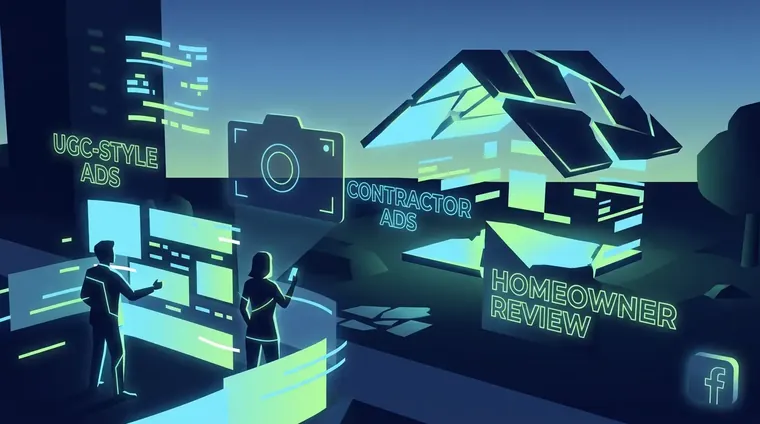
The creative brief for a contractor Facebook ad has three parts: a problem the homeowner already recognizes, visual proof that you solve it, and one call to action. Video beats static for home services because the product is physical and the transformation is visible. A roof before and after, a window installation in sixty seconds, a homeowner explaining why they finally called, those convert better than a logo on a blue background. Creator-style video, shot on a phone and edited to feel native to the feed, routinely beats polished production. We offer creator video by Marissa Snyder, who has 5.79M total views and 4.4M on her biggest single video, because the format that looks casual is often the one that actually stops the scroll. The FTC Endorsement Guides require that any paid or incentivized testimonial be disclosed. If you run UGC that involved compensation, the disclosure has to live inside the content itself. Burying it in a caption does not count. This is not optional and the penalties are real. Test one variable at a time. Change the hook, measure it against the control, then move to the next element. Running five completely different ads at once can find a winner, since Meta's delivery favors creative variety, but it will not tell you which element made the difference.
- A CRM with instant lead routing Every form fill needs to land in a pipeline immediately, trigger a notification to the person making contact, and log the time stamp. If you cannot see how fast your team responds to leads, you cannot improve it.
- An automated follow-up sequence The sequence sends a text, an email, and a callback within the first few minutes after a form fill, once the form has captured the homeowner's consent to automated texts. The sequence runs whether the lead comes in at 9 AM or 9 PM. Manual follow-up at home-services lead volume is not a system.
- A dedicated landing page, not your homepage The homepage has too many exits. A landing page with one offer, one form, and no navigation menu removes the friction between the ad click and the conversion event.
- Conversion tracking on the thank-you page Meta needs a conversion signal to optimize. A pageview on the thank-you URL after a form submission is the minimum. Without it, the algorithm is flying without instruments.
- A clear offer the ad can lead with A free inspection, a free estimate, a same-day assessment, something that makes the next step obvious and low-risk for the homeowner. 'Learn more' is not an offer.
Budget, Bidding, and How Long to Wait Before Judging a Campaign
Facebook ads for contractors need a budget held steady long enough for Meta's algorithm to exit the learning phase, and cutting spend early resets that clock.
Meta's ad algorithm has a learning phase. During that phase, performance swings and the data doesn't reflect what the campaign will do at scale. Cut the budget or make a major change and the learning phase resets. How long that takes depends on daily spend and how many conversions you're generating, because Meta measures the learning phase in optimization events, not weeks. The budget question every contractor asks is: how much is enough? The real answer is that your budget has to be large enough to produce enough conversion events for the algorithm to learn from. Meta's own documentation says an ad set needs roughly fifty optimization events per week to exit the learning phase. At higher ticket sizes, roofing, impact windows, full remodels, the cost per conversion event goes up. That means you need more budget to generate enough events in a reasonable window. Bid strategy matters. Highest volume bidding (the default, formerly called lowest cost) tells Meta to spend your budget and get as many conversions as it can. A cost per result goal (formerly cost cap) lets you set the average you want to pay per conversion, which is useful once you know your numbers. Set the goal too low and it throttles delivery. Start with highest volume while the campaign is learning. Move to a cost per result goal once you have baseline data. For lead-generation campaigns, instant forms, Meta's native lead forms, typically produce higher volume at a lower cost per lead than click-to-website campaigns. The trade-off is lead quality. Native forms pre-fill from the user's profile, which cuts friction and sometimes cuts intent along with it.
The Lead-Quality Problem and How to Diagnose It
When facebook ads for contractors produce high volume but low close rates, the problem is almost always audience targeting or offer mismatch, not the platform itself.
Bad lead quality is the most common complaint contractors have about Facebook ads. The leads come in. Nobody answers the phone. They give fake addresses or say they were just browsing. That complaint is almost always a targeting or offer problem, not a platform problem. Start with the audience. Cold interest-and-demographic targeting on Meta is loose. An income or interest filter does not mean the person owns a home, or that the home needs your service at all. Layer geo-targeting with areas that have the right housing age, income distribution, and weather exposure for your product, using zip codes where Meta allows them, since Housing-category ads cannot target by zip. Tighter inputs produce tighter audiences. Then check the offer. A "free quote" ad attracts price shoppers. An ad that leads with a specific problem, for example one aimed at Florida homeowners with older tile roofs worried about their next wind inspection, qualifies the reader before they click. The qualifier is in the creative. Anyone without an older tile roof removes themselves before they fill out the form. Then check the form. Longer forms with qualifying questions, homeowner or renter, type of roof, own or rent, reduce volume and raise quality. The right trade-off depends on your close rate and ticket size. At high ticket sizes, a smaller number of better-qualified leads almost always produces more revenue per dollar of ad spend than a large volume of low-intent contacts. The full math on that is at /roofing-leads.
We run paid social for roofing, windows, HVAC, and remodeling companies. Management pricing is not published. Book a call with Receipts Group before you sign another agency contract.
Facebook Ads vs. Google Ads: Which One to Run First
Contractors with an established brand and a working follow-up system should run Google ads first; Facebook ads for contractors are better suited to building volume once the back-end is proven.
Every contractor with a budget and a small team asks this question. The honest answer depends on where your constraint is. If your constraint is demand, people not finding you at all, Google is the faster path. Search ads capture homeowners who are already looking. Google's Local Services Ads put roofing and home-services companies at the top of local searches, and the "Google Verified" badge they carry, which shows only after Google's verification clears, cuts the friction to call. If your constraint is volume at a specific ticket size and your follow-up system is already working, Facebook is the right next layer. It reaches people who would never have searched for you. That is a different kind of prospect, but a real one. The contractors who fail at Facebook ads run them before the back end is ready. No CRM, no automated follow-up, no dedicated landing page. The platform is not the problem. The back end is the problem. For a full breakdown of how we think about paid search versus paid social for home-services, read our Google Ads for Contractors guide.
Facebook Ads vs. Google Ads for Home-Services Contractors
Facebook ads for contractors generate demand from cold audiences; Google Ads capture existing intent, they solve different problems and work best together.
| Feature | Facebook Ads | Google Ads |
|---|---|---|
| Audience mindset | Not actively shopping, you interrupt the scroll | Actively searching, already has intent |
| Targeting method | Demographics, life events, behavioral signals | Keywords and search queries |
| Creative requirement | High, must manufacture context and urgency | Lower, query provides context |
| Lead volume potential | High, large reachable audience | Constrained by local search volume |
| Lead quality | Varies, depends on qualifying creative and form | Higher intent on average |
| Speed to first lead | Fast, can generate leads same day | Fast, but LSA approval takes time |
| Learning period | Ends after about 50 optimization events in 7 days, per Meta | Smart Bidding has its own learning period after changes |
| Best for | Volume at scale once back-end is proven | Capturing demand that already exists |
The Follow-Up Stack That Turns Leads Into Booked Jobs
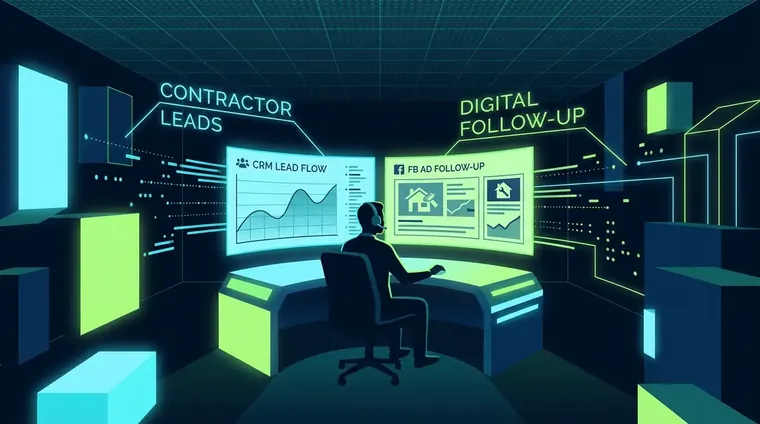
A working follow-up stack for facebook ads for contractors combines instant CRM routing, automated text-and-email sequences, and a live agent dial attempt within minutes of the form fill.
The ad gets the click. The follow-up system gets the job. These two things are built by different people, optimized by different metrics, and fail in different ways, which is why contractors who treat them as one problem stay confused about why their ads 'don't work.'
The stack has three layers. The first is routing: the lead hits the CRM the moment the form submits, a task is created for the setter, and a text notification goes to whoever is making the first call. The CRM should log the timestamp of every touch so you can measure speed-to-lead objectively.
The second layer is automated nurture: a text that arrives within minutes acknowledging the inquiry, followed by an email with the company's credibility markers (license number, years in business, photo of the truck). The automation runs on every lead regardless of when it came in.
The third layer is live outreach. A setter calls from a local number, not an 800 number, not a VOIP number with a suspicious area code. The goal on the first call is not to close. It is to confirm the appointment. Every call should be recorded, with the recording disclosure your state requires, so QA can identify where leads fall off.
This is the same infrastructure we build for contractors through our call center program: dialer, CRM, calendar, and payroll on one stack, with QA on every appointment before it counts.
One Hot Take: Stop Blaming the Algorithm
Most contractor campaigns fail because of what happens after the lead, not because Facebook's algorithm underperformed, the platform is rarely the problem.
Here is the opinion most agencies will not say out loud: Facebook ads for contractors work fine. The algorithm is not broken. The targeting is not the core problem in most accounts. The problem is that contractors have been told the media buy is the product, when the media buy is actually the smallest part of the system.
Plenty of contractors have campaigns that are genuinely well-built, right audiences, good creative, reasonable budget, and still do not make money from them. The constraint is usually downstream: a setter who works a nine-to-five schedule on leads that come in at seven PM, a CRM with no automation, or a landing page that loads slowly on mobile.
The ad platforms are not going to tell you this. They want you to believe that one more creative test or one more audience segment will unlock the results. Sometimes that is true. More often, the unlock is in the process that runs after the click.
That is also why SEO builds up in a way that paid ads cannot. Our own site went from 600 to 1,300 organic clicks a month in 90 days after we fired our SEO agency, not by running more ads, but by fixing the asset that generates demand without ongoing spend. Paid and organic are not competitors. They are complements.
How to Launch Facebook Ads for Contractors in Five Steps
Launching profitable facebook ads for contractors takes five sequential steps, skipping any one of them is why most campaigns underperform from day one.
- 1Build the back-end firstCRM, automated follow-up sequence, dedicated landing page, and conversion tracking on the thank-you URL. Run a test form fill yourself and confirm every piece fires correctly before the campaign goes live.
- 2Define the offer and the audiencePick one service, one geographic radius, and one specific offer. Choose the area by housing age and weather exposure, then target it by location and a few home-improvement interests. Start with your warm retargeting audience even if it is small, the data quality is better.
- 3Build the creative around a specific problemWrite the hook as the homeowner's problem, not your company's solution. Use video if you have it. If the video is creator-style and feels native to the feed, it will typically outperform a produced brand spot. Keep the call to action singular.
- 4Launch and hold the budget steadySet a daily budget you can sustain without cutting the campaign, and do not make structural changes while the algorithm is in its learning phase. Patience here is not passive, it is the active choice that lets the data accumulate.
- 5Measure what matters and iterateTrack cost per booked appointment, not cost per lead. A campaign that produces expensive leads that book and close is better than a campaign that produces cheap leads that ghost. Once you have a baseline, test one creative variable at a time and document what you learn.
Facebook ads are harder to justify when your average job is small. The overhead, ad spend, CRM, setter time, has to come out of the margin on every closed job. Below a certain ticket size, which shifts by market and trade, SEO or a referral program will beat paid social on the math. That's not a Facebook problem. It's arithmetic.
How Receipts Group Approaches Ads for Contractors
Receipts Group runs facebook ads for contractors as part of an operator-built system, the same stack that runs inside our own $23M-a-year windows and roofing operation.
We are not a generic digital agency that bolted on a contractor division. The system we sell is the system we run. Our own windows and roofing operation in Southeast Florida, $23M a year, books about 650 in-home appointments a month from our own outbound floor. The call center and the site platform we sell are the ones we built for our own company. Eric Snyder is the founder of Receipts Group and Marketing Director at Safeguard Impact. He grew monthly revenue at Safeguard from $800K to $2M over fifteen months. Before that, he ran a Florida fix-and-flip and wholesale real estate operation as Operations Director, taking it from zero to $6M a year. The background is operator, not agency. For contractors in roofing, windows, HVAC, and remodeling, we run Facebook ads as part of a broader paid-social program. Management pricing is not published. We cover it on the call. A campaign built on a broken back-end wastes your budget, so build the back end first.
Frequently Asked Questions
How much should a contractor spend on Facebook ads per month?
There is no universal number. The budget needs to be large enough to generate enough conversion events for Meta's algorithm to exit its learning phase, Meta's own documentation suggests roughly fifty optimization events per week per ad set. At high ticket sizes like roofing and impact windows, that threshold requires more daily spend than it does for lower-ticket services. Start with what you can hold steady for a full month without cutting the campaign, because pulling budget during the learning phase resets the algorithm and wastes what you already spent.
Are Facebook leads for contractors worth it compared to shared lead platforms?
Facebook leads are exclusive to your account, nobody else is calling the same person from the same ad. Shared lead platforms sell the same homeowner's information to multiple contractors simultaneously, which drives up the cost of follow-up and drives down the answer rate. The trade-off is that Facebook leads require a working follow-up system and a qualifying creative to produce bookable appointments, while shared leads can start flowing immediately. At higher ticket sizes, the exclusive nature of Facebook leads typically makes them more valuable despite the build cost.
What type of Facebook ad creative works best for roofing and window contractors?
Creator-style video built around a homeowner's specific problem outperforms polished brand production in the feed for home-services contractors. The hook should name the problem, storm damage, aging windows, rising insurance premiums, before mentioning the company. Static image ads can work for retargeting warm audiences who already know the brand, but cold audiences need video to create context. Keep the call to action singular: one offer, one form, no menu of options.
How long does it take for Facebook ads to work for a contractor?
Meta's learning phase ends once an ad set gets about 50 optimization events within a 7-day period, so how long it lasts depends on daily spend and conversion volume. During that period, performance is volatile and not representative of steady-state results. Contractors who cut campaigns in week two because the cost per lead looks high often never see what the campaign would have produced at scale. The practical answer is: hold the budget steady for at least a month before making structural changes, and measure cost per booked appointment rather than cost per lead from day one.
Should contractors use Facebook Lead Ads or send traffic to a landing page?
Facebook's native lead forms (Lead Ads) typically produce higher volume at lower cost per lead because they pre-fill from the user's profile and keep the conversion inside the app. The trade-off is lead quality: less friction means less intent. Landing pages require a click off the platform, which filters out lower-intent clicks, and give you room for a stronger credibility presentation, though Meta's instant forms also support custom qualifying questions and a "Higher intent" review step. At higher ticket sizes, the quality argument usually favors a landing page. At volume-first campaigns where the setter team can handle qualification by phone, native forms are worth testing.
Free guides on this, step by step:
Ready to Run Facebook Ads That Actually Book Jobs?
We run Facebook ads for roofing, windows, HVAC, and remodeling companies. The system is the same one behind our own $23M-a-year operation. If your back end is ready and you want a paid-social program accountable to booked appointments, not just form fills, book a call with Receipts Group. We'll walk through your setup on the call.