

HVAC Marketing: The Contractor's Playbook
The conventional advice for HVAC marketing is to 'build brand awareness first, then drive leads.' It's wrong. A residential HVAC company running on thin margins and seasonal swings can't afford to wait for awareness to compound. Every dollar spent that doesn't trace to a booked job is a dollar you needed for the next truck. The playbook that actually works looks nothing like a brand campaign. It looks like a tightly wired system: the right search presence to catch demand when it spikes, a phone operation that answers fast and qualifies hard, and a paid channel that stays disciplined when the easy money is to bid on anything that moves. That's what this guide covers, not theory, but the mechanics behind a marketing engine built to close.
This is also a guide written from inside the trade, not from a media company's content calendar. The systems described here are the ones behind our own $23M-a-year windows and roofing company. HVAC is not a branding exercise. It is a logistics and conversion problem, and the marketing has to be built accordingly.
Why Most HVAC Marketing Advice Misses the Point
HVAC marketing fails most contractors because it optimizes for impressions and clicks instead of answered calls and booked appointments.
Most HVAC marketing content is written by people who sell advertising, not by people who have ever dispatched a tech at 7 a.m. on a Tuesday. The result is advice that treats a click as a win and a form fill as a conversion. In residential HVAC, neither of those is money. Money is a scheduled call, a sold service agreement, or a signed replacement quote. The gap between a click and a close is where most HVAC companies bleed budget. Someone searches "AC not cooling" at 2 p.m. on a hot Friday. They call the first number they see. If your phone rings and nobody picks up inside two rings, they are already dialing the next result. Google's own local ranking guidance names relevance, distance, and prominence as what drives local results, and none of them helps you once the phone goes unanswered. The companies with the best close rates don't have the prettiest websites. They have the fastest phones and the sharpest intake scripts. HVAC marketing, done right, is a phone and calendar problem dressed up as a search problem. The other thing most HVAC marketing advice gets wrong is attribution. If you're not connecting your ad platform to your CRM and your CRM to your dispatch board, you have no idea which channel is actually producing booked revenue. You're optimizing toward clicks and form fills, proxies that feel measurable but routinely point in the wrong direction. The fix isn't a fancier dashboard. It's deciding upfront that cost per booked appointment is the only number that matters, then wiring every tool in your stack to report against it.
Cost per booked appointment, not cost per click, not cost per lead, is the only number in HVAC marketing that predicts whether you'll make payroll next month. Build your reporting around it from day one.
What Does an HVAC Marketing Funnel Actually Look Like?
A working HVAC marketing funnel has three layers: demand capture (search), demand conversion (phone and intake), and demand retention (reviews and repeat).
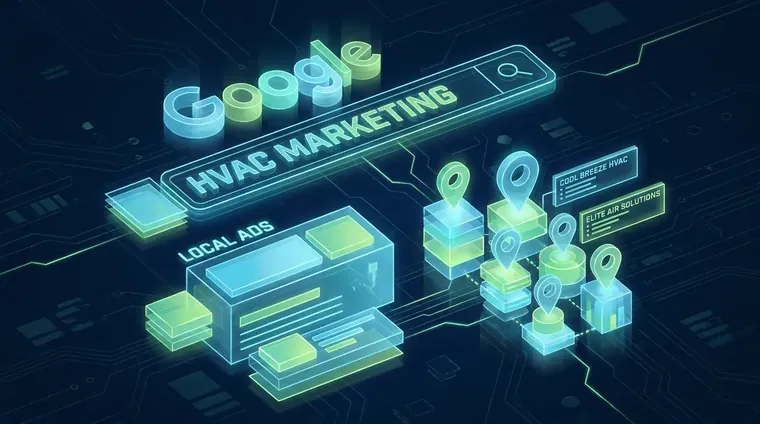
Strip away the jargon and an HVAC marketing funnel has three layers. Layer 1, Demand capture. This is everything that puts you in front of a homeowner who is already looking: Google Search ads, Google Local Services Ads (which now show a 'Google Verified' badge), organic rankings for service and city pages, and a Google Business Profile that's built to the platform's own guidelines. Homeowners searching 'HVAC repair near me' are at the bottom of the funnel. They want a tech today. Capture them here. What sets demand capture apart is urgency. These homeowners are not comparing options over a week. They are picking from whatever is in front of them in the next three minutes. Layer 2, Demand conversion. This is your phone operation. Speed matters more than almost any other variable at this layer. The homeowner who lands on your site or clicks your ad has very little patience before they dial the next result. A trained intake agent who follows a script, captures the right info, and puts a time on the calendar is worth more to your close rate than any ad creative. The script itself should collect four things before the call ends: service type, equipment age, whether the caller owns the home, and a confirmed appointment window. Miss any of those and your tech shows up half-blind. Layer 3, Demand retention. This is where HVAC money builds up: service agreements, maintenance plans, five-star reviews that pull new organic traffic, and referral programs. Most HVAC companies underinvest here because it doesn't feel like marketing. It is. A homeowner on a service agreement is far easier to convert on a replacement than a cold lead. Beyond the revenue math, retention customers generate reviews organically. They've had two or three positive touchpoints with your company before anyone asks. Those reviews feed back into Layer 1 and improve your local pack position.
The Five Channels That Move the Needle in HVAC Marketing
The five highest-use HVAC marketing channels are Google Search ads, Local Services Ads, organic SEO, Google Business Profile, and a trained call center.
- Google Search Ads Paid search captures in-market demand in real time. HVAC keywords in competitive markets are expensive. Tight geo-targeting and negative keyword lists are non-negotiable, or you burn budget on 'how to change my own filter' searches that never convert.
- Google Local Services Ads LSAs show above standard paid search with the 'Google Verified' badge. You pay per lead, not per click. For HVAC, LSAs tend to produce high-intent calls because the homeowner sees your reviews and badge before they even click. Your profile quality and review count determine your position, not your bid alone.
- Organic SEO City-plus-service pages ('AC repair in [city]', 'furnace installation [city]') capture demand that builds up over time. Unlike paid, you're not renting visibility, you own it. The catch is that it takes months to move rankings, so SEO is a long game that runs parallel to paid, not instead of it.
- Google Business Profile Your GBP is your local pack listing. Reviews, photos, service categories, and response time all factor into how Google ranks you in the map results. A fully built-out profile following Google's official guidelines consistently outranks thin profiles, even in competitive markets.
- Trained Inbound Call Center The phone is a channel. An untrained receptionist or a voicemail box is a conversion killer. A scripted intake agent who qualifies the caller, confirms the scope, and locks a time slot is the difference between a booked job and a hung-up caller who just became your competitor's customer.
How HVAC SEO Actually Works in 2026
HVAC SEO in 2026 runs on city-and-service page architecture, fast technical load, and review signals, not keyword stuffing or backlink schemes.
Search in 2026 is faster to punish thin content and slower to reward it. Write each page so the answer sits in the first paragraph: a homeowner who lands on your 'AC repair' page and can't find the point in five seconds leaves. As one Hacker News commenter put it bluntly about content quality: "if you see a recipe and then bounce in 5s Google treats that as bad", the same logic applies to a city service page that never gets to the point.
For HVAC specifically, the architecture that works is: one page per service per city, written for how people search. Not 'residential HVAC solutions for discerning homeowners', 'AC not cooling [city]'. Each page needs a fast load, structured data markup, and a clear call to action above the fold. That's the same platform we built for our own $23M-a-year windows and roofing operation, city and service pages, a content engine, and a dashboard showing which pages produce calls. For an HVAC contractor serving, say, eight cities across two counties, that architecture can mean 40 to 60 discrete pages, each written to answer one specific search query, not to describe your company's values.
Structured data markup deserves more than a passing mention. Adding LocalBusiness and Service schema to your city pages gives Google machine-readable confirmation of what you do and where you do it. It doesn't guarantee a rich result, but it removes ambiguity, and removing ambiguity is most of what on-page SEO is at this point.
A note on third-party data: keyword tools give you directional signals, not gospel. As one commenter on Reddit's r/SEO noted, "the data never seems accurate compared to what I see in GSC or GA." Your own Google Search Console tells you what's actually working. Use it. Track rankings in your real markets, not in a tool's estimate of them. The Air Conditioning Contractors of America (ACCA) publishes technical standards and business resources for contractors, not SEO playbooks, so for homeowner intent in your region, your own Search Console data is the better source.
Why Your Phone Operation Is an HVAC Marketing Channel
An HVAC company's phone operation, scripts, speed-to-answer, and CRM intake, determines whether paid and organic marketing investment converts to booked jobs.
We set about 650 in-home appointments a month on our own floor, for our own closers. That volume teaches more about home-services marketing than any conference keynote. The single biggest variable in whether a marketing dollar converts isn't the ad creative or the landing page, it's what happens in the first 90 seconds after the phone rings.
For HVAC contractors, that means: a live agent or a trained answering service available during peak hours (typically 7 a.m. to 7 p.m. in most markets), an intake script that captures service type, equipment age, and ownership status before the caller hangs up, and a CRM that logs the recording so QA can check whether the appointment was set correctly. We QA every appointment on our own floor before it counts, a person verifies the homeowner, confirms the scope, and re-confirms the time. That's not overhead. That's what makes a set appointment worth counting.
The intake script is worth treating as a living document, not a one-time build. The questions that matter most shift by season: in peak cooling season, equipment age and last-service date tell you whether a repair call is likely to convert to a replacement conversation. In the shoulder months, maintenance plan eligibility becomes the higher-value qualifier. A call center that updates its script quarterly based on what's actually closing will outperform one running the same script year-round.
For HVAC companies, we build outbound and inbound call centers: dialer, CRM, calendar and payroll on one stack, trained agents, and QA on every appointment. Two models, Full Management (we build, staff and run it) or Build-for-You (we build and staff it on our stack, and your team runs it). The build runs $15,000, financeable at $1,250 a month over 12 months at 0% through a third-party lender, subject to approval. The full three-month Full Management package is $30,000. You own the accounts and the data.
Sending a paid HVAC lead to a shared inbox or generic contact form is burning money. Every minute between a form fill and a live call drops your odds of making contact. Wire your ads directly to a phone number with a real person on the other end, or stop running the ads.
In-House Marketing Team vs. Contractor Marketing Partner
An in-house HVAC marketing team offers control but high fixed cost; a contractor-specialist partner costs less monthly but requires the right vetting to avoid generic agencies.
| Feature | In-House Team | Contractor Marketing Partner |
|---|---|---|
| Monthly Fixed Cost | High, salary, benefits, tools | Lower, one monthly fee covers tools and management |
| Industry Knowledge | Depends on who you hire | Strong if operator-run; weak if generic agency |
| Speed to Launch | Slow, hiring and ramp take months | Fast, systems already built |
| Accountability | Direct, you manage them | Contract-based, varies by vendor |
| Scalability | Requires more hires to scale | Can scale channels without headcount |
| Data Ownership | You own all accounts | Verify before signing, some agencies retain logins |
Google Ads for HVAC: What Discipline Actually Looks Like
Disciplined HVAC Google Ads management means weekly negative-keyword additions, geo bid adjustments by zip code, and conversion tracking wired to booked calls, not just clicks.
Paid search for HVAC is one of the more expensive categories in home services. That makes discipline non-negotiable. The contractors who lose money on Google Ads almost always share the same three problems: they're not tracking calls as conversions, they're not running negative keywords aggressively, and they're bidding on broad-match terms that pull in commercial and DIY searches that never convert.
A disciplined HVAC Google Ads account runs five operations every week. First, conversion tracking wired to booked calls, not just form fills. Second, negative keyword additions from the search terms report. Third, geo bid adjustments by zip code, pulling back on service areas with low close rates. Fourth, ad copy rotation runs with at least two active variants per ad group, measured by call rate not just click rate. Fifth, a weekly report that shows cost per booked appointment, not cost per click.
On negative keywords specifically: the list for an HVAC account needs to be built in categories, not one term at a time. Commercial intent negatives ('warehouse', 'apartment complex', 'property management'), DIY negatives ('how to', 'YouTube', 'manual', 'DIY'), and competitor brand terms you're not intentionally targeting. A well-maintained negative keyword list in a mature HVAC account can easily run to several hundred terms. That's not unusual, that's what it takes to keep a high-cost-per-click category profitable.
Local Services Ads run parallel to search, not instead of it. LSAs serve different intent and show in a different position. Running both and reading them against each other tells you where your budget is actually converting. We run paid search and paid social for HVAC contractors; management pricing is set on the call.
HVAC Reviews and Reputation: The Channel Nobody Budgets For
HVAC online reviews directly influence Local Services Ads rank and Google Business Profile placement, making review generation a core part of hvac marketing, not an afterthought.
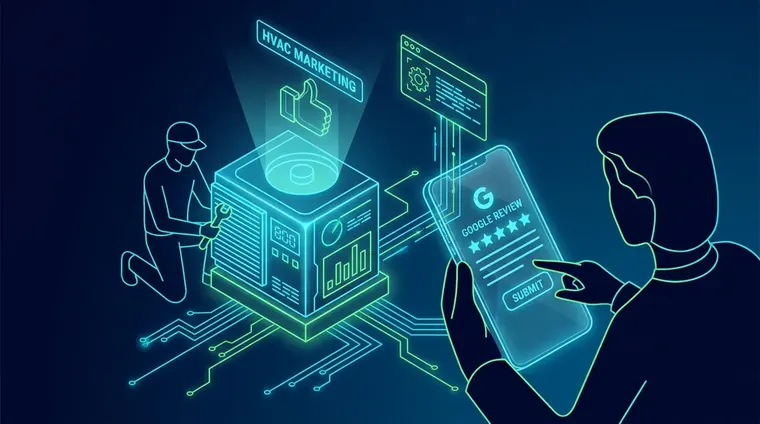
Reviews move rankings in both organic local search and Local Services Ads. LSA positions respond to review count and rating together, along with proximity, responsiveness, and business hours. Google doesn't publish the exact formula. The system that works: send a review request by text within 30 minutes of a completed job, with a direct link to your Google Business Profile review page. Don't wait for the end-of-day email blast. Response rates on a same-visit text are far higher than a follow-up email sent the next morning. Train your techs to mention the review before they leave the driveway, not as a script, but as a handoff: "If everything looked good today, a quick Google review helps us a lot."
The tech handoff matters more than most operators realize. It creates a warm ask at the highest-trust moment in the customer relationship. The job is done, the system is working, and the homeowner is relieved. That emotional state produces reviews. An email sent 18 hours later, when the homeowner is back in their normal routine, produces far fewer. The timing isn't a courtesy. It's a conversion mechanic. One thing to flag on incentivized reviews: Google's review policy prohibits reviews incentivized with discounts or gifts, and the FTC bars incentives tied to a positive review and requires disclosure of any incentive. Don't do it. It's a liability, and Google will suppress reviews it flags as incentivized. Ask plainly. Ask fast. That's the whole system. If you're running roofing alongside HVAC, or considering it, the demand-capture mechanics are nearly identical. Our roofing leads page walks through how we approach appointment generation for that trade specifically.
How to Audit Your Current HVAC Marketing in One Hour
A one-hour HVAC marketing audit covers Google Business Profile completeness, call tracking setup, ad conversion wiring, site speed, and review recency, five checks that expose most revenue leaks.
- 1Check Your Google Business ProfileLog in and verify: all service categories listed, photos updated in the last 90 days, and your phone number is a trackable line, not your personal cell. A thin profile following none of Google's own guidelines is leaving map-pack clicks on the table.
- 2Pull Your Search Terms ReportIn Google Ads, open the search terms report and sort by spend descending. For every term in the top 20 that has zero conversions, add it as a negative keyword. Do this weekly. The contractors we see with the worst cost-per-lead numbers are almost always running with zero negative keywords.
- 3Test Your Own Phone NumberCall your own business at 8 a.m. on a Monday and at 6:30 p.m. on a Friday. Time how many rings before a live person picks up. Count how many questions they ask before offering an appointment. If the answer is 'less than three' or 'voicemail', you found your conversion problem, and it has nothing to do with your ads.
- 4Check Site Speed on MobileRun your website through Google's PageSpeed Insights. HVAC searches skew heavily mobile, someone whose AC just failed is not on a laptop. If your mobile Core Web Vitals fail, slow load times are costing you visitors and weighing on your landing page experience in Google Ads.
- 5Count Your Last 30 Days of ReviewsOpen your Google Business Profile and filter reviews by date. If you haven't received a review in the last two weeks, your review request process is broken. Recency matters to both the algorithm and to homeowners scanning your profile at 2 p.m. on a 95-degree day.
A full-stack HVAC marketing build, paid search, SEO, and a call center, takes real budget and a runway of a few months before the numbers stabilize. This works above a certain monthly revenue floor. Below that floor, the math is hard to justify. Start with one channel, prove the cost-per-appointment, then add the next layer.
What Receipts Group Builds for HVAC Contractors
Receipts Group builds HVAC contractor marketing systems, custom SEO sites, Google and Facebook ad management, and outbound/inbound call centers, all operator-run, not by a generic agency.
Receipts Group sells the systems behind our own $23M-a-year windows and roofing operation to other contractors, including HVAC. This is not theory, it is the same stack, built for your trade.
For HVAC contractors specifically, we offer four things. First, custom SEO on the same site platform we built for our own company, off WordPress: city-and-service pages written for how people search, a content engine, and a dashboard showing which pages produce leads. Price: $3,500 to build, then $3,500 a month for six months, $24,500 all in. The 0% plan is $15,000 over 12 months, $1,250 a month through a third-party lender, subject to approval: it covers the $3,500 build and the first three months ($14,000), with the remaining $1,000 toward month four. You own the content, the code and the accounts. Our own site went from 600 to 1,300 organic clicks a month in 90 days after we fired our SEO agency, we show our numbers, we don't promise yours.
Second, Google Ads, Local Services Ads and Facebook ads, we run paid search and paid social for HVAC contractors. Management pricing is set on the call.
Third, call center builds, outbound and inbound, dialer, CRM, calendar and payroll on one stack, trained agents, QA on every appointment. Full Management or Build-for-You. The build is $15,000, financeable at $1,250 a month over 12 months at 0% through a third-party lender, subject to approval. Our own floor's best month was $700K in sales. We built a call center from $0 to $426K a month in nine months. We're operator-run. We bring the receipts, not a slide deck of methodology.
Fourth, for contractors who want video, UGC video through creator Marissa Snyder: 5.79M total views, 4.4M on her biggest single video, 20-plus brands. Pricing is on request. Short-form creator video is increasingly where homeowners first encounter a contractor brand, not in the search results, but on a feed, and having a face and a story attached to your company changes the conversion dynamic at every downstream touchpoint.
Note: our leads, appointments and rev-share programs are for impact windows and roofing. For HVAC, the tools are SEO, ads and call center builds.

Frequently Asked Questions
What is HVAC marketing and why does it differ from general contractor marketing?
HVAC marketing is the set of channels and systems used to book residential and commercial HVAC jobs, repair, maintenance, and replacement. It differs from general contractor marketing because HVAC demand is heavily seasonal and emergency-driven: a homeowner whose AC fails at 3 p.m. on a hot Friday isn't comparing three quotes, they're calling the first company that picks up. That makes speed-to-answer and local search visibility more important than brand awareness campaigns.
How much does HVAC marketing typically cost per month in a competitive market?
Costs vary widely by market, channel mix, and company size. Spend can climb fast in highly competitive metro areas, but the number that matters is cost per booked appointment, not total spend. Get your conversion tracking right before scaling spend.
Do you offer HVAC leads or appointments like you do for roofing?
No. Receipts Group's leads, in-home appointments, and rev-share programs are specific to impact windows and roofing. For HVAC contractors, we build custom SEO sites, run Google Ads and Facebook ads, and build outbound and inbound call centers. If you're looking for a comparable appointment-generation system for your HVAC company, the call center build is the closest equivalent: a branded operation built to set in-home appointments for you.
How important is Google Business Profile for HVAC companies in local search?
Critical. The Google local pack (map results) appears above the organic listings, which matters most on mobile, where many emergency HVAC searches happen. Your Google Business Profile drives your local pack ranking along with proximity and relevance signals. A fully built-out profile following Google's official guidelines, with recent reviews and updated photos, consistently outperforms thin profiles even in competitive markets.
What is the biggest mistake HVAC companies make with their marketing budget?
Spending on traffic without fixing the phone. HVAC companies routinely run paid search campaigns while routing inbound calls to a shared inbox, a voicemail, or an untrained receptionist. The click budget is wasted the moment a homeowner hangs up because nobody answered. The highest-use fix in most HVAC marketing audits isn't a better ad, it's a faster, scripted phone operation. Fix intake before you scale spend.
How long does HVAC SEO take to produce real results?
Realistically, months, not weeks, before city-and-service pages move into competitive ranking positions, depending on your domain's existing authority and the competitiveness of your market. Our own site went from 600 to 1,300 organic clicks a month in 90 days, but we had an existing domain with history. A brand-new domain will take longer. Run paid search in parallel during the SEO ramp so you're not waiting on organic to pay the bills. We show our own numbers and never guarantee rankings or timelines for clients.
Can HVAC companies use Local Services Ads alongside regular Google Search Ads?
Yes, and they should. Local Services Ads (now showing the 'Google Verified' badge) appear above standard paid search results and charge per lead rather than per click. They serve different intent signals and occupy a different position in the SERP. Running both and comparing cost per booked appointment across them tells you where to shift budget. LSAs can produce cheaper contacts than search ads because the homeowner sees your review count and badge before calling, higher intent, less wasted spend.
Free guides on this, step by step:
Ready to Wire Your HVAC Marketing to Actual Revenue?
We don't sell retainers that buy you a slide deck. We build the system, SEO, ads, or a full call center, and we show you the numbers from our own operation before we ask you to trust ours. If your HVAC company is serious about tracing every dollar to a booked job, let's talk. Book a call and we'll walk through the right starting point for your market and your budget.