

Roofing Marketing: The System That Actually Closes Jobs
Buying more leads is not a roofing marketing strategy. It's a race. You call the same homeowner as several other roofers, and whoever picks up first wins a job priced at the floor. That race shrinks the average ticket, trains homeowners to treat roofing like a commodity, and punishes the contractor who spent money on crew quality and materials. It destroys margins for operators who are otherwise running tight, professional businesses. The real problem isn't volume. It's exclusivity, follow-up infrastructure, and showing up where homeowners are already making decisions. Fix those three things and volume becomes profitable. Ignore them and volume just accelerates the bleed. This guide covers the full stack: organic search, paid channels, review strategy, outbound appointment-setting, and how to know which channel is actually closing. No fluff, no invented case studies. Just the system we run every day, the same one powering a $23M-a-year impact windows and roofing operation in Southeast Florida.
Why Most Roofing Marketing Fails Before It Starts
Roofing marketing fails when contractors buy shared leads with no follow-up system, volume is the wrong problem to solve first.
Shared leads are the default starting point for most roofing companies. An aggregator collects a homeowner's info, sells it to several contractors simultaneously, and the homeowner gets bombarded with calls. Speed-to-call matters, but so does what happens when nobody picks up, when the homeowner doesn't answer, or when the pitch isn't tight. Most roofing companies have none of that wired. The typical contractor is working off a spreadsheet, calling from a personal cell, and leaving a voicemail that never gets returned, then wondering why their close rate is low.
The fix isn't more leads. It's a system that handles the leads you already have. That means a CRM with automated follow-up sequences, a call center or answering service that catches inbound calls after hours, and appointment-setting logic that confirms all decision-makers are present before a closer drives out. Without those three things, doubling your lead volume just doubles your waste. A power dialer running a disciplined follow-up cadence, day one, day three, day seven, day fourteen, will recover opportunities that a manual process leaves on the table entirely.
In our view, contractor differentiation, not low price, drives repeat and referral business. That's the upstream roofing marketing problem: if you're not differentiated in the channel, you're just another caller ID homeowners ignore. Differentiation in this context isn't a tagline; it's a documented warranty, a credentialed crew, a before-and-after photo library, and a review count that a competitor can't match next week. Build the system first. Then buy the volume.
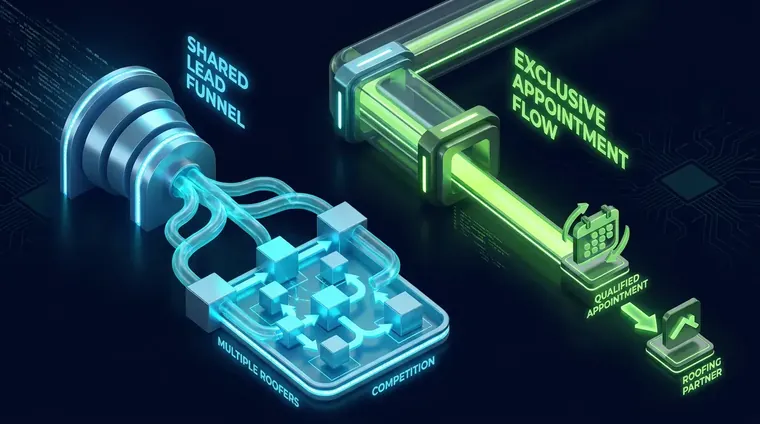
Shared leads mean shared homeowners. By the time you dial, the homeowner has likely heard from a competitor. Your marketing spend is funding a price war, not a pipeline.
The Roofing Marketing Channels That Actually Close Jobs
The channels that close roofing jobs are Google Local Services Ads, organic search, outbound appointment-setting, and referral programs, in that order of reliability for most markets.
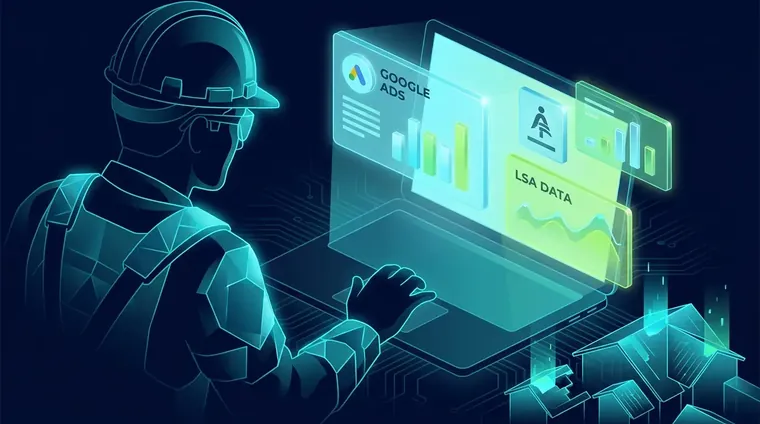
Google Local Services Ads (LSA) sit above paid search and organic results. They carry a Google Verified badge and pull calls from homeowners who are actively looking. You pay per lead, not per click. Lead quality runs higher than most paid search campaigns because the intent is explicit: the homeowner searched, saw your badge, and called. Budget management works differently here. You set a weekly lead budget instead of a daily click budget, so pausing spend when your calendar is full takes about 30 seconds. Follow the Google Business Profile guidelines to keep your verification clean. Violations can suspend your LSA entirely. Organic search is slower to start but it builds. A well-structured roofing site, city pages, service pages, blog content matched to how homeowners actually search, generates inbound leads at a fraction of paid channel costs over a 12-to-24-month window. A page ranking in position three for "roof replacement Miami" sends leads every month without an incremental spend per click. We rebuilt our own company's site on a custom platform, cut the prior SEO agency, and went from 600 to 1,300 organic clicks a month in 90 days. That's not a guarantee. It's what happened when we stopped bolting SEO onto broken architecture and built it right from the first URL. Outbound appointment-setting is the channel most roofing marketing guides skip entirely. A trained call floor working targeted lists, recent permit pulls, storm-affected zip codes, neighborhoods with aging roofs, books in-home appointments before the homeowner has started searching. That timing matters. You are having a conversation before they have collected three competing quotes. The catch is real: this requires actual infrastructure, not just a VA and a spreadsheet. Retargeting and paid social sit at the lower-intent end of the stack, but they earn their place. A homeowner who visited your site, watched a before-and-after video, and then saw your ad on Instagram is warmer than any cold impression. That warmth shows up in cost per conversion.
- Google Business Profile Your GBP is your storefront for local search. Complete every field, post weekly, and follow Google's tips to improve your local ranking, proximity, relevance, and prominence all factor into the map pack.
- Local Services Ads LSA puts you above organic and above paid search for high-intent roofing queries. The Google Verified badge gives homeowners a trust signal before they call. Budget for leads, not clicks, the cost structure is fundamentally different from standard Google Ads.
- SEO and Content City-plus-service pages written for how homeowners actually search, 'roof replacement cost [city]', '[city] roofing contractor reviews', drive inbound leads that cost nothing per click once ranked. This is a 6-to-12-month play, not a quick fix.
- Outbound Call Floor Permit data, storm reports, and homeowner lists feed a trained outbound team that sets in-home appointments. This is the highest-use channel for volume, but it requires dialer infrastructure, QA, and CRM integration to work at scale.
- Review and Reputation Engine Roofing is a trust purchase. A homeowner paying for a new roof reads reviews. A systematic review request, text, email, and in-person ask at job completion, builds up faster than any ad budget.
SEO for Roofers: Architecture First, Content Second
Roofing SEO works when URL structure, city pages, and schema are built before content, retrofitting SEO onto a bad architecture wastes budget every month.
Most roofing websites are designed for the owner's approval, not for how homeowners search. The result is a homepage with a stock photo of a hammer and a contact form, no city pages, no service-specific URLs, no schema markup, no internal linking structure. Bolting SEO onto that after launch is expensive and slow, and a careless migration to a properly structured URL hierarchy can cost months of rankings.
The architecture that works for roofing looks like this: a root service page (`/roofing/`), city-specific landing pages (`/roofing/miami/`, `/roofing/tampa/`), and individual service pages nested under each (`/roofing/miami/roof-replacement/`). Each page targets a specific keyword cluster. Each page has LocalBusiness and Service schema markup. Internal links connect related pages so link equity flows where you need it. The navigational structure should mirror the hierarchy: a visitor landing on any city page should be one click away from every service offered in that city, and one click away from your review page and contact form.
Content on these pages isn't blog filler. It's the information a homeowner actually needs: average job scope, what to expect during installation, how long the process takes, and what questions to ask a contractor. That content, written for how people search rather than how roofers talk, is what earns a ranking and holds it. Practically, that means using the phrase 'roof replacement cost in Tampa' in a header and answering it directly in the first paragraph, not burying it in the fifth paragraph after three sentences about your company's founding year.
One useful check: as one commenter on Reddit's r/bigseo put it, "pSEO without unique data is dead now" (u/DigitalHarbor_Ease on r/bigseo). Generic city-page templates with no unique data get filtered out. Bring your own numbers, your own photos, your own job examples. A gallery of actual installs in the Miami zip codes you serve, with real captions and real permit numbers where available, signals to both Google and the homeowner that you operate in that market, not just that you copied a template.
For a deeper look at how leads flow once the SEO kicks in, see our guide to roofing leads.
Outbound Appointment-Setting for Roofing Contractors
Outbound appointment-setting generates in-home roofing appointments before homeowners start searching, but it requires dialer, CRM, QA, and trained agents to work at scale.
We set about 650 in-home appointments a month on our own floor, for our own closers. That number took infrastructure to reach: a power dialer, a CRM that logs every call and disposition, a calendar integration that syncs with closer schedules in real time, and a QA step on every appointment before it counts. The QA step alone changes the math, every sit we confirm has the homeowner, all decision-makers, the product scope, and a re-confirmed time. A no-show costs a closer a half-day, and a QA'd appointment changes that.
The lists that work for roofing outbound are more specific than most contractors expect. Permit pulls, homeowners who recently pulled a building permit in a zip code, are warm because the homeowner is already in construction mode. Storm-impact data by county, combined with roof age data where available, narrows the list further. Running a generic homeowner list without that filter wastes dial volume on people who have no immediate reason to replace a roof that's performing fine.
Compliance is not optional on an outbound floor. The Telephone Consumer Protection Act (47 U.S.C. 227) governs how and when you can dial cell phones; private damages run $500 per violation and up to $1,500 if a court finds the violation willful. A compliant dialer stack, one that scrubs against the National Do Not Call Registry, maintains internal do-not-call lists, and restricts call hours to the federal window, is non-negotiable before the first dial goes out.
This is a real operational build. Hiring a VA, handing them a phone, and hoping for booked appointments isn't this. It's a dialer platform, a CRM workflow, an IVR or live-transfer protocol for inbound, a payroll system, and a QA rubric. We've built that from scratch, the same floor our own company runs on, and we build it for contractors who want to own the infrastructure rather than rent access to someone else's.
Roofing contractors in Florida outside our five counties, Texas, Louisiana, Georgia and the Carolinas: if you qualify, we set in-home appointments using the same infrastructure our own closers run on. You pay no cost per lead. You pay 15% of what you close, settled weekly. See how the rev share works.
Shared Leads vs. Exclusive Appointments: Side by Side
Exclusive appointments beat shared leads on every quality metric, the trade-off is higher per-sit cost versus lower per-lead cost with shared competition.
| Feature | Shared Leads (Aggregator) | Exclusive Appointments (Our Model) |
|---|---|---|
| Exclusivity | Sold to multiple contractors simultaneously | One contractor per appointment |
| Decision-maker confirmed | Rarely, homeowner filled a web form | Yes, QA call confirms all decision-makers present |
| Call recording included | No | Yes, delivered into your CRM with the homeowner's answers |
| No-show policy | No replacement, you absorb the loss | No-shows and reschedules are replaced |
| Upfront cost | Pay per lead, regardless of outcome | Nothing down for rev share; per-sit pricing for appointment blocks |
| Speed-to-competition | You race multiple competitors from the first call | No competition, the sit is yours |
Google Ads and Paid Social for Roofing Companies
Google Ads and Facebook ads work for roofing when campaign structure, conversion tracking, and negative keywords are set up correctly, most contractors are paying for clicks that will never convert.
Paid search for roofing is competitive. Cost per click on terms like "roof replacement [city]" or "storm damage roofing" reflects that, it's a high-intent, high-ticket category. The contractors who make paid search profitable aren't bidding more. They're bidding smarter. That means tight match types, aggressive negative keyword lists filtering out "DIY," "repair kit," "how to," and competitor brand terms, plus conversion tracking tied to booked appointments, not just form fills. A form fill that never gets followed up inside two minutes is a lead that belongs to your competitor. Your conversion tracking needs to reflect that. Google Local Services Ads deserves its own budget line. LSA runs on a cost-per-lead model instead of cost-per-click, and that changes the economics in a real way. A contractor who keeps their LSA profile complete and collects reviews regularly, following the Google Business Profile guidelines, will typically see a lower effective cost per acquired customer than from standard search campaigns alone. Google now reviews LSA leads automatically and credits the ones it deems invalid, so rate every lead in the dashboard and check which ones were credited. Facebook and Instagram work best for retargeting and brand awareness, not direct response. A homeowner who visited your site, watched your before-and-after video, and then sees your ad on Instagram is warmer than a cold impression. The creative that performs in paid social for roofing is almost always UGC-style, raw, real, shot on a phone. A thirty-second clip of a crew mid-install, narrated casually, will outperform a produced brand spot in most roofing markets because it matches the format homeowners already consume on those platforms. Our own video approach leans on creator content that performs because it looks like what homeowners already watch, not like an ad. For contractors running both roofing and HVAC divisions, the channel logic differs. See our HVAC marketing guide for how we think about paid search in that category.
Reviews, Reputation, and the FTC Rules Every Roofer Needs to Know
Roofing reviews drive local rankings and close rates, but the FTC's endorsement rules require disclosure when reviews are incentivized, and violations carry real risk.
In our view, reviews are the second-strongest trust signal for a homeowner evaluating a roofing contractor, after a referral from someone they know. Everything else, ads, rankings, branded content, comes after those two. A systematic review program is therefore one of the highest-ROI moves in roofing marketing, and it's free beyond the labor to ask.
The mechanics that work: a text message sent within two hours of job completion, a follow-up email at 48 hours if no review was posted, and an in-person ask from the installer or project manager at the final walkthrough. The in-person ask converts at a higher rate than any automated message alone. The message should be short: two sentences, a direct link to your Google Business Profile, nothing else. Anything longer, a paragraph of explanation, a list of platforms to choose from, reduces completion. Send one link and prompt one action.
Volume matters as much as average rating. Google lists review count and review score among the factors behind LSA ranking, so a steady volume of strong reviews tends to beat a curated handful of perfect ones. Building that volume requires making the ask a documented step in your post-job process, not a suggestion someone might remember to do.
One legal point that trips up roofing contractors: the FTC's endorsement rules require disclosure when a review is incentivized, if you're offering a gift card, discount, or entry into a drawing in exchange for a review, that relationship must be disclosed. Asking for a review without an incentive is clean. Offering something in exchange and not disclosing it is an FTC violation, regardless of whether the reviewer is a genuine customer, and Google's review policy bans incentivized reviews outright, so keep the ask clean and skip the incentive.
How to Audit Your Roofing Marketing in One Afternoon
A roofing marketing audit takes four hours and covers GBP, paid campaigns, organic rankings, and lead-to-close tracking, most contractors find money leaking at step two.
- 1Pull Your GBP InsightsLog into your Google Business Profile and export the last 90 days of search queries, calls, and direction requests. If calls are declining while impressions are flat, your conversion path, photos, reviews, response time, is the problem, not your ranking.
- 2Check Your CRM Lead Disposition DataSort every lead from the last 60 days by source and final disposition: closed, lost, no-show, or no contact made. As a rule of thumb, if 'no contact made' is more than 15% of your leads, you have a follow-up infrastructure problem, fix that before buying more volume.
- 3Run a Keyword Gap AnalysisUse Ahrefs or Google Search Console to find city-plus-service queries where competitors are ranking and you are not. These are the pages to build or improve first, they have proven demand and your site isn't capturing any of it.
- 4Audit Your Review VelocityCount how many new Google reviews you received in the last 30 days. Divide by jobs completed. As a rule of thumb, if the ratio is below 20%, your review ask process is broken, not the homeowners' willingness to leave one.
- 5Calculate Cost Per Closed Job by ChannelAdd up all spend for each channel, LSA budget, Google Ads spend, lead-buy invoices, and divide by jobs closed from that source. This is the only metric that matters for roofing marketing budget allocation. Everything else is a leading indicator.
Paid ads are a tax. You pay it every month or you disappear. SEO is an asset, you build it once and it keeps earning. The contractors who own local search today mostly started building their content years ago. The window is long and most competitors quit before it paid off.
The Conceded Reality: Outbound Doesn't Work at Every Job Size
Outbound appointment-setting works best for roofing jobs above a certain ticket size, below it, the cost per sit doesn't justify the infrastructure investment.
Outbound appointment-setting is the highest-use roofing marketing channel for companies doing full replacements, impact roofing, or storm restoration, jobs where the average ticket is high enough that the cost per appointment justifies the infrastructure. At the repair-only end of the market, where average tickets are small, the math gets harder. A qualified in-home appointment costs real money to set: dialer time, agent labor, QA. A small repair ticket may not produce enough margin to absorb that. That's the honest reality. Our model, and the appointment model generally, works above a certain job size. Below it, the better play is inbound-focused, strong GBP, solid reviews, and a fast call-answering setup so you capture every lead that comes in. If you're running a mixed business, the right answer is often to route inbound repair calls through a streamlined booking flow while reserving outbound for your replacement and restoration pipeline. Forcing a high-cost acquisition model onto a low-ticket product will always hurt margins. Seasonal timing adds another layer. Roofing demand accelerates after storm events and peaks differently by region. A Gulf Coast contractor's busy season doesn't mirror a Carolinas contractor's. Outbound call volume, ad budgets, and SEO content calendars should all be planned around those regional demand curves, not set once and left flat. The U.S. Census Bureau's Construction Spending data tracks residential construction spending trends that affect how many homeowners are actively in a buying cycle at any given time. Worth checking seasonally when you're planning outbound call volume and paid ad budgets.
We're not a generic agency. We sell the systems behind our own $23M-a-year windows and roofing company. The SEO runs on the same platform we run. The call center stack is the same one our floor uses. The outbound appointments are QA'd by the same team that sets sits for our own closers. The receipts are our own numbers.
Frequently Asked Questions
What is roofing marketing and why does it matter for contractors in Florida?
Roofing marketing is the full system a contractor uses to generate, qualify, and convert leads into closed jobs, covering organic search, paid ads, outbound appointment-setting, and reputation management. In Florida's competitive coastal markets, where impact roofing and storm restoration drive high ticket values, a structured marketing system is the difference between a consistent pipeline and chasing the next storm.
How much does roofing marketing cost for a small or mid-size roofing company?
Costs vary significantly by channel. Google Local Services Ads charge per verified lead. Organic SEO for roofers typically requires a build investment plus a monthly content and optimization budget, our own SEO program is priced at $3,500 to build, then $3,500 a month for six months. Our call center build is $15,000, then a monthly fee for a 2 to 3 month package. The right number depends on your average job size and target close volume, we don't publish a one-size-fits-all answer because the math is different for every market.
Do Google Local Services Ads work for roofing contractors?
Yes, LSA is one of the highest-intent channels available to roofing contractors. The Google Verified badge increases call-through rates, and the cost-per-lead model means you're paying for a real contact, not just a click. The key is keeping your Google Business Profile complete and collecting reviews consistently, as both influence your LSA ranking. Follow the official Google Business Profile guidelines to protect your verification status.
What is the difference between a roofing lead and an appointment?
A lead is a homeowner's contact information, often shared with multiple contractors, with no confirmation of intent or decision-maker availability. An appointment is a confirmed in-home sit where the homeowner, all decision-makers, the product scope, and the time have all been verified by a person before the closer drives out. The sit rate on our appointments runs 55 to 60%, and no-shows are replaced. The economics are fundamentally different.
Is roofing SEO worth the investment compared to buying leads?
Over a 12-to-24-month horizon, a well-built roofing SEO program will typically produce a lower cost per closed job than paid lead sources. The trade-off is time, SEO builds up slowly, and most contractors quit before it pays off. Paid leads are faster to turn on but cost you every month. The best roofing marketing stacks run both simultaneously: paid channels for near-term volume, SEO for long-term cost efficiency.
What FTC rules apply to roofing companies collecting online reviews?
The FTC's endorsement guidelines require disclosure whenever a review is incentivized, and Google's own review policy prohibits offering a gift card, discount, or any compensation in exchange for a Google review at all. Asking customers to leave a review without any incentive is the clean approach, as long as you ask every customer, not only the happy ones. The FTC's guidance applies to every business that collects reviews, so review your ask process before you launch it.
How does the rev share model work for roofing contractors?
For qualifying roofing contractors in Florida (outside our own five counties), Texas, Louisiana, Georgia, South Carolina and North Carolina, we set in-home appointments using the same outbound infrastructure our own closers use. There's nothing down, no cost per lead, and no monthly retainer. We're paid 15% of what you close from our appointments, settled weekly. Every appointment is checked by a person before it counts: homeowner, decision-makers, scope, and time confirmed.
Free guides on this, step by step:
Ready to Build a Roofing Marketing System That Builds up?
You're a roofing contractor in Florida outside our five counties, Texas, Louisiana, Georgia or the Carolinas. You do full replacements, storm work, or impact roofing. We should talk. Our rev share model carries no cost per lead and no retainer. If you qualify, you pay 15% of what you close, settled weekly. For contractors who want the infrastructure without the rev share, we build call centers, run SEO, and manage paid search. Every number we show you is a screenshot from a tool we don't own. Book a call and we'll show you the actual data.