

B2B Thought Leadership: Why Distribution Beats Brilliance
Only 15% of global B2B buyers rate the thought leadership they consume as "very good" or "excellent." Another 48% call it merely "good." That's not a content quality crisis. That's a distribution crisis. A good article nobody reads does less revenue work than a decent article 10,000 target buyers see twice a week. Our content marketing agency program is built on that premise: earn the distribution first, then build quality on top of it. This guide covers exactly how. Who should be your named thought leader. How to extract real insight from busy executives. What metrics actually tell you if it's working.
Why Does Most B2B Thought Leadership Fail?
Most B2B thought leadership fails at distribution, not quality. Brilliant content published once to a company blog reaches almost no one.
The standard advice is a content quality pep talk. "Do more original research. Be more opinionated. Cite better data." All true. All secondary.
Here's the part nobody says out loud: a mediocre article with a real distribution strategy outperforms a brilliant one published once to a company blog. Every time. We've watched it happen with our own clients. Not once, but repeatedly. Distribution is the variable most thought leadership programs refuse to treat as the primary variable.
The 2024 Edelman-LinkedIn B2B Thought Leadership Impact Report puts the stakes plainly: 70% of C-suite executives say thought leadership has at least occasionally led them to question whether to continue with an existing supplier. That's not a brand awareness stat. That's a churn and expansion lever. It only fires if decision-makers actually consume the content. That requires a distribution plan, not just a publish button.
The other finding worth sitting with: 9 in 10 decision-makers say they're more receptive to sales outreach from companies that consistently produce high-quality thought leadership. "Consistently" is doing real work in that sentence. Consistency requires a repeatable system. Not occasional inspiration.
Thought leadership is a paid and earned media problem first, and a content quality problem second. In that order.
Thought leadership is a paid and earned media problem first. A content quality problem second. Most programs get this backwards. They spend 90% of budget on production and 10% on distribution. Then wonder why the pipeline attribution is invisible.
Who Should Be Your Named Thought Leader?
The right thought leader depends on your audience tier: CEOs for category-level influence, SMEs for technical credibility, and external voices for fast trust with cold audiences.
This is the execution decision nobody covers. The wrong call costs you six months of content effort.
CEO or founder: High authority ceiling, hard to scale. Works best when the CEO has a genuine point of view and some appetite for public visibility. If they don't, ghostwriting them unconvincingly is worse than not using them at all. Buyers can tell.
Subject-matter expert (SME): Lower initial reach, but higher technical credibility with mid-funnel buyers who are evaluating vendors. This is our default recommendation for most B2B SaaS and professional services companies. The SME doesn't need a big LinkedIn following on day one. The distribution strategy handles initial reach.
External influencer or analyst: Fast trust with cold audiences. Expensive. The content rarely converts as well because the entity driving trust isn't the brand selling the product.
Brand-level thought leadership: Works for large enterprises with existing audience gravity. For companies under $50M ARR, brand-level content without a named human face tends to read like a press release. The B2B International 2024 Superpowers Index found that 'active thought leader in the category' jumped from 20th to 3rd as a global B2B decision driver. For Gen Z and Millennial buyers, it ranks second. Those buyers want to see a person, not a logo.
I've seen companies burn a full content budget on a CEO series that died because the CEO wouldn't approve any post with a real opinion in it. That's the hard truth about thought leadership: the bottleneck is almost always internal, not creative.
How to Extract Real Insight From Busy Executives
A 20-minute structured interview, recorded and transcribed, yields more genuine insight than a 5-hour writing brief. Get the raw voice first.
- Book a 20-minute voice memo session A structured audio prompt. Not a written questionnaire. Extracts sharper, less polished answers. Polished is the enemy of authentic. Transcribe it, then build the piece from the transcript.
- Lead with a provocation, not a topic Ask 'What do you think most companies in this space are getting wrong?' not 'Can you share your thoughts on market trends?' Provocations produce quotable content. Topics produce press releases.
- Give them veto power, not writing power Executives should approve or kill a piece. Not write it. The moment they start editing prose, the voice becomes committee-speak. Separate the insight-extraction step from the writing step entirely.
- Build a 90-day editorial calendar before asking for time If you show up with a full calendar of 12 topics mapped to pipeline stages and ask for 20 minutes per topic, executives engage. If you show up asking 'what should we write about,' they cancel the meeting.

How Does Distribution Actually Work for Thought Leadership?
Effective thought leadership distribution combines LinkedIn Thought Leader Ads, paid retargeting, and executive organic posting. Not just publishing to a company blog.
Here's what a real distribution stack looks like. Not a theory. What we've actually run.
LinkedIn Thought Leader Ads are the most under-used tool in this category. LinkedIn names them explicitly as a paid distribution format for putting individual content in front of matched audiences. You attach the ad to a specific person's post. Not the brand page. So it shows up in feed as a human voice, not a sponsored brand post. CPMs are higher than Google Display. The conversion signal is different. It's worth it for the right ICP.
Paid retargeting on content is step two. Get the article in front of your target titles organically or via Thought Leader Ads first. Then retarget everyone who spent 60+ seconds on page with a case study or a demo CTA. That sequence. Awareness piece, then retargeted proof. Is how thought leadership actually influences pipeline. One touch doesn't do it.
Executive organic posting is free reach with a return that builds. One LinkedIn post per week from the named thought leader, written to the same editorial line as the long-form piece, feeds the algorithm and widens the top of the funnel. We track this separately from branded page metrics because the attribution paths are different. As one practitioner put it on r/bigseo, "what we should track are actual leads coming from ChatGPT". Same logic applies here. Track the lead source, not the impression.
For companies asking about organic search alongside this, our guide on SEO content writing services covers how long-form articles build over time when the keyword architecture is set correctly from the start. That's a different motion than paid distribution. But they work together.
We run a 30-minute content strategy session to map your thought leadership distribution stack before writing a single word.
We run a 30-minute session. No deck, no pitch. We map exactly where your thought leadership is losing reach. If there's a fit, we'll outline a distribution-first program. Book the call →
What Does a High-Velocity Content Operation Look Like?
Receipts Group ships one new long-form article per day via a Vercel Cron → GitHub Actions pipeline, with 70+ pre-researched pieces in the queue, each with verified Ahrefs volume and KD attached.
Consistency is what decision-makers say when you ask them who they trust. Consistency takes infrastructure, not willpower.
Our content queue holds 70+ pre-researched articles, each with Ahrefs volume and KD attached at backlog time. One ships every day on a Vercel Cron → GitHub Actions schedule. That's not "AI-generated spam." Every piece in the queue has a research brief, a keyword target, and an E-E-A-T-compliant outline reviewed before it enters the queue. The pipeline is automated. The research and editorial judgment are human.
This matters for thought leadership because cadence is the trust signal. A buyer who sees your named expert publishing substantive content every week builds a different level of trust than one who sees a cluster of posts followed by three months of silence. Google's Helpful Content System rewards the same consistency signal in organic search. Fresh, topically deep, people-first content from a demonstrated expert source.
We also track where traffic goes after it lands. Not just sessions. Scroll depth, time-on-page, and whether a piece is getting picked up by AI search engines. Which increasingly surface thought leadership content as cited answers. That tracking tells us which topics get expanded into full content clusters and which get retired after 90 days of flat performance. See how this fits into a broader content marketing agency program if you want the full picture.
Company-Level vs. Executive Thought Leadership: Which Fits?
Company-level thought leadership scales reach but loses personal trust; executive thought leadership builds deeper credibility but depends on one person's bandwidth.
| Feature | Company-Level Thought Leadership | Executive / Individual Thought Leadership |
|---|---|---|
| Trust signal | Brand authority — works for recognized names | Personal credibility — works for any company size |
| Content voice | Approved, often softened by committee | Sharp, attributable, harder to dilute |
| Distribution ceiling | Scales via ad spend on brand channels | Scales via LinkedIn Thought Leader Ads on personal posts |
| Key risk | Feels like marketing — lower trust with sophisticated buyers | Bandwidth-dependent — dies if the executive disengages |
| Best for | Enterprise brands with existing audience gravity | Growth-stage B2B companies building category credibility |
How Do You Actually Measure Thought Leadership ROI?
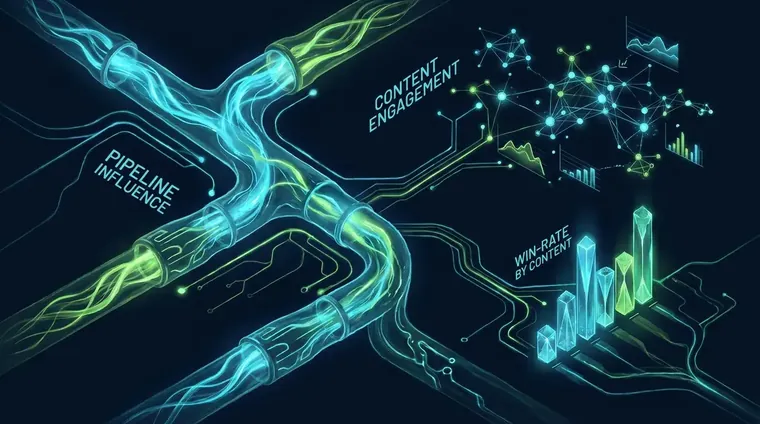
Measure thought leadership through pipeline influence, not impressions. Track content-touched opportunities, sales cycle length, and win rate by content-engaged vs. Non-engaged accounts.
Most measurement advice stops at "avoid vanity metrics." Nobody says what to replace them with. Here's the framework we actually use.
Content-touched pipeline. Tag every deal in your CRM with which thought leadership assets the contact consumed before the opportunity opened. This requires UTM discipline and a CRM with reasonable attribution. Not magic. It just needs to be set up before the program launches, not retrofitted after.
Sales cycle delta. Accounts where the buying team consumed three or more thought leadership pieces before the first sales call should close faster. If they don't, your content isn't matching the buyer's questions at the right stage. That's a calibration problem, not a measurement problem.
Win rate by content engagement tier. Segment closed-won vs. Closed-lost by how much thought leadership the account consumed. The 2024 Edelman-LinkedIn data backs this at the macro level. Nine in ten decision-makers are more receptive to sales outreach after consuming thought leadership. But your own data will tell you whether it's working for your specific ICP.
AI search citation rate. Nobody's tracking this yet. If your thought leadership is getting cited by ChatGPT, Perplexity, or Google AI Overviews when buyers search your category, that's distribution you didn't pay for. We track this per client using search sampling every 30 days. It's early, but the direction is already clear.
For a deeper look at how thought leadership fits alongside paid distribution, our guide on choosing a B2B content marketing agency walks through what a full-program engagement looks like and what questions to ask before signing.
Frequently Asked Questions
What is b2b thought leadership and why does it matter for pipeline?
B2B thought leadership is a content and distribution strategy where a brand or named individual publishes substantive, expert-led content to build credibility with buyers before a purchase decision. It matters for pipeline because the 2024 Edelman-LinkedIn report found that 9 in 10 decision-makers are more receptive to sales outreach from companies that consistently produce it. Which directly shortens sales cycles and improves win rates with informed buyers.
How long does it take for b2b thought leadership to show results?
Paid distribution tactics like LinkedIn Thought Leader Ads can show pipeline influence within 60–90 days if your tracking is set up correctly from the start. Organic search and AI citation stacking typically takes 6–12 months to build meaningful volume. The fastest path is to run paid distribution on thought leadership content immediately while the organic authority builds. Not to wait for organic results before investing in distribution.
Should the CEO or a subject-matter expert lead b2b thought leadership?
For most B2B companies under $50M ARR, a named subject-matter expert outperforms CEO-led content because SME credibility is more specific and technical buyers trust domain depth over title. CEO-led programs work when the CEO genuinely has a sharp public POV and will approve opinionated content. Which is rarer than most leadership teams admit. The wrong choice isn't which person, it's ghostwriting either one unconvincingly.
How do you measure the ROI of a b2b thought leadership program?
The most reliable measurement framework tracks three things: content-touched pipeline opportunities (tagged in your CRM at the time of first contact), sales cycle length for content-engaged vs. Non-engaged accounts, and win rate segmented by content engagement tier. Impressions and follower counts are not measurement. They're proxy signals at best. Set up UTM tracking and CRM tagging before the program launches, not after you're trying to justify the spend.
What is the difference between company and executive thought leadership?
Company-level thought leadership is published under the brand's name and scales via brand channel advertising. It works best for enterprises with existing audience gravity. Executive thought leadership is published under a named individual's profile and builds deeper personal credibility, especially with sophisticated buyers who distrust brand marketing. For growth-stage B2B companies, individual thought leadership with LinkedIn Thought Leader Ads as the distribution engine typically generates faster trust than brand-level content.
Related reading
Ready to Build a Thought Leadership Program That Actually Reaches Buyers?
Most thought leadership programs publish good content into a void. We build the distribution infrastructure first. Paid amplification, editorial cadence, and measurement that traces back to pipeline. If that sounds like what your program is missing, start with our content marketing agency overview or book a 30-minute strategy session to see if there's a fit. No deck. No pitch. Just the diagnosis.
---
Most thought leadership programs publish good content into a void. We build distribution first. Paid amplification, editorial cadence, measurement tied directly to pipeline. If that's what your program is missing, start with our content marketing agency overview or book a 30-minute strategy session to find out if there's a fit. No deck. No pitch. Just the diagnosis.