
How to Get Roofing Leads That Close at Margin
The standard advice on roofing leads is to stack more channels, Google Business Profile, Local Services Ads, Angi, door-knocking, Facebook, until the phone rings enough. That advice is wrong. Volume without quality means your closers burn time on jobs that were never going to close. The real problem isn't generating more leads. It's that most roofers are pulling in the wrong mix, and fixing the mix moves profit faster than turning up the volume. This post cuts into the lead quality problem most roundups skip. If you want the full channel rundown, start with our roofing leads pillar. This post goes deeper on the decisions that actually move profit.
Why Does Lead Source Matter More Than Lead Volume?
Lead source determines close rate and job margin, more leads from a bad source just produces more unprofitable bids.
Most roofing company owners track lead count, but fewer track close rate by source. That gap is where margin disappears.
A shared lead from a platform like Angi or HomeAdvisor arrives in the inbox of multiple competing contractors at the same moment. You're not selling, you're racing. The homeowner who submitted that form is already fielding calls, comparing quotes, and often choosing on price alone. Your close rate on those leads will be structurally lower than on referrals or exclusive inbound calls, even if you answer faster than anyone.
According to *Roofing by the Numbers 2025* (cited by Roofr), 63% of roofing business owners say generating new leads is their number-one growth challenge. But generating more leads from a bad channel doesn't solve that, it builds up it. More spend on a channel you're losing doesn't fix the channel.
What Does a Healthy Roofing Lead Mix Look Like?
A healthy mix combines exclusive inbound leads with referrals and a small volume of vetted paid leads, not mass shared-lead platforms.
- Referrals close highest Referral leads carry pre-built trust. The homeowner already believes you can do the job because someone they know said so. These leads have the highest close rate in any roofing pipeline and typically the highest average job value.
- Exclusive inbound beats shared lead platforms When a homeowner finds you through organic search or a Local Services Ad and calls you directly, that lead belongs to you alone. You are not racing four other contractors to the phone at 7 a.m.
- Local Services Ads produce exclusive calls Google's Local Services Ads deliver calls and messages, not form submissions sold to a list. Each lead comes to one contractor. Invalid leads are credited automatically, no manual dispute workflow needed.
- Shared platforms work at the right price Angi and similar platforms are not worthless, but they require a close-rate-adjusted cost-per-job calculation before you spend. If you're closing 8% of shared leads and 35% of referrals, budget accordingly.
- Outbound appointment-setting produces qualified sits A trained outbound floor can pre-qualify homeowners, confirming all decision-makers are present, scope and product interest, and time, before a closer ever drives to the house. That's a different category of lead than a web form.
How Do You Handle the Shared Lead Problem Operationally?
When leads are sold to multiple contractors simultaneously, you need a same-minute response system and a disqualification filter, not just speed.
If you're buying shared leads today, speed still matters. Industry research shows that leads contacted quickly convert far more often than leads reached after a long delay. But speed alone doesn't fix the real problem. You're faster, and so is every other contractor who bought the same lead. The smarter move is to add a disqualification filter on the first call. Is the homeowner a renter? Is the job cash or insurance? Are both decision-makers available to meet? Knowing this in the first 90 seconds tells you whether to invest a full appointment. It also tells you whether the lead platform is sending you qualified homeowners or scraped web forms. Our own outbound floor runs about 650 in-home appointments a month for our own windows and roofing company, and every appointment is checked by a person before it counts: homeowner confirmed, all decision-makers confirmed, product and scope verified, time re-confirmed. You can read more about how to get roofing leads through that kind of outbound infrastructure in our home improvement leads guide. For telemarketing compliance, scrub your list against the National Do Not Call Registry at least every 31 days and keep calls between 8 a.m. and 9 p.m. local time. Florida has its own additional rules on top of the federal floor. TCPA violations run $500 per call, up to $1,500 if willful, per FCC guidance.
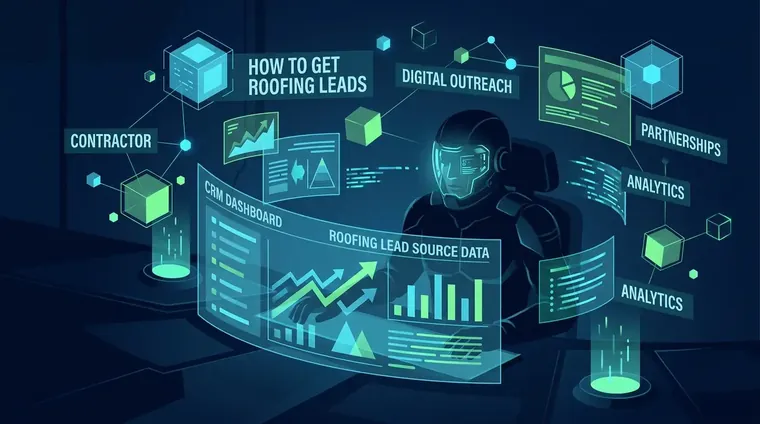
Only 28% of roofers use a CRM; tracking lead source, close rate, and job value by channel is the foundation of fixing a lead mix.
*Roofing by the Numbers 2025* puts CRM adoption at 28% across roofers. You can't fix your lead mix if you can't see it. A CRM that tracks source, close rate, and average job value by channel is the first tool you need, not the last.
What Should Your Seasonal Lead Strategy Look Like?
Roofing lead generation needs a seasonal channel shift, storm season favors outbound and storm mapping, winter favors SEO and referral nurture.
Roofing demand is not flat. Any roofer who has been through a Florida summer or a Texas hail season knows lead volume swings hard. The problem is most roofing companies run the same channel mix year-round and wonder why the phones go quiet in January.
During storm season, outbound and door-to-door work with neighborhoods you can target by damage address. Storm damage mapping tools let you target affected streets with neighbor letters while your competitors are still waiting for inbound calls. This is a high-volume, time-sensitive play.
In slow months, typically late fall and winter across most of the South, the right move is investing in assets that generate inbound demand later. SEO content, Google reviews, and referral follow-up all build pipeline that pays out in spring. Our own site went from 600 to 1,300 organic clicks a month in 90 days after we fired our SEO agency and ran a real content program. Organic traffic doesn't turn off when ad budgets get cut.
Spring ramp-up is the window to test new paid channels, Local Services Ads, Google Search campaigns, before the summer rush. That's when conversion data accumulates fastest and Smart Bidding strategies can build the conversion history they need to perform. Waiting until peak season to launch a new channel means you're still in the learning phase when demand peaks.
How Should You Follow Up When a Roofing Lead Goes Cold?
A cold lead needs a short, structured re-engagement sequence, three touches over five days, then a quarterly check-in, not an indefinite drip.
- 1Day 1: Same-day text and voicemailSend a text within the first hour of the lead going unresponsive. Keep it short, one sentence, one question, one call to action. Follow with a voicemail that references the homeowner's specific project, not a generic 'just checking in' script.
- 2Days 2 and 3: One call per day, alternating timesCall once on day two in the morning, once on day three in the afternoon. Alternating windows catches different schedules. If you get voicemail both times, leave a message only on one of the two calls, back-to-back voicemails read as desperation.
- 3Day 5: Final email with a clear closeSend a short email that gives the lead a clear off-ramp: 'If your timing has changed, no problem, I'll reach back out in 90 days.' This does two things. It removes pressure, and it schedules a legitimate re-engagement rather than an indefinite drip.
- 490-day re-engagement touchPull every 'closed-lost' lead from 90 days ago and send a single outreach. Roofing decisions stall for budget, insurance, or timing reasons, not always because the homeowner chose a competitor. A 90-day re-touch costs almost nothing and routinely re-opens jobs.
Does Operator-Run Experience Change How to Get Roofing Leads?
Operator experience, running the same systems in your own company, produces lead generation tactics that survive real sales floors, not just agency decks.
Knowing how to get roofing leads in theory is different from knowing what breaks at volume on a live sales floor. At Safeguard Impact, Eric Snyder runs marketing. Over 15 months, that program grew from $800K to $2M in monthly revenue. That growth came from fixing the lead mix, not from stacking more channels on top of a broken cost structure. We built the systems behind that growth. Now we sell those same systems to roofing and windows contractors outside our own five-county footprint. Our rev share model means we only get paid when you close, 15% of what you close, settled weekly. Our incentive is tied to your close rate, not your lead count. Spots per market are limited. The market is there. The contractors who win it know how to get roofing leads from sources that actually close, not just sources that generate volume. You can see a full breakdown of those channels in our roofing leads guide.
Shared Leads vs. Exclusive Appointments: Which Channel Wins?
Exclusive appointments cost more per lead but produce higher close rates and lower cost-per-job than shared leads at scale.
| Feature | Shared Lead Platforms | Exclusive Appointments |
|---|---|---|
| Who else gets the lead | Multiple competitors simultaneously | Only you, one contractor per appointment |
| Pre-qualification | None, web form, unverified | Decision-makers, scope, and time confirmed by a person |
| Close rate expectation | Lower, homeowner is comparing quotes on price | Higher, homeowner chose the meeting and is expecting you |
| No-show risk | No replacement, you absorb the wasted drive time | No-shows and reschedules are replaced |
| Budget model | Pay per lead regardless of outcome | Pay per sit, or rev share on what you close |
Frequently Asked Questions
How do I know which lead sources are worth the budget for my roofing company?
Track close rate and average job value by source in your CRM, not just lead count. A roofing company in Florida spending on shared lead platforms may find that 10 referrals outperform 50 Angi leads on total revenue. Once you see close rate by source, budget allocation becomes straightforward.
What is the biggest mistake roofers make when getting more leads?
Adding more lead volume from channels that already have low close rates. If shared leads are closing at 8% and your referrals close at 35%, buying more shared leads scales the wrong behavior. Fix the source mix first, then scale what's working.
How does Local Services Ads work for getting roofing leads in my area?
Google's Local Services Ads deliver calls and messages directly to your business, leads are not shared with competing contractors. Ads cannot run until Google's verification clears, and invalid leads are credited automatically. Budgets are set weekly, with a maximize-leads or max-per-lead bidding option.
How long should I follow up on a cold roofing lead before giving up?
Run a five-day sequence, text and voicemail on day one, one call each on days two and three at alternating times, and a final email on day five with a 90-day re-engagement scheduled. After that, pull every closed-lost lead at the 90-day mark for a single re-touch. Many roofing jobs stall for insurance or budget reasons and re-open months later.
Does Receipts Group offer roofing leads in Florida and other coastal markets?
Yes. We set in-home appointments for roofing and impact windows contractors in Florida outside our own five counties, plus Georgia, South Carolina, North Carolina, Texas, Louisiana, and Arizona. Each appointment is exclusive to one contractor, checked by a person before it counts, and delivered into your CRM with the call recording and the homeowner's answers. Spots per market are limited, book a 30-min call to check availability.
Related reading
Ready to Fix Your Lead Mix, Not Just Your Lead Count?
We set in-home appointments for roofing and impact windows contractors in Florida outside our own five counties, Georgia, South Carolina, North Carolina, Texas, and Arizona, the same appointments our own floor runs, checked by a person before they count. You pay no cost per lead and no retainer. We're paid 15% of what you close, settled weekly, if you qualify. Or if you want to build your own outbound floor, we build and staff the whole stack for you. Either way, the first step is a conversation. Visit our roofing leads page for the full picture, then book a 30-min call to see if your market is available.