
Plumbing Lead Generation: Speed, Quality, and Channel Fit
68.5% of local businesses never respond to an inbound lead within a day. That's from a national study of 1,824 businesses cited by Ignitivo. Your average plumbing competitor isn't beating you on marketing. They're burning leads in their voicemail. This section ties into our broader HVAC marketing guide, and the same rule holds for plumbing: volume is almost never the real problem. Speed and quality are. Fix those first, then stack channels.
Why do most plumbing lead guides get it wrong?
Most guides add channels before fixing response speed, the real constraint that kills plumbing leads before they convert.
Every list you find ranks 10 or 15 tactics without telling you which one to run first. That's the problem. A plumbing business at $400K a year has different pressure points than one at $2M. Handing a small shop a 15-tactic roadmap doesn't help. It paralyzes. Here's the contrarian reality: most plumbing businesses don't have a lead generation problem. They have a lead response problem. A Harvard Business Review analysis found that responding within 5 minutes makes you 21x more likely to qualify a lead than if you wait 30 minutes. One automated missed-call text-back, set up in an afternoon, will outperform adding two new marketing channels, if your team isn't consistently answering in the first place. That's the gap most of your competitors are leaving open.
When you buy a lead from HomeAdvisor, Angi, or Thumbtack, you're not the only buyer. The same homeowner gets called by several plumbers simultaneously. Your stated cost-per-lead looks low, but your actual cost-per-acquisition, once you factor in the competitive dilution and the follow-up labor, is a different number entirely. As one commenter on Hacker News put it, services like these 'very much killed the golden goose' by optimizing for lead volume over lead quality. Know what you're paying for before you scale spend there.
How should you score and sort incoming plumbing leads?
Emergency calls, maintenance inquiries, and quote-shoppers convert at different rates and need different follow-up sequences, treating them equally wastes capacity.
Not every inbound call earns the same dispatch cost. Emergency calls, burst pipe at 11 PM, water heater out in January, close at a high rate and tolerate almost no response delay. These buyers aren't shopping. Maintenance and tune-up inquiries close at a lower rate but build long-term customer value. Quote-shoppers, people who've already called three plumbers, close at the lowest rate and drain your estimating time. A three-bucket intake process changes your economics fast. Train whoever answers the phone, or set your CRM auto-response, to tag the call type at intake. Emergency tags trigger an immediate callback SLA. Quote-shoppers get one qualifying question before you roll a truck: "Have you had a chance to look at other estimates yet?" That question tells you exactly where you stand. HVAC contractors working through the same triage problem can find channel-specific close rate differences in our HVAC lead generation guide.
What does a property manager partnership actually look like?
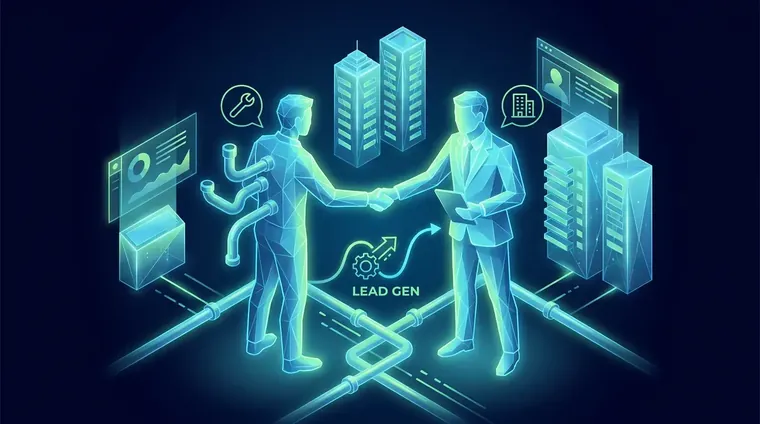
A preferred-rate property manager agreement gives you predictable volume in exchange for a discounted service rate and guaranteed response SLA.
- Set a preferred rate in writing Offer property managers a fixed preferred rate, typically 10–15% below your standard service call price, documented in a one-page agreement. Verbal handshakes are not acceptable. The discount only applies when work is dispatched through the agreed channel.
- Define your response SLA Property managers care about one thing: their tenants get help fast. Put a written SLA in your agreement, something like a 2-hour response acknowledgment and a 4-hour same-day dispatch for non-emergency calls. This is your competitive moat.
- Build a check-in cadence Text or email your property manager contact once a month, a quick recap of jobs completed and open items. This keeps you top of mind when a new property comes into their portfolio, and it surfaces referrals before another plumber gets the call.
- Start with smaller portfolios A manager with 15–30 units is a better first target than a 300-unit complex. Smaller portfolios have faster decision cycles and fewer vendor approval layers. Nail the relationship, get a testimonial, then use it to open the larger accounts.
How do you shift your plumbing lead strategy between seasons?
Plumbing demand peaks in winter freeze events and drops in mid-summer, your budget and channel mix should shift with it, not stay flat year-round.
No plumbing lead generation guide talks about seasonality. They should. In northern markets, winter freeze events spike emergency call volume, while in southern markets, summer humidity drives condensate drain and water heater issues. The slowest period for most residential plumbers is mid-summer, when homeowners are distracted and non-emergency repairs get deferred.
What to do in a slow month: Shift budget from paid search (high CPCs, lower intent in slow season) toward reactivation. Pull your customer list from the last 18 months. Identify anyone who hasn't called back. A simple SMS sequence, 'Hey, it's [Company], we serviced your water heater in March. Summer is a smart time to check the anode rod before the demand season hits', costs almost nothing and converts on name recognition alone.
What to do in a peak month: Don't spend on brand awareness. Put paid search dollars behind emergency and same-day keywords. Adjust your Google Business Profile hours and services to reflect surge availability.
For HVAC shops managing the same feast-or-famine cycle, our HVAC marketing pillar has a section on seasonal budget allocation that maps directly.
What does operator-level marketing actually look like for plumbers?
At Safeguard Impact, where Receipts Group's founder Eric is Marketing Director, monthly revenue grew from $800K to $2M over 15 months, by fixing intake and channel sequencing, not adding channels.
At Safeguard Impact, where Receipts Group's founder is Marketing Director, monthly revenue grew from $800K to $2M over 15 months, not by running 15 tactics simultaneously. By tightening intake, fixing response speed, and sequencing channels in the right order for the company's stage.
We build call center systems for plumbing and HVAC operators, a call center stack with outbound and inbound agents, dialer, CRM, calendar and payroll on one platform, and a QA check on every appointment before it counts. The roofing marketing framework we use follows the same stage-based logic: get the intake right, then add paid channels, then optimize SEO for stacking return.
For plumbers specifically: if you're under $1M in annual revenue, fix your phone answer rate and your CRM intake before you buy another lead. A one-person operation answering 60% of its calls will outperform a three-truck shop answering 30%. The return is faster than you expect, and the stacking is real.
How do reviews actually move plumbing leads, and what's legal?
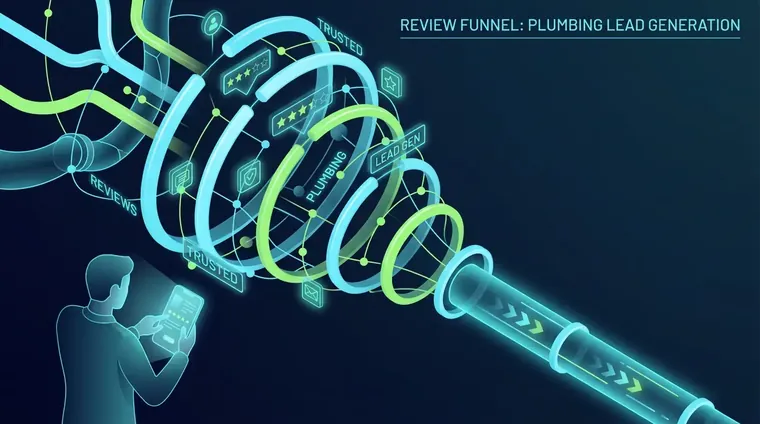
Reviews boost conversion by up to 270%, but the FTC bans incentivized reviews conditioned on a positive outcome, ask every customer, not just happy ones.
BrightLocal's 2025 Local Consumer Review Survey found that 73% of consumers only pay attention to reviews from the last month. That second number matters more than the first. A plumber with 200 reviews and nothing new in 90 days looks stale to a buyer reading them in real time.
The fix is a consistent ask-every-customer process, not a campaign. After every closed job, your tech or your CRM automation sends a review request, not just after great jobs but after every job. The FTC's endorsement guides are clear: Google bans incentivized reviews outright, and the FTC bans incentives conditioned on a positive outcome. Ask broadly, ask consistently, and don't filter.
On your Google Business Profile: per Google's own guidelines, keeping your services, hours, and business description accurate is table stakes. Google's local ranking tips confirm that review count and score feed prominence, one of the three named local ranking factors alongside relevance and distance. Posts and photo uploads are good habits, but they're not named ranking factors. Don't confuse activity with signal.
Residential vs. commercial plumbing lead generation: what changes?
Commercial plumbing leads require longer sales cycles, different channels, and relationship-driven outreach, not the same tactics that win residential jobs.
| Feature | Residential Plumbing | Commercial / Mechanical |
|---|---|---|
| Decision timeline | Same day to 48 hours | Weeks to months; involves facilities managers or procurement |
| Primary lead channel | Google Local Services Ads, GBP, word of mouth | Direct outreach, property manager networks, bid boards |
| Lead quality signal | Emergency vs. quote-shopper call type | Scope size, project phase, and who controls the PO |
| Review importance | Critical, buyers read before calling | Secondary, references and licensing matter more |
| Reactivation approach | SMS or email to past homeowners | Quarterly check-in call to facilities contacts |
Adding more plumbing lead generation channels before fixing intake is the most common and most expensive mistake in contractor marketing.
Most plumbers should stop buying leads before they fix their phone. Shared lead platforms can work. But only after your intake can handle volume without dropping calls. If 40% of your inbound calls go to voicemail, buying 50 more leads a month produces 50 more missed opportunities. The ranking, the ad spend, the GBP optimization, none of it matters if the phone rings into a void. Fix the floor before you raise the ceiling.
Frequently Asked Questions
How much does plumbing lead generation cost in 2026?
It depends entirely on the channel. Google Local Services Ads for plumbers are billed per lead, with budgets set weekly and costs varying by market and service type, Google does not publish fixed prices. Shared lead platforms like Angi or Thumbtack have stated per-lead costs, but the same lead goes to multiple plumbers simultaneously, so your effective cost-per-acquisition is higher than the sticker price. A well-optimized Google Business Profile and local SEO program can generate organic leads over time without ongoing ad spend, but results take time to build. For plumbing businesses in Texas, Georgia, the Carolinas, Florida, or Arizona, we build custom SEO programs starting at $3,500, then $3,500 a month for six months, with 0% financing available through a third-party lender.
What is the fastest way to get more plumbing leads without buying ads?
The fastest single action is fixing your missed-call response rate. A Harvard Business Review analysis found you're 21x more likely to qualify a lead if you respond within 5 minutes versus 30 minutes. An automated missed-call text-back, which most CRMs can set up in a day, covers the gap when your team can't answer live. After that, a reactivation SMS sequence to customers from the last 18 months is the next fastest return: they already know you, trust is built, and the offer doesn't need to compete with four other plumbers.
Should plumbers use Google Local Services Ads or Google Search Ads?
For most residential plumbing businesses, Local Services Ads are the better starting point in 2026. On mobile, ads and Local Services Ads usually appear above the map pack and standard paid search results, leads arrive as calls or messages, and invalid leads are credited automatically. The tradeoff: your ads can't run until Google's verification process clears, which takes time. Standard Search Ads give you faster launch and more targeting control, but the cost per click is higher and you manage every lead manually. Note: Google stopped accepting new call-only ads in February 2026, so use call assets on Search campaigns instead. For more on structuring your contractor ad setup, see our guide on Google Local Services Ads for contractors.
Related reading
Ready to build a plumbing lead system that actually converts?
We build call centers, SEO programs, and paid ad accounts for plumbing and HVAC contractors, the same systems we run for our own $23M-a-year windows and roofing operation. We charge no retainer. If you're serious about fixing the intake and stacking channels in the right order, start with our HVAC and contractor marketing guide or book a 30-min call to see if we're a fit. We're selective, a small number of clients at a time, and we're honest about whether the timing works for you.