
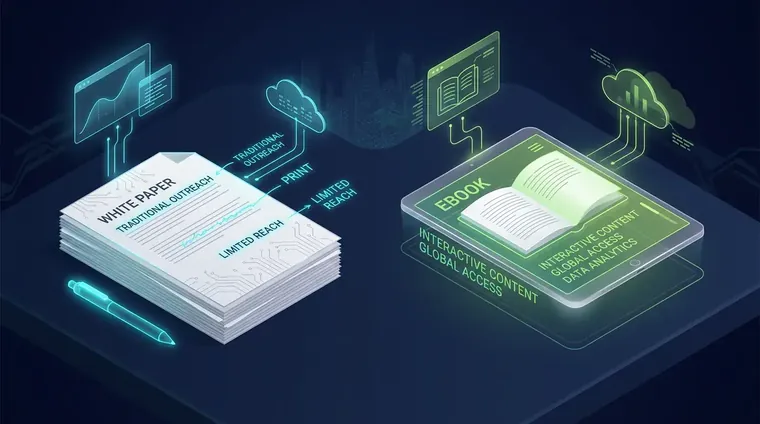
White Paper vs Ebook: Pick the Format That Fits Your Channel
The default advice is to match format to funnel stage. EBook for awareness, white paper for decision. That advice is wrong. It skips the two variables that actually decide the outcome: where you plan to distribute and what your production budget can support. Funnel stage is a proxy. Channel and budget are the real constraints. If you're building a content program and need to justify the asset choice to a skeptic, our content marketing agency guide covers the full framework. This post handles the sharper question: when the choice is white paper vs ebook, what actually determines which one you build first?
Why Does the Format Decision Actually Matter?
The white paper vs ebook choice shapes production cost, distribution reach, and whether search engines can crawl your content at all.
Most content teams treat this as a design question. It isn't. It's a distribution and SEO decision wearing a design costume.
White papers are almost always gated PDFs. Zero crawlable content. Google gets nothing. The Helpful Content System rewards pages that directly answer questions. A locked PDF does the opposite. You're trading organic reach for a contact form fill, every single time.
Ebooks can be gated too, but they don't have to be. An ungated ebook published as HTML or a crawlable landing page can earn backlinks, build dwell time, and climb in search rankings for years. We've watched ungated long-form assets beat gated ones in lead volume after the 6-month mark. Not because the gated version converted poorly. Because it simply wasn't visible.
That gap is the part no top-ranking comparison page bothers to explain. The white paper vs ebook debate isn't academic. It has real consequences for your organic channel.
A gated white paper that gets 40 downloads is worse for pipeline than an ungated eBook that earns 200 backlinks and ranks on page one.
A gated white paper with 40 downloads hurts pipeline more than an ungated eBook that earns 200 backlinks and ranks page one. Prestige format with zero distribution is expensive shelf furniture. Build the thing people can actually find.
What Actually Separates the Two Formats?
White papers prioritize depth and credibility for a specific argument; eBooks prioritize reach, visual structure, and channel flexibility.
- Argument vs. Journey Gordon Graham. Author of *Whitepapers for Dummies* and known in the industry as 'That Whitepaper Guy'. Defines a white paper as 'a persuasive essay that uses facts and logic to promote a certain product, service, or viewpoint.' An eBook, by contrast, guides a reader through a topic without necessarily landing on a single verdict.
- Word count range White papers typically run 1,000–10,000 words with dense citations. EBooks are often shorter per 'chapter' but longer visually. Heavy on callout boxes, charts, and section breaks that reduce perceived reading effort.
- Production timeline A properly researched white paper takes 4–8 weeks to produce: SME interviews, data sourcing, fact-checking, legal review in regulated verticals. A well-designed eBook can ship in 2–3 weeks when the outline is locked and a designer is already on retainer.
- SEO footprint EBooks published as ungated web pages can carry E-E-A-T signals. Author bylines, citations, structured data. And earn referring domains. White papers rarely do.
- Channel fit EBooks circulate naturally on LinkedIn carousels, Slideshare, and email sequences. White papers get submitted to industry publications, analyst platforms like Forrester Wave, and procurement portals. These are completely different distribution muscles.
Can You Repurpose One Into the Other?
Yes. A white paper's original research is the ideal data backbone for a follow-up eBook campaign targeting a broader distribution audience.
This is the gap every competitor skips. The white paper vs ebook choice isn't either/or. The smarter sequence: produce the white paper first to lock in the original research and the credibility claim, then strip the core data and rebuild it as an ebook formatted for broader distribution.
Cognism's CMO did exactly this. She built an ebook targeting marketing leaders specifically and used it to reach senior prospects who would never have downloaded a dense research document. The format changed. The underlying insight stayed the same.
We've run this playbook on content programs where the white paper was the primary gated asset for paid traffic. LinkedIn lead gen forms, $55–$80 CPL. Then the ebook version ran ungated as the SEO landing page. The ungated page ranked. The gated white paper converted. Same research. Two distribution channels. Neither asset steps on the other.
If you're working with a content marketing agency that treats these as mutually exclusive formats, that's a workflow problem. Not a strategy problem.

White Paper vs Ebook: Format Decision Matrix
Choose white papers for credibility-heavy arguments distributed to niche platforms; choose eBooks when you need SEO reach or faster production cycles.
| Feature | White Paper | Ebook |
|---|---|---|
| Primary goal | Persuade with data and logic | Guide and educate at scale |
| Production time | 4–8 weeks with SME review | 2–3 weeks with locked outline |
| Typical word count | 1,000–10,000 words | 3,000–8,000 words |
| SEO footprint | Near zero (gated PDF default) | High if published ungated as HTML |
| Best distribution channel | Industry pubs, analyst platforms, procurement portals | LinkedIn, email nurture, organic search |
| Buyer persona fit | Technical evaluators, procurement teams | Practitioners, senior buyers (when research-backed) |
| Cost to produce | $3,000–$12,000+ with full research | $1,500–$5,000 depending on design depth |
What Do Conversion Benchmarks Actually Look Like?
Gated eBooks typically convert landing page visitors at 20–35%; white papers often convert at 15–25% but generate more qualified pipeline per download.
Nobody in the white paper vs ebook conversation publishes real conversion data. Here's what we see across B2B programs.
Gated eBook landing pages convert between 20–35% of visitors when the topic is specific and the headline is tight. White paper landing pages run lower. 15–25%. But the contact quality skews higher. Someone who sits through a 6,000-word technical document has already done more qualification work than someone who grabbed a visual overview.
The more interesting benchmark is cost per qualified lead on paid distribution. LinkedIn lead gen forms, for instance. White papers tend to command higher perceived value, which sometimes cuts CPL despite lower raw conversion rates. We've seen white paper campaigns at $62 CPL outperform eBook campaigns at $48 CPL in pipeline contribution. The sales team could actually close the white paper leads.
One conceded reality: these benchmarks depend almost entirely on topic specificity and audience targeting. A vague eBook with a generic title will underperform a tight white paper every time, regardless of format. The format isn't the variable. The offer specificity is.
How Does Channel Choice Change the Decision?
LinkedIn and email nurture favor eBooks; industry publications and analyst platforms favor white papers. Distribute before you design.
Pick your channel before you pick your format. This sounds obvious. Almost no one does it.
If your primary distribution channel is LinkedIn organic or paid, eBooks win. LinkedIn's native document format. Carousels and uploaded PDFs. Rewards visual, chunked content that previews well in the feed. A dense white paper with 47 footnotes reads fine on a procurement portal. On a LinkedIn scroll, it dies in the first 3 slides.
If you're targeting industry publications, analyst aggregators, or enterprise procurement platforms, white papers carry the credential weight those platforms expect. A 2,000-word backgrounder on compliance risk has institutional weight that a visual eBook simply doesn't in those environments.
One practitioner on a Reddit r/SEO thread put it bluntly: distribution channel is the variable most marketers don't control, so they default to format wars instead. That's the real reason the white paper vs ebook debate never resolves. Teams are fighting about the artifact instead of mapping the channel.
For deeper context on matching content format to paid distribution, our team covers the channel-by-channel breakdown in the SEO content writing services guide and in our B2B content marketing agency guide.
If you know your channel and have your research locked, Receipts Group can scope the asset production and distribution plan in one call.
If your channel is locked and your research is ready, we can scope the right format and distribution plan in a single call. Book a strategy session →
Which Format Works Better With Paid Ads?
EBooks perform better on broad paid audiences; white papers convert better on intent-targeted LinkedIn or retargeting campaigns with a known buyer persona.
Paid amplification changes the math on white paper vs ebook decisions. We've run both through LinkedIn lead gen forms and through ungated landing pages driving to form fills.
For cold audiences. People who've never heard of your brand. Ebooks convert more reliably. The ask feels proportional to the relationship. Dropping a 40-page research document on a cold prospect is asking for too much trust too early.
For retargeting or intent-targeted campaigns where you've already warmed the audience, white papers hit harder. The buyer who visited your pricing page twice is already in evaluation mode. A dense, credentialed white paper confirms the technical depth they're looking for before they talk to sales.
On the paid side, white papers also work well when paired with ungated teasers. Publish 20% of the content as a free article. Gate the full research behind a form. That hybrid captures some SEO value while keeping the conversion mechanic intact. Our Reddit Ads Agency team runs a version of this for community-first distribution on technical topics where Reddit threads drive initial discovery.
Frequently Asked Questions
What is the main difference between a white paper and an ebook?
A white paper is a persuasive, research-heavy document designed to make a specific argument. Typically 1,000–10,000 words with citations and formal structure. An ebook is a longer-form educational asset with more visual structure, designed for broader distribution. The bigger practical difference: white papers are almost always gated PDFs with no SEO value, while ebooks can be published as ungated HTML pages that rank in search and earn backlinks.
Which format generates more leads. A white paper or an ebook?
EBooks typically see higher landing page conversion rates (20–35%) because the perceived ask feels lighter for cold audiences. White papers often convert lower (15–25%) but generate higher-quality pipeline because the download signals deeper intent. For most B2B programs, the format that fits your paid distribution channel will outperform the one that doesn't. Regardless of which format theoretically 'converts better.'
Can a white paper be repurposed into an ebook?
Yes, and this is one of the most underused content workflows in B2B marketing. Produce the white paper first to anchor original research and credibility, then rebuild the core data as an ebook formatted for broader channels like LinkedIn and email nurture. The research stays the same. The format shifts to match the distribution channel. This lets one body of work serve both gated demand-gen and ungated SEO simultaneously.
Does the format choice affect SEO rankings?
Significantly. White papers are almost always gated PDFs. Google cannot crawl them, they earn no organic rankings, and they generate zero backlink surface area. Ebooks published as ungated web pages can carry E-E-A-T signals, earn referring domains, and compound in search rankings over time. If organic search is part of your content program's distribution strategy, an ungated ebook (or a hybrid approach with a teaser article gating the full PDF) will outperform a traditional gated white paper every time.
Related reading
Build the Asset That Fits Your Channel
The white paper vs ebook decision isn't hard. It gets hard when you try to answer it without knowing where the content will live, who will distribute it, or what the production budget can support.
Safeguard Impact. The program Receipts Group's founder runs as Marketing Director. Went from $800K to $2M in monthly revenue in 15 months. Content assets were part of that system. Not prestige PDFs collecting dust. Channel-matched, distribution-first work that moved pipeline.
If you want to build a content program that works the same way, our content marketing agency team can scope it. One call. No retainer required to start the conversation.