Contractor Marketing Ideas That Fill Your Calendar
Most contractors spend money on marketing before they fix the basics. U.S. Census Bureau construction spending data shows demand is real. The gap is almost never demand. It's execution. What follows are the contractor marketing ideas we've actually run inside our own windows and roofing operation, a business pacing toward $23M this year. What worked, what order to build it in, and what to skip. For the full framework, see our contractor marketing guide. This post goes deep on specific tactics.
Why do most contractor marketing ideas fail to produce leads?
Most contractor marketing fails because tactics are added without a lead-to-close system behind them, so budget evaporates with no measurable return.
The honest answer: too many channels, too thin. I see roofing and HVAC owners running Google Ads, buying shared leads from aggregators, posting on Facebook, and chasing TikTok, all at the same time, all half-baked. None of it has a close system behind it.
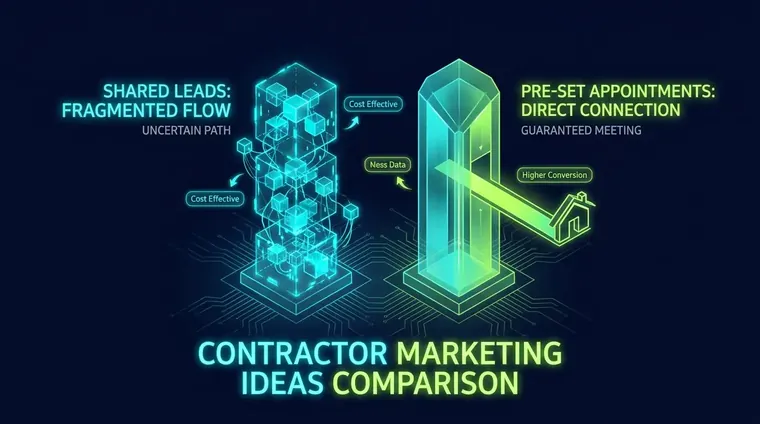
Shared leads from aggregators are sold to several contractors at once. That means your phone has to ring first, your pitch has to land first, and your follow-up has to be faster than everyone else who bought the same name. That's not a lead problem. It's an infrastructure problem.
As one commenter put it on a Reddit r/bigseo thread, "You can't take a domain with nothing and just put in internal links and change titles." The same logic applies to your calendar: you can't bolt a marketing tactic onto a business with no answering system and expect volume.
Pick one or two channels. Build the backend. Then scale when both are solid.
Which contractor marketing ideas give the fastest return?
Google Business Profile, outbound calling, and referral systems return leads fastest because they reach homeowners who are already in a buying mindset.
- Google Business Profile Free, authoritative, and the first thing homeowners see. Follow Google's own guidelines for representing your business, accurate category, complete service areas, photos updated weekly. Per Google's local ranking tips, relevance, distance, and prominence (reviews, citations) drive the map pack. Posts no longer expire after seven days, so batch them and schedule.
- Local Services Ads LSAs appear above the map pack on mobile. Leads arrive as calls or messages. Google's verification has to clear before ads run, so apply before you need volume. Invalid leads are credited automatically, no manual dispute workflow required.
- Outbound calling Homeowner data, a good script, and a dialer can produce booked appointments the same week. It's the fastest cold channel we've run. The compliance side matters: scrub against the National Do Not Call Registry at least every 31 days, and keep calls between 8 a.m. and 9 p.m. local time.
- Referral programs Past customers who had a good experience are warm. A simple ask, plus a reason to ask, converts. Keep incentives legal: the FTC's Endorsement Guides require disclosure and ban incentives conditioned on a positive review. Ask every customer, not just the happy ones.
- SEO content (city + service pages) Takes 90–180 days to compound, but the cost per lead drops over time. We went from 600 to 1,300 organic clicks a month in 90 days after we fired our SEO agency and built our own site on our own platform. The key is pages written for how people search, not how your company describes itself.
Our outbound floor runs about 650 in-home appointments a month for our own windows and roofing company. If you're a roofing or impact windows contractor in Florida (outside our five counties), Georgia, South Carolina, North Carolina, Texas, or Arizona, we can put those same appointments in your CRM. Book a 30-min call and we'll tell you whether your market is open.
How should a contractor marketing plan be sequenced?
Start with the channel that matches your current revenue stage: referrals and GBP first, then paid search, then outbound, then SEO content to lower cost-per-lead over time.
Sequencing is the step most marketing vendors skip. If you need everything at once, you need a bigger retainer. The real order is simpler. Stage 1 (under $1M): Nail your Google Business Profile. Collect reviews from every job. Ask for referrals with a system, not a hope. These three steps cost nothing except discipline. Stage 2 ($1M–$3M): Layer in Local Services Ads and Google Search Ads once you have someone answering the phone fast. Speed-to-answer is the variable most contractors underestimate. Leads from paid search go cold fast if no one picks up. Stage 3 ($3M+): Add outbound calling or buy pre-set appointments to build a predictable pipeline. Run SEO in parallel so organic cost-per-lead keeps dropping. This is where our roofing marketing guide and HVAC marketing guide go deep on channel-specific playbooks. The hot take nobody says out loud: most contractors need a better close system before they need more leads. More impressions into a leaky funnel just burns budget faster.

What does a contractor call center actually produce?
One floor, one month: about $800K in sales from our own call center in September 2026, proof that outbound calling at scale produces real revenue, not just activity.
Here is what one floor produced in one month: about $800K in sales from our own call center in September 2026. That's not a forecast. That's a screenshot from one of the best months our outbound floor has produced so far.
We built that floor from zero, dialer, CRM, calendar, and payroll on one stack, trained agents, and a QA check on every appointment before it counts. The first version of that system went from $0 to $426K a month in nine months. September 2026 was the peak so far.
We now build the same infrastructure for other contractors. Two models: Full Management (we build it, staff it, and run it) or Build-for-You (we build and staff it on our stack, your team runs it). The build is $15,000. The full three-month Full Management package is $30,000. The $15,000 build can be financed at $1,250 a month over 12 months at 0% through a third-party lender, subject to approval.
For remodeling, HVAC, and plumbing contractors looking for similar infrastructure, see our related reads on HVAC lead generation and remodeling marketing, the channel logic translates even if the scripts differ.
Shared leads vs. pre-set appointments: what's the real difference?
Shared leads sell the same homeowner to multiple contractors at once; pre-set appointments are exclusive, confirmed, and delivered with the call recording already in your CRM.
| Feature | Shared Leads (Aggregators) | Pre-Set Appointments (Receipts Group) |
|---|---|---|
| Exclusivity | Sold to multiple contractors simultaneously | One contractor per appointment, exclusive |
| Qualification | Name and phone number, variable intent | Homeowner, decision-makers, scope, and time all confirmed by a human before it counts |
| Delivery | Email or portal, you call cold | Dropped into your CRM with the call recording and homeowner's answers |
| No-shows | No replacement policy | No-shows and reschedules are replaced |
| Pricing model | Per lead, volume discounts common | Per sit; price set on the call (not published) |
| Risk | You pay whether you close or not | Rev share option: nothing down, 15% of what you close, settled weekly (impact windows and roofing, if you qualify) |
How do contractor SEO and paid ads work together?
Paid ads deliver leads now while SEO builds stacking organic traffic, the two channels work best when they share the same keyword data and landing pages.
Paid and organic aren't rivals. They're a relay. Ads tell you which keywords convert. SEO turns those same keywords into traffic you don't pay per click for. The common mistake is running ads to a homepage. Every campaign needs a landing page written for the search intent. Storm damage roofing in a specific city is a different buyer than energy-efficient window replacement. We build city-and-service pages for exactly this reason: the same pages that rank organically also carry the paid traffic. For Google Ads in 2026, call-only ads stopped accepting new campaigns in February 2026, and existing ones stop serving in February 2027. Use call assets instead. They attach to standard search ads and still route calls directly to your phone. For Local Services Ads, budgets are weekly and you can bid by maximize-leads or set a maximum cost per lead. Smart Bidding and Performance Max need conversion history before they optimize well. Give them time before judging the results. Facebook and Meta ads for home improvement can fall under the Housing special ad category. That classification restricts age, gender, and location targeting. Build your audiences and creative around that constraint. For HVAC-specific paid channel breakdowns, our HVAC marketing ideas post covers seasonal bidding logic that applies across trades.
Speed-to-answer is the single highest-ROI marketing move most contractors haven't made, it multiplies every other channel's return.
Speed-to-answer is a marketing system. If your phone goes to voicemail, every dollar you spent getting that call just evaporated. A live answering service or a trained agent picking up on the first ring is not an ops decision. It is the last mile of your marketing investment. Fix this before you spend another dollar on ads.
Frequently Asked Questions
What are the most effective roofing marketing ideas in 2026?
The highest-return starting points for a roofing company in 2026 are a fully optimized Google Business Profile (accurate category, consistent reviews, weekly photos), Local Services Ads once Google verification clears, and either outbound calling or pre-set appointments for fast pipeline. SEO content, city and service pages written for how people search, builds up over time and lowers cost-per-lead.
How much should a contractor spend on marketing to grow in a competitive market?
There's no universal percentage, and the right number depends on your market, stage, and channel mix. The more important variable is where the spend goes: outbound calling and pre-set appointments produce measurable cost-per-appointment; shared leads are harder to track. Whatever your budget, fix your answer rate and close system before scaling spend.
Does Google Business Profile optimization actually move the needle?
Yes, but with a clear ceiling. Google's local ranking factors are relevance, distance, and prominence (which includes review count, review score, and information from across the web). A complete, accurate GBP with strong reviews improves your map-pack position, and that's free traffic with real purchase intent. It won't replace a paid or outbound pipeline at scale, but it's the highest-ROI first move for any contractor in a new market. Follow Google's guidelines for representing your business and their local ranking tips to avoid policy violations that can get your profile suspended.
Related reading
Ready to build a contractor marketing system that builds up?
The contractor marketing guide on this site covers the full framework, channels, sequencing, and what to build first. If you're past strategy and want to talk appointments, a call center build, or SEO, book a 30-min call. We're selective. If the market fits and the timing is right, we'll tell you exactly what we'd build and in what order.