
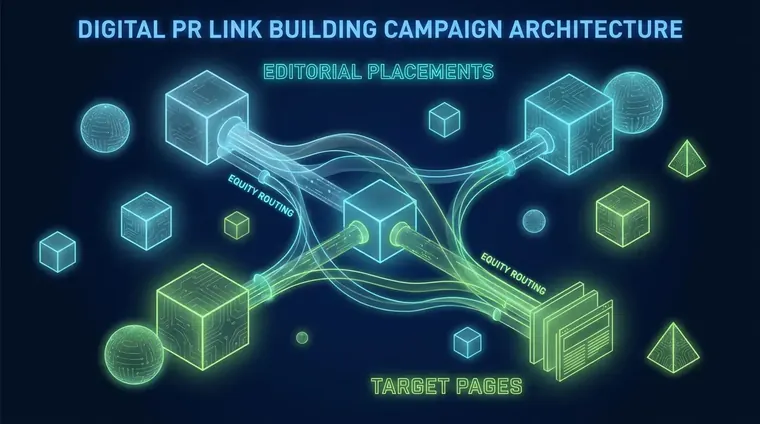
Digital PR Link Building: Earn the Link, Route the Equity
Last month we audited 12 home-services sites running active PR campaigns. Every one of them had earned real placements. DR 65+, editorial mentions, the kind of links most agencies charge a premium to get. The pattern was painful. Nine of the twelve were pointing those placements at their homepage. Their `/services` and `/locations` pages. The URLs actually competing for commercial keywords. Were sitting on DR 30 link profiles while the homepage piled up authority it didn't need. That's the core failure mode of digital pr link building that no one in the PR-led guides will say out loud. We cover the full link acquisition picture in our link building services pillar. This post is specifically about why campaign architecture. Which URL earns which link. Is the variable most teams never touch.
Why do most digital PR campaigns misroute their link equity?
Most digital PR campaigns default to homepage URLs because PR teams optimize for brand visibility, not keyword-level ranking lift on commercial pages.
Most digital PR programs are run by PR people, not SEOs. That's not a slight. It's just true. A PR person measures success in coverage. An SEO measures success in ranking movement on revenue pages. When those two functions don't share a brief, the campaign defaults to the brand URL. Easiest to pitch, easiest to log in a coverage report.
Google's link building best practices are clear: PageRank flows through the specific URL that earns the link. Not across the whole domain by osmosis. A DR 80 placement pointing to `yourdomain.com/` does relatively little for `yourdomain.com/hvac-repair-miami/` unless your internal linking is tight enough to route that equity down the tree. Most sites' internal linking isn't. We check this on every audit we run.
The fix isn't complicated. It just requires the SEO and the PR lead in the same room before the campaign brief is written. Not after the coverage report comes in. Decide which URLs need ranking lift. Build the campaign story around an asset that lives on. Or naturally links to. Those URLs. Then pitch that URL. Campaign volume is secondary. The destination URL is the primary variable.
What makes a digital PR campaign actually move rankings?
Ranking movement from digital PR requires the right URL target, strong internal equity routing, and placements with genuine editorial context. Not just high DR.
- Target URL specificity Define the exact URL you want to rank before the pitch goes out. If it's a service page, the campaign asset should live on or link to that page. Not sit on a subdomain or a standalone microsite.
- Internal link routing post-placement Once a DR 70+ placement lands, audit your internal link structure within 48 hours. Add contextual links from your homepage and top-traffic pages to the target URL so the equity flows where you need it.
- Editorial context, not just DR A DR 61 placement where your URL is cited as the source of a specific data point passes far more equity than a DR 75 placement where you're listed as one of twelve 'helpful resources' in a listicle.
- Syndication accounting When one data campaign earns 40 placements and 30 are AP wire syndications of the same story, that's effectively one link source. Report unique linking root domains. And weight them by editorial distinctness, not raw count.
- Anchor text coordination You rarely control anchor text in editorial placements, but you can shape it by naming your campaign asset strategically. A study called 'The 2026 HVAC Cost Index' will earn 'hvac cost' anchors more reliably than 'a new study from [brand].'
30 minutes before any digital PR brief goes live, we review the campaign architecture. Thin content, broken internal links, cannibalization problems. If those exist on the target pages, the placements won't move rankings. DR doesn't matter if the foundation is broken. Book a call. We'll tell you what needs to be fixed first.
When should you shift budget from traditional link building to digital PR?
Shift budget toward digital PR when your domain reaches DR 35–40 and traditional outreach placements are no longer meaningfully lifting your authority curve.
We get this question every engagement cycle. Nobody answers it with a real number. Here's ours.
Below DR 35, traditional outreach and niche-relevant guest posts move your authority faster and cheaper per link. The going rate for an earned digital PR link runs around $750. Quality outreach runs $100–500. At low DR, you need volume first. Cost per link matters more than placement prestige.
Cross DR 35–40 and the ceiling on outreach starts to hurt. You're competing for mid-difficulty commercial keywords. You can't buy DR 70 placements through outreach. Those publications don't take them. That's the gap digital PR fills. The Digitaloft/Reboot Online benchmark puts the average campaign at 42 unique linking domains at DR 61. That's the link profile that moves competitive SERPs.
For clients at Receipts Group's link building services, we typically recommend a 70/30 split at that threshold. 70% digital PR for authority building, 30% targeted outreach for niche-specific equity on specific pages. That ratio shifts as the domain matures.
It also shifts if you're running paid alongside organic. One HN commenter put it plainly about Google's current landscape: 'crappy organic results plus highly targeted ads is the optimal revenue machine'. In some verticals, pairing PR wins with paid through our Google Ads services produces returns neither channel hits alone.

How do you recover a link when a journalist quotes your data without linking?
When a journalist cites your data without a link, a polite same-day correction email citing the original URL recovers the link in roughly 40% of cases. Speed is the key variable.
This happens more than most case studies admit. A Cision 2025 survey of 3,000 journalists across 19 markets found 86% immediately reject pitches not aligned with their beat. Even well-aligned pitches produce unlinked citations when editors rush copy to publish. We've seen it on multiple campaigns: the mention goes live, the traffic spike shows up in Search Console, and there's no referring domain in Ahrefs.
The recovery move is fast and direct. Same-day email to the journalist. Not the editor. Acknowledge the coverage, thank them, and give the exact URL they should link. Don't call it a correction. Frame it as "the direct URL for your readers who want the full data." Most journalists respond well to this if you're within 24 hours of publication. Our internal number from the campaigns we've tracked: roughly 40% of unlinked citations convert to linked citations when contacted same-day. That drops sharply after 72 hours.
If the journalist doesn't respond, escalate to the editor once. And only if the placement is DR 60+. Don't make it adversarial. Journalists who block your pitch address are journalists you'll never place with again. Beat reporters have long memories. The relationship is worth more than a single link recovery.
How does digital PR link building drive AI citation visibility?
Editorial placements earn AI Overview citations at 3x the rate of traditional backlinks because AI extractors weight branded mention signals, not just link-based authority.
The BrightEdge 2026 finding is the one worth anchoring to: only ~17% of Google AI Overview citations come from pages ranking in the organic top 10. Your rankings and your AI citation share are increasingly decoupled. An Ahrefs study of 75,000 brands found that branded web mentions had a 0.664 correlation with AI Overview visibility. Traditional backlink metrics scored 0.218. Editorial coverage is now doing two jobs: building ranking authority and seeding the mention graph that AI extractors pull from.
This is why AI search isn't theoretical for us. 417 Copilot citations and 16.74% share of authority on Safeguard Impact, measured in Microsoft Clarity, validate the AI Overview extraction patterns Receipts Group writes for. Real client. Real screenshots. Real tool data. The content structure that earns those citations uses question-phrased subheads, extractable answer blocks in the first 60 words, and clear attribution hooks. That overlaps almost entirely with what makes a good digital PR asset. When you build a data study designed to be cited by journalists, you're also building content structured to be cited by AI. Same architecture, two distribution channels.
The implication for campaign design: write your press release and data summary as if Perplexity will pull a paragraph from it verbatim. Because it will. See also our competitor backlink analysis post for how to identify which of your rivals are already earning AI citation share from their PR programs.

Digital PR vs. Traditional outreach: which should you run?
Digital PR produces higher-authority placements and AI citation signal; traditional outreach wins on speed, cost-per-link, and niche-specific equity at lower domain authorities.
| Feature | Digital PR Link Building | Traditional Link Outreach |
|---|---|---|
| Avg. placement DR | DR 61 (Digitaloft benchmark) | DR 30–50 typical range |
| Cost per link | ~$750 | $100–500 |
| AI citation signal | High — editorial coverage drives 84% of AI citations | Low — paid/directory links = ~0.3% of AI citations |
| Best domain threshold | DR 35+ (authority ceiling otherwise) | DR 0–40 (volume builds base fast) |
| Time to placement | 4–12 weeks per campaign | 1–4 weeks per outreach cycle |
| Journalist relationship risk | High — misaligned pitches get you blocklisted | Low — webmaster relations are transactional |
Digital PR campaign architecture. Specifically which URL earns which link. Matters more than campaign volume, and PR-led guides skip this because PR teams don't own the rankings dashboard.
Most digital PR campaigns get great coverage and flat rankings. That's because the people running them answer to the coverage report, not the ranking curve. Change the brief. It needs a target URL. Not a topic, not a brand name. A URL. Running a PR program and running a link building program are two different things. Google's spam policies are clear: links must be editorially earned. But editorial doesn't mean misrouted.
What should a digital PR campaign brief include for SEO outcomes?
A brief built for SEO outcomes must name the target URL, define the internal link routing plan, specify the anchor text goal, and assign post-placement tracking in Ahrefs within 48 hours of coverage going live.
We've built a lot of these briefs. The short version of what separates the ones that move rankings from the ones that produce great slide decks: the brief names a URL, not a topic.
Before a single pitch goes out, the brief should answer four questions. Which URL is this campaign earning links to? What internal links will we add to that URL within 48 hours of a placement landing? What anchor text pattern are we targeting by naming the asset the way we've named it? Who owns the Ahrefs check post-placement? Those four questions take 20 minutes to answer. They prevent three months of equity misrouting.
For asset design, the Muck Rack journalist data is instructive: 86% of journalists reject pitches not aligned with their beat. That means the brief also needs a media list built by beat, not by publication prestige. A DR 55 trade publication in your exact vertical beats a DR 80 general-interest outlet when contextual relevance is higher. Check out our guest posting strategy post for how we think about beat alignment in outreach sequencing. For ecommerce verticals, the URL-targeting logic gets even more specific. Our link building for ecommerce post covers that in detail.
Frequently Asked Questions
How much does digital PR link building typically cost per link?
Industry benchmarks put digital PR link building at roughly $750 per earned link. Higher than traditional outreach ($100–500) or guest posts ($200–1,000+), but placements average DR 61 versus the DR 30–50 ceiling on most outreach campaigns. The cost-per-link math only makes sense once your domain is at DR 35+ and you're competing for keywords where high-authority editorial links are the actual differentiating variable.
What do I do if a journalist uses my data without linking back to my site?
Contact the journalist directly. Not the editor. Within 24 hours of publication. Provide the exact URL and frame it as a resource link for their readers, not a correction request. Based on campaigns we've tracked, same-day contact converts roughly 40% of unlinked citations into live backlinks. After 72 hours that rate drops significantly. If the journalist doesn't respond and the placement is DR 60+, one follow-up to the editor is appropriate. After that, drop it and protect the relationship.
How does digital PR link building affect AI Overview and Copilot citation share?
Editorial placements from digital PR campaigns are the primary source of AI Overview citations. Muck Rack 2026 data shows 84% of all AI citations come from earned media, while paid or advertorial links account for just 0.3%. At Receipts Group we measured 417 Copilot citations and 16.74% share of authority for Safeguard Impact in Microsoft Clarity, directly tied to content structured for AI extraction. Ranking position alone doesn't predict AI citation rate. BrightEdge 2026 found only ~17% of AI Overview citations come from top-10 organic pages.
When should you switch to digital PR link building exclusively?
There's no clean cutoff, but we recommend shifting the majority of budget toward digital PR once your domain crosses DR 35–40 and traditional outreach placements are no longer meaningfully lifting your authority curve. Below that threshold, volume-focused outreach builds the base faster at lower cost-per-link. We typically run a 70/30 split at the transition point. 70% digital PR for authority building, 30% targeted outreach for page-specific equity. Then adjust as the domain matures.
Related reading
Ready to route your digital PR equity where it actually moves rankings?
We audit the campaign before the first pitch. Which URL gets the links. Which internal links carry the equity. Which anchor patterns the page needs. Which supporting pages need the lift. Run digital pr link building without that brief and you're leaving ranking movement on the table. Start with our full link building services overview, or book a call and we'll audit your current campaign structure in 30 minutes.