
HVAC PPC: The Bid Strategy and Call Tracking Playbook
Search 'hvac ppc' in 2026 and the SERP is a wall of agency landing pages cycling through the same three talking points: keyword lists, campaign structure, and a monthly budget range with no CPL math attached. None of them answer the question operators actually have, why does a clean campaign still burn spend? The answer sits one layer deeper: bid strategy mode selection and call tracking architecture. Miss either and campaign structure does not matter. If you want the broader framework first, start with our Google Ads for Contractors pillar and come back here for the HVAC-specific layer.
Why Does HVAC PPC Fail When the Campaign Looks Right?
Most HVAC PPC campaigns fail at the bid strategy layer, not the keyword layer, Smart Bidding without conversion history actively destroys a new account.
The hot take most agencies won't say out loud: campaign structure is the least important lever in HVAC PPC. A well-organized account with the wrong bid strategy and broken call tracking will lose money faster than a messy account with solid conversion data feeding the algorithm.
Here's the mechanism. Google's Smart Bidding, Target CPA, Maximize Conversions, needs conversion history to function. Without enough signal, the algorithm is guessing. For an HVAC account without enough tracked conversions to build reliable history, enabling Target CPA or Maximize Conversions puts the campaign into a perpetual learning phase. Spend burns and CPLs spike. The fix looks like a creative or keyword problem, so the agency rebuilds the ad groups. The root cause goes untouched.
For thin-history accounts, Manual CPC with Enhanced CPC is the honest starting point. Hold it there until the account accumulates real conversion data, then shift bid strategy. The algorithm misfiring without enough signal to learn from is where the bulk of wasted spend tends to go, not bad keywords.
How Should You Set Up Call Tracking in an HVAC PPC Account?
HVAC leads are overwhelmingly phone calls, set up call conversion tracking with deduplication before you run a single dollar of spend.
HVAC leads close on the phone. Almost every service call, tune-up, and system replacement starts with a call. Yet most accounts we audit are tracking form fills as the primary conversion and treating calls as an afterthought, or ignoring them entirely. The right setup: use Google Ads call conversion tracking with call assets on every campaign. Not call-only ads, those stopped accepting new creations in February 2026 and stop serving entirely in early 2027. Set a minimum call duration. Ninety seconds is a workable threshold for HVAC. A 30-second call is not a lead. Then deduplicate: if a user submits a form and calls within the same session, count one conversion, not two. Double-counting inflates reported volume and pushes Smart Bidding to overprice clicks it thinks are converting well. Call recordings do a second job here that nobody talks about. When your call center listens back to calls generated by each campaign, you get a direct quality signal, not just volume. A campaign converting at 10% where 70% of callers are asking about "HVAC jobs hiring near me" is not a 10% conversion rate. It's a negative keyword problem wearing a performance win as a costume. Review those recordings before you call a campaign healthy.
Manual CPC comes first. Smart Bidding without conversion history doesn't optimize, it guesses, and it guesses with your money. Move to Maximize Conversions only after the account has consistent monthly data behind it. Rushing that transition is the fastest way to burn through budget and walk away with nothing.
Which Bid Strategies Work at Which HVAC Account Stages?
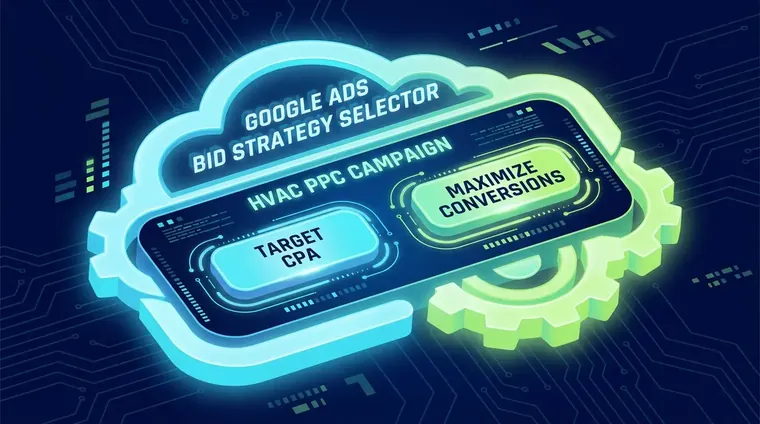
Match your bid strategy to your account's conversion history: Manual CPC for new accounts, Maximize Conversions for mid-stage, Target CPA only with strong data.
- New account (thin data) Manual CPC with Enhanced CPC. You control the ceiling, the algorithm makes micro-adjustments, and you're not handing the wheel to a system that has nothing to learn from. Build toward consistent monthly conversion data before changing anything.
- Mid-stage (growing data) Maximize Conversions without a Target CPA cap. Let the algorithm optimize for volume first. Watch CPL closely. Once CPL stabilizes and you've accumulated a few months of history, layer in a Target CPA bid.
- Mature account (strong history) Target CPA. Target CPA only gets you there when the data is real and clean.
- Seasonal surge periods Bid adjustments by time-of-day and device during heat waves or storm response windows. Surge periods push CPCs up sharply, so tighten your audience and geography before raising bids.
Should You Run LSAs and Google Ads at the Same Time?
Running LSAs and Google Ads simultaneously causes self-competition and inflates your effective CPL, budget allocation between the two needs active management.
Most HVAC operators run Local Services Ads and Google Search Ads at the same time without thinking about how the two interact. The problem: both products compete in the same search auctions for the same queries. On mobile, where ads and LSAs usually sit above the map pack, you can end up bidding against yourself. The fix is to treat the two channels as a funnel stack, not a parallel spend. LSAs cover branded trust signals and Google Verified badge placement, which appears after Google's verification clears. Search Ads cover specific service-line keywords, geographic radius targeting, and seasonal campaigns LSAs can't segment cleanly. If your LSA is pulling consistent lead volume, pull Search Ads back on the overlapping queries and push that budget toward lower-competition service lines or off-peak months. For keyword-level control in your Search campaigns, read Google's guide to keyword match options. Phrase and exact match are the defaults for HVAC service keywords. Broad match on service terms in a new account is how you burn through budget on irrelevant traffic fast. For a closer look at how paid channels interact for contractors, the Facebook Ads for Contractors page covers channel stacking from the social side.
What's the Right HVAC PPC Strategy in Off-Peak Months?
Shoulder-season HVAC PPC should shift spend toward maintenance and tune-up keywords at lower CPCs, not simply cut budget across the board.
January and February are the months most HVAC operators go dark on paid search or slash budgets across the board. Both are wrong. The smarter move is to shift the budget mix, not the total. Emergency repair search volume drops in winter in most markets. But tune-up, maintenance plan, and "furnace inspection" queries stay alive and convert at lower CPCs. Tune-up and maintenance CPCs run below emergency repair CPCs. Your cost to acquire a maintenance agreement lead is lower in January than at any other point in the year. Those agreements generate recurring revenue and fill your technicians' schedules through the shoulder months. Build your storm-response ad group now, before you need it. A dormant campaign for hail or storm damage, with insurance-specific messaging, pre-written headlines, and a landing page ready to go, can be activated within hours of a documented weather event. Waiting until the storm hits to write copy means you miss the first critical window. That window is when search volume spikes hardest. Emergency AC repair searches surge dramatically during July heat waves versus baseline. Storm events behave the same way. Be ready.

Performance Max is not the right default for most HVAC accounts, it needs conversion history to function and offers little control over where spend goes.
Every new Google Ads account gets nudged toward Performance Max. For HVAC, treat it as a later-stage tool, not a launch pad, because PMax requires conversion history to optimize across channels, and with thin data it will spray spend across placements you can't audit easily. Build your Search campaigns first. Let PMax earn its budget once the account is healthy.
How Does Call Center Depth Change HVAC PPC Results?
HVAC PPC results compound when a trained inbound call center converts clicks within the first minute, speed to answer is a multiplier on ad spend.
Paid search can put your phone number in front of a homeowner with a broken AC at 2 PM on a Tuesday. What happens next is entirely a call center problem, not an ads problem.
This is where data gets selectively interpreted constantly. In HVAC PPC, that narrative is usually 'our CPL is great' while the close rate on those leads is invisible. A $90 CPL that closes at 8% is worse math than a $130 CPL that closes at 22% because the phone was answered in 45 seconds by someone trained to book.
We built a call center from $0 to $426K a month in 9 months, not by running better ads, but by building the intake layer that made the ads worth running. Our own floor now sets about 650 in-home appointments a month. The ads are the traffic. The call center is the conversion. If you want to read more about what speed to answer actually does to lead economics, Speed to Lead for Contractors: Fast Isn't Enough breaks down the mechanics. And for a broader look at negative keyword strategy, Google's negative keyword documentation is the right starting point, blocking 'HVAC jobs,' 'HVAC school,' and 'DIY' queries is table stakes, not strategy.
Manual CPC vs. Smart Bidding: Which Mode for Your HVAC Account?
Manual CPC protects new accounts from wasted spend; Smart Bidding outperforms only once the account has enough conversion data to learn from.
| Feature | Manual CPC (new/thin accounts) | Smart Bidding (mature accounts) |
|---|---|---|
| Conversion data required | None, works from day one | Needs consistent monthly conversions to exit learning |
| Budget control | Full, you set the ceiling per keyword | Algorithm adjusts bids dynamically, harder to cap |
| CPL predictability | More predictable, easier to audit | Optimizes toward CPL goal once data is sufficient |
| Risk during learning phase | Low, no algorithm guessing | High, spend can spike before the model stabilizes |
| Ceiling performance | Lower, human bid management has limits | Higher, algorithm finds patterns humans miss at scale |
What Does a Managed HVAC PPC Program Actually Include?
A managed HVAC PPC program covers campaign build, call tracking setup, bid strategy management, and ongoing negative keyword maintenance, not just ad writing.
We run paid search for contractors through the same system we built for our own windows and roofing company, the one pacing toward $23M this year. This is not a set-it-and-check-monthly engagement. It's active bid management, call tracking QA, negative keyword maintenance, and a dashboard that shows which campaigns are producing booked jobs, not just clicks. Management pricing isn't published here. Scope varies by market, competition, and what call infrastructure the contractor already has. What I can tell you: the contractors who get the most out of HVAC PPC treat the call center as part of the ad system, not a separate department. The ads drive the phone. The phone drives the close. Those two things have to be calibrated together. For HVAC lead generation beyond paid search, HVAC Lead Generation: Pick Two Channels First is the right next read. If you're weighing whether SEO should run alongside your ads, the Google Ads for Contractors pillar covers how both channels interact at the contractor level.
Frequently Asked Questions
How much should an HVAC contractor budget for PPC in 2026?
Budget depends on your market and service mix. MB Adv Agency cites $1,500–$3,000 a month as a typical HVAC PPC range, but that number doesn't account for your local CPC landscape or how many conversions you need to graduate out of Manual CPC into Smart Bidding. A better frame: what CPL can you afford given your average job value and close rate? Work backwards from that number, not from an industry average.
Why is my HVAC PPC campaign spending fast but producing few leads?
The most common causes in HVAC accounts are Smart Bidding activated before there's enough conversion data to learn from, call conversions not being tracked properly (so the algorithm is optimizing toward form fills that aren't actual leads), and broad match keywords pulling irrelevant traffic. Audit your bid strategy setting and call tracking setup before touching ad copy or keywords.
Should an HVAC company use Performance Max campaigns?
Not as a starting point. Performance Max needs conversion history to allocate spend intelligently across placements, and it offers limited transparency into where the budget actually goes. Build your Search campaigns first, get your call tracking clean, and let the account accumulate real conversion data before adding PMax. Google's own documentation covers what Performance Max optimizes for, read it before enabling it.
Related reading
Free guides on this, step by step:
Ready to Run HVAC PPC That Actually Closes?
We build and manage paid search programs for HVAC contractors using the same systems behind our own $23M-a-year home services operation. We use no generic agency playbook and no dashboard theater. If you want to see whether your current hvac ppc setup has the call tracking and bid strategy architecture it needs, or if you're starting from scratch and want it built right, book a 30-min call and we'll walk through your account. More on how paid search fits the contractor growth stack: Google Ads for Contractors.