

Resource Page Link Building: Fix the Asset First
The SERP for 'resource page link building' in 2026 is a wall of agency posts about Google operators and outreach templates. Almost none of them name the real reason most campaigns fail. The failure is the asset, not the email. The top three results skip that part entirely. Our full approach to earning editorial links lives in the link building services pillar. This piece focuses on the resource page tactic and the measurement layer everyone ignores.
What is resource page link building, exactly?
Resource page link building is the practice of earning editorial links by getting your content listed on curated 'resources' or 'links' pages on other domains.
A resource page is a curated list of external links a site maintainer keeps for their audience. Think a university's "Recommended Reading" page, a trade association's "Industry Tools" directory, or a software blog's "Best Guides on X" roundup. Resource page link building is the practice of getting your content onto those lists. And earning an editorial, contextual link in the process.
According to Aira's 2022 State of Link Building Report, 24% of SEOs use this tactic. That makes it the second most popular link building method behind guest posting. The number tracks. The tactic works. But why it works for some operators and fails for others almost never gets said plainly.
Here's the plain version: the curator's job is to protect their list's quality. They are not looking for a reason to say yes. They are looking for a reason to say no. If your asset is thin, generic, or commercial, it does not get added. No outreach cadence fixes that.
Resource page link building is an asset problem first. If the content doesn't deserve a spot, no outreach tactic will earn one.
Every top-ranking guide on resource page link building spends 70%+ of its word count on finding pages and writing emails. The real conversion problem is whether your content belongs on the list at all. Fix the asset first. The outreach almost takes care of itself.
Which content types actually earn resource page placements?
Original research, free tools, complete beginner guides, and templates earn placements consistently. Commercial pages and thin posts do not.
- Original research or benchmark data Curators link to primary sources because it makes their list credible. A report with real numbers. Your own survey data, a first-party analysis. Is the strongest asset type.
- Free tools or calculators A free calculator that solves a specific problem earns links at a disproportionate rate. The utility is obvious and the inclusion case writes itself.
- Complete beginner guides Not 'ultimate guides'. Actual beginner-grade explainers that answer a foundational question with depth. Curators add these because they reduce the emails they get from confused readers.
- Templates and frameworks A downloadable or embeddable template that saves the end reader 2 hours of work gets added. Pure blog posts without a functional artifact rarely do.
- What does NOT work Commercial landing pages, product pages, and thinly-researched listicles do not get added regardless of how good the outreach email is. Outreach Monks flags this explicitly. And they're right.
How do you qualify a resource page prospect fast?
A viable resource page prospect has DR ≥ 10, organic traffic ≥ 5,000/month, fewer than 200 outbound links on the page, and was updated within the last 18 months.
Ahrefs recommends filtering to DR ≥ 10 and domain search traffic ≥ 5,000 before you spend a minute on a prospect. That filter alone cuts a raw scrape by roughly 70%. It removes the noise fast. We use the Ahrefs SEO Toolbar plus openallurls.com to batch-open tabs for manual review. About 90 seconds per page once you know what to look for.
Two disqualifiers we check before anything else: outbound link count and last-updated date. A resource page with 200+ external links is a link graveyard. Your link there passes almost no authority and drives zero referral traffic. It's a vanity metric, not a business signal. A page last updated in 2019 tells you the curator stopped caring. We skip both, every time.
For prospecting tools, Citation Labs Link Prospector and ScrapeBox are the two worth knowing. Citation Labs runs $1–$5 per scrape. Cheap enough to run several keyword variations without sweating the budget. The Backlinko-sourced search string trick we do like: pair your core keyword with 'best blogs,' 'blog awards,' or 'places to learn' to surface resource pages that won't show up with standard operators. It finds the less-picked inventory.
Follow Google's link building best practices when deciding whether a placement is worth pursuing. Check Google Spam Policies to confirm the hosting domain isn't flagged before you put outreach time into it.

Resource page link building by the numbers
Realistic benchmarks: 24% of SEOs use the tactic, DR 10+ filter removes 70% of junk prospects, and Citation Labs scrapes cost under $5 per run.
What does a realistic conversion rate look like at scale?
A clean, well-filtered prospect list typically yields one placement for every 15–25 outreach contacts. Expect 4–7% conversion on qualified targets, not the inflated rates most posts imply.
None of the top three SERP results give you a number here. We will. Running outreach programs on qualified prospect lists. Filtered by DR, traffic, and recency. We see conversions land at 4–7%. One placement per 15–25 contacts.
Raw, unfiltered lists perform far worse. A Hacker News commenter noted that one exact-phrase footer search "returned less than 30 results, over 70% spam." That's what unfiltered resource page discovery looks like at scale. You're not emailing curators. You're emailing dead inboxes attached to link farms.
The honest math: 10 resource page placements per month means 150–250 qualified outreach contacts. That's a real number with a real workload behind it. Budget accordingly before you pitch this tactic internally as "low effort."
For related context on outreach economics across link types, our link building services page breaks down how we allocate effort across tactics. Resource pages, guest posting, and competitor backlink pursuit included.
Why resource page links decay. And how to audit them
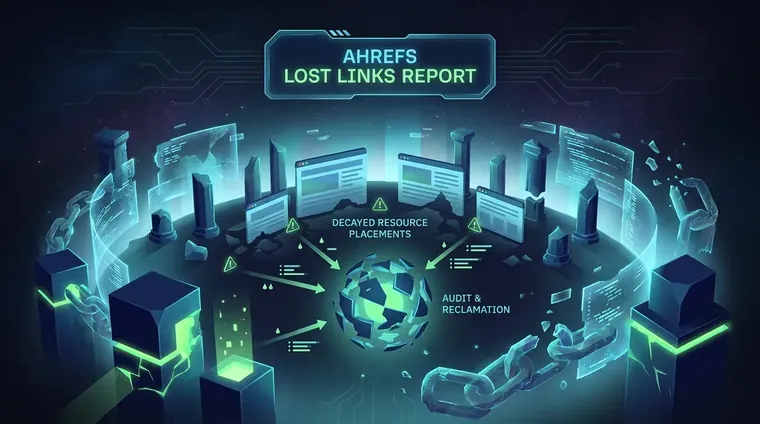
Resource page links decay when host pages are deleted, go stale, or lose organic traffic. Audit your existing placements every 6 months using Ahrefs lost-links reports.
Here's the gap no one else covers: resource page links have a shelf life. Curators retire pages. Sites migrate domains without redirects. A page that drove referral traffic in 2023 may be a 404 today. We've reclaimed DR 40+ links simply by auditing a client's existing placements and finding live redirect chains that broke during a site rebuild.
The audit workflow is simple. Pull your backlink profile in Ahrefs. Filter by lost links in the last 90 days. Cross-reference against your placement log. For links that are still live, check the referring page's current organic traffic. If it's dropped below 500 visits/month, the link is effectively dead from a referral standpoint. Even if it still resolves.
Run this audit every six months minimum. The Safeguard Impact program Receipts Group runs from the inside moved from $800K to $2M/month over 15 months. Backlink maintenance was part of the monthly work, not a one-time event. Links placed and forgotten are not an asset. They're a slowly deflating tire.
On prioritization: when you're choosing between two resource page opportunities with a limited outreach budget, the framework we use is page-level traffic first, DR second, recency third. A DR 30 page with 8,000 monthly visitors beats a DR 60 domain where the resource page has been dead since 2021.
Strong vs. Weak resource page opportunities
A strong resource page target has live traffic, fewer than 100 outbound links, was updated recently, and sits on a topically relevant domain.
| Feature | Strong Opportunity | Weak Opportunity |
|---|---|---|
| Page-level traffic | ≥ 2,000 visits/month to the resource page | < 500 visits/month or not measurable |
| Outbound link count | < 100 links on the page | 200+ external links — a link graveyard |
| Last updated | Within the last 18 months | 2019 or earlier — curator has moved on |
| Domain relevance | Topically aligned — same industry or adjacent | Generic 'resources' page on an unrelated domain |
| Domain Rating | DR ≥ 10 with real organic traffic | DR 30+ but zero organic traffic — inflated metric |
Search your core keyword plus 'resources' or 'recommended tools' in Ahrefs Content Explorer. If fewer than 50 pages with traffic ≥ 1,000 appear, the resource page ecosystem in your niche is too thin to run at scale.
Not every niche has a resource page ecosystem worth targeting. Before you build assets or write outreach sequences, run a Content Explorer search in Ahrefs: your core keyword plus "resources" or "recommended tools," filtered to pages with ≥ 1,000 organic visits. Fewer than 50 results means the inventory isn't there. Redirect that effort toward SaaS link building tactics or ecommerce-specific link strategies instead. Don't force a tactic into a niche that can't hold it.
Frequently Asked Questions
How many resource page outreach emails does it take to get one placement?
On a properly filtered list. DR ≥ 10, organic traffic ≥ 5,000, fewer than 200 outbound links, updated within 18 months. Expect a 4–7% conversion rate. That's roughly one placement per 15–25 qualified contacts. Unfiltered lists perform far worse and skew your benchmarks.
How do I know if my niche has enough resource pages?
Run a Content Explorer search in Ahrefs using your core keyword plus 'resources' or 'recommended tools,' filtered to pages with at least 1,000 monthly organic visits. If fewer than 50 results appear, the resource page inventory in your niche is too thin to run a scalable campaign. Invest the budget elsewhere.
Do resource page links decay over time, and how do I track that?
Yes. Host pages get deleted, domains migrate without redirects, and traffic to the resource page itself can drop to zero. Making a technically live link practically worthless. Audit your placements every six months using the 'lost links' report in Ahrefs and check current page-level traffic on links still showing as active.
Related reading
Ready to build links that hold their value?
Resource page link building works when the asset earns its place and the placement gets watched after it goes live. We don't hand you a domain list and call it done. Our link building services cover the full program. Asset audit, prospect qualification, outreach, and monthly backlink maintenance. If you're ready to run it right, let's talk.