Revenue Attribution Modeling That Finance Will Actually Trust
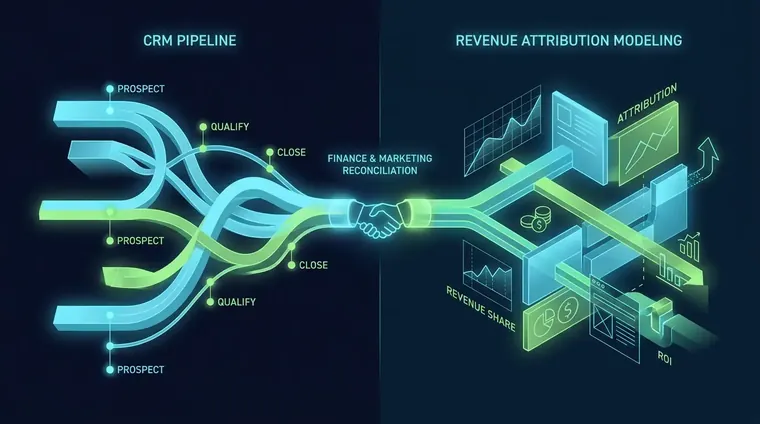
The biggest failure mode in revenue attribution modeling isn't picking the wrong model type. It's that the model's output never leaves the marketing dashboard. Until your attribution numbers are reconciled against the CRM and ERP data finance lives in, you don't have an attribution model. You have a marketing self-reporting system that gets ignored in every real budget conversation. That's the problem our marketing automation agency work keeps running into, and it's the one this post fixes.
Most operators know the standard model menu: first-touch, last-touch, linear, time-decay. The SERP is full of those lists. What none of those pages address is the organizational and political problem sitting underneath the technical one. We've seen sound attribution builds get shelved because the RevOps lead and the CFO had no hand in defining the model's assumptions. The math was right. The trust wasn't there.
Why Does Revenue Attribution Modeling Keep Getting Ignored by Finance?
Attribution outputs are ignored because they live in marketing tools, not the CRM or ERP systems finance uses to make budget decisions.
LatentView says it plainly: most enterprise marketing teams don't have a data problem. They have a data trust problem. Google Ads claims full credit for the conversion. Meta claims it too. Your email platform claims it. Finance adds up the platform numbers and gets 2x or 3x actual revenue. Their response is rational. They stop trusting the number entirely.
The fix isn't a better algorithm. It's a different process. Attribution numbers need to be reconciled. Line by line, deal by deal. Against closed-won records in the CRM before anyone walks into a budget meeting. HubSpot CRM documentation outlines the contact and deal object structure that makes that reconciliation possible at scale. If you're not writing attribution outputs back into deal records, you're not doing attribution. You're doing reporting.
We've mapped this reconciliation into our own ops stack. The short version: every attributed touchpoint gets a deal ID attached at the point of capture. Not retroactively. That one discipline closes the gap between what marketing reports and what finance sees.
Once channel teams know which attribution model is in use, they optimize for touchpoint insertion. Not actual influence. Making the model's outputs progressively less reliable.
Here's the position we'll defend: running a known attribution model inside a single-channel org is self-defeating. The moment a paid search team knows you're on last-touch, they optimize for closing touchpoints. The moment you switch to linear, they start inserting micro-touches across the funnel to grab more fractional credit. The model stops measuring influence and starts measuring gaming. The only partial fix is keeping the weighting logic away from channel teams. Or run incrementality tests alongside the model to confirm whether credited touchpoints actually caused lift. Not just correlated with it.
What a Finance-Ready Attribution Model Actually Requires
A finance-ready attribution model requires deal-level CRM reconciliation, a signed-off attribution window, and a CFO or RevOps lead in the room when assumptions are set.
- Deal-level CRM reconciliation Every attributed touchpoint maps to a deal ID in your CRM. Not a session, not a lead record. Salesforce Trailhead has a full module on opportunity influence tracking that operationalizes this. Without it, attribution is a marketing estimate, not a revenue record.
- Empirically calibrated attribution window Don't guess at your window length. Pull 12 months of closed-won deals, measure the median days from first known touchpoint to close, and set your window at median plus one standard deviation. For a 45-day median cycle with 20-day SD, that's a 65-day window. Not the default 30 days most teams leave in place.
- CFO or RevOps sign-off on model assumptions Finance has to be in the room when you define what counts as a touchpoint, what the lookback window is, and how credit is distributed. If they weren't there for the design, they won't trust the output. This is organizational, not technical.
- Parallel model validation run Run two models simultaneously for 60–90 days, then compare credit distribution against actual revenue outcomes. LatentView documents this method; it's the fastest way to surface model disagreements before they cause a bad budget call. When the two models contradict each other on channel rank, you need a predefined adjudication rule. Not a debate.
- Incrementality testing alongside attribution Attribution measures correlation between touchpoints and closed revenue. Not causation. A channel can rack up touchpoints on deals that would have closed anyway. Holdout tests and geo-lift studies are the only way to confirm whether a credited channel actually caused lift.
What Does the Safeguard Impact Program Tell Us About Attribution Windows?
The Safeguard Impact program, which grew from $800K to $2M/month over 15 months, surfaced the attribution window problem in the first 90 days of the rebuild.
The Safeguard Impact program. The one Receipts Group runs from the inside. Went from $800K to $2M/month over 15 months. One of the first problems we hit was a miscalibrated attribution window. The account had a default 30-day window on impact windows and doors. The actual sales cycle runs 45–75 days from first ad click to signed contract. Upper-funnel paid channels were showing near-zero credited revenue. The previous team had been cutting their budget based on that bad read.
We pulled 14 months of closed deals, ran the median-plus-SD calculation, and reset the window to 68 days. Paid social's attributed revenue share moved from 4% to 19% overnight. Not because the channel got better. Because we stopped cutting off the measurement before the deal could close. That's a real number from a real program. It's the kind of thing that changes budget conversations.
For reference on how call tracking fits into this window math: Twilio Voice Programmable is the layer we use to tie inbound call events back to the originating ad touchpoint with a timestamp. Without call-level attribution, service businesses running any volume of inbound leads will always undercount upper-funnel influence.

A 45-minute attribution audit identifies where your model's outputs are being ignored and what it takes to get finance to sign off.
If your attribution model lives only in Google Analytics or your ad platform dashboards, it's not driving real budget decisions. Book a call and we'll show you exactly where the reconciliation gap is in your stack. No slide deck. Just the actual data. Start here →
Marketing-Only Attribution vs. Finance-Reconciled Attribution: What Changes?
Finance-reconciled attribution closes deals in the CRM, uses audited touchpoint data, and earns sign-off. Marketing-only models don't do any of those three things.
| Feature | Marketing-Only Attribution | Finance-Reconciled Attribution |
|---|---|---|
| Data home | Lives in GA4, ad platform dashboards | Written back to CRM deal records |
| Touchpoint sourcing | Platform self-reported clicks and impressions | First-party events + call tracking + CRM timestamps |
| Attribution window | Platform default (usually 7–30 days) | Empirically set from closed-won deal history |
| Finance trust level | Ignored in real budget conversations | Presented in CFO reviews with sign-off |
| Model validation | Single model, no parallel comparison | 60–90 day parallel run with adjudication rule |
How Do Two Contradictory Attribution Models Get Resolved?
When two models give contradictory channel rankings, resolve the conflict using a predefined adjudication rule. Typically incremental revenue testing, not a vote.
Every multi-touch attribution build hits this question. No competitor page answers it.
LatentView's case study on a global financial software company is the right place to start. Last-touch attribution gave TV spend zero credit. The team was ready to cut the channel entirely. After running top-down aggregate regression alongside bottom-up channel-wise analysis in parallel, TV was confirmed as a real touchpoint. The business saw a 16% increase in overall sign-ups after keeping it.
The lesson isn't that TV works or that regression beats multi-touch. The lesson is that when two models contradict, you need a third input. That input should be incrementality data. Not a committee vote. Define the adjudication rule before you run the parallel models. Here's the sequence we use: (1) flag any channel where model A and model B disagree on rank by more than two positions, (2) run a 4-week holdout or geo-lift test on the flagged channel, (3) let the holdout result override the model disagreement. That's it. No debate.
For teams connecting attribution outputs to automated lead routing and dialer workflows, our predictive dialer setup page covers how touchpoint data feeds into dial priority. Most attribution write-ups skip that integration entirely. And if you want the broader organizational playbook, our piece on CRM implementation services covers the data-first infrastructure that makes attribution reconciliation possible in the first place.
Attribution Modeling: The Numbers That Actually Matter
Multi-touch attribution delivers 15-25% marketing ROI improvement. But only when the model's outputs are reconciled with finance-side revenue data.

Where Does Revenue Attribution Modeling Fit in the Automation Stack?
Attribution modeling is the measurement layer of your automation stack. It only works when touchpoint data flows into the same system your CRM and ERP use for revenue reporting.
Attribution isn't a reporting exercise. It's a data infrastructure decision. The Zapier integration directory has hundreds of pre-built connectors between ad platforms, CRMs, and analytics tools. But stitching those together without a unified deal ID schema creates the exact multi-platform overcounting problem finance already doesn't trust.
Deal ID generation belongs at the top of the funnel. At form fill, call connect, or chat initiation. Then it carries through every downstream system. When a deal closes in the CRM, you query every touchpoint that carried that deal ID and build the attribution model from first-party data, not platform-reported estimates. As one practitioner noted on r/SEO, "the data never seems accurate compared to what I see in GSC or GA." That's because most attribution stacks pull from platform exports instead of first-party event streams.
We walk through how to build this end-to-end, from lead capture through closed-won, in our marketing automation workflow piece. If your attribution problem is really a data schema problem, that's where to start. How all of this connects to campaign execution is in our enterprise marketing automation breakdown.
Frequently Asked Questions
What is revenue attribution modeling and why does it matter?
Revenue attribution modeling assigns credit to the marketing touchpoints that contributed to a closed deal. It matters for budget decisions because without it, teams either rely on last-touch platform data. Which step by step undercounts upper-funnel channels. Or gut instinct. The catch: attribution only earns a seat in real budget conversations when the output is reconciled against CRM deal records and signed off by finance, not just reported in a marketing dashboard.
How do I set the right attribution window length for my business in my market?
Pull 12 months of closed-won deals from your CRM and calculate the median number of days from first known touchpoint to close. Then add one standard deviation to that median. That's your attribution window. If your median is 45 days and your standard deviation is 20 days, set a 65-day window. Don't use platform defaults; they're calibrated for e-commerce cycles, not considered-purchase or B2B sales processes common in markets like South Florida home services or financial software.
What should teams do when two attribution models contradict each other?
Define an adjudication rule before you run the parallel models. Not after the disagreement surfaces. The rule we use: flag any channel where two models disagree on rank by more than two positions, then run a holdout test or geo-lift study on the flagged channel for 4 weeks. Let the incrementality result override the model disagreement. This is what LatentView's financial software case study demonstrated when TV spend was nearly cut based on last-touch attribution before regression modeling confirmed it was driving a 16% sign-up lift.
How does call tracking integrate with revenue attribution modeling?
For any service business driving inbound calls. Home services, legal, medical, financial. Call tracking is the critical link between ad touchpoints and deal records. A tool like Twilio Voice Programmable assigns dynamic tracking numbers to ad sources, captures the originating touchpoint with a timestamp at call connect, and passes a session or deal ID into your CRM. Without this layer, inbound-call-driven revenue is invisible to your attribution model, which will step by step undervalue the channels that generate those calls.
Related reading
Ready to Build an Attribution Model Finance Will Actually Use?
We build revenue attribution modeling infrastructure that closes the gap between marketing dashboards and finance-side budget decisions. Safeguard Impact went from $800K to $2M/month over 15 months. Part of that was stopping attribution from living only inside the ad platforms. If your model isn't reconciled to CRM deal records and signed off by RevOps or your CFO, it isn't working yet. Our marketing automation agency practice is built around ops that hold up in the room where budget decisions actually get made. Book a call and we'll show you exactly where your attribution stack breaks.