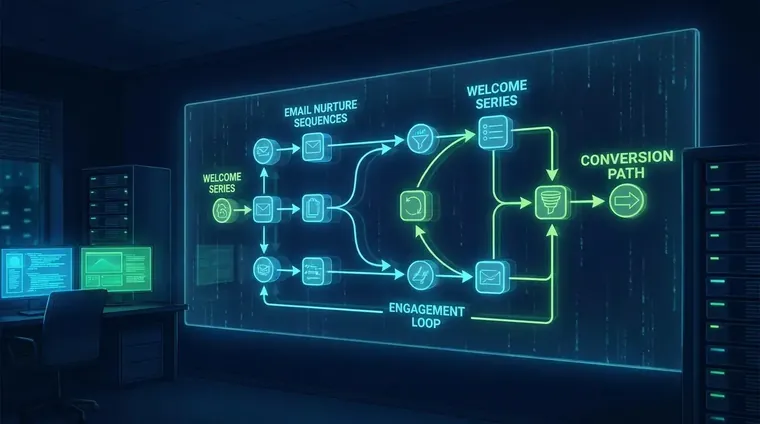
Email Nurture Sequences That Branch on Behavior
Last month we audited 12 home-services sites. The pattern was consistent enough that we stopped and wrote it down. Every single operator had an email sequence running. Every single one was linear. Day 1, Day 3, Day 7. The same five emails going to everyone. Regardless of what that subscriber had clicked, ignored, or already bought. That's not a nurture sequence. That's a scheduled blast with extra steps.
If you're serious about turning your email program into an actual revenue channel, the architecture matters more than the copy. Our marketing automation agency work is built around that distinction. This is the operational detail behind it. How we build email nurture sequences that branch, which triggers matter, and what you do when the sequence ends.
Why do most email nurture sequences fail to convert?
Most email nurture sequences fail because they treat every subscriber identically, ignoring the behavioral signals that reveal real purchase intent.
The top-ranking guides on this topic treat email nurture sequences as a fixed progression: Welcome → Problem → Quick Win → Proof → Offer. Source three in our SERP research calls this the five-day framework. It's not wrong. It's incomplete.
Here's the problem. That structure assumes every subscriber is at the same readiness level. They're not. One person opts in after reading a 2,000-word article about pricing. Another lands from a paid Facebook ad and barely knows what you do. Sending them the same Day 3 email is a targeting failure, not a nurture strategy.
What we've seen in our own builds: engagement decay is real and it's fast. One published SaaS educational sequence documented by Sequenzy hit a 52% open rate on Email 1. By Email 8, that number was 28%. CTR fell from 12% to 4%. That decay isn't inevitable. It's the cost of sending irrelevant follow-ups to a mixed-intent list. A sequence that branches based on what someone clicks on Day 3 can reset that decay curve. A linear sequence cannot.
A sequence that doesn't branch on click behavior is just a slow blast to your list. The real move is building it so what a subscriber clicks on Day 3 determines what they get on Day 4. Paced isn't adaptive. Those are two different things.
What signals should actually trigger a sequence branch?
Behavioral signals. Link clicks, page visits, reply actions, and purchase events. Are the only reliable triggers for branching email nurture sequences.
- Link click on a specific topic If a subscriber clicks a link about pricing on Day 2, they're further along than someone who skipped it. Fork them into a shorter, sharper close sequence. Not Day 3 of the same educational track.
- No open after 48 hours A non-open is signal too. We pause the main sequence and test a subject line variant before continuing. Continuing blindly tanks your sender reputation with engaged-segment ISPs.
- Reply to any email A reply is the highest-intent signal in the sequence. It should exit the automation immediately and route to a human or a direct-sales track. We use Zapier integrations to trigger that handoff in under 60 seconds.
- Traffic source at opt-in Paid social subscribers need more context than organic search subscribers. We tag every opt-in at source and load a different Day 1 variant for each. Same offer, different proof and pacing.
- Purchase or CRM stage change If someone books a call or makes a purchase mid-sequence, they should exit the nurture track instantly. Sending a 'still thinking it over?' email to someone who just paid is a fast way to earn an unsubscribe.
How does deliverability risk change with sequence pacing?
Sending 5–8 emails in 21 days to a cold or low-engagement list spikes spam complaint rates. Pacing must account for list age and prior engagement.
Nobody talks about this, and it burns operators regularly. Sending five to eight emails in 21 days to a cold list doesn't just underperform. It actively damages your domain's sender score. ISPs watch complaint rates relative to send volume. If your list is new, unwarmed, or purchased. Please don't do that last one. A dense sequence will get you filtered before Email 4 ever lands.
Our rule for lists under 90 days old: cap sends at three emails in the first 14 days. After that, we check engagement rates in HubSpot CRM before extending cadence. If open rate on Email 3 is under 18%, we pause and re-evaluate the subject line strategy before continuing. That's not caution. It's protecting the infrastructure we're building on.
Re-engagement sequences targeting subscribers who've gone cold are where the pacing problem gets worse. Every top-ranking guide skips this use case entirely. A 90-day-dormant subscriber needs a single re-permission email before you touch them with a full sequence. One email. Wait 72 hours. If they don't open, suppress them. Trying to warm them up with four more emails is how you get spam-trapped.
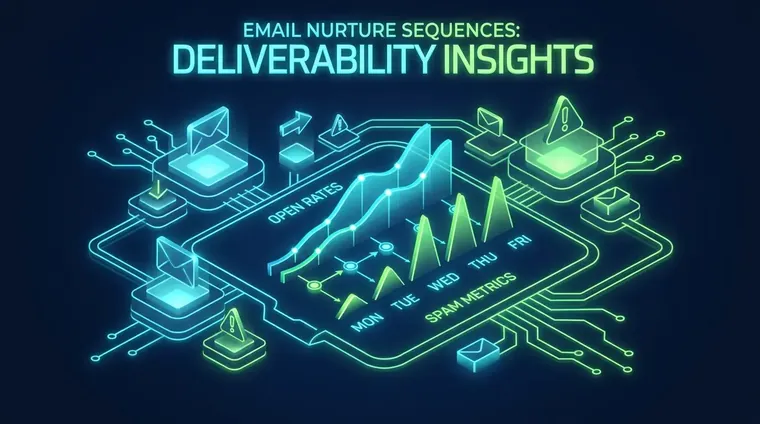
A 30-minute audit catches the branching gaps and deliverability risks that kill sequence ROI before you scale send volume.
We run sequence audits as a standalone engagement. 30 minutes, live screen share. We flag every missing branch and every deliverability risk in your current setup. Book a call and we'll tell you exactly what's broken before you scale it.
What happens after the email nurture sequence ends?
After a nurture sequence ends, subscribers must be explicitly routed to a broadcast list, a sales sequence, or a segmented track. An abrupt drop-off kills the relationship.
The handoff problem is where most email programs quietly die. The sequence finishes. Silence. Maybe the subscriber hits a generic newsletter list. Maybe nothing. We've audited accounts where 40% of nurtured leads fell into an untagged catch-all segment that hadn't been emailed in six months.
There are three valid exits from a completed nurture sequence. First: move them to a broadcast list with explicit segment tagging so they get content matched to what they engaged with. Second: if they clicked a high-intent signal but didn't convert, trigger a sales sequence. Shorter, more direct, and paired with a predictive dialer outreach if the deal size justifies it. Third: if they engaged with almost nothing, move them to a low-frequency re-engagement track. Don't suppress them outright.
None of those exits happen on their own. You have to build the conditional logic before the sequence launches. Build the exits first. Then build the sequence body. That order matters more than the email copy.
Linear drip vs. Behavioral email nurture sequences
Behavioral email nurture sequences outperform linear drips by routing subscribers based on intent signals rather than calendar days.
| Feature | Linear Drip | Behavioral Nurture Sequence |
|---|---|---|
| Trigger logic | Calendar-based (Day 1, Day 3, Day 7) | Behavioral (click, open, visit, reply) |
| Content differentiation | Same email to every subscriber | Branched by topic interest and traffic source |
| Deliverability management | Fixed send volume regardless of engagement | Pauses based on open/complaint rate thresholds |
| Sequence exit logic | Falls off or hits generic newsletter list | Explicit routing to broadcast, sales, or re-engagement track |
| Re-engagement handling | Not addressed — assumes new subscribers only | Separate re-permission flow for dormant subscribers |
How does operator experience shape better sequences?
Operators who've built and exited real businesses bring a different tolerance for what actually converts. They skip the theory and build for the handoff.
There's a reason I'm specific about what works and what doesn't here. Before the Cash Buyers and Safeguard Impact chapters, the founder built and sold DeliveryLean, still operating today as one of Florida's earliest food-service operators. That exit taught one clear lesson: the systems that survive an ownership transition have clean logic, documented branches, and no tribal knowledge baked into the workflow. Email nurture sequences are no different. If the branch logic lives in someone's head, the sequence dies when they leave.
That principle shapes how we build sequences now. Every branch condition is documented. Every exit is labeled. The sequence map exists as an artifact, not just a live automation. When we hand off to a client's internal team or an incoming operator, they can read the logic without us in the room.
For the technical build, we typically work in HubSpot CRM for mid-market and pull sequence performance data through Salesforce Trailhead certifications to verify the CRM logic our clients have inherited. The tool matters less than the branch map. We've seen clean sequences built in basic tools outperform bloated multi-platform setups where nobody understood the conditional logic they were running. Also worth reading: what a marketing automation consultant actually does versus what agencies claim they do. The gap is bigger than most expect.
One honest concession: behavioral branching takes longer to build. A linear five-email sequence can go live in a day. A properly branched sequence with re-engagement forks and explicit exits takes three to five days of build time at minimum. That's a real trade-off and we don't pretend otherwise. But a sequence that doesn't branch isn't a nurture program. It's a slow blast. We'd rather build it right once.

How should email sequences differ by traffic source?
Subscribers from paid social need more context and proof than organic search subscribers. Treating them identically burns budget on mismatched messaging.
Nobody publishes this angle. You already know where your subscribers came from. Your analytics tells you. Use it.
A subscriber who found you through organic search for '[service] pricing in [city]' has already done comparison research. They need specificity and social proof. Not a brand introduction. A subscriber from a broad-match paid social campaign may not even remember what they opted in for. Sending the same Day 1 email to both wastes the touch for at least one of them.
We tag every opt-in with UTM source at the form level. That tag loads into the CRM contact record and determines which Day 1 variant they get. The offer is identical. The proof, the context, and the assumed prior knowledge are different. For the technical setup, we use Zapier's integration directory to pipe UTM data from form submissions into HubSpot field values. No developer needed. About 45 minutes to configure. It's one of the highest-use pieces of any sequence build we run. For a deeper look at the CRM data layer underneath this, fix the data first. That article covers why bad CRM data kills even well-built sequences.
Frequently Asked Questions
How many emails should an email nurture sequence include?
There's no fixed number that works for every audience. In our experience building sequences for home-services and B2B clients, the right length is determined by engagement signals. Not a calendar. A behaviorally branched sequence may route high-intent subscribers to a 3-email close track while sending lower-intent contacts through an 8-email educational path. The sequence ends when the subscriber takes action or exits to a different track, not on a fixed day count.
What's the biggest deliverability mistake in email nurture sequences?
Sending too many emails too fast to a cold or low-engagement list. We cap new lists at 3 emails in the first 14 days and check open rates before extending cadence. If open rate on Email 3 is under 18%, we pause and test subject lines before continuing. Spam complaint spikes from dense sequences on unwarmed lists can suppress your domain for months. It's far easier to pace correctly upfront than to repair a damaged sender score.
How do email nurture sequences work for re-engaging cold subscribers?
Re-engagement sequences for dormant subscribers require a different approach than new opt-in nurture. We send a single re-permission email first, then wait 72 hours. If the subscriber doesn't open, we suppress them rather than continue. Sending a full sequence to a 90-day-dormant subscriber without re-permission is one of the fastest ways to spike spam complaints and hurt deliverability for your entire list.
What happens after an email nurture sequence finishes?
This is the handoff problem most email programs ignore. At sequence end, subscribers should be explicitly routed to one of three tracks: a broadcast list with segment tags matching their engagement, a direct sales sequence if they showed high intent, or a low-frequency re-engagement track if they barely interacted. An abrupt drop-off to an untagged list. Or worse, nothing. Wastes the relationship built during the sequence. We build the exit logic before we build the sequence itself.
Related reading
Build sequences that branch, not blast
We build email nurture sequences with branch logic, documented exits, and deliverability pacing built in from Day 1. No tribal knowledge. No linear drips dressed up as automation. If your current sequence doesn't branch on behavior, it's costing you conversions every week it runs.
Our marketing automation agency work starts with a sequence audit. We map what you have, find every missing branch, and tell you exactly what to build next. Book a call and we'll bring the receipts.