Inbound vs Outbound Call Centers: The Operator's Real Guide
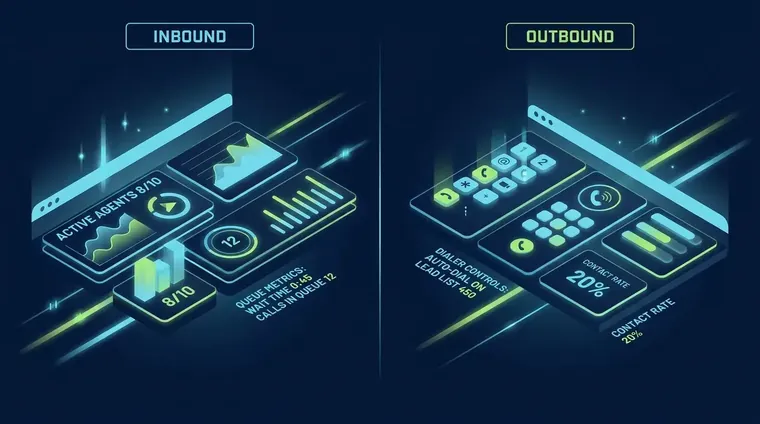
The inbound vs outbound call centers debate is the wrong question. Most operators running real revenue need both. The ones who build a clean wall between them end up with bloated headcount on one side and burned-out agents on the other. This is part of our broader call center services breakdown. But here we're getting specific: what actually separates the two models operationally, when hybrid wins, and how to size the decision before you hire your first agent.
We've run this from the inside. Operations Director at Cash Buyers Network. Scaled from $0 to $6M/year. That's the operator-first lens Receipts Group brings to every engagement. It wasn't theory. It was daily queue management, CRM routing logic, and a TCPA compliance scare that killed two weeks of outbound capacity. What follows is built from that.
What actually separates inbound vs outbound call centers?
Inbound centers respond to demand; outbound centers create it. And the operational tension between the two is where most contact centers lose money.
Inbound takes calls. Outbound makes them. That's true, but it doesn't tell you much. The real difference is who controls the timing. In an inbound center, the customer decides when to call. That makes staffing reactive. You're forecasting call volume, building Erlang C models, and praying your AHT stays flat when a product issue spikes. In an outbound center, your team controls the dial rate. That makes staffing proactive. You size the team to a quota, plug in a predictive dialer, and optimize for connect rate and conversion.
Those two operating rhythms produce completely different cost structures. Inbound staffing is demand-driven and hard to predict. You over-hire to protect CSAT, or you under-hire and pay in churn. Outbound staffing is quota-driven and easier to size, but the cost-per-outcome is higher. You're paying agents for talk time and prospecting time. Neither model is cheaper. They're just expensive in different ways.
The technology stacks reflect that gap. Outbound centers run on predictive dialers, CRM integrations (see HubSpot CRM documentation for how contact records tie to call outcomes), and disposition tracking. Inbound centers prioritize IVR trees, ACD routing, and ticketing tools. Trying to run both functions on one tool set without intentional configuration is where blended centers break.
Which KPIs does each model actually optimize for?
Inbound centers track AHT, CSAT, and FCR; outbound centers track connect rate, conversion rate, and call-to-close ratio. Conflating them produces misleading scorecards.
- Inbound: Average Handle Time (AHT) Lower AHT means faster resolution and lower cost-per-contact. But push it too hard and CSAT drops. Agents rush, customers repeat-call, and your FCR (first-call resolution) tanks.
- Inbound: First-Call Resolution (FCR) FCR is the metric inbound teams should protect most aggressively. One resolved call beats three escalated tickets every time. And it's the number insurance and SaaS support centers watch weekly.
- Outbound: Connect Rate How many dials reach a live human. A blended center running a predictive dialer on a cold list should target 8–14% connect rate; below 6% means your list is dead or your caller ID is flagged.
- Outbound: Conversion Rate & Call-to-Close The SDR/AE split maps cleanly here. Some outbound agents set appointments, others close. Tracking call-to-close separately from contact-to-appointment stops you from blaming the closer for a bad list.
- Shared danger: conflated scorecards Blended centers that apply inbound AHT targets to outbound agents punish good discovery calls. That single misconfiguration is one of the fastest ways to kill outbound morale and conversion in the same week.
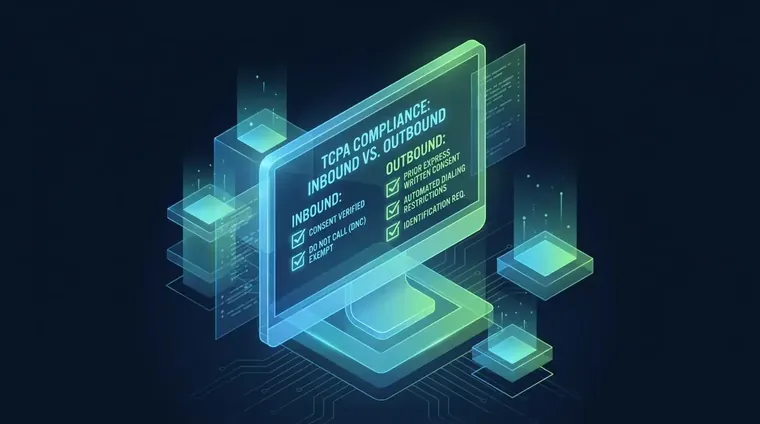
Outbound centers face TCPA liability, Do Not Call registry obligations, and robocall rules that inbound-only centers never encounter.
Outbound calling carries legal exposure that inbound never touches. The TCPA compliance rules (FCC) govern when you can call, what consent you need, and what your abandoned-call rate cap is. Currently 3% per 30-day campaign. We learned this one the hard way. A bad-list scrub failure killed two weeks of outbound capacity at Cash Buyers Network while legal reviewed the exposure. Inbound centers carry none of that risk. If you're standing up an outbound function, TCPA and DNC scrubbing are infrastructure. Not afterthoughts.
When does the hybrid/blended model actually make sense?
A blended center makes sense when inbound volume is predictable enough to leave gaps that outbound work can fill. But only if routing logic and KPIs are configured separately for each mode.
No top-ranking page on inbound vs outbound call centers treats blended operations as a real model. They bury it in a footnote. A blended center is what most growing businesses actually end up running, whether they planned to or not.
Here's when it works. Your inbound volume has a predictable daily shape. Busy at 10am, quiet from 1–3pm. During those quiet windows, agents flip to outbound: re-engagement campaigns, appointment confirmations, renewal calls. The Twilio Voice Programmable platform makes queue-switching configurable at the routing layer, not the scheduling layer. You can set skill-based routing rules that pull agents into outbound queues when inbound wait time drops below 45 seconds.
Here's when it breaks. Agents carry the same scorecard for both modes. Outbound calls running 6–8 minutes for proper discovery get flagged as AHT violations when your inbound target is 4 minutes. You need separate KPI frameworks, separate call recordings reviewed separately, and managers who know the difference. The marketing automation agency work we do surfaces this problem constantly. CRM sequences fire outbound touches while the same team handles inbound support. Nobody has separated the performance data.
Inbound vs outbound call centers: side-by-side
Inbound and outbound call centers differ at root in who controls timing, which metrics matter, what technology they need, and what legal risk they carry.
| Feature | Inbound Call Center | Outbound Call Center |
|---|---|---|
| Who controls timing | Customer — reactive staffing | Your team — proactive quota |
| Core KPIs | AHT, FCR, CSAT | Connect rate, conversion rate, call-to-close |
| Primary tech stack | IVR, ACD, ticketing (e.g. Zendesk) | Predictive dialer, CRM, disposition tracking |
| Compliance exposure | Low — customer initiated contact | High — TCPA, DNC registry, abandon rate cap |
| Cost structure | Unpredictable — spikes eat budget | Predictable sizing, higher cost-per-outcome |
| Staffing model | Erlang C forecast, over-hire buffer | Quota-based headcount, ramp time matters |
How do you decide which type your business needs?
Start with your revenue motion. If customers come to you, build inbound first; if you go to customers, build outbound first; if both, design the blend before you hire.
Most decision frameworks on inbound vs outbound call centers stop at 'what industry are you in.' That's not a framework. Here's what we actually look at.
First, map the revenue motion. If customers discover you. SEO, referrals, paid inbound. And call to buy or get help, you need inbound capacity first. If you're going to customers, cold outreach, re-engagement, appointment-setting, outbound is the build. If your model has both, you're blended on purpose, not by accident.
Second, check your CRM data model. You can't run effective outbound without clean contact records and a dispositioned call history. Before you buy a single dialer seat, review Salesforce Trailhead or HubSpot CRM documentation for how your data should be structured. Bad data makes outbound a money pit. We've seen teams burn $40K on dialer licenses only to find their contact list had a 60% bad-number rate. No dialer fixes that.
Third, stress-test your compliance posture. Outbound requires DNC scrubbing, written or oral consent documentation, and abandoned-call rate monitoring. If you can't staff that infrastructure, start with inbound. Grow into outbound once the ops backbone is built. Automation tools like the Zapier integration directory can wire compliance triggers between your dialer and CRM. But someone still needs to own the logic.
What does the tech stack look like in practice?
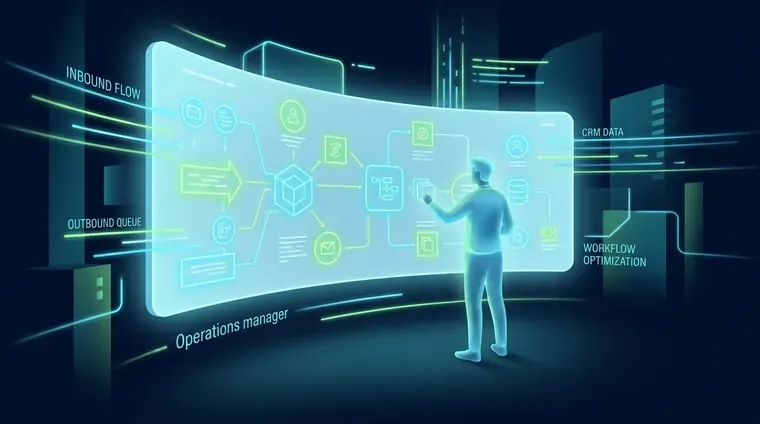
Outbound centers need a predictive dialer plus CRM integration as their core stack; inbound centers need IVR, ACD routing, and a ticketing layer. Sharing one platform without separate configs breaks both.
Hot take: the technology decision matters more than the headcount decision. You can train agents. You cannot patch a dialer configured for inbound-only work that's now running outbound campaigns. The routing logic, call recording labels, and disposition codes are all wrong.
For outbound, Five9 and Twilio Voice Programmable are the two platforms we've seen handle high-volume predictive dialing without the caller ID reputation problems that kill cheaper tools. Five9's documentation covers progressive, preview, and predictive modes. Each one fits a different list quality and agent experience level. For inbound, the IVR design is where most teams break down. A poorly built IVR adds 90 seconds to every call. Over 500 daily calls, that's 750 agent-minutes burned before anyone says hello.
For blended centers, the integration layer is where deals fall apart. Your dialer, CRM, and ticketing tool need to talk to each other in real time. A missed connection in the Zapier integration directory between your dialer and HubSpot means dispositions don't write back, managers can't pull clean reporting, and agents are manually logging calls. They will stop doing that by week three. Build the integration before you go live. See our CRM implementation services article for how we sequence that build.
The inbound vs outbound framing is increasingly obsolete. The real operational question is how you manage the tension when both functions share agents, queues, and tools.
Every vendor blog treats inbound vs outbound call centers as a permanent either/or. That's the wrong question. The real question most growing businesses face is how to manage the operational tension when both functions share agents, queues, and tools. Optimizing for one mode while ignoring the other creates measurable staffing gaps and missed revenue. Build for the blend early, or you'll retrofit it later at twice the cost.
Frequently Asked Questions
What is the main difference between inbound and outbound call centers?
The core difference is who controls timing. In an inbound call center, the customer decides when to call. Making staffing reactive and demand-driven. In an outbound call center, your team controls when calls go out. Making staffing quota-driven and proactive. That single difference changes your cost structure, KPIs, tech stack, and compliance exposure entirely.
When does a blended (hybrid) inbound/outbound call center make sense?
A blended center works when your inbound volume has a predictable daily shape with quiet windows. Say, 1–3pm. Where agents can flip to outbound work like re-engagement campaigns or appointment confirmations. It breaks when you apply the same KPI scorecard to both modes. Agents doing outbound discovery calls that run 6–8 minutes should not be measured against an inbound AHT target of 4 minutes.
What compliance risks do outbound call centers face that inbound centers don't?
Outbound centers are subject to TCPA regulations, Do Not Call (DNC) registry scrubbing requirements, and an FCC-mandated 3% abandoned-call rate cap per 30-day campaign. Inbound centers carry almost none of this exposure because the customer initiated the contact. If you're standing up an outbound function, TCPA compliance and DNC scrubbing are infrastructure decisions, not legal afterthoughts.
Which KPIs should inbound vs outbound call centers focus on?
Inbound call centers should prioritize Average Handle Time (AHT), First-Call Resolution (FCR), and CSAT. Outbound call centers should track connect rate, conversion rate, and call-to-close ratio. Running a blended center with one unified scorecard. Instead of separate KPI frameworks for each mode. Is one of the fastest ways to produce misleading performance data and burn agent morale.
What technology does outbound call centers need that inbound centers don't?
Outbound centers require a predictive (or progressive) dialer, deep CRM integration for contact records and disposition tracking, and DNC scrubbing automation. Inbound centers prioritize IVR design, ACD routing rules, and a ticketing layer. Platforms like Twilio Voice Programmable and Five9 support both modes, but the configuration for each function must be kept separate. Shared configs without separate routing logic break both operations.
Related reading
Ready to build the right call center model for your business?
We don't sell call center software. We build what runs underneath it. The routing logic, the CRM data model, the compliance layer, and the KPI framework that makes the whole thing measurable. Start with our full call center services breakdown, then book a call if you want us to map your specific situation. We're selective. But if you're ready to build something that actually converts, we want to talk.