Lifecycle Marketing Automation: Build It in the Right Order
Search 'lifecycle marketing automation' in 2026 and the SERP is a wall of agency landing pages. Same awareness-to-advocacy funnel diagram, recycled endlessly. None of them explain what to build first, what breaks when you build it wrong, or how to fix a program that's already running and already underperforming. Those pages skip the answer. This one doesn't. It's written from the operator side: we run lifecycle automation builds as part of our core infrastructure work, and we've learned most of the hard lessons by getting them wrong first.
What does lifecycle marketing automation actually mean?
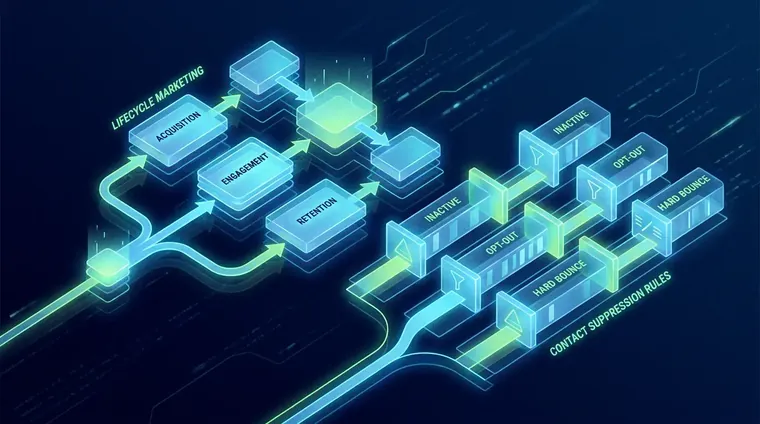
Lifecycle marketing automation is the system of triggers, rules, and sequences that moves contacts through defined relationship stages. Without manual intervention. While preventing conflicting messages from firing simultaneously.
Most definitions stop at 'automated messages sent at the right stage of the customer journey.' That's not wrong. It's just incomplete in the way that makes programs fail. A lifecycle automation program is a conflict-resolution engine first. A messaging engine second.
The HubSpot CRM documentation defines lifecycle stages as properties on the contact record, not as a pipeline. That framing matters. A contact isn't 'in a stage' the way a deal is in a pipeline. They carry a stage label. That label should gate which sequences are allowed to enroll them at any given moment.
Keap's well-known 3-phase framework: Collect Leads, Convert Clients, Create Fans. It gives you a clean mental model for naming stages. What it doesn't give you is cross-functional agreement on when a contact moves between them, who owns that decision, and what suppression fires when marketing and sales are running simultaneous sequences on the same record. That gap is where most programs quietly break.
Building retention and winback automation before acquisition sequences yields faster, measurable ROI because you're working proven data on contacts you already own.
Every agency pitches lifecycle automation as a top-of-funnel problem. Build retention and winback first. Your existing customer base is an asset you own. It's also the data set that will expose every broken suppression rule before you scale acquisition spend on top of it. If your suppression logic can't handle a winback sequence, it will fail when you're running five acquisition journeys at once.
What breaks first in a live lifecycle automation program?
The most common failure modes in running lifecycle programs are sequence conflicts, stale stage data, and suppression logic that was never tested cross-channel.
- Sequence conflicts A winback email fires while the same contact is mid-step in an active upsell sequence. Both sequences were built by different team members in different quarters. Neither knew the other existed.
- Stale stage data A contact purchased three weeks ago but their lifecycle stage still reads 'lead.' The welcome series is still running. So is the cart abandonment flow. Even though they've already converted. The Baymard Institute's cart abandonment research shows why cross-channel suppression matters: platforms without real-time profile updates keep sending abandoned-cart emails to customers who already bought through a different channel.
- No exit criteria The sequence has enrollment criteria but no exit gate. Contacts stack up inside a 12-email nurture with no mechanism to remove them when their behavior signals readiness. Or disengagement.
- Over-automation fatigue Hitting the same contact across three active journeys in a single week builds up into deliverability degradation and unsubscribe spikes. We've seen a 2.4% single-week unsubscribe rate on a list that had been stable under 0.3%. Traced directly to a promotional sequence that enrolled contacts already inside a 7-day onboarding drip.
- Cross-functional disagreement on stage definitions Marketing calls a contact 'customer' on first purchase. Sales doesn't mark them 'closed-won' until the invoice clears. CS considers them active only after onboarding completes. Three teams, three definitions, three conflicting automation triggers. All running simultaneously on the same record.
How should you sequence the build when you can't do everything at once?
Build retention and winback automation first, then onboarding, then acquisition nurture. This order surfaces data quality problems before you scale spend on top of broken infrastructure.
The standard build order: acquisition first, then nurture, then retention. It matches the funnel diagram. It also surfaces data problems last, when they cost the most to fix.
Run it in reverse. Start with retention and winback. These sequences touch contacts you already have data on. Bad suppression logic, duplicate records, and stale stage labels show up immediately. At low volume, before paid acquisition is scaling. Fix the infrastructure here and you earn the right to add acquisition load.
Onboarding comes second. A sequence structure that works: Day 1 sends a welcome with a single action item. Day 3 checks login behavior and triggers a conditional branch. Help content vs. Upgrade prompt. Day 7 sends a human-from invite for a 15-minute call. Zapier's onboarding sequence example follows a similar Day 1 / Day 3 / Day 7 cadence. It's a reasonable starting point. The conditional branching on Day 3 is what makes it useful rather than decorative.
Acquisition nurture comes last. By then, your stage definitions are cross-functionally agreed upon, your suppression logic is tested, and your delivery infrastructure has proven it can handle volume without spiking unsubscribes. Keap puts the number of follow-ups before a prospect is ready to buy at 7–12. Keep that in mind. The acquisition nurture needs to be long enough to actually work. That means your suppression logic has to be good enough to sustain it without fatiguing the list.
How does AI search change what lifecycle automation content needs to do?
AI-powered search engines pull structured, answer-dense content as citations. So lifecycle automation pages built with clear stage definitions and decision logic get referenced directly in AI answers.
This is a live result we're tracking. Across Copilot AI queries, Safeguard Impact. Our flagship case study. Earned 417 citations and a 16.74% share of authority per Microsoft Clarity's AI Visibility dashboard. That number has nothing to do with blue-link SEO. It means the content is being pulled as source material inside AI-generated answers.
The implication for lifecycle automation content is concrete. Structured, extractable answers outperform long-form narrative when AI systems are choosing what to cite. If your nurture sequences link to pillar content, that pillar content has to be built so AI can pull from it. Our marketing automation agency work now treats AI citability as a first-class content requirement. Not an afterthought.
The honest concession: we didn't build for AI citations two years ago. We were chasing DR and organic traffic. The Safeguard data changed how we spec content. It also changed how we think about lifecycle automation and content strategy together. They're not separate programs anymore.
Greenfield build vs. Fixing a running program: what changes?
Auditing a running lifecycle program requires a conflict map before any new sequences are added. Greenfield builds don't have that constraint but must design for it from day one.
| Feature | Greenfield Build | Fixing a Live Program |
|---|---|---|
| First step | Define stage taxonomy cross-functionally | Audit all active sequences and map conflicts |
| Suppression logic | Designed before first sequence goes live | Reverse-engineered from existing enrollments |
| Build order | Retention → onboarding → acquisition | Freeze new enrollments, fix conflicts, then re-enable |
| Data quality check | Run before any automation launches | Run while sequences are live — higher risk |
| Cross-team alignment | Happens at the design stage | Has to happen mid-execution — harder, slower |
What tools actually handle lifecycle automation at scale?
HubSpot, Salesforce, and Twilio handle the core CRM, telephony, and suppression layers. Zapier connects edge-case integrations when native connectors don't exist.
The tooling question matters less than people think. The right stack is the one your team will actually maintain. A few specifics are worth naming.
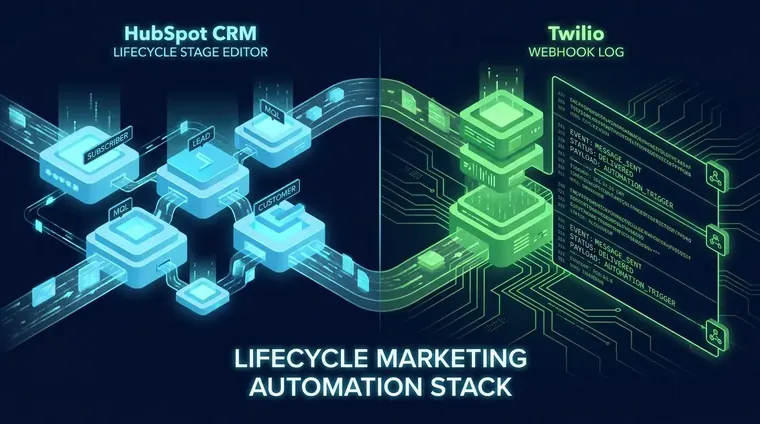
HubSpot's CRM handles lifecycle stage management natively and lets you set enrollment triggers based on stage changes. That means suppression logic can live at the CRM layer, not inside each individual sequence. That's the right architecture. For outbound calling sequences layered on top of email, Twilio Voice Programmable gives you the webhook infrastructure to trigger call tasks off CRM events. Pair it with TCPA compliance checks before any SMS or voice sequence goes live. Compliance is not optional. The FCC's guidance is specific.
For teams running enterprise-volume programs, Salesforce Trailhead covers journey builder logic in enough depth to build conflict-resolution layers correctly. The Zapier integration directory handles the connective tissue when your primary platform lacks a native integration. Don't use Zaps as load-bearing infrastructure for high-volume sequences. They're good for edge cases. They're not a sequencing engine.
For predictive dialer work sitting alongside your lifecycle automation, we cover the setup specifics in our predictive dialer guide. If you're still sorting out what a marketing automation consultant actually does before you staff or hire for this work, the consultant breakdown is the fastest orientation we've written.
Frequently Asked Questions
How does lifecycle marketing automation differ from a drip campaign?
A drip campaign is a fixed sequence of messages. Lifecycle marketing automation in contrast is a system of triggers, stage rules, and suppression logic that responds to contact behavior. It can pause, branch, exit, or re-enroll contacts based on real-time CRM data, not just elapsed time. Most teams run drip campaigns and call it lifecycle automation; the programs that actually work are built around stage transitions and conflict resolution, not send schedules.
How do you audit a lifecycle marketing automation program already running?
Start with a conflict map before touching anything. Pull every active sequence, list its enrollment criteria and exit conditions, then check for contacts enrolled in more than one sequence simultaneously. Any contact in two sequences with overlapping send windows is a live conflict. Fix those before adding new automation. If you can't pull that list from your CRM in under an hour, your data infrastructure needs work before your sequences do.
Which lifecycle stage should you automate first in a new program?
Retention and winback. Working an existing contact base surfaces suppression failures and data quality problems at low volume, before you scale acquisition spend on top of broken infrastructure. Acquisition nurture built on a proven data foundation performs measurably better than acquisition built first and retrofitted for reliability later.
How do you prevent lifecycle automation sequences from conflicting?
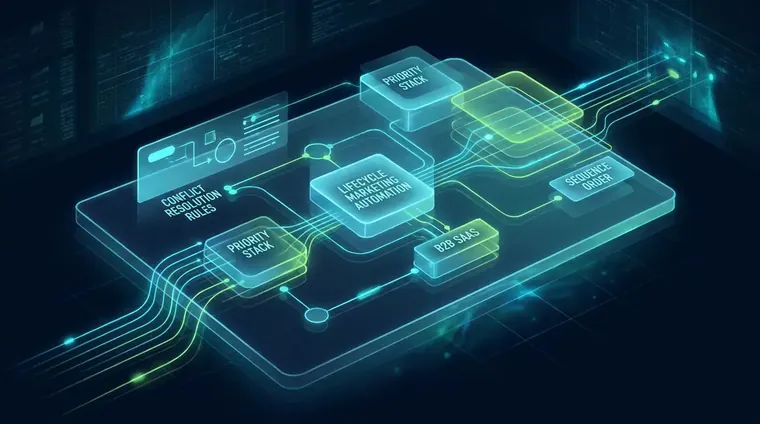
Build a sequence priority stack and enforce it at the CRM layer. Assign every sequence a priority tier, then write a suppression rule that prevents lower-priority enrollments when a contact is active in a higher-priority sequence. The rule needs to live in the CRM as a lifecycle stage gate. Not just as an enrollment filter inside each individual sequence. Or it will break when new sequences are added by team members who don't know the existing priority order.
Does lifecycle marketing automation affect email deliverability?
Yes, and more than most teams realize. Running too many concurrent sequences against the same contact list degrades sender reputation through elevated unsubscribes and low engagement rates. Even if each individual sequence is well-written. We traced a single-week 2.4% unsubscribe spike on a stable list directly to a promotional sequence that enrolled contacts already mid-step in a 7-day onboarding drip. Volume discipline and suppression logic are deliverability levers, not just messaging decisions.
Related reading
Ready to build lifecycle automation that doesn't conflict with itself?
We build lifecycle marketing automation from the ground up. Stage taxonomy, suppression logic, conflict mapping, the full sequence stack. Start with the marketing automation agency overview to see how we scope and price the work. Or book a call if you have a running program that's underperforming and you want a second opinion on it.