

AI Overviews Optimization: The Click-Impact Audit First
The standard advice on ai overviews optimization is: get cited, get visible, win. That advice is wrong. A citation that replaces your click is not a win. It's a traffic transfer from your domain to Google's interface. Before you build any citation-capture playbook, you need to know whether AIO citations actually drive incremental clicks for your content type. That's the question our AI SEO agency work starts with. Most teams skip it entirely.
Why 'get cited' is the wrong primary goal right now
AIO citations often replace clicks rather than generate them. So citation volume is a misleading proxy for traffic impact.
Every guide frames ai overviews optimization as a capture game: structure your content right, earn a citation, profit. Nobody addresses the gap. What happens when the citation exists and the traffic doesn't move?
Google's AIO interface runs on Gemini 1.5 variants on Vertex AI infrastructure. It synthesizes an answer and surfaces one to three source links below it. Most users read the synthesis and stop. The citation link is there for credibility, not navigation. For informational queries, we've seen citation appearances produce click-through rates under 0.4% in Search Console. Lower than a position-four blue link.
The take worth saying out loud: for most brands, chasing AIO citation is the wrong first move. Not unless you can verify that a citation drives incremental clicks. Not just impressions. You may be optimizing for a metric that actively replaces your traffic. Start with a click-impact audit. If your content type shows citation clicks converting to sessions, optimize hard. If it doesn't, put that energy toward content that earns direct clicks instead.
Being in the candidate set but not getting cited means the content format failed extraction. Not the SEO.
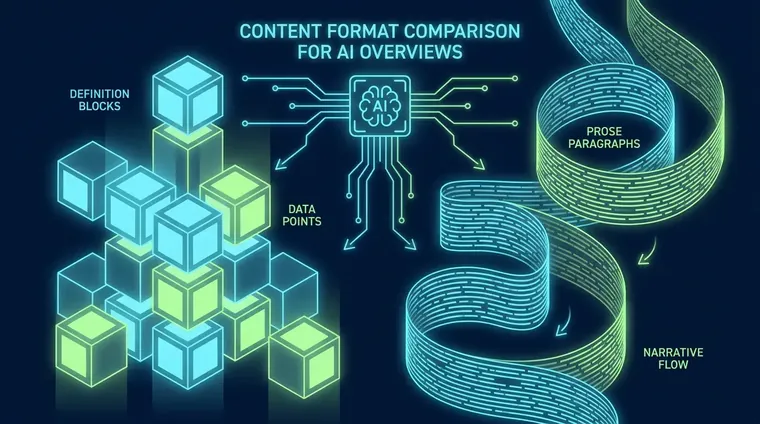
You can rank in the top ten, sit inside Google's candidate pool, and still never show up in an AIO. That's an extraction failure. It's a different problem than a ranking problem. The issue isn't authority. It's format. Google's pipeline pulls definition blocks, numbered lists, and data tables far more often than dense prose paragraphs. If your content isn't formatted for extraction, ranking won't save you.
How to diagnose an extraction failure specifically
Extraction failures show up as high impressions with zero AIO citations. Fixable by auditing content format, not domain authority.
- Check the RAG pipeline stage Google's retrieval process runs five named stages: Query Analysis, Retrieval, Extraction, Synthesis, Citation Mapping. If you rank but aren't cited, the failure is almost always at Extraction. Meaning the content format didn't yield a clean, attributable answer block.
- Match format to query type Definition queries pull definition blocks. Process queries pull numbered steps. Comparison queries pull tables. Audit the AIO for your target query. Then reverse-engineer which format triggered citations for the sources that appear.
- Add FAQ schema with question-phrased subheads The most reliable extraction-friendly format is a definition block paired with Schema.org FAQ markup. It gives Gemini a clean Q&A pair to lift verbatim. Subheads phrased as natural questions outperform declarative headings for citation pull.
- Audit semantic density, not just keyword presence One Hacker News commenter put it plainly: 'the difference lies in natural language and not features of the page.' High semantic density. Topic co-occurrence, entity relationships, concept coverage. Signals extractability better than keyword frequency alone.
- Run a repeatable citation share audit Use Search Console filtered by query + impression source to track AIO appearances over time. Pair it with a SERP scraper (Ahrefs SERP features report works) to log which format triggered each citation. This is the only way to build a repeatable **ai overviews optimization** measurement loop.
What our quality gate system does before a page ships
The seo-site-agents framework enforces 25 hard quality gates per page, so extraction-optimized structure is validated before publish, not patched after.
We built the ai overviews optimization workflow into our publishing infrastructure. Not as a post-publish checklist. The seo-site-agents framework enforces 25 hard quality gates per page, plus soft surgical-patch gates that auto-rewrite specific failures. Reading level, FAQ length, heading length. Pages that fail hard gates don't ship.
Every page we publish has question-phrased subheads, a direct answer in the first 60 words, FAQ schema validated against Schema.org spec, and Core Web Vitals passing at the template level. Not after the fact. The Search Quality Rater Guidelines define what "helpful" looks like to a human evaluator. Our gates turn that definition into code.
Here's the honest trade-off: the 25-gate framework catches format failures before publish, but it can't predict which citation slot Google's Gemini model picks on a given query. Extraction eligibility is necessary but not sufficient. You still need the organic authority to enter the candidate set. Typically a top-20 ranking. Before the extraction question even matters. Our SEO audit service finds that gap first.
When AIO citations are built that way suppressed. And what to do
YMYL verticals like health and finance see far fewer AIO citations intentionally, making traditional organic clicks more valuable than citation optimization there.
Not every industry should chase ai overviews optimization with the same urgency. YMYL verticals. Health, finance, legal. Have seen aggressive AIO rollbacks since late 2024. Google Search Central documentation notes that queries with high real-world harm potential trigger extra review layers before AIO citation surfaces. For a finance brand optimizing hard for AIO citation, that means near-zero citation events regardless of how good the content is.
For YMYL clients, run a two-week SERP monitoring window on your target queries before spending anything on citation-specific formatting. If AIO panels aren't appearing for your query set, format optimization returns nothing. Put that energy into SEO website design and structured data that builds entity authority over time. The Knowledge Graph entity-linking mechanism is what makes entity-based SEO outperform keyword-based SEO for AIO eligibility long term.
For non-YMYL verticals where AIO panels are active, the question shifts back to click impact. We ran this audit on two client sites: Safeguard Impact and Sunset Pool Care. Citation clicks converted to sessions at rates that justified the format investment in one case. Not the other. The category matters more than the tactic.
A 30-minute audit call identifies whether AIO citations drive incremental traffic for your content type before any work begins.
We keep a short call list for operators ready to run the numbers. Book a call → and we'll pull your Search Console data in the first 15 minutes. We'll show you where the citation opportunity is real. And where it isn't.
Citation-first vs. Click-impact-first approach
Starting with a click-impact audit prevents wasted effort on citation optimization that doesn't move revenue.
| Feature | Citation-first (conventional) | Click-impact-first (our method) |
|---|---|---|
| Starting point | Build citation-optimized content immediately | Audit whether citations drive clicks for your query set |
| Success metric | AIO citation appearances (impressions) | Session lift attributable to AIO citation clicks |
| YMYL handling | Apply same playbook across verticals | Skip citation optimization if AIO panels are suppressed |
| Format strategy | Add FAQ schema and definition blocks everywhere | Reverse-engineer format from existing citation winners in your SERP |
| Measurement cadence | Manual, infrequent SERP checks | Repeatable audit loop: Search Console + SERP scraper weekly |
How to measure AIO citation share with a repeatable process
Use Search Console impression filters plus a weekly SERP scrape to build a citation share trend you can actually act on.
Vague monitoring advice is the norm in ai overviews optimization guides. Here's what we actually run: filter Search Console by query, set impression source to 'web,' and flag queries where impressions are climbing but clicks are flat or falling. That pattern usually means AIO is absorbing the answer. Cross-reference against PageSpeed Insights scores. Slow-loading pages get deprioritized at the synthesis stage even when the content is strong.
For citation format tracking, use Ahrefs' SERP Features report filtered to 'AI Overview' on your target keyword set. Log which URLs appear. Pull the content format of each cited block. Definition, list, table, prose. And map it to query type. Do this weekly for six weeks. You'll have enough data to spot format-to-citation patterns specific to your niche. That's worth more than any generic playbook.
The broader point: ai overviews optimization only matters if it's measured. One Hacker News commenter joked it was 'miraculous that Google doesn't suck more than it does.' Honestly, the AIO system is sophisticated enough that guessing won't get you cited. You need the audit trail.
Frequently Asked Questions
What is AI overviews optimization exactly?
AI overviews optimization is the practice of structuring content so Google's Gemini-powered AIO panel extracts and cites it. It covers content format, FAQ schema, entity linking, and organic ranking. But starts with verifying that citations actually drive clicks for your query type before investing in format changes.
How do I know if AIO citations hurt my click traffic?
Filter Search Console by your target queries and watch for rising impressions paired with flat or falling clicks. That divergence usually means AIO is answering the query before users click through. If you see it, run a citation click audit before optimizing further for AIO citation appearances.
Does AI overviews optimization work for YMYL topics?
Rarely at scale. Google suppresses AIO panels on health, finance, and legal queries more aggressively than other verticals, especially post-2024 rollbacks. Monitor your specific query set for two weeks. If AIO panels aren't appearing, redirect that effort to entity authority building and structured data instead.
Related reading
Ready to run the click-impact audit?
We pull your Search Console data, identify which queries have active AIO panels, and show you whether citations are driving traffic or absorbing it. All of that happens before any optimization work starts. Our AI SEO agency keeps a short call list for operators who want the receipts, not the theory. If you want to see the framework first, our technical SEO audit services page shows exactly how we run the diagnostic.