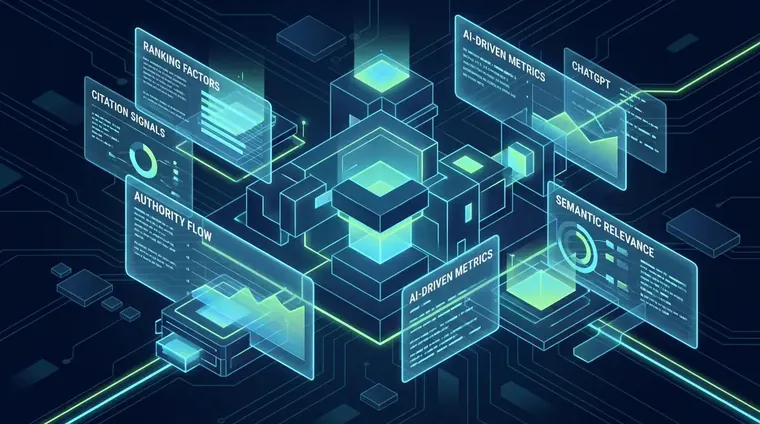
ChatGPT Ranking Factors: The Bing Gap Nobody Talks About
If you've searched "chatgpt ranking factors" in 2026, the SERP is a wall of generic agency posts. They say "get more mentions" and stop there. No method. No audit framework. No acknowledgment that the real gate is a Bing SEO gap most brands don't even know they have. This page is the specific answer. We run an AI SEO agency and we've tested these signals across live client builds. Here's what the data actually shows.
What are the actual ChatGPT ranking factors in 2026?
ChatGPT citation is gated primarily by conventional search ranking. 88% of cited URLs already rank in organic search, per Ahrefs.
ChatGPT ranking factors are, first and foremost, organic search ranking factors. Nobody in the top results will say that out loud. An Ahrefs study found that 88% of URLs ChatGPT cites come directly from its general web search index. The ranking prerequisite isn't a PR campaign. It's a search ranking problem. Specifically, a Bing ranking problem. ChatGPT's retrieval layer pulls from Bing's index when serving live search-mode responses.
Most brands are losing ChatGPT citations because their pages don't rank on Bing for the target query. Not because they lack brand mentions. That distinction matters. It changes the entire action plan.
The Search Quality Rater Guidelines have always anchored trust signals in demonstrable expertise and authoritativeness. ChatGPT's retrieval logic inherits those same biases. It surfaces pages that already cleared the conventional index's authority bar. Fix the organic ranking first. The citation follows.
Semrush research found only 6–27% of brands that earn AI mentions actually rank as top cited sources. That number shifts by industry. Being mentioned and being cited are two different outcomes. The gap is almost always a Bing indexing and ranking failure. Not a brand awareness failure.
Which on-page signals move ChatGPT citation rates?
Page speed, FAQ schema, early content placement, and backlink authority are the four highest-use on-page chatgpt ranking factors.
- First Contentful Paint under 0.4s AI Clicks (2025) data shows pages with FCP under 0.4 seconds average 6.7 ChatGPT citations vs. 2.1 for pages over 1.13 seconds. Speed is not a tiebreaker. It's a multiplier. PageSpeed Insights and Core Web Vitals are the measurement baseline.
- FAQ schema with inline citations Authoritas (2025) found pages with FAQ schema and inline citations are weighted approximately 40% higher in ChatGPT source selection. Schema.org FAQ markup is not decorative. It's a retrieval signal that LLMs extract directly.
- Front-loaded substance (first 30% of page) Zyppy (2025) tracked that 44.2% of all LLM citations come from the first 30% of a page. The final 30% accounts for only 24.7%. Put the answer in the first section. Every time.
- Referring domain threshold Fortis Media (2025) found sites with 32K+ referring domains are 3.5x more likely to be cited than sites with under 200. Raw authority mass still moves the needle hard.
- Third-party review profiles Domains with active review profiles on Trustpilot, G2, Capterra, or Yelp show 3x higher citation probability per Fortis Media (2025). This isn't just reputation management. It's a retrieval signal.
How do you audit which URLs ChatGPT is already retrieving for your queries?
Run your target queries in ChatGPT with web search enabled and log every source URL cited. That list is your real competitive set.
None of the posts ranking for "chatgpt ranking factors" right now tell you how to actually do this. Here's the method we use.
Open ChatGPT with web search enabled. Run your exact target query. Not a paraphrase. The exact string. Log every cited URL. Then run three or four variant phrasings of the same query and log those too. You'll see a pattern: 3–5 URLs appear repeatedly. Those are the pages ChatGPT treats as authoritative for that topic cluster. That's your real competitive set. Not whoever ranks #1 on Google.
As one practitioner put it on r/bigseo: 'Gonna be the obvious one here: Google Search Console'. The best starting data is already in your own tools. Same logic applies here. The audit starts with your own query testing, not a third-party report.
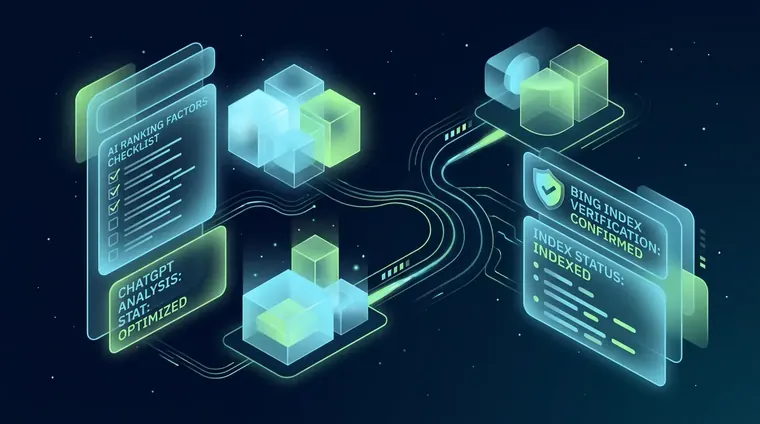
Once you have the URL list, run each through Ahrefs. Note the domain rating, referring domain count, and whether they carry FAQ schema. That tells you the citation floor you need to clear. Then check whether each URL ranks in Bing's index for the same query using Bing Webmaster Tools. Most of the time, the cited pages rank top-5 on Bing. That's the gate.
Does getting cited negatively hurt your ChatGPT visibility?
Negative citations suppress brand-query results. ChatGPT surfaces the sentiment in context, not just the mention count.
Citation volume is not purely additive. No existing ranking-factors post says this clearly enough.
We've seen brand queries where ChatGPT leads its answer with a cited complaint forum or a negative comparison post. Not because the brand lacks mentions. Because the highest-authority pages mentioning that brand are negative.
Zyppy's 2025 finding matters here: only 15% of pages ChatGPT retrieves during a session are ever cited. The model selects from what it retrieves. Sentiment and framing shape that selection. A brand with 500 low-authority positive mentions and 3 high-authority negative ones will often see the negative framing surface first on branded queries.
The fix is not to bury bad reviews. It's to out-publish them. High-authority, well-structured content gives the model a better-framed answer to pull. That's what wins the citation slot.
Our SEO audit service includes a citation sentiment pass. We map the top retrieved pages for branded queries and flag which ones carry negative framing before they surface at the top of a ChatGPT answer.
Category queries like 'best CRM software' require listicle placement; branded queries require authoritative owned-domain content that dominates Bing.
Ranking in "best project management software" means getting placed in the high-authority comparison listicles ChatGPT already pulls for that query. Ranking in "is Asana good" means your own domain has to own Bing for that exact branded phrase. Those are two different problems. Running the same campaign at both is why most citation-building efforts move no numbers.
Category-Level vs. Brand-Level ChatGPT Citation Strategy
Category citation targets third-party listicles; brand citation targets your own Bing-ranking content. Each requires a different playbook.
| Feature | Category-Level Queries | Brand-Level Queries |
|---|---|---|
| Primary target | Third-party comparison pages ChatGPT already retrieves | Your own domain pages ranking on Bing for branded terms |
| Key action | Earn inclusion in listicles with 32K+ referring domains | Build high-authority FAQ-structured pages on owned domain |
| Sentiment risk | Low — framing is controlled by the listicle author | High — negative branded content can outrank and dominate |
| Timeline to citation | Weeks to months (dependent on outreach + publication) | Days to weeks (dependent on Bing crawl + index speed) |
| Controllability | Low — third-party editorial decisions | High — you control the content and schema |
How does content velocity factor into ChatGPT ranking?
Publishing one substantive article per day on pre-researched queries builds up citation surface area faster than any single high-effort post.
One article a quarter doesn't build topical authority. LLMs use publication volume and consistency to classify whether you're a category expert or a footnote. Those aren't vanity metrics. They're signals.
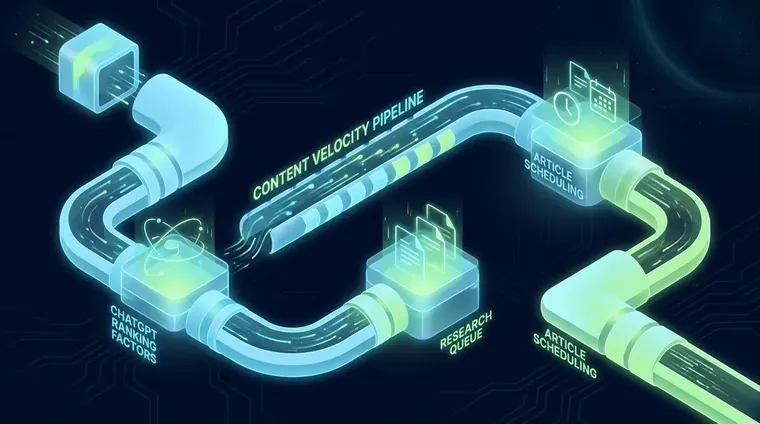
Our pipeline publishes one new long-form article per day. An auto-publish system pulls the next pending topic from a queue of 70+ articles. Every topic is pre-researched with Ahrefs volume and difficulty scores before it enters the queue. That's what content velocity actually looks like. Not "publish more." A structured queue with research briefs on every row, shipped on a Vercel Cron schedule.
A practitioner on Hacker News put it plainly: "adding content to a page usually results in fairly quick change in ranks." That principle scales. More pages indexed means more surface area for ChatGPT to retrieve. Topical clusters rank faster than isolated pages. Google Search Central has documented cluster authority as a trust signal for years. ChatGPT inherits that same bias.
I'll be honest about one real limitation: velocity without quality degrades. We learned it the hard way on an early build. We shipped fast. The pages were thin. Thin pages get retrieved and discarded. Zyppy's 85% discard rate is real. Every article in our queue now has a minimum word count floor and a schema requirement before it ships. Speed matters. So does the floor.
Do ChatGPT ranking factors apply equally across AI engines?
Perplexity, Gemini, and Claude each weight retrieval signals differently. A single-model strategy leaves most of your AI citation surface unoptimized.
Every post ranking for *chatgpt ranking factors* writes exclusively about ChatGPT. That's a real blind spot. Perplexity leans harder on real-time web retrieval and surfaces more niche sources than ChatGPT does. Gemini privileges Google's own index signals and tends to cite pages with strong Google Search Central-aligned structured data. Claude, in document-mode usage, weights long-form depth differently than ChatGPT's chat-mode retrieval.
The shared floor is organic search ranking. That 88% finding from Ahrefs holds directionally across models because they all draw from indexed content. But the weighting diverges above that floor. A page built purely for ChatGPT citation may underperform on Perplexity because it lacks the freshness signals Perplexity weights.
Build to the shared floor first: Bing ranking, FCP under 0.4s, FAQ schema, authority backlinks. Then audit each model separately for the queries that matter most to your business. It's extra work. But the brands ignoring multi-model parity are leaving real citation surface on the table. See our SEO website design approach to see how we wire these signals into page architecture before a single word is written.
Frequently Asked Questions
What is the single most important ChatGPT ranking factor in 2026?
Organic search ranking. Specifically Bing ranking. Is the primary gate. An Ahrefs study found 88% of URLs ChatGPT cites already rank in conventional search. If your page doesn't rank on Bing for the target query, it almost certainly won't be retrieved or cited by ChatGPT regardless of your off-domain mentions.
How do I audit which URLs ChatGPT is retrieving for my target queries?
Run your exact target queries in ChatGPT with web search enabled and log every cited source URL. Repeat with 3–4 variant phrasings. Pages that appear repeatedly are your actual competitive set. Then check each URL's domain rating, referring domain count, FAQ schema presence, and Bing ranking position to understand the citation floor you need to match.
Does having a fast website actually improve ChatGPT citations?
Yes, measurably. AI Clicks (2025) data shows pages with First Contentful Paint under 0.4 seconds average 6.7 ChatGPT citations compared to 2.1 citations for pages with FCP over 1.13 seconds. You can measure your current FCP baseline with PageSpeed Insights and diagnose Core Web Vitals issues before optimizing content.
Can a negative mention on a high-authority site hurt my ChatGPT citations?
Yes. ChatGPT selects from what it retrieves, and sentiment influences that selection. A few high-authority negative pages can dominate branded query responses even when you have many more positive low-authority mentions. The fix is publishing high-authority, well-structured owned content that out-ranks the negative framing on Bing. Not suppression, but out-publishing.
Do ChatGPT ranking factors work the same way in Perplexity and Gemini?
Not exactly. The shared floor. Organic search ranking, page speed, backlink authority, and FAQ schema. Applies across AI engines because they all draw from indexed content. But Perplexity weights real-time freshness more heavily, and Gemini privileges Google-index signals. Build to the shared floor first, then audit each model separately for your highest-priority queries.
Related reading
Ready to Fix Your ChatGPT Citation Gaps?
We run the full audit. Bing index check, FCP measurement, schema validation, citation sentiment pass, and a query-by-query competitive map of what ChatGPT is actually retrieving in your category. That's the work our AI SEO agency does before we touch a single page. If you're serious about owning your category in AI search, book a call with us and we'll show you exactly where the gap is.