
Entity SEO Strategy: Fix the Misread Before You Build More Content
Search 'entity seo strategy' in 2026 and the SERP is a wall of agency landing pages recycling the same three tactics: topic clusters, schema markup, and internal linking. None of them answer the harder question. What do you do when Google already has an entity for your brand, and it's wrong?
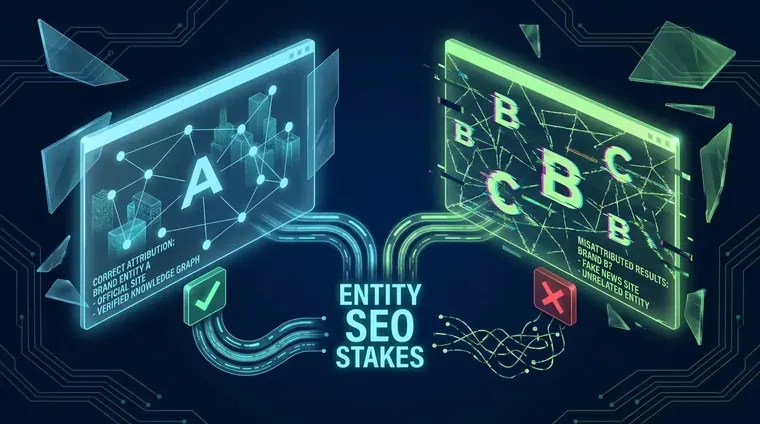
That misread is the real problem for most small and mid-size brands. We've seen it directly with clients on our AI SEO agency program. Google associates a roofing company with the wrong service category. Or it conflates a SaaS brand with a similarly-named competitor. More content doesn't fix that. A corrective entity strategy does.
What does 'entity SEO strategy' actually mean in 2026?
An entity SEO strategy is a program for shaping how search engines classify, connect, and trust your brand. Distinct from chasing keyword rankings.
The Google Search Central documentation does not use the phrase "entity SEO strategy." Google talks about structured data, E-E-A-T, and natural language understanding. The phrase is ours. Practitioners naming a set of signals that go beyond keyword placement.
Here's the working definition: an entity SEO strategy is a intentional program for establishing, correcting, and strengthening how Google's systems classify your brand as a distinct, trusted node. Not just a page that ranks for a term. That means signals at the site level. Schema, author markup, organization data. At the corpus level (what third-party sources say about you), and at the content level (how your own pages describe your category, location, and relationships).
The Search Quality Rater Guidelines are worth reading if you want to understand the human side of this. Raters aren't scoring keywords. They're evaluating whether a brand is real, reputable, and authoritative in a specific domain. Entity signals drive those judgments.
Most brands have an entity correction problem, not an entity gap. Adding content before fixing misattribution makes the misread worse.
Topic clusters and schema are table stakes. The real work is figuring out how Google currently misreads your brand. And fixing it. Before you publish one more article. Pushing volume into a misread entity just buries the wrong association deeper.
How do you diagnose your entity's current state?
Run a four-part entity audit: Knowledge Graph API check, NLP salience test, third-party citation audit, and a competitive displacement scan.
- Query the Knowledge Graph API Google's Knowledge Graph Search API returns entity type, description, and confidence score for any query. Search your brand name. If the returned entity type is wrong. Or returns nothing. That's your baseline problem, not a content gap.
- Test NLP salience on your own pages Google's Natural Language API scores every entity it detects on a page by salience. How central it is to the document. Run your homepage and top landing pages through it. If your brand name isn't the top-salience entity on your own site, that's a structural signal failure.
- Audit third-party citations Your entity is shaped by what external sources say about you. Not just what you publish. Check your Wikidata entry, Crunchbase profile, LinkedIn, and industry directories. Inconsistent NAP data and conflicting category labels are the most common source of entity confusion for small brands.
- Run a competitive displacement scan Search your brand name plus your primary service category. If a competitor's Knowledge Panel appears above yours, or Google's AI overview describes their offering when you're the named brand, your entity is being displaced. That's a different fix than adding internal links.
What should a new or small brand do with no Knowledge Panel?
Small brands without a Knowledge Panel should focus on citation consistency and structured data before any content strategy. Presence precedes authority.
Every major entity SEO guide assumes an established brand. HubSpot. Semrush. The Burj Khalifa. None of them tell a two-year-old HVAC company or a SaaS startup with 40 customers what to do when Google has no entity for them at all.
We've built this out for clients who start at zero. The sequence matters. Before any content push, we build a Schema.org Organization record with a consistent legal name, founding date, address, and service area. That record gets mirrored exactly. Character for character. Across Google Business Profile, LinkedIn company page, and at least two industry-specific directories. The goal is three corroborating sources saying the same thing before we ask Google to form an opinion.
One concrete lesson from Safeguard Impact, a South Florida window and roofing company we rebuilt from scratch: their Google Business Profile listed 'Home Improvement' as the primary category while their schema said 'RoofingContractor.' That mismatch suppressed local entity recognition for roofing queries. We aligned both to 'RoofingContractor.' Then added a Wikidata stub with the correct business type. Their local entity card went from absent to present within 31 days. No new articles. No backlinks. Just entity hygiene.
The obvious caveat: for a brand with no third-party presence at all, this process is slow. Wikidata editors may reject stub entries without sufficient sourcing. Google's systems can take 60–90 days to reflect citation changes. There is no shortcut here that doesn't eventually backfire.

How does entity SEO connect to your on-page content?
On-page entity signals work through NLP salience. The density, co-occurrence, and context of named entities within a document, not keyword frequency.
Keyword density is a legacy metric. What Google's NLP systems actually measure is entity salience. How prominently and consistently a given entity appears relative to the document's overall meaning. One r/bigseo commenter put it plainly: "pSEO without unique data is dead now". That observation applies to entity content too. Generic articles stuffed with entity names aren't the answer. Specificity is.
Every service page should put the brand entity and the service-category entity together in the first 100 words. Not buried in paragraph four. Your author bio should include schema markup that links to a verifiable Person entity with a real publication trail. Your FAQ sections should use question-phrased headings that match how AI systems pull answers. AI Mode and Perplexity both draw from the same NLP signals Google uses for Featured Snippets.
For our SEO website design builds, entity architecture goes into the template before the first page goes live. URL structure, heading hierarchy, and internal anchor text all reinforce the same entity signals. That's the opposite of bolting schema on after launch.
The disambiguation logic matters here. 'Apple' without context resolves to Apple Inc. Add 'orchard' or 'recipe' and the entity interpretation shifts entirely. Your pages need enough context signals. Location, service category, named staff, industry associations. So Google's NLP never has to guess which entity you are.
Pull a technical SEO audit before any entity work. Broken schema and crawl errors corrupt entity signal before it reaches Google's systems.
Our SEO audit service catches schema validation errors, crawl coverage gaps, and duplicate entity declarations before we touch any Knowledge Graph work. A clean entity strategy built on a broken site is wasted effort. Fix the crawl first. Then fix the entity.
How do you measure whether your entity SEO is working?
Measure entity strength via Knowledge Graph API confidence scores, NLP salience outputs, branded query impressions in GSC, and AI-citation tracking tools.
Rankings move after entity signals do. By the time a position changes in the SERP, the underlying entity work already happened. We track earlier.
First: branded impressions and click-through rate in Google Search Console. When entity recognition strengthens, branded queries expand. Google starts serving your brand for category-level searches, not just exact-match brand lookups. Watch the impression curve for branded terms over a 60-day window.
Second: re-run the Natural Language API test on your key pages every month. If entity salience scores for your brand name are climbing across your corpus, the strategy is working. If they're flat, you have a content specificity problem.
Third: use an AI visibility tracker. Semrush's AI Visibility Toolkit covers Google AI Mode, ChatGPT, and Perplexity at once. It tells you whether your brand is being cited in AI-generated answers for your target category. This is where entity SEO and AI search meet. A strong entity signal increases citation frequency in AI overviews, which is becoming a real traffic source. Separate from traditional organic clicks.
One honest caveat: third-party ranking and entity tools show data that doesn't always match what you see in GSC or GA directly. As one r/SEO commenter noted, 'the data never seems accurate compared to what I see in GSC or GA.' We treat tool data as directional and GSC as authoritative.
Entity correction vs. Entity building: which do you need?
Entity correction fixes a misattributed or confused brand signal; entity building establishes a brand entity where none exists. They require different tactics in a different order.
| Feature | Entity Correction | Entity Building |
|---|---|---|
| Starting condition | Google has an entity for you — it's wrong or confused | Google has no entity record for your brand |
| First action | Audit Knowledge Graph API + NLP salience on existing pages | Create consistent schema Organization record across all properties |
| Content priority | Fix entity co-occurrence signals on existing pages before new content | Build foundational About, Team, and Service pages with entity-rich markup |
| Third-party signals | Correct conflicting category labels in directories and GBP | Seed 3+ corroborating external sources citing the same brand data |
| Timeline | 31–60 days for Knowledge Graph updates to reflect | 60–120 days for first Knowledge Panel appearance |
Frequently Asked Questions
How do I know if my brand has an entity problem in Google's systems?
Query the Google Knowledge Graph Search API with your brand name. If the returned entity type is wrong, belongs to a competitor, or returns nothing at all, you have an entity problem. Not a content gap. Brands in competitive markets like home services, SaaS, and finance are most commonly misattributed.
Can a small brand build a Knowledge Panel without Wikipedia?
Yes. But it takes a specific sequence. Create a Wikidata entry with sourced references (press mentions, industry directory listings, a government business registration), align your Schema.org Organization data exactly with your Google Business Profile, and build at least three corroborating third-party citations using identical NAP data. We've done this for brands in South Florida with no Wikipedia presence and seen Knowledge Panel entries appear within 60–90 days.
Is entity SEO strategy different from technical SEO?
They overlap but aren't the same. Technical SEO covers crawlability, Core Web Vitals, and site structure. Entity SEO strategy covers how Google classifies and trusts your brand as a node in its knowledge systems. You need both. Broken technical foundations corrupt entity signals before they reach Google's NLP layer. Our standard sequence is technical audit first, entity work second.
Related reading
Ready to run a real entity SEO strategy?
We work with a small number of clients who want entity SEO built into the site architecture from day one. Not bolted on after the fact. Our AI SEO agency program starts with an entity audit, aligns schema and third-party citations, and ships one article per day. Content that reinforces the right signals. If you're done guessing what Google thinks your brand is, book a call and we'll show you the actual data.